





Dropshipping is a method of making money online that isn't discussed as often as some other monetization strategies. And no, it doesn't have anything to do with airdropping in soldiers like in a video game. Well, unless the product you're shipping is GI Joes or something.
Dropshipping is a method of monetization where the store that sells the product does not actually own the product. You, as a dropshipper, act much like any other retail storefront. You build and maintain a storefront full of products, you support customers who buy those products, and you make money selling those products.
The difference is, unlike a normal storefront, you don't have a warehouse full of stock. Instead, you simply have suppliers. You might have a supplier that sells Product X for $5. You sell it on your website for $15. When a user buys it for $15, you take that $15 and turn around and buy it from your supplier for $5. The remaining $10 is split between the cost of shipping the item from your supplier to your customer, and profits that maintain your business.
It's basically a way you can become a retail storefront without relying on affiliate marketing or finding the storage space for a ton of products you might not sell right away. In that sense, it's a lot like print-on-demand businesses, which don't have the product on hand to ship until it has been ordered and paid for. And it's more popular than ever - as of 2024, approximately 33% of all online stores use the dropshipping fulfillment model.
- Dropshipping doesn't require very much capital to start. If you can afford to host a website with a storefront like Shopify, and you have a little seed money to cover shipping, you're capable of starting up a dropshipping business.
- Dropshipping is easy to start up. The hardest part is lining up suppliers, but thankfully you don't need to go out of your way to do so; many businesses simply have dropshipping programs already. It's just as easy to enroll as with an affiliate marketing program.
- Dropshipping has low costs for maintaining the business. You don't have to pay rent on a warehouse or manage it, you don't have to pay for or manage packing and shipping, you don't have to track inventory, you don't have to handle returns and shipments, you don't have to keep products in stock, or anything else. You can successfully run a dropshipping business for the cost of a website plus a modest monthly budget.
- Dropshipping can be run as an entirely electronic business, meaning you need nothing more than your computer and an internet connection. You can "work" from anywhere in the world, as long as you can communicate with both suppliers and customers.
- Dropshipping is incredibly easy to scale, because you're just a middleman doing marketing to earn cash. You can expand your product lines or reach new customers with very little effort or money expended.
On the other hand, dropshipping is not without its drawbacks. The number one drawback is the competition. Tons of people have taken up dropshipping, and they have driven down possible prices. If there are five websites all selling the same product, purchasable from the supplier for $5 and sold on those sites for $6, why would anyone buy from your site for $15? You have to do a lot of work building your reputation and customer service to make it worth it.
Additionally, dropshipping has low margins for the same reason. You can't charge much more than that $6 for that $5 product because other people will undercut you and drive you out of business. That said, platforms like Shopify Collective have helped address this somewhat, offering margins typically ranging from 20-50% by connecting you with vetted U.S.-based brands rather than generic overseas suppliers.
There are some complexities with dropshipping that don't normally come up with other businesses as well. If a supplier runs out of an item but you don't mark it out of stock, you're on the hook; you might have to find another supplier, and you might have to pay a premium to do it. Otherwise, you're letting down your customers, which can be much more detrimental than a little lost profit. Plus, if the supplier makes a mistake with shipping, it's up to you to make it right somehow.
The trick to dropshipping is being invisible in the process. You don't want people to realize you're just a middleman; they'll want to cut you out of the process and go to your supplier, who is likely cheaper and is already doing all of the work anyways. You're just standing between the two, doing the marketing and making the sales. All fulfillment, all support, it all comes down to how well the supplier works with you and the customer to make things right. Typically, that means you working with the supplier and passing off their support as your own.
Key Takeaways
- Dropshipping lets you run a retail storefront without owning inventory, acting as a middleman between suppliers and customers.
- Key advantages include low startup costs, easy scalability, and the ability to operate entirely online from anywhere.
- Major drawbacks include intense competition, low profit margins, and responsibility for supplier errors or stockouts.
- Fake wholesalers can be spotted by signs like public sales, monthly fees, flashy websites, and no minimum advertised price.
- Reputable supplier directories include Worldwide Brands, SaleHoo, Doba, and Shopify Collective, though free directories require careful vetting.
Finding Suppliers
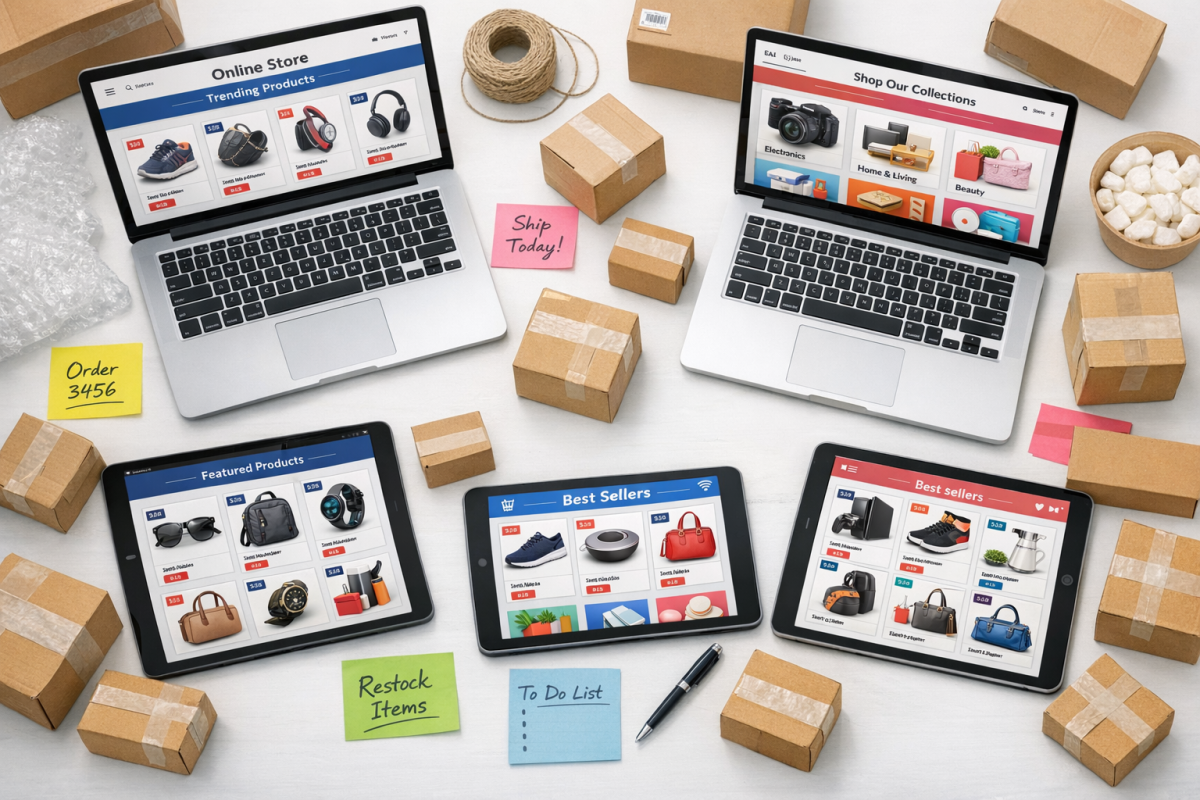
The number one issue dropshippers face tends to be finding suppliers or wholesalers to provide the product they want to sell. If you want to sell tablets, you're going to need to get in touch with a wholesaler who is providing tablets. Unfortunately, wholesalers have issues with marketing, so they can be pretty hard to find. After all, they're relying on you to make sales for them.
At the same time, there are people who find this an opportunity. They insert themselves as a middleman between you and the wholesaler, as a "dropshipper's dropshipper" of a sort. They pretend to be wholesalers and try to sell to you, but they themselves are working with a wholesaler, skimming profits off the top. Thankfully, there are a few warning signs you can use to spot these "fake wholesalers" before you build a business around them.
- They sell to the public. Wholesalers only want to deal with businesses, they don't want to do the sales themselves. If the wholesaler is selling directly to the public, they're not actually a wholesaler.
- They charge you to maintain your presence in their program. Fake wholesalers know they'll be found out eventually, so they charge monthly fees to make additional money from you before you drop them. Real wholesalers won't charge you; they're already making money selling products to you.
- They have a flashy, well-produced website. Most wholesalers have bare-minimum websites. They aren't focused on advertising or SEO. A real flashy website is a sign of a marketer, not a wholesaler.
- They list prices publicly. Because they don't sell to the public, wholesalers don't list their prices publicly. They only share pricing information with incorporated businesses that open up dropshipping accounts.
- They have no minimum advertised price. Real wholesalers will tend to have a minimum advertised price, which is a price floor that you cannot drop below. This prevents undercutting price wars and allows for competition through value adds instead.
One of the easiest ways to find a wholesaler, though it requires a little legwork, is to look up the actual manufacturer of the product you want to sell. Manufacturers will often have lists of their wholesalers, which they will give you in order to facilitate more sales. You can then reach out to these wholesalers and ask them if they have dropshipping programs.
If you decide to search for wholesalers manually through Google, remember that you won't be finding them on the first few pages of results. These are people who probably have thin content penalties and other issues with their websites pushing them way back in the rankings. Be skeptical of any "wholesaler" that appears in the first handful of pages.
Another trick you can use is locating a competitor. Figure out what you want to sell, and figure out who sells that product. Then, just order from the competition directly. You will very likely get a package with a return address for the wholesaler, which you can use to track them down and set up your own contract.
If you have the capability to travel and the credentials to get in, trade shows are often good places to meet representatives for wholesalers directly. You can make some great contacts, both within the wholesalers and within other sales niches. It's expensive, though, so it's not a viable method for everyone.
Finally, of course, you can use directories. This article - the remainder of it, anyways - is going to be a minor directory of directories listing wholesalers that have dropshipper programs. I'll also list a few other directories. Keep in mind that directories are often hidden behind paywalls, and you tend to get what you pay for. Free directories can fall out of date very quickly, and wholesalers can collapse or be bought or otherwise stop what they're doing. Paid directories tend to have more robust lists that are kept up to date. The caveat, of course, is that some paid directories are scams from people looking to prey upon novice dropshippers. Exercise caution.
Wholesaler Directories
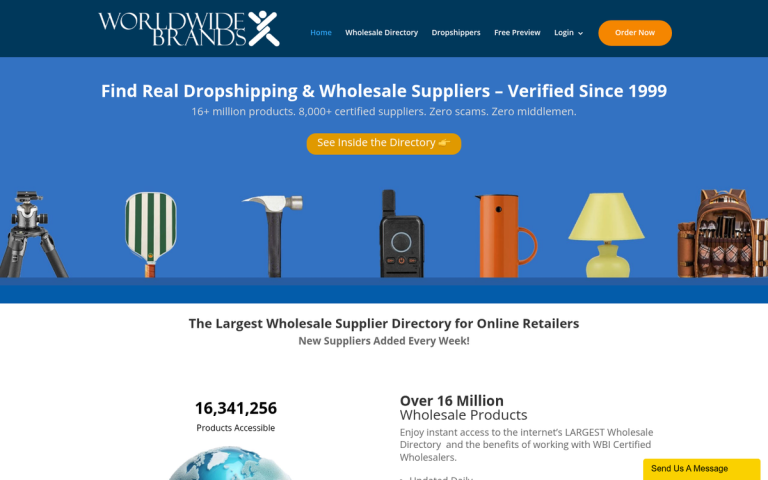
Worldwide Brands - One of the most established directories in the space, Worldwide Brands has been around for over two decades and lists thousands of certified wholesalers covering millions of products. It's not 100% comprehensive, but it's well-respected and regularly maintained. The price has actually dropped over the years - it's now available for a one-time lifetime membership fee of $197, which is much more accessible than it used to be.
SaleHoo - SaleHoo has grown into one of the most popular supplier directories available, now listing over 8,000 suppliers with access to more than 2.5 million products. They tend to cater to people who dropship via Amazon and eBay marketplaces, but they work for anyone building their own storefront too. Pricing is around $67 per year, and they offer a money-back guarantee if it's not the right fit.
Doba - Doba has come a long way and now offers access to over 2 million products from multiple suppliers. Their platform includes tools and integrations that help dropshippers create product listings and push them to various marketplaces quickly, along with redundancy features to keep fulfillment rates high. The downside remains the cost - they run on a monthly subscription model that can add up fast, so make sure the product selection fits your niche before committing.
Wholesale Central - This long-running free directory charges wholesalers to be listed rather than charging you to browse, which keeps it accessible. That said, the trade-off is quality control - because it's free for dropshippers to access, it tends to attract some fake wholesalers looking to exploit the traffic. Browse carefully and vet any supplier you find here thoroughly before building a business around them.
Wholesale2B - A solid option that doesn't get enough attention, Wholesale2B gives you access to over 1 million products and integrates directly with platforms like Shopify, WooCommerce, Amazon, and eBay. They handle the product data feeds and order automation, which can save a lot of manual work. Pricing varies by plan and integration type, so check their current offerings to find the right tier for your setup.
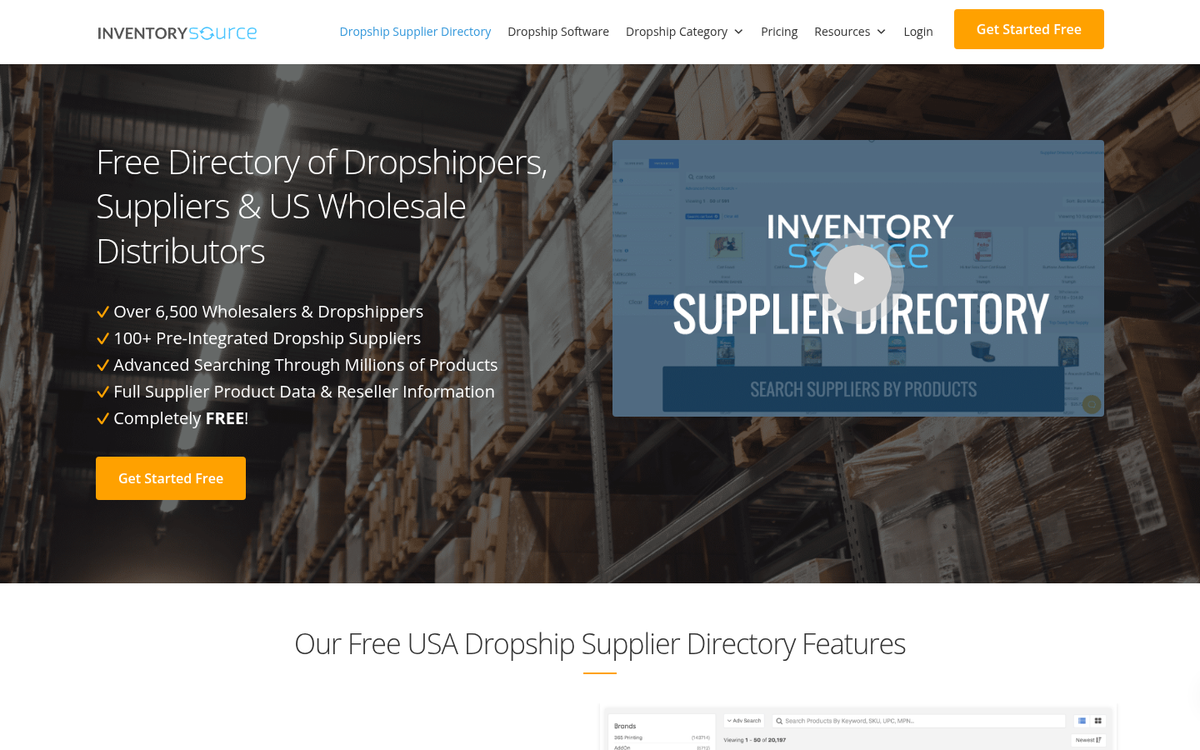
Inventory Source - Inventory Source connects you with over 180 pre-integrated suppliers and focuses heavily on automation - syncing inventory, routing orders, and uploading product data to your store automatically. It's a bit more of a premium tool, but if automation is important to you and you want a curated, reliable supplier network rather than a massive open directory, it's worth a look.
Modalyst - Modalyst has carved out a niche by focusing on independent brands and trending products, including a solid selection of U.S. and European suppliers. Their free plan lets you list up to 25 products, which is a reasonable way to test the waters before committing. The paid plan expands that to 250 products for around $35 per month. It integrates directly with Shopify and other platforms, making setup relatively painless.
Shopify Collective - Worth mentioning separately because it's become increasingly popular for Shopify store owners. Shopify Collective connects you with other Shopify-based brands to sell their products directly in your store. It's free to use and offers margins typically in the 20-50% range - higher than what you'd find with many traditional dropshipping arrangements. The catch is that your supplier options are limited to other Shopify merchants who have opted in, so product variety depends heavily on your niche.
Beware of any directory that tries to be a middleman as well. A variation on the fake wholesaler is the aggregator - essentially the "affiliate network" equivalent of the dropshipping world. They present themselves as wholesalers but are really just another layer between you and the actual source, skimming margin in the process.
1 response
Thoughtful replies only - we moderate for spam, AI slop, and off-topic rants.
Hi Kenny.
I consider myself one of the procrastination masters out there and thus have been collecting a huge lump of related information on the last couple of years (I keep saying to myself this is the year I'll start it).
I even bought WWBrands a long time ago - still waiting for proper use(!).
Great article. Simple but all that matters said through a perfect summary.
Best regards and success!