Competitive analysis is surprisingly valuable when it comes to PPC ads. PPC ads almost all operate via an auction system, with each company bidding what they're willing to pay, with Google or whatever platform then organizing the ads in positions equivalent to the amount they're willing to pay. Google Ads alone holds over 83% of the PPC market share, so understanding the landscape has never been more important.
If you don't know who your competitors are, and you don't know what they're doing, you're going to have a hard time staying afloat. You can rest assured that your competitors are using these kinds of tools for their own analysis, pulling all kinds of information about you. It's only fair that you do the same to them. In fact, more than 50% of marketers now cite competitor research as a key challenge in their PPC strategies - which tells you just how competitive the space has become.
Competitive analysis helps you learn about the other companies vying for position in the ads for the same keywords you're using. It's also a way that you can scout out new keywords before you invest yourself, to avoid instances where you simply don't have the budget or the clout to make headway.
Key Takeaways
- Competitive analysis reveals competitor bids, ad copy, landing pages, and budget strategies, helping you make smarter PPC decisions.
- Targeting position #2 instead of #1 often delivers similar click-through rates at meaningfully lower cost per click.
- SpyFu is recommended for most small businesses, offering deep U.S. PPC data starting at $39/month.
- SEMrush covers 140+ countries and multiple channels but costs $149/month minimum, better suited for larger teams.
- Competitive analysis can detect sabotage bidding, where competitors deliberately inflate auction prices to increase your costs.
What Competitive Analysis Can Tell You
Before we get into specific tools, first an overview. What can competitive analysis get you, and how is that information useful?
First of all, such analysis can tell you who your competitors are. It goes deeper than just checking which other brands are bidding on the keywords, though. You can also analyze specific information about them, including their average bids, ad copy, and landing page strategies.
You can learn a few things with this information. For one thing, you can learn which competitors keep showing up but don't have high enough budgets to matter. You can also discover new competitors - and which existing competitors seem to be ignoring the space. This can give you opportunities to get ahead of competitors who aren't capitalizing on certain keywords you can use.
When you know who your competitors are, you can learn what kind of competitor they are. You can figure out which ones are just big budget monsters crushing all competition, not worth fighting because they can out-spend you any day of the week. You can find others that are aiming at the same keyword, but with different enough goals that they aren't even really competitors. You can find which ones are affiliates of other companies that you might consider competitors, and might even be able to use their own in-fighting competition against them.
If you have affiliates, resellers, or partners, you can also double-check to see if they're using your branding appropriately. A lot of affiliate programs have stipulations against using brand trademarks or even certain keywords, specifically to avoid competing with itself. You can use competitive analysis to determine if any of your own affiliates are violating your terms of service or cannibalizing your traffic.
Most competitive analysis tools help you by pulling data from more than just one ad network. You might get information about Google Ads, about Meta (Facebook/Instagram) PPC, about Microsoft Advertising, and about other major ad networks, all at once. A good marketing model will take advantage of multiple streams whenever possible. You can use this information to determine which competitors are using which services, for which keywords, and with what open space. If you find that a lot of your competitors are ignoring Microsoft Advertising, for example, you can do some test runs to see if you can make it work. With 65% of high-intent searches resulting in an ad click, finding an underserved channel can be a genuine competitive advantage.
You can also spot sabotage. Believe it or not, occasionally a miffed competitor will attempt to use the nature of the auction to attack you. Negative SEO exists, and so does sabotage bidding. A competitor might invest a budget bidding on your keyword explicitly so they can raise the price of the auctions, running you out of your position or forcing you to spend more. This can be great information to have, particularly if your costs have unexpectedly increased.
One question you have to ask yourself when you're performing competitive analysis is how are you going to use the information you get? You can, of course, make use of your insider knowledge to attempt to out-bid everyone by a few cents to get that coveted top spot in the ad lists.
Is it worthwhile, though? In reality, the answer is probably not. In organic search, getting the #1 position is better than any other position by an order of magnitude. For PPC ads, that's not always the case.
PPC ads don't have as strong a division between #1 and #2. This is fine; it means #2 isn't as detrimental as it otherwise could be. More importantly, though, #2 is going to be cheaper. Position two or three will likely be moderately less expensive than #1, for a roughly similar click-through rate. And with businesses earning an average of $2 for every $1 spent on Google Ads, squeezing out inefficiencies in your bidding strategy - rather than just chasing the top spot - is where the real gains are made.
Using competitive analysis, you can see what kinds of bids your competitors are making to reach the #1 spot, and you can decide to undercut them just enough to take #2 without falling to #3. Even if you get fewer clicks, you get a better return on your investment, and all you had to do was know about it.
Available Tools

Now, the title of this post indicates that I'm going to tell you which competitive analysis tool is the best, but that's slightly disingenuous. I'm going to give you my top handful of options, and let you make a choice. Each one has its own pros and cons, as with any set of services. After all, if you're focusing entirely on Google Ads, you don't need a more expensive tool that scans every network under the sun, right?
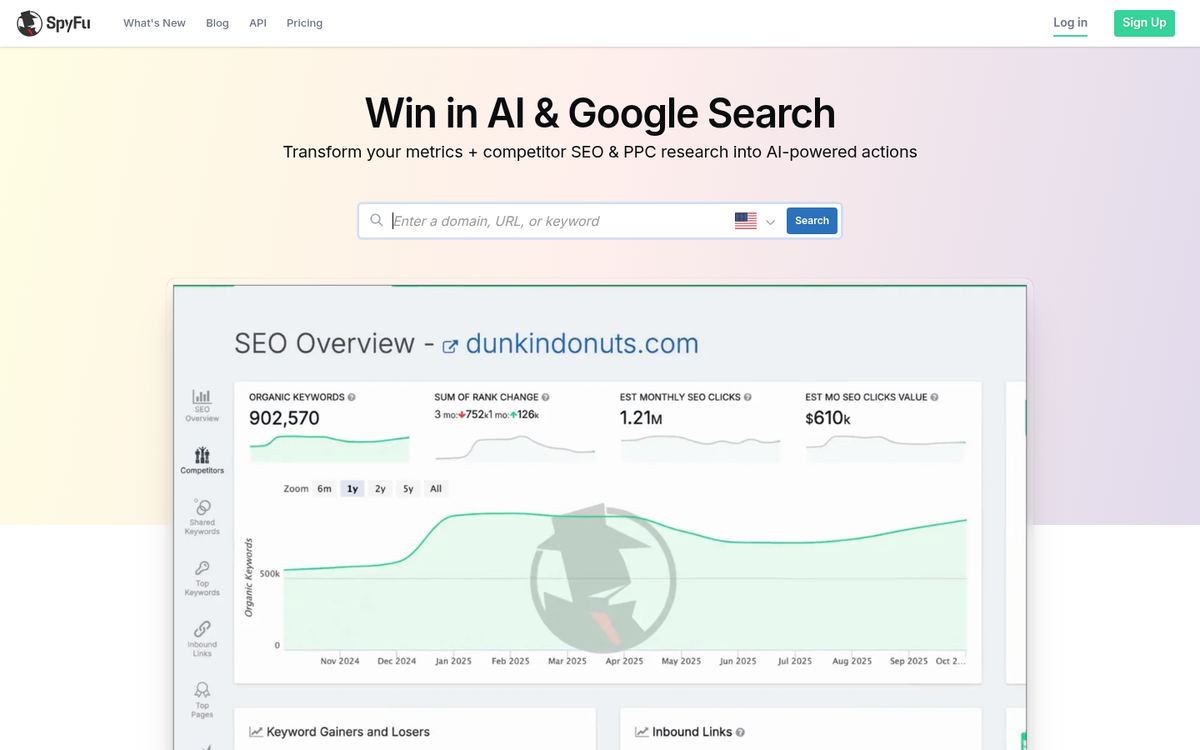
First on the list is SpyFu. SpyFu is a web app that shows you a ton of information about a site just for plugging in the domain name. You can see the site's organic keywords, estimated monthly clicks, and ranking history. You can see the number of keywords they rank for that their competitors also rank for. For paid ad research, you can see their paid keywords, estimated monthly clicks, and estimated budget - and with 16 years of historical data in their index, you can track how a competitor's strategy has evolved over time, which is genuinely useful.
All of that is just the overview. When you drill down to PPC-specific information, you can see keywords, clicks, and budget, trends over recent months and years, how long they've been advertising, and a graphical representation of keyword distribution.
One useful element is the competitors section; when you plug in one of your competitors, you can see which other sites are competitive with them. You can see if you show up there, and you can see which other sites show up there. You can also add in your domain to see how you compare in the graphs.
SpyFu has a lot of other information as well. They can show you recommended keywords you might consider buying, keyword groups, ad history complete with ad copy, and a bunch more. One of the most interesting features is the "kombat" tab, which allows you to plug in several domains and see how they compare head-to-head.
One thing worth noting is that SpyFu is primarily focused on the U.S. market, so if you're running international campaigns, keep that limitation in mind. That said, for domestic PPC research, SpyFu tends to surface significantly more paid keyword data than its competitors - in head-to-head comparisons, SpyFu has shown up to 10x more paid keywords for the same domain versus SEMrush.
Pricing starts at $39 per month for the basic plan, which includes unlimited searches, exports, and domain overviews. More expensive plans add white label reports, API access, team access, and higher keyword tracking limits.
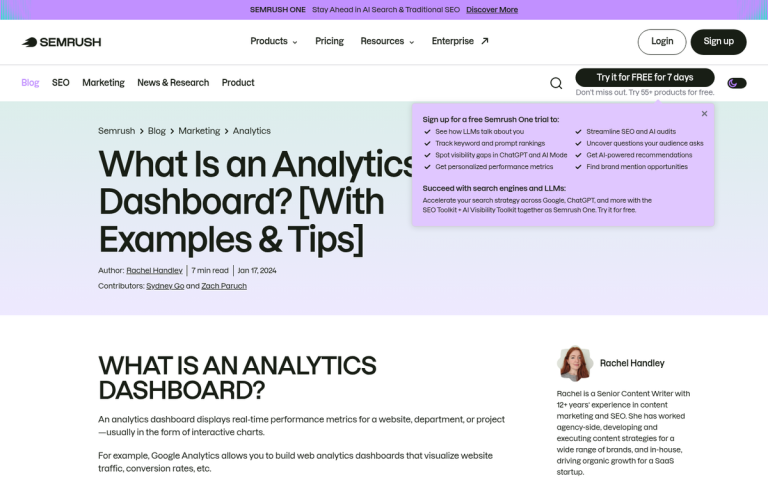
My second recommendation is SEMrush. SEMrush is a great tool, though it has a free search limit before prompting you to register. Even with a free account, you're quickly nudged toward a paid plan to get meaningful data volumes.
The data, however, is excellent. SEMrush is a comprehensive domain analysis platform that goes well beyond PPC. You get deep SEO insights, backlink analysis, traffic geographic breakdowns, domain comparisons, and a lot more. Crucially, SEMrush spans 140+ countries, making it the stronger choice if your campaigns run internationally - a significant advantage over SpyFu in that regard.
SEMrush also covers Google Ads, Microsoft Advertising, and provides advertising research across multiple channels, along with the ability to track individual competitors and keywords for changes or emerging opportunities.
All of this is excellent, but it's also quite expensive. The cheapest available plan is $149 per month as of 2026, and it comes with limits on keyword tracking, page crawling, report scheduling, and projects. Higher-tier plans push toward $300-$500 per month for API access, historical data, and expanded limits.
SEMrush is great, but it's a tough sell for most small businesses. You need to be able to leverage the information directly enough to at least offset what you're paying just to break even. For larger teams running multi-channel international campaigns, though, the investment can absolutely make sense.
Third on the list is iSpionage. This tool is a lot like SpyFu, though it tends to focus more specifically on PPC competitive intelligence rather than being a broad SEO suite. When you plug in a domain, you get a readout for that domain, with the option to browse PPC or SEO data. It covers both Google Ads and Microsoft Advertising (Bing/Yahoo), and you can view charts for both side by side.
With the free version, you can see keywords and ad copy for those keywords, and the landing pages those ads direct to. You can also see the top keywords, the number of ads they place for those keywords, estimated costs, search volume, and so on.
The main downside is that the free version is limited to just a small handful of results. This can be fine for very small businesses doing light research, but once you're dealing with dozens of keywords or more, you'll hit the ceiling quickly.
On the plus side, pricing for iSpionage is reasonable. The basic plan starts at $30 per month and gives you competitive research with 50 searches per day. Bumping up to $60 per month gets you unlimited searches, data exports, and keyword alerts so you can monitor your most important keywords for changes that could signal an opportunity. Higher-tier plans add white label reports, campaign monitoring, and more robust alerting features - useful in highly competitive niches.
So, of those three, which one do I recommend? Honestly, for most small to mid-sized businesses focused on U.S. Google Ads campaigns, I would lean toward SpyFu. The historical keyword data depth is impressive, the pricing is the most accessible of the three, and for raw PPC competitive intelligence, it tends to surface more data than SEMrush at a fraction of the cost - up to 60% less expensive depending on the plan you'd otherwise need. If you're running international campaigns or need a broader marketing analytics platform beyond just PPC, SEMrush is worth the investment. And if you want something laser-focused on PPC monitoring with solid alerting features, iSpionage is a solid, budget-friendly alternative. Really, though, the choice is yours.