Key Takeaways
- SEMRush offers extensive features including keyword research, backlink analytics, site audits, competitor ad analysis, and AI-powered content tools.
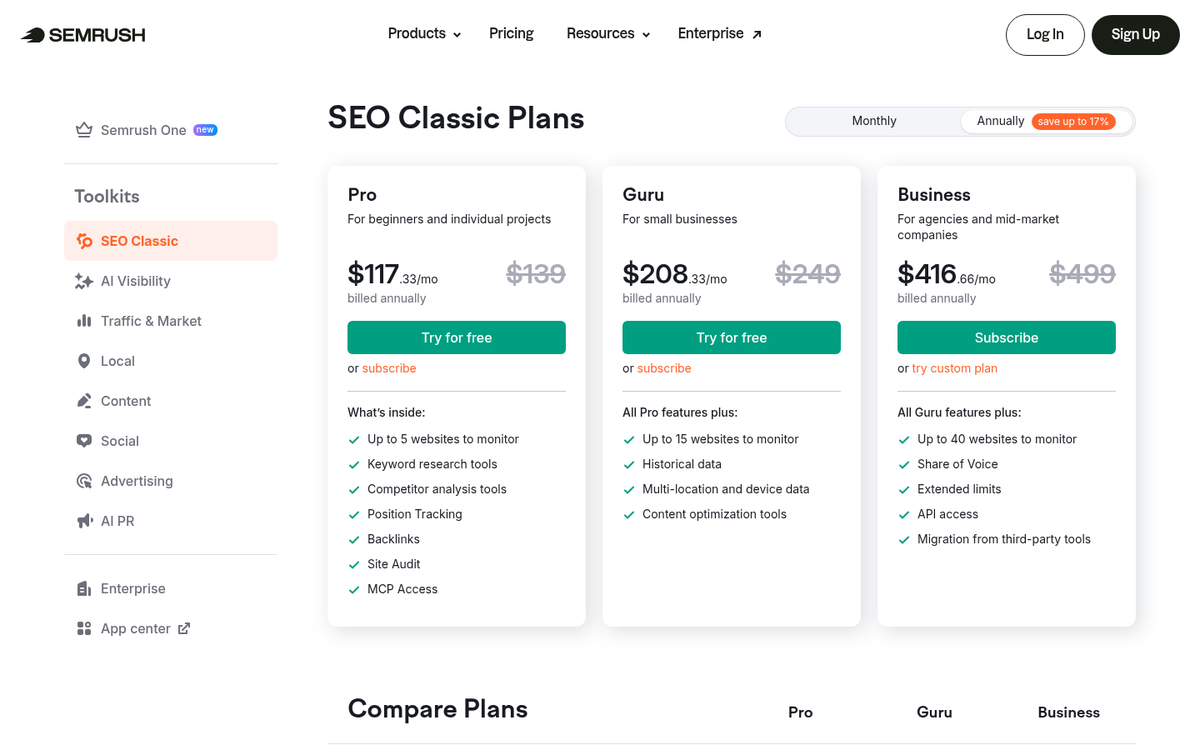
- Pricing starts at $139.95/month for the Pro plan, scaling to $499.95/month for Business, with annual billing saving roughly 17%.
- Data inaccuracies exist since SEMRush estimates rather than pulls directly from Google, but errors remain proportionally consistent across all sites.
- The Keyword Magic Tool contains over 25.7 billion keywords, though coverage is weaker for hyper-local, niche, or non-English smaller markets.
- The two main drawbacks are high pricing and a steep learning curve, though most teams become productive within a few weeks.
Tools and Features
SEMRush starts out as a simple web search, but there's a lot more to it than just a web app. You can plug in a domain name, a keyword, or a specific URL and you'll get a huge pile of data back. You can focus that data within a handful of different markets, including US Google, Google in other countries like Brazil, Canada, and France, or even Bing.
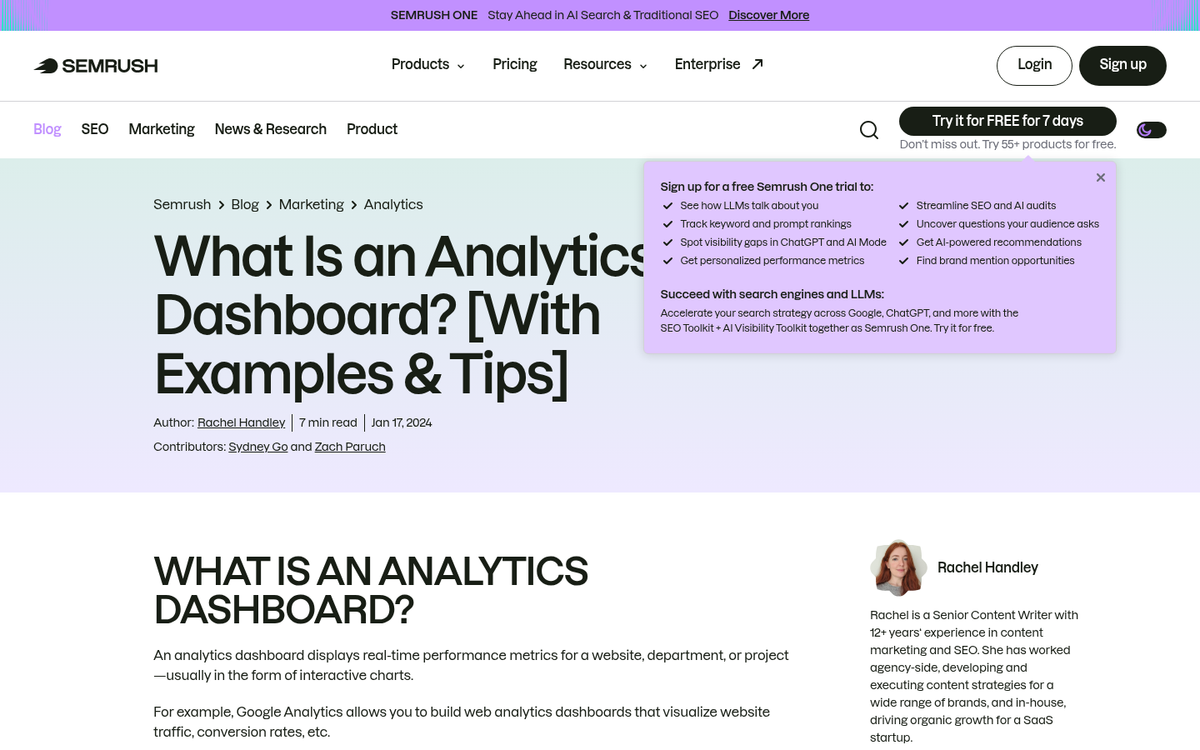
When you submit a phrase or link, you are taken to an analytics dashboard. This dashboard shows different data for different types of search. For a keyphrase, for example, you get an overview that you can toggle between desktop and mobile. You see organic search volume and the number of existing results. You see paid search CPC and a competition ranking. You see a CPC distribution by geographic location, and you see trending info.
In boxes below that, you get related keywords and their metrics, phrase match keywords and their metrics, and a box with organic search results. If there are results for Google Ads or for product listings, those will be listed as well. All of that, my friends, is just the first page, and I'm skimming it for the sake of simplicity.
Domain analytics are similar. They show organic and paid search metrics, backlink rankings, and a chart showing locations and types of traffic. There's a box with organic keyword information, including positions in SERPs, search volume, CPC, and a traffic ranking.
What features does SEMRush promote on their site?
- Organic keyword research analytics. This includes the ability to see the best keywords in use on a competitor's site, the ability to discover new competitors you might have missed, and the chance to monitor changes in ranking. The Keyword Magic Tool alone contains over 25.7 billion keywords, with 3.4 billion for the U.S. alone - that's not a small database.
- Advertising research and analytics. This gives you the ability to see what the ad campaigns of your competitors look like, including the keywords they're targeting and an estimated budget. This also includes analysis of ad keywords and ad copy, so you can adopt successful strategies or improve beyond them. It even tells you how long an ad has been running, which is a reliable indicator of a successful ad. Ad research also helps you discover people paying to compete with you, who might not have an organic presence but are willing to pay for an ad presence. All of this also includes geolocation tracking so you can see regional opportunities as well.
- Display advertising analytics. This shows the top publishers and advertisers in Google's display network for your keywords. There's an ad analysis engine to help you take those ads apart to figure out what they're doing right and wrong. You can spot new publishers relevant to your advertising through this system, as well. On top of that, you have the ability to change the device you're viewing to see statistics per device.
- Detailed backlink analytics. SEMRush has indexed over 43 trillion backlinks, which is a genuinely staggering number. You can conduct a deep link analysis to show you what links coming in are helpful versus harmful, while recording the domain authority of the links involved. You can also check whether or not the links are followed, and whether they show up in a frame, form, or image rather than just standard text. There's also geolocation data, so you can see where in the world your links are coming from.
- Specialized keyword research features. Each keyword you look up has detailed statistics, including related keywords and phrase match variations ranked by search volume and cost per click. This data helps you identify high-volume keywords with lower costs that you may be able to target with future content and ads. On top of all of this, you have long-tail keyword analytics and multinational/multilingual keywords - incredibly useful for companies operating outside of English-speaking markets, since most competing tools still skew heavily toward English and the U.S.
- Detailed analytics about Google Shopping product listings and product ads. If you're using ecommerce and want to be listed in Google Shopping, this is invaluable information.
- Keyword difficulty measurements, based on search volume, cost, and competition.
- Domain comparison tools, which allow you to plug in two domains and see all of the above metrics for each, side by side. Use this to scope out how two competitors stack up against each other, or how you compare to them.
- Charts and other visual representations of data; you're not going to go all glassy-eyed staring at table after table of raw numbers.
- Position tracking, to monitor your place and the places of your competitors in search at the national, regional, and local levels. Track keywords and domains this way.
- A complete site audit for SEO health. This analysis checks both internal and external links, tagging opportunities, metadata, image functionality and alt text, error pages, duplicate pages, and other SEO issues.
- Social media analytics. This all-in-one dashboard showcases social media ad campaigns and organic traffic, both for yourself and your competitors, tracked across multiple platforms.
- AI-powered content tools. SEMRush has expanded significantly into AI-assisted content creation and optimization since the AI boom of the early 2020s. Their ContentShake AI tool helps you draft, optimize, and refine content based on real SEO data - a genuinely useful addition for content teams working at scale.
All of that is a pretty good overview of what SEMRush has to offer, and it all boils down to one thing: detailed analytics of ads and keywords that is independent of logging into any site-specific analytics suite. It really is the next best thing to having Google Analytics access to your competition.
Pricing
You had to know it was coming. You can get a taste of SEMRush for free, but the free tier is extremely limited. A lot of the drill-down data, historical data, and API access are gated behind a paid plan. As they should be - SEMRush is a good business and deserves to make money for what they do.
Warning: SEMRush is a professional-grade tool. That means it is not cheap. Don't be shocked by the pricing.
The lowest tier plan (Pro) runs $139.95 per month. It allows you to generate up to 3,000 reports per day, with up to 10,000 results per report. You can have 5 total projects saved, can track 500 keywords, and can crawl up to 100,000 pages per month.
The middle tier (Guru) is $249.95 per month, and adds on to the lower tier. Results per report jump to 30,000, and you get 5,000 reports per day. You can run 15 projects, track 1,500 keywords, and crawl up to 300,000 pages. You also unlock historical data and the Content Marketing Platform, which is where a lot of the AI content tools live.
The top tier (Business) sits at $499.95 per month, squarely in enterprise-level pricing territory. For that, you get 10,000 reports per day, 50,000 results per report, 40 projects, 5,000 tracked keywords, and 1,000,000 pages crawled per month. You also get API access, Google Data Studio integration, and extended limits across the board.
Annual billing is available and knocks roughly 17% off the monthly rate, which adds up fast at these price points. If you have the budget to commit upfront, it's worth it.
In case you're skeptical about the data, here's some context: SEMRush was founded in 2008 and has grown into one of the most widely used SEO platforms in the world, with over 28 million users globally - from solo bloggers to Fortune 500 companies. They reported an ARR of $337.1 million in 2023, up 23% from the year before. This isn't some fly-by-night company promising the moon; this is a legitimate, well-funded platform with a lot of horsepower behind it.
Inaccuracies
SEMRush is not a perfect tool. As I said, it's the next best thing to having access to Google's own data. It is not, itself, Google. That means it is, necessarily, flawed in terms of data. There's only so much one company can harvest, even with an immense set of databases and tools on hand. Traffic estimates, CPC figures, and keyword volumes are approximations - useful ones, but approximations nonetheless.
There's no way to avoid this. Without actually pulling data directly from Google, no competitive analysis app will ever have completely accurate data. Even Google's own tools have well-documented discrepancies between platforms.
Just remember one thing: SEMRush is inaccurate in the same ways for all sites. It doesn't make individual predictions about each site using different methodologies - it uses the same data and the same algorithms across every keyword and domain.
You can figure that if you check your site against Google Search Console and SEMRush, the difference will be roughly proportional to the difference between SEMRush and the real numbers for your competitors too. The scale might differ, but the margin tends to stay consistent. This is why SEMRush is such a good competitive analysis tool - the comparisons hold up even when the raw numbers aren't exact. If SEMRush says your competition is above you in traffic, they're almost certainly above you in traffic. You can also find out how much traffic your competitors get using other methods to cross-check these figures.
SEMRush also does not have a complete database of all possible keywords. The only entity with that would be Google itself. That said, with 25.7 billion keywords in the Keyword Magic Tool, the gaps are much smaller than they used to be. Where you'll still notice limitations is with highly localized, hyper-niche, or non-English keywords in smaller markets. SEMRush has improved a lot here, but it remains a stronger tool for national and global analysis than it is for very small local markets.
I have one gripe with the site audit, and that's how it tends to individually list every single issue rather than group them meaningfully. You can run it and come back to a terrifying list of a thousand-plus errors, only to find out it's 500 images missing alt text. Those are real issues, sure, but presenting them as a wall of individual line items is more alarming than it is helpful. That said, SEMRush's auditing tool has improved over the years, and for an automated tool, it catches a lot. Just don't expect it to replace a real SEO professional doing a hands-on audit.
Really, there are only two meaningful problems with SEMRush: the price and the learning curve. It's not cheap - the days of a $70/month entry plan are long gone - but if you put it to good use, it can pay for itself relatively quickly. The learning curve is real too. SEMRush throws a lot of data at you fast, and it's easy to get lost in the charts and tables without actually surfacing the insight you need. Once you get your bearings, though, it becomes second nature. Most teams are productive with it within a few weeks. Pairing it with some of the best free marketing tools available can also help stretch your budget further.