




For website owners and managers focused on Answer Engine Optimization (AEO), the context window is one of the most practical concepts to understand. When an AI-powered answer engine pulls in your page to generate a response, summarize information, or decide whether to cite your content, it's working within this fixed boundary. How you structure, prioritize, and present your content can directly affect whether the most important information makes it into that window - and whether the AI can accurately represent what your page is actually about.
Tokens are not the same as words, but they are close enough to think of in similar terms. Most words are one to two tokens, so a context window of 4,000 tokens holds roughly 3,000 words. Modern models support much larger windows, but size alone does not guarantee your content gets the attention it deserves. AI models tend to weight information near the beginning and end of a context more heavily, which means placement and structure matter just as much as length.
Quick Answer
A context window is the maximum amount of text (measured in tokens) that a large language model can process at one time - both input and output combined. It defines how much information the model can "see" and remember during a single interaction. Larger context windows allow models to handle longer documents, conversations, and complex tasks without losing earlier information. Once content exceeds the context window limit, earlier information is dropped or must be summarized.
How Tokens Work and Why They're the Unit That Matters
A token is not the same as a word - it's a chunk of text that a language model reads as a single unit, and that chunk could be a full word, a fragment of a word, a syllable, or just a few characters. The word "running" could be one token. But a longer or less familiar word could get split into two or three pieces.
This matters because the context window isn't measured in words - it's measured in tokens. So when a model has a 128,000-token limit, that number means something different depending on what you're feeding into it.
The language you write in has a direct effect on how many tokens your content uses. IBM has said that languages like Telugu can need roughly seven times more tokens than the same content written in English; it's not a small gap. A page of Telugu text and a page of English text might carry the same meaning. But one of them is taking up dramatically more space in the model's window.
If you're running content in multiple languages and using an AI model to process it, your non-English content isn't the same value per token. You're spending more of the window's capacity to say the same thing. This is also worth considering if you're wondering whether to blog in English when it's not your first language.
Code, structured data, and file formats can have a similar effect. Dense content with lots of punctuation, symbols, or repeated patterns tends to tokenize differently than plain prose. There's no universal formula. But the general principle holds: not all content is equal in what it costs the model to read.
A helpful way to imagine this is to ask what each token is actually contributing. If a large portion of your input is boilerplate text, navigation labels, repeated disclaimers, or formatting artifacts, those tokens are consuming space in the window without adding much for the model to work with. The model reads everything in its window with equal attention, so it doesn't automatically skip the parts that aren't relevant.
Token count is what the model is actually working with, which makes it the unit that matters most. Word count gives you a rough sense of volume. But the distinction between the two is the starting point for making better decisions about what you put into a prompt or a pipeline.
If your content strategy involves AI processing at any point - summarization, translation, retrieval, generation - the token cost of your content can affect how much the model can hold in view at once.
The Gap Between a Model's Stated Limit and What It Actually Uses
The advertised context window doesn't tell the full story. There's a difference between how many tokens a model can technically accept and how many it pays attention to.
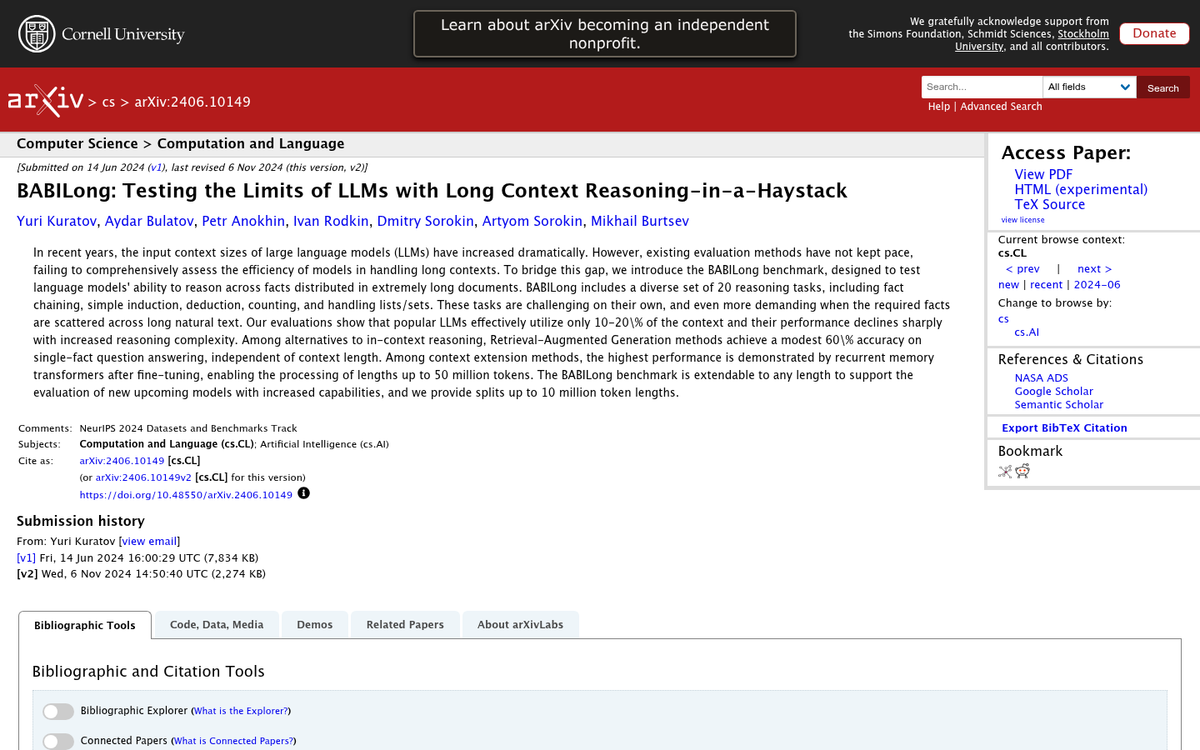
The BABILong benchmark, which tests how well models manage information spread across long documents, found that large language models use only around 10 to 20 percent of their stated context window. That means a model advertised with a 100,000-token limit might only be reliably drawing on 10,000 to 20,000 of the tokens in practice. The rest gets processed in a technical sense. But the model's ability to reason over it drops substantially.
It gets more uncomfortable. A 2025 study by Norman Paulsen found that some models start to fail when the relevant information is buried, and this degradation can happen with as few as 100 distractor tokens surrounding the content that matters; it doesn't take much noise to cause an actual drop in accuracy.
Chroma's research into retrieval-augmented generation reinforces this. When irrelevant content surrounds the information a model needs, performance degrades - not because the model can't see the content, but because the surrounding noise competes with it. More tokens in the window doesn't mean better; it can work against you.
The assumption that "it fits, so it'll work" is a trap that gives you problems in production. This is similar to how making your content more effective isn't just about volume - quality and structure matter more than sheer quantity.
| Year | Representative Model | Advertised Context (Tokens) | Estimated Effective Use |
|---|---|---|---|
| 2020 | GPT-3 | 4,096 | ~2,000-3,000 |
| 2021 | GPT-3.5 (early) | 4,096 | ~2,000-3,000 |
| 2022 | GPT-3.5-turbo | 16,385 | ~3,000-6,000 |
| 2023 | Claude 2 | 100,000 | ~10,000-20,000 |
| 2024 | GPT-4o | 128,000 | ~13,000-26,000 |
The advertised numbers have grown dramatically year over year, and that growth is legitimately helpful for handling long documents. But the helpful range hasn't scaled at the same rate, and that disconnect matters when you're picking how to structure what you send to a model.
Fitting inside the window and landing well inside the window are two very different things.
Where Your Content Sits in the Window Changes Everything
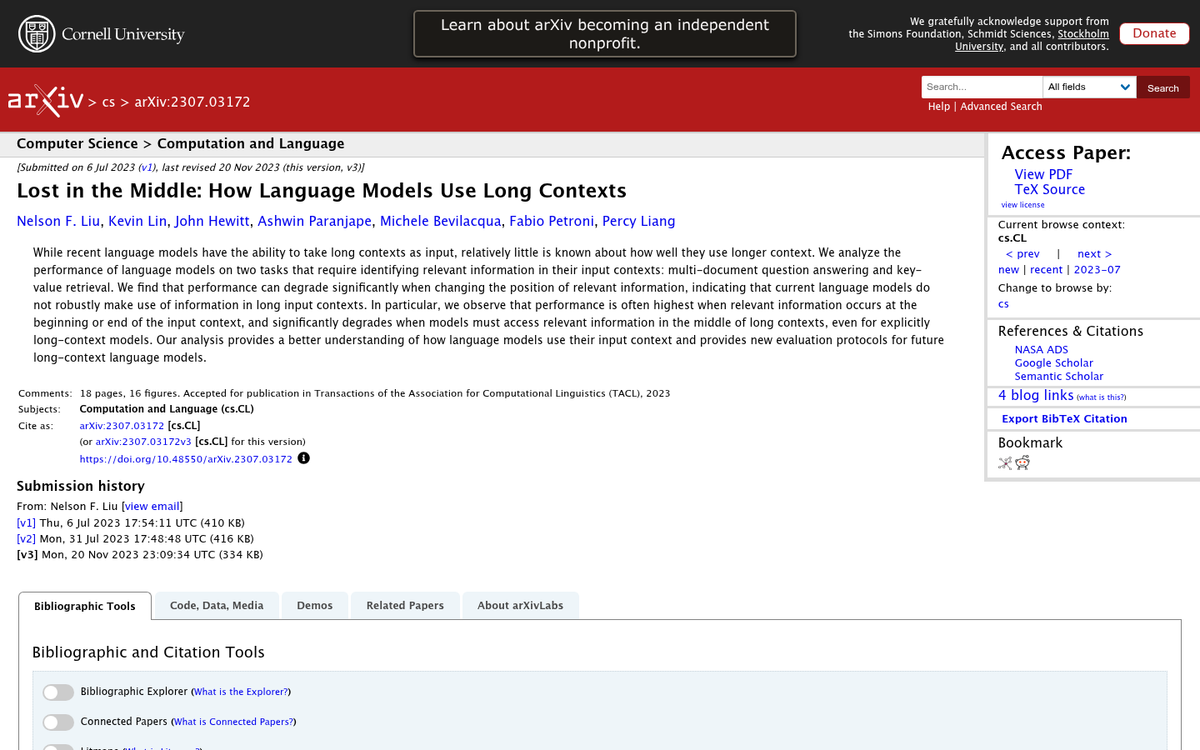
There's a well-documented pattern in how AI models process long inputs - content near the beginning or end of a context window tends to get more attention than content buried in the middle. Researchers call this the "lost in the middle" problem, and it has consequences for how your pages get read and used.
Consider what that means for a long post or service page. If your most important answer is sitting in paragraph nine, sandwiched between background context and filler sentences, the model may deprioritize it - not because it's bad content, but because of where it lands in the input.
That's a helpful reason to front-load your key points. Put the direct answer close to the top of the page, before the supporting detail. You can still include context and explanation, but the core of what the reader needs to know should not have to wait.
Page structure plays a bigger role here than most writers know. Clear headers help a model segment your content into discrete chunks instead of processing it as one long undivided block. Short focused paragraphs make it easier to extract a claim or answer. Tight structure maps well onto how these models manage input, and it's also good writing practice.
Filler content is worth looking at too. Introductory paragraphs that restate the title, transitions that pad word count, and repeated caveats all take up space in the window without adding signal. Should I Approve New WordPress Pingbacks & Trackbacks?

Ask yourself where your most important content actually lives on the page. If the answer you most want cited or referenced is in the second half of a long document, that placement is working against you. Moving it earlier costs you nothing but can meaningfully change how the content gets used.
Chunking also helps at a deeper level. When related ideas are grouped together under a header, a model can treat that section as a self-contained unit. That makes it easier to pull a relevant answer even when the full page is long. Scattered information - where a point starts in one paragraph and gets finished three paragraphs later - is much harder to use cleanly.
None of that means you'll have to restructure every page from scratch - it means being honest about whether your page is organized around what the reader needs first, or around what felt natural to write. Those two things are not necessarily the same, and the difference between them is where content goes unnoticed. If you're working through a WordPress editing workflow, it's worth revisiting how your drafts are structured before publishing.
Make Your Content Count Within the Window
For website owners, the helpful steps are easy. Put your most important information first, before filler phrases and background context push it further into the token stream. Write in clear, direct sentences instead of dense, clause-heavy constructions that take tokens without adding meaning. Avoid repetitive phrasing and unnecessary padding, and know that non-English content, heavily formatted tables, and verbose markup can quietly take a share of your allocated window before a model reaches your core message.
The good news is that none of this is going to need a full content overhaul. Small structural changes - tightening a lead paragraph, reorganising a page so the answer comes before the explanation, and cutting a few hundred words of boilerplate - can meaningfully change how an AI engine reads and represents your content. Treat the context window less like a container to fill and more like attention to earn, and your pages will be better positioned as the technology continues to evolve.
FAQs
What is a context window in AI?
A context window is the fixed amount of text an AI model can process at one time, measured in tokens. It determines how much of your content the model can "see" when generating a response or citation.
How many words fit in a context window?
Most words are one to two tokens, so a 4,000-token context window holds roughly 3,000 words. Larger modern models support much bigger windows, but effective attention doesn't scale equally with size.
Do AI models use their full context window?
No. Research suggests models reliably use only 10-20% of their stated context window. A model advertised at 100,000 tokens may only effectively process around 10,000-20,000 tokens in practice.
Why does content placement in a page matter?
AI models pay more attention to content at the beginning and end of a context window. Key information buried in the middle risks being deprioritized, a pattern researchers call the "lost in the middle" problem.
How can I optimize content for AI answer engines?
Front-load your most important information, use clear headers, write concise sentences, and remove boilerplate text. Reducing filler ensures the model reaches your core message without wasting valuable context window space.