




Think of it this way: when a tool like ChatGPT, Perplexity, or Google's AI Overviews scans your page, it isn't reading your content the way a human would. It's scanning for discrete, digestible units of information - a definition here, a process there, an answer to a question somewhere else. If your content is one long, unbroken wall of text, those tools will have a hard time pulling anything helpful from it. Chunked content, on the other hand, hands AI what it needs on a silver platter.
For website owners and managers, this has consequences. Pages that are well-chunked are far more likely to be cited in AI-generated answers, featured in zero-click results, and trusted as authoritative sources - it's one of the most helpful changes you can make to your content strategy, and it doesn't require rebuilding your site from scratch.
This entry breaks down what chunking looks like in practice, why AI systems respond to it well, and how you can start applying it to your existing content to improve your visibility in AI-driven search.
Quick Answer
Chunking is a cognitive strategy that involves breaking down large amounts of information into smaller, manageable groups or "chunks." This technique helps improve memory retention and learning by reducing cognitive load. For example, a phone number like 1234567890 is easier to remember as 123-456-7890. The brain can hold roughly 7 (plus or minus 2) chunks of information in working memory at once, as identified by psychologist George Miller. Chunking is widely used in education, UX design, and everyday memorization tasks.
Where Chunking Comes From (And Why It Matters for AI)
The idea of chunking didn't originate with websites or AI - it came from a psychologist named George Miller, who published a paper in 1956 that changed how scientists thought about human memory. His finding was simple: the human brain can hold roughly seven pieces of information at once, give or take two.
That range - five to nine units - became one of the most referenced ideas in cognitive science. A chunk is an actual group that the brain treats as a single thing. A phone number broken into sections is easier to remember than ten digits in a row, because your brain reads each section as one unit instead of ten.
This is just how human cognition works. We group things to make sense of them, and we process grouped information faster than scattered information - it's a built-in feature of how memory operates, not a learning style or a preference.
Large language models - the technology behind answer engines like ChatGPT, Perplexity, and Google's AI Overviews - were trained almost entirely on human-written content. That means they learned to find and prioritize patterns that match how humans write and read.

Grouped, structured content is one of those patterns - it picks up on how ideas are organized, which concepts belong together, and where one thought ends and another begins. Content that mirrors natural cognitive groupings is easier for a model to interpret accurately.
The reason chunking works for AI isn't some arbitrary technical rule - it's because the AI learned from humans, and humans have always chunked information to understand it.
There's also a retrieval dimension to this. When an AI pulls information to answer a question, it tends to surface content that's self-contained and bounded. A well-defined chunk - a paragraph that covers one idea, a section with a descriptive heading - is much easier to lift and use accurately than a long block of text where ideas blend into each other.
In that sense, writing for human readers and writing for AI retrieval are more aligned than many assume. The cognitive science Miller described in 1956 turns out to be a helpful foundation for both. Structure that helps a human reader follow along also helps a language model figure out what your content is actually saying.
How Chunking Works Inside Your Content
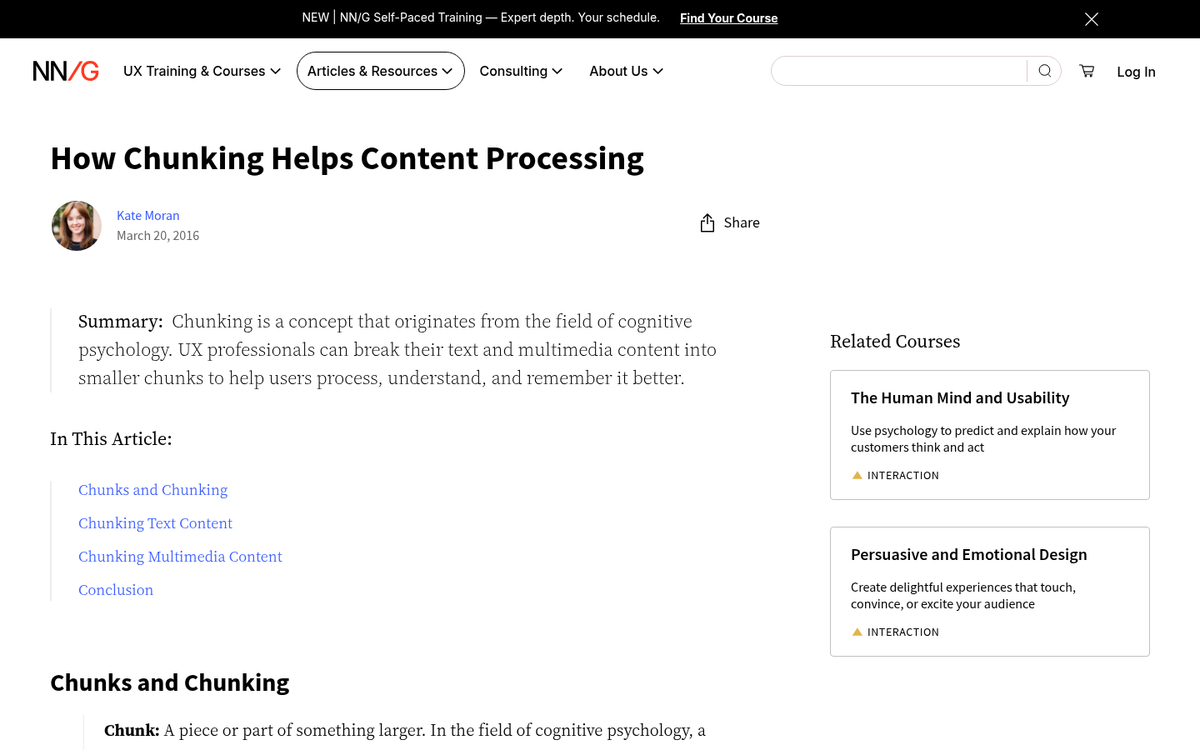
On a webpage, a chunk is any discrete unit of content that covers one idea from start to finish - maybe a short paragraph under a subheading, a numbered list of steps, or a standalone section with a scope. The way it matters is that each chunk does one job and then stops.
Headers are the most visible chunking tool you have. They signal to readers and AI systems that a new idea is starting. A header reads like a question or a direct statement - something a person might actually type into a search bar - this gives each chunk an entry point.
Paragraph length matters more than expected. A wall of text looks like one big idea even if it has five different ones. Keeping paragraphs to three or four sentences forces a separation of the ideas, which makes each one easier to find and process.
Numbered steps and bullet points work well for content where sequence or comparison is part of the point. A recipe, a process, a list of requirements - these benefit from visual separation because the structure itself carries meaning. That said, not everything should have a list. Some ideas are better explained in two connected sentences than broken into fragments.
Here is a quick comparison of chunked versus unchunked content so you can see the helpful difference.
| Format Type | Structure | AI Readability | User Readability |
|---|---|---|---|
| Chunked content | Headers, short paragraphs, scoped sections | High - distinct ideas are easy to extract | High - readers can scan and navigate |
| Unchunked content | Long paragraphs, no subheadings, mixed ideas | Low - meaning is harder to isolate | Low - requires more effort to follow |
| Over-chunked content | Too many headers, very thin paragraphs | Medium - structure exists but context is thin | Medium - can feel fragmented or shallow |
That last row is worth mentioning. Content can be broken into too many pieces. If every paragraph gets its own header and each paragraph is one sentence long, the content starts to lose the connective tissue that makes ideas make sense together.
You want to structure writing so each section has a beginning, a middle, and an end - giving each idea enough room to breathe without letting it sprawl into territory that belongs to the next idea. This same principle applies when you breathe life into old blog posts, where restructuring scattered ideas into tighter sections can dramatically improve both readability and performance.
Scoped sections are what tie this all together. When a section has a tight focus, it can become something a reader - or an AI - can lift out and use independently.
The Connection Between Chunking and Featured Snippets or AI Answers
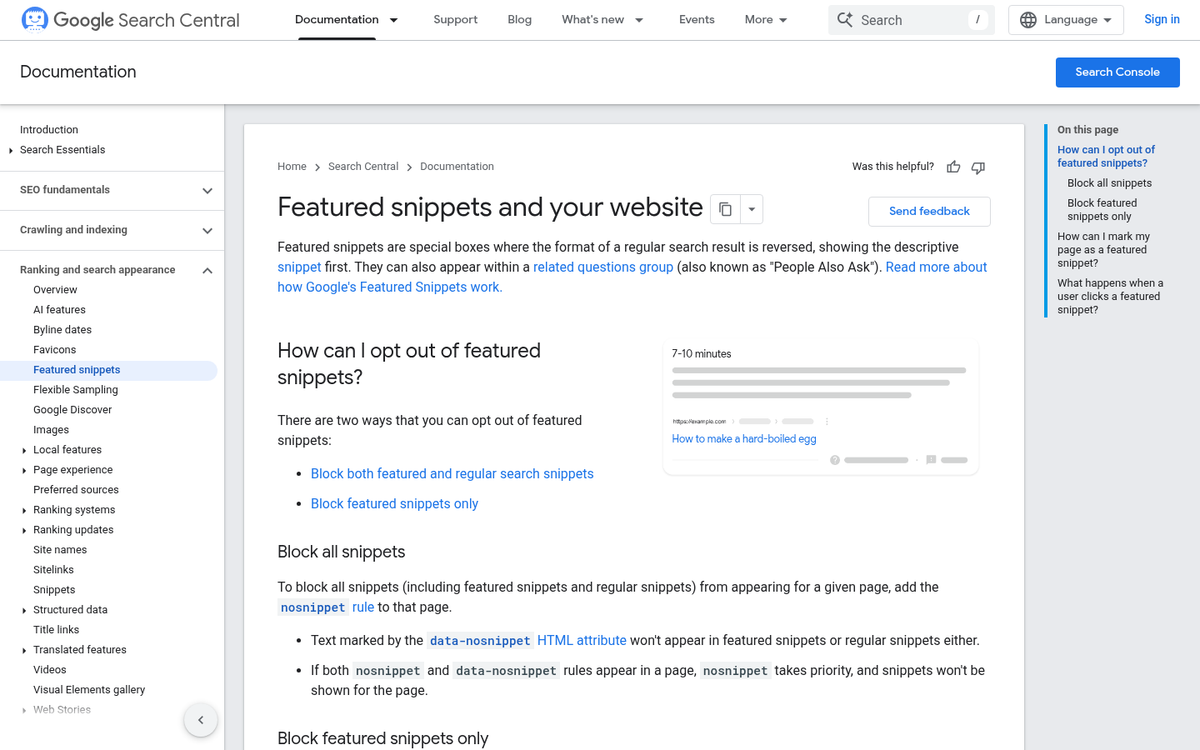
When Google pulls a featured snippet or when an AI tool generates a direct answer, it's not reading your whole page - it's scanning for a passage that cleanly answers a question on its own. That is what a well-chunked paragraph does.
Answer engines are built to extract. They look for content that has a clear scope, a descriptive heading, and a tight focus.
This changes how you should think about writing. The usual goal is to write something a person will scroll through and like. But AI tools don't scroll. They pull the most self-contained, well-labeled part of content they can find and serve it as the answer.
A 60-word paragraph with a strong heading can outperform a 1,200-word post that never quite lands on a direct answer. That is not about word count - it's about how extractable your content is.
Knowledge panels work the same way. When search engines build a snapshot of information about a topic, they pull from structured, labeled content that holds its meaning without surrounding context. If your paragraphs depend on what came before them to make sense, they are much harder to use in that way.
The helpful side of this is straightforward: each chunk you write should be able to stand alone. The heading should name the topic. The paragraph should answer it. No setup needed, no follow-up. That independence is what makes your content helpful to human readers and automated systems.
It also helps to remember the types of questions your audience would type into a search bar or ask an AI assistant. If you write each section to directly address one of those questions, you are creating content that fits the format these systems look for. Understanding how certain content choices affect your rankings can help you make smarter decisions at the section level.
The deeper change here is worth thinking about. Is your content written for a human to read from top to bottom, or is it written so any part of it can be lifted out and used on its own? Both can be true at the same time - but only if you are deliberate about how you structure each part of your blog.
Make Your Content Easy to Grab
Chunking works because it goes hand in hand with the way people actually process information. Our brains manage discrete, well-labeled pieces far more efficiently than unbroken walls of text. AI answer engines work on a similar logic, scanning for self-contained passages that map cleanly to a question or intent. When your content is built in tight, purposeful blocks with strong headers and focused paragraphs, it's easier to read, easier to cite, and easier to trust.
That benefit is only going to grow. As AI tools become more capable of pulling precise answers from across the web, the content that wins will not necessarily be the longest or the most exhaustive - it will be the most organized. Chunking your content now is not just a writing practice but a heavy duty investment in your visibility, credibility, and practicality no matter how the search landscape changes.
FAQs
What is chunking in content writing?
Chunking is the practice of breaking content into discrete, focused units - each covering one idea - using headers, short paragraphs, and structured lists to improve readability and AI extractability.
Why do AI tools prefer chunked content?
AI tools scan for self-contained passages that cleanly answer a question. Chunked content makes it easier for systems like ChatGPT or Google's AI Overviews to extract and cite accurate information.
Can chunking improve featured snippet visibility?
Yes. Featured snippets are pulled from content with clear headings and focused paragraphs. A well-chunked 60-word section can outperform a lengthy post that never delivers a direct, standalone answer.
What does over-chunked content look like?
Over-chunked content has too many headers and very short, thin paragraphs. This fragments ideas and removes the connective context that helps both readers and AI systems understand meaning accurately.
Where did the concept of chunking originate?
Chunking originates from psychologist George Miller's 1956 research showing the human brain retains roughly five to nine units of information at once by grouping them into manageable chunks.