




This distinction matters more than it might seem. Before an AI can summarize your page, pull a quote, or choose if your content answers a user's question, it has to tokenize everything first - breaking your text into those small, processable pieces. The way your content is structured, phrased, and organized directly influences how cleanly it tokenizes and, as you might expect, how well an AI understands and represents it.
It's about recognizing that the clarity, conciseness, and structure of your writing have a measurable effect on how AI engines interpret and cite your content. Small choices - like how you phrase a definition, break up a sentence, or label a section - can affect whether your content gets surfaced in an AI-generated answer or gets passed over entirely.
This entry will talk about what tokens are, why they matter in an AEO context, and what helpful steps you can take to make your content more token-friendly - so AI systems can read it accurately and confidently use it as a source.
Quick Answer
A token is a unit of data used to represent something of value or grant access/authentication. In computing, tokens can be security credentials (like JWT or OAuth tokens) used to verify identity. In blockchain/cryptocurrency, tokens are digital assets built on existing networks. In linguistics/NLP, tokens are individual units of text (words or characters) used in processing. In general usage, a token can also mean a physical symbol or voucher representing value, like a subway token or arcade token.
How AI Models Read and Break Down Your Content Into Tokens
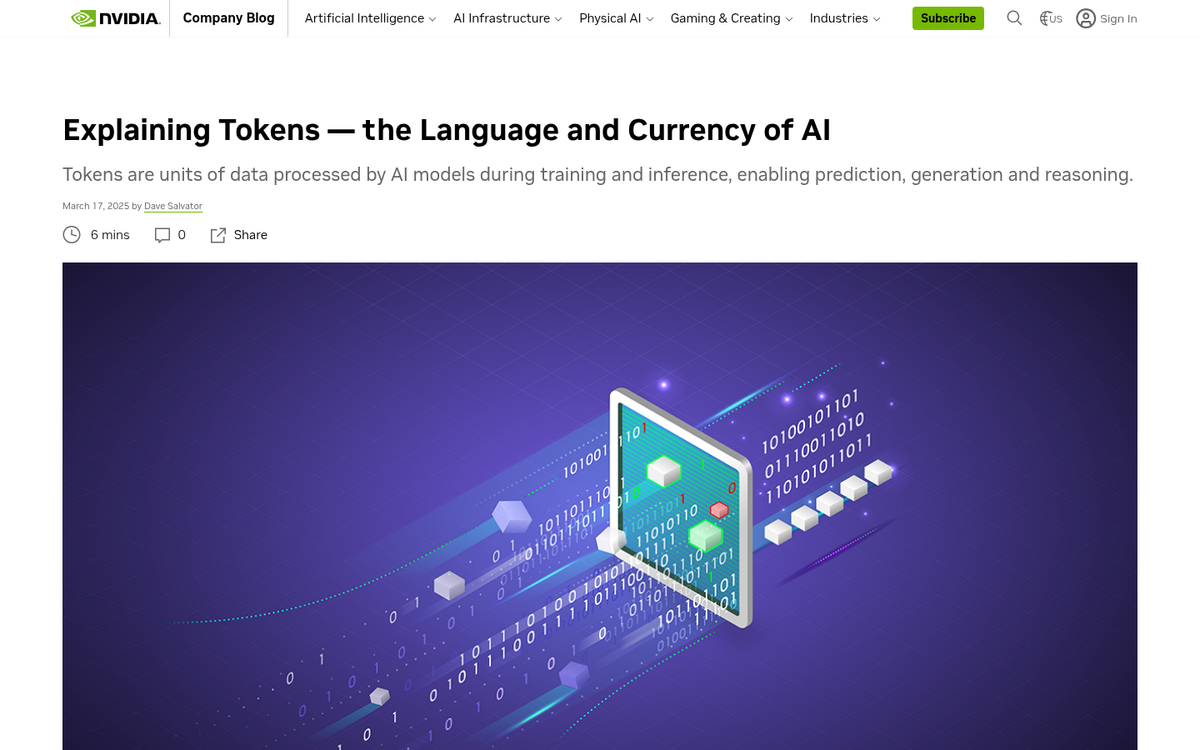
When an AI model reads your content, it doesn't take in full words or sentences the way a human does. Instead, it breaks everything down into smaller pieces called tokens, and those pieces don't always line up with the words you'd expect.
The process behind this is called tokenization, and most large language models use a technique known as byte-pair encoding for it. This works by finding the most common sequences of characters across a giant body of text and grouping them into reusable units. Common words like "the" or "and" usually become a single token. But longer or less familiar words get split into multiple pieces.
A rough rule of thumb for English text is about one token per four characters, or around 75 words per 100 tokens; it's a helpful number to hold onto, even if it changes slightly depending on the model. Whitespace, punctuation, and formatting all count too, so a page that looks clean to you is still being processed character by character under the hood.
This matters more than it might feel for content structure. Take a page that's dense with technical language or unusual compound terms - each unfamiliar string of characters forces the tokenizer to break it into fragments it can reassemble. The model still processes it. But the relationship between concepts can get harder to reconstruct when terms arrive as disconnected pieces instead of recognizable units.
Plain, familiar language tends to tokenize more efficiently. Words that appear frequently in training data get encoded as single tokens, so the model spends less of its processing on reconstruction and more on context. This isn't a reason to strip out all technical language. But it does help explain why plain writing is easier for AI to work with. If you're wondering whether blogging in English as a non-native speaker affects readability, the same principles apply here.
It's also worth knowing that tokenization isn't consistent across different models. GPT-based models, Claude, Gemini, and others each use their own tokenizers with slightly different vocabularies. A word that becomes one token in one model might become three in another, so the same piece of content can have a different token count depending on which AI is reading it.
Formatting choices play into this too. Markdown symbols, HTML tags added by your WordPress editor, repeated punctuation, and even extra line breaks all add tokens that carry no meaning for the reader but still take up space in the model's context window. Lean, well-structured content gives the model more room to process the substance of what you've written.
Token Limits and What They Mean for Your Content Length
Every AI model has a maximum number of tokens it can hold in memory at one time - this limit is called the context window, and it controls how much content the model can read and work with during a single session.
Think of it as the AI's working memory. Once you hit that ceiling, the model can't load more content - something has to give.
Different models have very different context window sizes. Here's a quick look at a few known ones to give you a sense of the range.
| AI Model | Context Window (approximate) |
|---|---|
| GPT-3.5 Turbo | 16,000 tokens |
| GPT-4 Turbo | 128,000 tokens |
| Claude 3 Opus | 200,000 tokens |
| Gemini 1.5 Pro | 1,000,000 tokens |
Those numbers sound generous, and for most web pages they are. A common blog post sits between 500 and 2,000 tokens, so a single post isn't a problem on its own.
The complication comes when AI tools pull in content from multiple sources at once, or when your pages are legitimately long. A dense pillar page with thousands of words, embedded FAQs, and repeated boilerplate text can take up a actual chunk of a smaller model's context window all by itself.

Content that falls outside the window either doesn't get seen or is treated as lower priority. Some models will summarize or truncate content to fit. Others will favor what comes first and process later content with less attention. In either case, if your most helpful information is buried toward the bottom of a long page, there's a chance it gets underweighted or missed entirely.
This matters more than most website owners know. Word count is not a number to hit or stay under - what matters is where your key points live within the content the model actually reads.
Crawlers used by AI engines also have their own constraints. They don't always send full pages into a model in one go. Content can be chunked, filtered, or partially indexed before it ever reaches the model's context window. That means your page could be trimmed before the AI even starts to process it.
Plenty of long pages perform well with AI tools. The question worth asking is whether the most important information on your page would still land if the model only processed the first half.
Writing Token-Efficient Content That AI Engines Actually Use
A 4,000-word page can get reduced to two sentences by an AI - and that's a frustrating thing to discover. It doesn't mean the content was bad - it usually means the structure made it hard for the AI to find the most helpful parts faster.
The fix starts with how you lead. Put your direct answer at the top of any section - not at the end after a long build-up. AI systems scan for the most relevant response to a query, and if your answer is buried in paragraph six, it might not make the cut at all.
Cut the filler, not the detail
There's a difference between words that add meaning and words that just take up space. Phrases like "it's worth noting that" or "in today's world" take tokens without giving the reader anything helpful. Drop them and get to the point - your content can become stronger if you do this.
Short declarative sentences work well here. They're easy to process, easy to index, and they leave no room for ambiguity. That last part matters quite a bit to AI systems, which pull content that states things clearly.
Use structure as a guide, not just decoration
Headings, short paragraphs, and steady formatting do more than make a page look readable. They are signals that help an AI understand where one idea ends and another begins. A well-structured page is much easier to break into helpful chunks than a wall of text.
Consider how your content would read if someone only saw one paragraph pulled out of context. If that paragraph still makes sense and answers something helpful on its own, you're on the right track. If it only makes sense after reading everything before it, that's a sign to restructure. This kind of thinking also applies when you decide what to keep or remove on your WordPress blog - every element should earn its place.
A quick comparison
| Less token-efficient | More token-efficient |
|---|---|
| "It's important to understand that there are many factors that can affect how well your content performs." | "Content structure and answer placement affect AI visibility." |
| Answer buried after three paragraphs of background | Answer in the first sentence, context added after |
| Long flowing sections with no subheadings | Short sections with descriptive headings |
The goal isn't to write less - it's to write in a way where every sentence earns its place. Detailed content is still helpful. But it should have a foundation so an AI can get through it the same way a reader would.
Front-load your answers, keep your sentences tight, and use headings to break ideas into digestible pieces; it's what makes content helpful to humans and the AI systems that summarize it. The same principle applies whether you're writing a standard post or trying to earn money from Medium articles - clear structure is what gets read and rewarded.
Make Every Token Work Harder for Your Website
The most helpful next step is an easy one: pick one page on your site and read the first few hundred words as if you were an AI with no memory of the rest of the document. Is there a clear, direct answer to the question the page is meant to help with? Is the most important information front-loaded, or buried after a long introduction?
As AI systems become more embedded in how people find and consume information, the difference between content that's technically present and content that's retrievable will only widen. Thinking in tokens is one of the clearest ways to stay on the right side of that gap. If you're publishing on WordPress, understanding your hosting setup can also affect how efficiently your content is served and indexed.
FAQs
What are tokens in AI content processing?
Tokens are small units of text that AI models use to process content. They don't always align with full words - common words become single tokens, while longer or unfamiliar words get split into multiple pieces.
How do token limits affect my content's visibility?
Each AI model has a context window limiting how much content it can process at once. If your page is too long or key information is buried, it may be truncated or underweighted by the model.
Which AI models have the largest context windows?
Gemini 1.5 Pro leads with approximately 1,000,000 tokens, followed by Claude 3 Opus at 200,000 tokens and GPT-4 Turbo at 128,000 tokens.
How can I make my content more token-efficient?
Place direct answers at the top of each section, cut filler phrases, use short declarative sentences, and structure content with clear headings so AI systems can identify key information quickly.
Does content structure affect how AI reads my page?
Yes. Headings and short paragraphs signal where ideas begin and end, making it easier for AI to chunk and retrieve your content accurately as a source.