Google Analytics is one of the most powerful, ubiquitous and easy to use analytics suites in the world. One of the major reasons for this is the association with Google; obviously the tool has a lot of press, a lot of adoption and a lot of documentation. There are, however, several good reasons to avoid using it.
- A user with NoScript or JavaScript disabled is not tracked. - Lengthy idle times skew statistics. - It tracks device instead of user. - You can't retroactively change data; changes are only applied going forward. - It's on a delay; anything more recent than 24 hours old may be skewed. - If you have too much data, Google will sample it instead of record it all. - Google has access to your data, which you might object to on principle.
If you're against Google, or you've found that it's just not quite satisfactory, you can try one of these three alternatives.
Key Takeaways
- Google Analytics has notable flaws: data sampling, 24-hour delays, no retroactive changes, and third-party data access.
- Matomo offers full data ownership, self-hosting, no data sampling, and built-in heatmaps and A/B testing.
- Mixpanel focuses on event tracking rather than pageviews, excelling at complex behavioral queries and user retention analysis.
- Plausible is cookieless, under 1 KB, and GDPR-compliant, requiring no consent banner in most jurisdictions.
- All three alternatives offer free tiers, with paid plans scaling based on traffic or event volume.
1. Matomo

Originally launched in 2007 under the name "Piwik," Matomo has grown into one of the most trusted Google Analytics alternatives in the world, now used by over 1 million companies across more than 50 languages. If privacy and data ownership are your primary concerns, Matomo is arguably the strongest option on this list.
Unlike Google Analytics, Matomo gives you full ownership of your data. You can self-host it on your own servers, meaning no third party - including Matomo itself - has access to your visitor data. This makes it a popular choice for healthcare, government, and finance sectors where data sovereignty is non-negotiable.
- Full data ownership; self-host or use their cloud option.
- GDPR, CCPA, and privacy regulation compliant out of the box.
- No data sampling - you see 100% of your data, always.
- Real-time analytics with no 24-hour delay.
- Heatmaps, session recordings, A/B testing, and funnel analysis built in.
- Seamless migration from Google Analytics, including historical data import.
- Holds a 3.62% market share in the web analytics category, making it a well-established and actively maintained platform.
Matomo offers a free self-hosted version with no data limits, which is a compelling proposition for developers and businesses that have the infrastructure to support it. Their managed cloud plans start at a modest monthly fee based on traffic volume, making it accessible for small businesses and scalable for larger ones.
2. Mixpanel

Mixpanel is a unique form of analytics that doesn't center itself around tracking pageviews and related information. Instead, the analytics app tracks events. What kind of events? Virtually anything. You can see how many of the visitors that saw a particular ad went on to convert. You can see how engaged the users of your mobile app may be. You can see what method your paying customers use to find your site.
One of the standout features of Mixpanel is a robust data segmentation interface. Rather than needing to write complex database queries manually, Mixpanel puts a visual layer over its query engine, allowing you to specify fields, filters, and more without any coding knowledge required.
Mixpanel is also very good at handling complex questions. Want to know how many users clicked on your banner ad, visited three pages, converted, and then didn't come back for a month? Normally it would take several independent queries and some intuitive thinking to answer; Mixpanel can find you the specific number. You can also study detailed statistics regarding your retention rates and how users move through your site.
As of 2025, over 1.3 million websites have used Mixpanel and more than 47,000 companies globally rely on it as their primary analytics tool - a testament to its staying power. The platform generated $170.7 million in revenue in 2024, up from $145.2 million the prior year, signaling that it continues to grow and invest in its product. Pricing scales with usage, so the more traffic volume you have per month, the more you'll pay. A free tier is available, and paid plans scale from there depending on your event volume and feature requirements.
3. Plausible
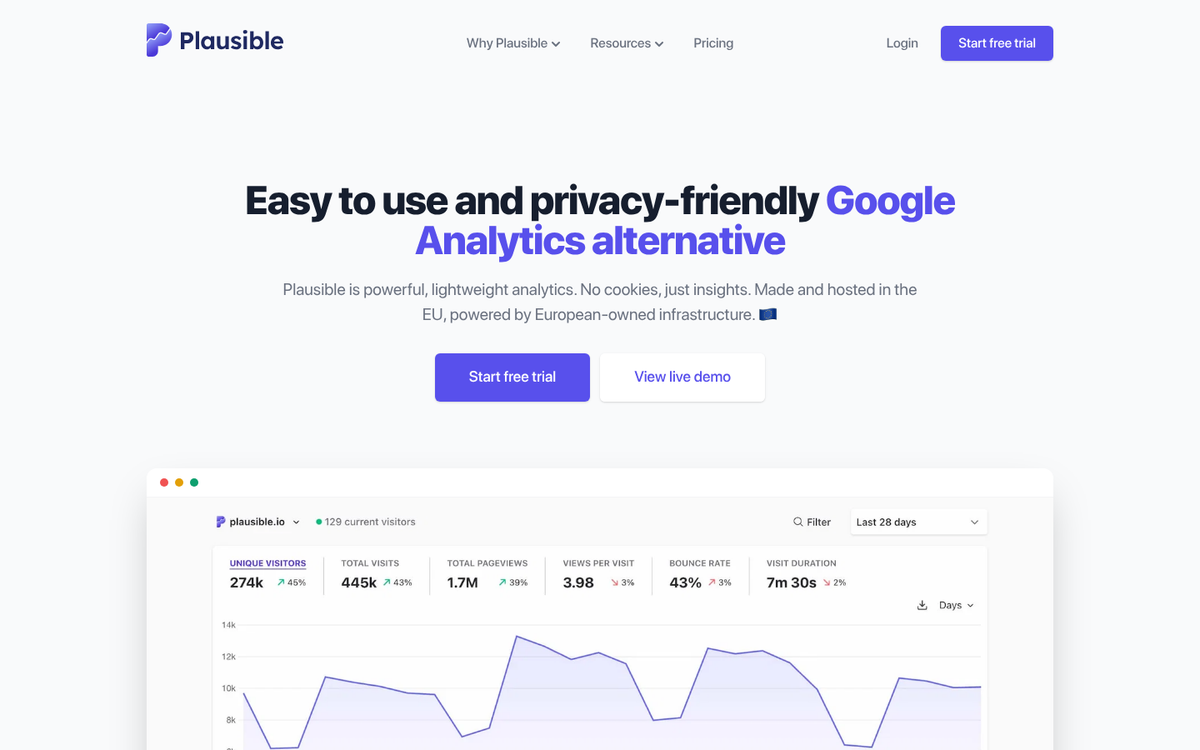
Plausible is a lightweight, privacy-first analytics tool that has surged in popularity as cookie consent fatigue has become a real problem for site owners. With over 50% of users now declining cookie consent - up from 42% in 2024 - traditional analytics tools are losing visibility into a growing chunk of their audience. Plausible sidesteps this entirely by being cookieless by design, meaning it doesn't require a consent banner at all in most jurisdictions.
What makes Plausible especially appealing is its script size: under 1 KB, compared to Matomo's 22.8 KB tracker and Google Analytics' significantly heavier footprint. For sites where page speed and traffic matter, this difference is meaningful.
- Cookieless tracking - no consent banner required in most regions.
- Script under 1 KB; negligible impact on page load speed.
- Simple, clean dashboard that takes minutes to understand.
- Fully GDPR compliant and hosted in the EU.
- Open source; can be self-hosted if preferred.
- No personal data collected, no cross-site tracking.
Plausible is intentionally simple - it won't replace Mixpanel if you need deep event tracking or behavioral funnels, but for content sites, blogs, and small to mid-sized businesses that just want clean, honest traffic data without the compliance headaches, it's hard to beat. Pricing is straightforward and based on monthly pageviews, with plans starting affordably and a 30-day free trial available.