Key Takeaways
- Facebook dominates social media referral traffic, driving approximately 74% of global social referrals versus X's 7.7%.
- X visitors spend more time on-page (133 seconds vs. 107 seconds), offering better engagement quality despite lower volume.
- A multi-platform strategy is recommended, with Facebook as the anchor and X playing a supplementary, niche-dependent role.
- Meta's advertising ecosystem is far more sophisticated than X's, making it the stronger choice for paid social campaigns.
- Audience demographics matter - Gen Z has largely migrated away from Facebook, so knowing your audience overrides general statistics.
Facebook vs. Twitter (Now X): Which Social Platform Should You Focus On in 2026?
When webmasters ask for advice on driving traffic to their websites, one of the first pieces of advice to come up is "use social media." It's free, it's full of engaged users, and the platforms are built with marketers in mind - with robust ad systems, analytics dashboards, and native content tools designed to keep people clicking.
The next question a webmaster might ask is "which platform?" The standard answer remains "any platform your users are on." Are your users scrolling Facebook? Build a presence there. Are they posting short-form takes on X (formerly Twitter)? Get active and join the conversation. Are they watching short videos on TikTok or saving ideas on Pinterest? Meet them where they are.
There can be no doubt that the dominant social network for web traffic referrals is Facebook - and it's not particularly close. X (formerly Twitter) still has a role to play, but its traffic referral power has declined significantly over the past several years. Google+ is long gone, having been shut down by Google back in 2019. The social media landscape in 2026 looks very different from what it did even five years ago.
So you still face a choice about where to invest your time and energy. The honest answer is that you should have a presence on multiple platforms - but Facebook should almost certainly be your anchor for driving actual web traffic, while X serves a more supplementary role depending on your niche and audience.
Facebook excels at volume: sheer number of users, referral traffic, and advertising reach. X is better suited for real-time conversation, breaking news, customer service, and reaching certain professional or enthusiast communities. TikTok and Instagram have surged in importance for brand awareness and discovery, though their direct referral traffic to external websites remains limited by design. The landscape is fragmented in 2026, and a smart social strategy reflects that reality.
The Statistics
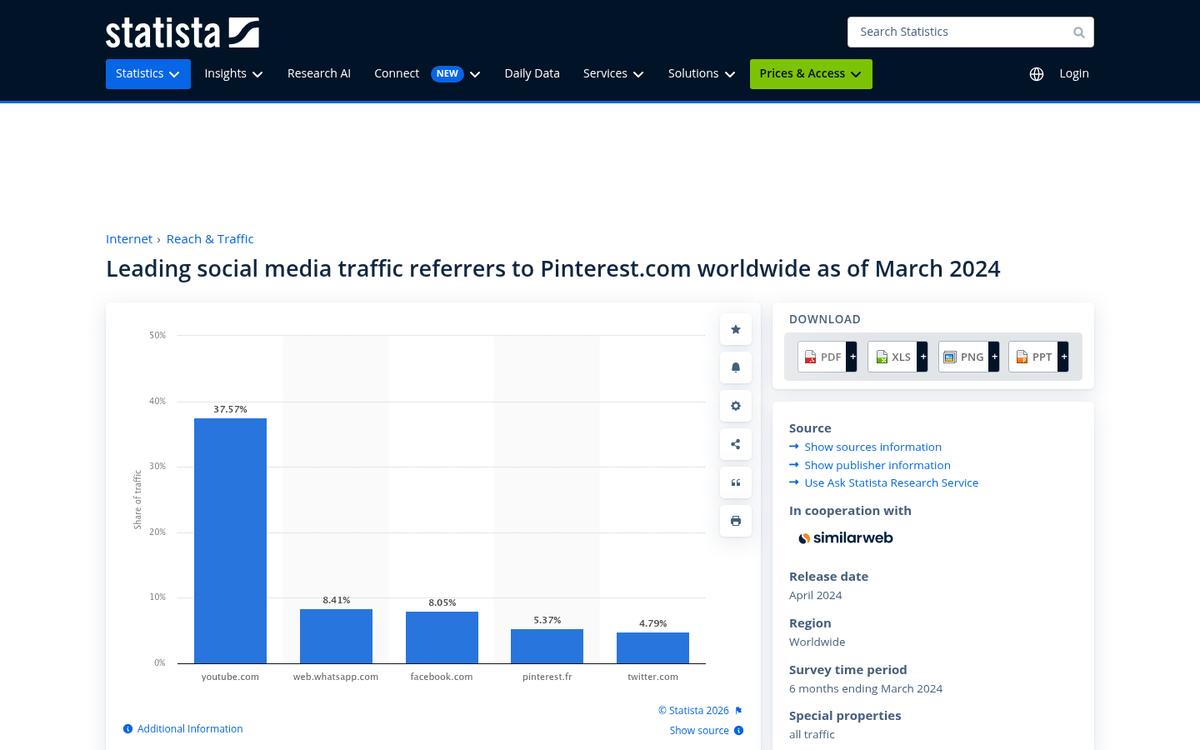
The numbers tell a clear story. According to Statcounter, Facebook drives approximately 74% of global social media website referrals outside of China - a staggering share that has held relatively steady even as newer platforms have risen. X (formerly Twitter), by contrast, accounts for roughly 7.7% of total social media referrals according to DataReportal data.
Chartbeat data reinforces this gap. Facebook generated over 8x as many page views as Twitter in recent tracking periods, per Press Gazette analysis. Pew Research Center data shows Facebook sends 82% of social traffic to longer news stories and 84% to shorter ones, while Twitter accounted for just 16% and 14% respectively.
There is one interesting nuance worth noting: Twitter referral visitors have historically spent more time on-page - around 133 seconds for long-form content, compared to Facebook's 107 seconds. So while X sends far fewer visitors, those visitors may be more engaged when they arrive. Depending on your goals, that quality-vs-quantity tradeoff matters.
Echobox's Social Media Index found that Twitter's referral share has hovered between 1% and 1.5% since mid-2015, with further decline since Elon Musk's acquisition of the platform in late 2022 and the subsequent rebranding to X. Many publishers have quietly deprioritized X as a traffic source as a result.
Judging by sheer referral volume, Facebook is the clear and dominant winner. That said, the platform you should prioritize still depends heavily on where your specific audience lives online.
Making Social Media Work for You in 2026
There's one major caveat to all of this. You can look at all the data in the world, but none of it will help unless you put a real plan into action.
First, there's no reason to limit yourself to a single platform. Facebook and X complement each other rather than compete. Beyond those two, platforms like LinkedIn (excellent for B2B), Pinterest (strong for lifestyle, food, and DIY niches), and even Reddit can drive meaningful, highly targeted traffic depending on your content. A diversified presence is smarter than betting everything on one channel.
Second, there's the audience factor. If your audience skews younger and spends their time on TikTok or Instagram rather than Facebook, the raw referral statistics won't reflect your reality. Gen Z users in particular have largely migrated away from Facebook. Know your audience and go where they actually are - not where the aggregate statistics say people might be.
Third, Facebook remains by far the stronger platform for paid social advertising. Meta's ad ecosystem - spanning Facebook, Instagram, and its Audience Network - is extraordinarily sophisticated in 2026, with advanced targeting, AI-driven campaign optimization, and remarketing capabilities that X simply cannot match at scale. If you have any marketing budget to allocate toward paid social, Meta's platform should almost certainly be your first stop.
X's advertising product has become more volatile and less trusted by marketers since the platform's ownership change. Many major brands have reduced or paused their X ad spend entirely over the past few years. That said, X Ads can still work well for certain niches - particularly tech, finance, and political content - where the platform's user base remains highly engaged.
Timing and Usage
Regardless of which platforms you choose - and again, the answer should be more than one - you need to use them strategically. Here are some general guidelines that hold up in 2026:
- Facebook posts tend to receive the highest engagement mid-week, particularly Tuesday through Thursday. Weekends can also perform well depending on your audience and niche.
- The best time to post on Facebook varies significantly by audience - use Meta's built-in analytics to identify when your specific followers are most active and schedule accordingly.
- X (Twitter) engagement tends to peak on weekdays, particularly Tuesday and Wednesday, with activity spiking around late morning and early evening in your audience's primary time zone.
- Retweets and reposts on X still tend to cluster around 5pm, though this varies by niche and geography.
- For LinkedIn, Tuesday through Thursday during business hours remains the conventional wisdom for highest reach, particularly 8-10am and noon.
Post frequently, but with purpose. For Facebook, 1-3 posts per day focused around peak hours is still a reasonable baseline. For X, posting 4-6 times per day can help maintain visibility without overwhelming your followers. Tools like Buffer, Hootsuite, and Later remain excellent options for scheduling posts across multiple platforms without letting everything pile up at once.
Success on any social network comes down to consistent analysis and iteration. Use Meta Insights, X Analytics, and whatever native tools your platforms provide. Figure out what resonates with your specific audience and double down on what's working - whether that's long-form link posts, short punchy takes, images, or video. The platforms reward engagement, and engagement comes from genuinely useful, interesting, or entertaining content.
The social media landscape in 2026 is more fragmented than ever, but the fundamentals haven't changed: show up consistently, speak directly to your audience's interests, and measure everything you can. Get those basics right, and the traffic will follow.