




Understanding user intent has always mattered for SEO, but its role has expanded significantly with the rise of AI-powered answer engines. Tools like ChatGPT, Perplexity, and Google's AI Overviews don't match keywords - they interpret the intent behind a query and surface content that best satisfies it. That change affects how your content needs to be structured, written, and positioned if you want it to show up in AI-generated replies.
For website owners and managers, that means intent is no longer just a background consideration - it's a primary signal that AI systems use to determine if your content is worth citing, summarizing, or recommending. Getting this right is one of the most helpful things you can do to improve your visibility in an AI-first search environment.
This entry breaks down the core types of user intent, explains how AI answer engines interpret and respond to those intent signals, and walks you through how to match your content strategy accordingly.
Quick Answer
User intent refers to the underlying goal or purpose behind a search query or action. It falls into four main categories: informational (seeking knowledge), navigational (finding a specific site), transactional (completing a purchase or action), and commercial investigation (researching before buying). Understanding user intent helps content creators and marketers deliver relevant results that match what users actually want, improving engagement and conversions. Search engines prioritize content that accurately satisfies user intent over keyword-stuffed pages.
The Four Types of User Intent You Need to Know
Every search query falls into one of four categories, and knowing which one you're dealing with changes everything about how you respond to it. The four types are informational, navigational, transactional, and commercial investigation.
Informational intent is by far the most common. Research from the ACM found that over 80% of queries are informational, which means users want to learn something instead of buy or find a page. A query like "how does photosynthesis work" is an example - the person just wants an explanation.
Navigational intent is when a user already knows where they want to go and uses a search engine to get there faster. Typing "Facebook login" or "BBC Weather" into Google is navigational. The user has a destination in mind.
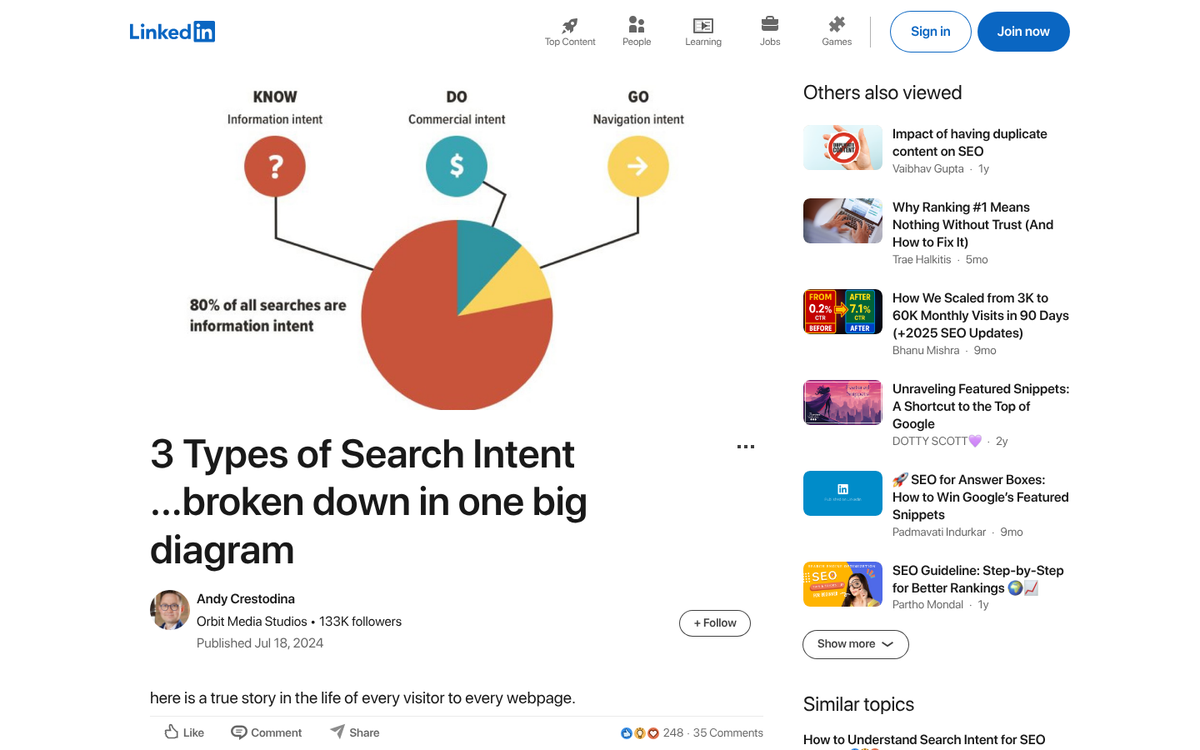
Transactional intent means the person is ready to take action. That action is usually a purchase. But it can also be a sign-up, a download, or a booking. A query like "buy noise-cancelling headphones" tells you the user is close to a choice and wants a path to it.
Commercial investigation sits in the middle ground between informational and transactional. The person is interested in making a choice but isn't quite there yet. They're comparing, evaluating, and weighing up their options - think "best project management tools for small teams" or comparing options like camera quality across competing products.
| Intent Type | Example Query | User Goal | Content Format That Fits |
|---|---|---|---|
| Informational | "How does compound interest work?" | To learn or understand something | Blog post, explainer, FAQ |
| Navigational | "Spotify web player" | To reach a specific page or site | Homepage, login page, branded landing page |
| Transactional | "Buy running shoes online" | To complete an action or purchase | Product page, pricing page, booking form |
| Commercial Investigation | "Best laptops under $1000" | To compare and evaluate before deciding | Comparison article, review, roundup |
Most content strategies focus too heavily on transactional queries because those feel closest to revenue. The informational majority is where trust gets built, and that trust is what moves users toward a choice later.
How AI Answer Engines Read and Match Intent
Traditional search engines match keywords. AI answer engines do something different - they try to figure out what you actually want and pull the most direct answer to satisfy that need. That change changes everything about how content gets surfaced.
Google's AI Overviews are an example of this in action. Rather than scanning for pages that have the right words, the system reads for meaning and intent - it asks, in effect, what is this person trying to accomplish?
Research from Authoritas found that 74% of AI Overview triggers came from problem-solving queries and 69% from question-based searches. That tells you something important about what these systems are tuned to find.
The difference comes down to how the technology interprets language. A traditional search engine sees a query like "my laptop keeps shutting down" as a string of words to match against indexed pages. An AI answer engine reads it as a problem that should have an answer and goes looking for content that actually explains what to do.
These are categories the technology itself is actively reading for. Informational, navigational, commercial, transactional - AI systems are trained to detect these tells and match replies accordingly.

Keyword density, which once carried weight, is much less relevant here. The AI is looking at context, structure, and whether a piece of content actually resolves the question being asked. A page that buries its answer under three paragraphs of background text may rank but still lose the AI Overview placement to a page that gets to the point faster. This is similar to how certain technical choices can quietly undermine your visibility without obvious warning signs.
It also pays attention to specificity. Vague, general content tends to get passed over in favor of content that matches the exact shape of the query - the who, what, why, or how behind it.
The technology is basically doing what a thoughtful person would do when scanning a page: checking if the content matches the reason someone is asking.
Matching Your Content to What Visitors Actually Want
Once you understand how AI engines read intent, the next step is to look at your own content and check if it delivers what searchers are after. This is called an intent audit, and it's worth doing before you write anything new.
A common problem is a product page that ranks for an informational query. Someone searches "how does X work" and lands on a page that just lists features and prices. That visitor did not come to buy - they came to learn. The mismatch frustrates them, and it tells search engines that your page is not the right fit.
Sometimes the answer is to create a separate piece of content that serves the informational intent and then links to your product page once the reader is ready. You want to meet them where they are instead of where you want them to be.
A helpful way to check intent alignment is to search your target keyword yourself and study what comes up. Look at the format of the top results - are they guides, comparison tables, short definitions, or long explainers? That format is not random - it reflects what searchers have responded to and what AI engines have learned to trust.

You can reverse-engineer this fairly easily. If the top answer is a 300-word explainer with a simple example, a 2,000-word deep dive might work against you for that query. Match the depth and format to what the question calls for - not to what feels most impressive.
| Query Type | What the Visitor Wants | Content Format That Fits |
|---|---|---|
| Informational | An explanation or answer | Guide, explainer, FAQ |
| Navigational | A specific page or brand | Landing page, homepage |
| Commercial | Help to compare options | Comparison post, review |
| Transactional | A place to buy or sign up | Product page, pricing page |
Use this as a quick reference to audit each page. Ask yourself which column your content belongs in and whether the page you have actually delivers on that.
Using Intent Data to Prioritize What You Create Next
Most site owners plan their content calendars based on gut feeling or keyword volume alone. That works to a point. But it leaves value on the table.
The numbers behind this are hard to ignore. A DemandScience study found that 98% of B2B marketers see intent data as important to their work, and 17% of B2B teams reported a 30% improvement in lead conversion after using it. That result comes from planning content around demand instead of assumptions.
You probably already have more intent data than you realize. Google Search Console will show you the exact queries people use to find your pages, and patterns in those queries tell you quite a bit about intent. If visitors are arriving through questions like "how do I fix X" or "X vs Y", that tells you what format and angle to use next.
AI chatbots are another underused source. Pay attention to what people ask tools like ChatGPT or Perplexity in your niche - many of these tools now surface trending questions or common prompts. The language people use when they talk to AI tends to be more natural and intent-rich than a typed search query, which makes it a helpful window into what they actually want to know.

Third-party intent platforms go further by tracking behavioral signals across the web - things like which topics a company's team has been researching before they ever land on your site. These tools tend to show up more in B2B settings. But the principle applies anywhere: build content for demand that already exists instead of demand you hope to create. If you're also looking to use Mix.com to promote your blog posts, understanding that existing demand can help you target the right audiences there too.
If your data shows a steady pattern of navigational queries around a topic you haven't covered, that's a content gap worth filling before anything else on your list.
Intent data turns your content calendar from a schedule into a strategic response to audience behavior. Pairing it with tools like auto-sharing plugins for new blog posts helps you act quickly once you've identified what your audience wants.
Turn Intent Into Action: Your Next Steps for AEO
To put this into practice, work through this short checklist:
- Audit your top-traffic pages - confirm that the content type, format, and depth actually match the intent behind the keywords driving visits.
- Identify question-based gaps - search your core topics as questions and note where your content is absent or too thin to earn a feature.
- Test your AI visibility - run your target queries through tools like ChatGPT, Perplexity, and Google's AI Overviews to see whether and how your content appears.
- Check for intent drift - flag any pages trying to serve multiple competing intents, and consider whether splitting or refocusing them would help.
- Prioritize specificity - look for opportunities to replace broad, general content with answers that are precise, structured, and immediately useful.
None of this is going to need a full site overhaul. Even small adjustments - a sharper headline, a page restructured around a clearer user goal, or one well-defined content gap filled - can change how users and AI systems perceive your relevance. Start with one page, measure what changes, and build from there.
FAQs
What are the four main types of user intent?
The four types are informational, navigational, transactional, and commercial investigation. Informational users want to learn, navigational users seek a specific page, transactional users are ready to act, and commercial investigation users are comparing options before deciding.
How do AI answer engines differ from traditional search engines?
Traditional search engines match keywords, while AI answer engines interpret the meaning and intent behind a query. They look for content that directly resolves what the user is trying to accomplish, not just pages containing the right words.
What is an intent audit and why does it matter?
An intent audit involves reviewing your existing content to check whether it matches the actual intent behind the queries driving traffic to it. Mismatches, like a product page ranking for an informational query, frustrate users and signal poor relevance to search engines.
How can I use intent data to plan content?
Google Search Console reveals the queries people use to find your pages, highlighting intent patterns. AI chatbots and third-party intent platforms can also surface what topics your audience is actively researching, helping you create content around existing demand.
Does content length matter for matching user intent?
Yes. Content depth should match what the query calls for, not what feels most thorough. If top-ranking results are short explainers, a lengthy deep dive may actually hurt your chances of being featured by AI answer engines.