





Key Takeaways
- Textbroker and iWriter are budget content mills with inconsistent quality; higher tiers cost more but remain unreliable without careful writer selection.
- Contently serves enterprise clients with professional editorial support, costing $200-$600+ per post, making it impractical for most solo bloggers.
- Many content mill writers now use AI themselves, meaning you may pay human rates for minimally edited AI-generated content.
- A hybrid approach-AI-generated drafts refined by skilled human editors-often outperforms content mills at comparable or lower cost.
- Content mills work best as temporary scaffolding; long-term blogging success requires investing in genuinely high-quality writing.
The life of a blogger is one filled with work. Imagine if you're posting one blog post per day, five days per week; it's 260 blog posts and each post is, say, 2,500 words; it's 650,000 words of writing. In the pre-AI era, if it took you an hour to write 1,000 words, that would amount to 27 days of writing throughout the year. That doesn't even factor in time spent collecting data, reading research, or generating ideas.
Do you want to spend a full month of your life writing posts for your blog?
One of the traditional solutions to this problem has been to hire writers. The problem with that is they tend to need input, oversight, and money. You need to train them, manage them, and cope with the inevitable turnover that comes with freelancers juggling multiple clients. It's easier than doing everything yourself, but it's still an issue when your time is limited.
Of course, it's now 2026 and the landscape has shifted dramatically. AI writing tools like ChatGPT, Claude, and Gemini have changed what's possible for solo bloggers. Many bloggers use AI to manage first drafts, outline generation, and research summaries - dramatically cutting down the time investment. That said, AI content still needs human editing, fact-checking, and genuine expertise to perform well in search results, so it's not a magic bullet.
Beyond AI, another answer thousands of bloggers still use is paying for writing through content platforms. You can hire ghostwriters through so-called "content mills" to produce content per your specifications, with full rights to that content, for considerably less than hiring writers directly. The three we're going to talk about are Contently, iWriter, and Textbroker.
Textbroker
Starting with Textbroker makes sense because, of the three, it's the most straightforward - it's a fairly simple platform. You sign up as a client and are given access to tools that allow you to post assignments. Your assignments are pretty open-ended; you basically have a text box to submit your idea, with options to specify keywords and word count ranges.
There are three ways you can submit an order. You can submit to the open pool, create a team, or submit directly to a writer. In the open pool, you choose from star levels ranging from 2 to 5. The lower the star level, the lower the quality - and the lower the price. Rates currently range from approximately 1.1 cents per word at the low end to 5.5 cents per word at the top tier. Remember that Textbroker also charges a $0.35 service fee on each order, so factor that into your budgeting. Their talent pool includes more than 100,000 writers worldwide, though writer eligibility does require being a U.S. citizen over the age of 18 for domestic payouts.
Teams can be open auditions or hand-picked from writers you want to invite. You can set your own price, with a minimum floor per word. Direct orders are assignments to specific writers; the writer sets their price - so you have to be willing to pay what they ask.

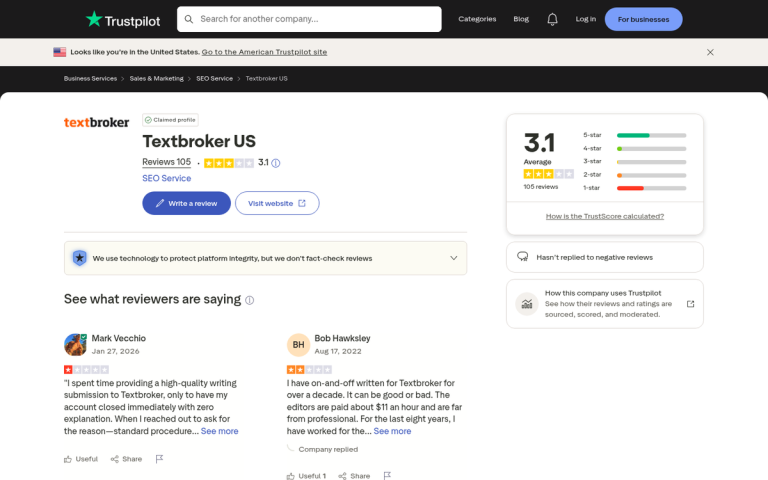
Having used Textbroker, I can tell you one thing: the content is not great at the lower tiers. At the 4-star level you'll see mediocre content. Many clients layer in thousands of words of instructions to try to make the content viable, and even then the results can disappoint. There are legitimate writers working at the 4-star level, but you have no control over whether they pick up your assignments - you have to get lucky or send them direct orders.
Textbroker also has a managed service where account reps edit content and guarantee a higher level of quality. However, this requires a minimum budget that puts it out of reach for most individual bloggers.
If you don't like the content you receive, you are allotted one free revision, which the writer is free to accept or drop. If they drop the order, you start over in the open or team pool. You can't reject a post until after that first revision. Additional revisions are possible as long as the writer agrees. But writers will drop articles at the revision stage to avoid the risk of rejection, which hurts their standing on the site. If you don't cancel, reject, or request a revision within 72 hours of submission, you automatically accept the content and the writer is paid.
All things considered, Textbroker is best approached as a last resort or a high-volume, low-stakes content operation. The quality is simply too inconsistent. If you find a strong writer and lock them in for direct orders, you can get decent content at a reasonable price - but that takes time and luck to achieve. For a deeper look at how Textbroker content can affect your SEO, it's worth understanding the risks before committing to the platform. You may also want to explore more affordable content writing alternatives that offer better consistency.
iWriter
iWriter has been around since 2011 and operates similarly to Textbroker. You post content to a pool and writers can pick it up, at varying quality tiers and price points. Their tier structure uses four levels: Standard, Premium, Elite, and Elite Plus.
Pricing has evolved over the years. Currently, a basic 1,000-word blog post at the Premium level costs $20. But the same post at Elite Plus runs $80. iWriter has also introduced an AI-assisted option - content generated by AI and edited by a human - at approximately $0.01 per word, which aligns with the wider industry shift toward hybrid AI-human workflows. For bigger projects, bulk eBook pricing starts at $160 for 7,000 words at the 2-star level.
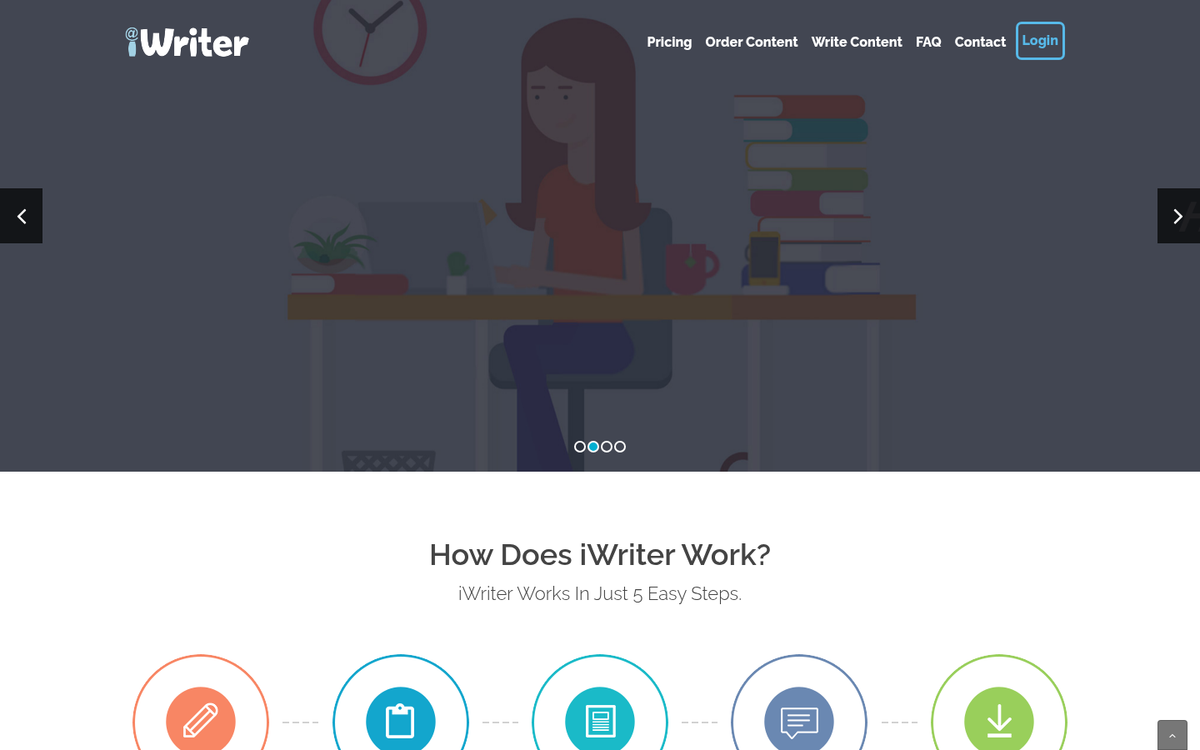
As for content quality, you largely get what you pay for. iWriter and Textbroker share overlap in their writer pools. Writers at these pay levels need volume to earn actual income. That volume-first mindset means less attention to detail and research. iWriter has also historically had problems with rating manipulation, which means a 3-star writer might not have legitimately earned that designation.
The best content you can realistically expect from iWriter is serviceable but unremarkable blog content, and you'll need to pay for the Elite Plus tier to reliably reach even that bar. At that price point, you're not far off from hiring a vetted freelancer directly - which is usually a better investment.
Contently
Contently is not a content mill in the same sense as the other two - it's a content marketing platform and CRM designed for business-level clients - think Consumer's Digest, Buzzfeed, Esquire, and Investopedia. If you're a solo blogger on a tight budget, Contently is almost certainly not the right fit. But it's worth understanding what best-in-class content operations look like.
Contently goes far beyond text. They work with photographers, videographers, writers, journalists, and graphic artists.

Pricing is negotiated directly with their sales team and varies based on scope. That said, published reports suggest clients pay anywhere from $200-$300 per blog post at the lower end, $600 or more for premium pieces, and some engagements reach $2 per word - making a 1,000-word post quite expensive. In return, you're getting professional-grade writing, editorial oversight, graphic design, and research and strategy support built in.
For most small to mid-sized bloggers, Contently represents an aspirational benchmark rather than a practical option. But understanding what that level of investment produces helps you calibrate expectations at every tier below it.
Navigating Content Mills in the AI Era
There are real dangers to relying on platforms like Textbroker and iWriter for your blog in 2026. They're inexpensive and they save you time. But they are not known for producing quality content - and quality content matters more than ever now that search engines have grown increasingly refined at detecting thin, generic writing.
It's also worth mentioning that many of the writers on these platforms are now competing with - or supplementing their output with - AI tools themselves. That can mean you're paying human-tier prices for content that was largely AI-generated with minimal editing, which defeats the purpose.
Here are the most important tips if you do use content mills:
Be picky. Don't accept mediocre work just because it meets the technical requirements. Your blog's reputation can depend on quality, and search algorithms increasingly reward genuine expertise and depth.

Plan ahead. Build a content buffer of at least six to eight weeks - it can take multiple revision cycles to get a publishable post out of an open-pool assignment, and you don't want to be scrambling with nothing to post.
Work with the highest tier writer you can afford. On Textbroker, building a team with an entry-requirement assignment and a pay rate above the base floor will filter out low-quality writers and draw those with genuine skill. On iWriter, don't go below Elite if you care about quality.
Keep assignments focused but not hyper-specific. Too narrow a topic drives away writers who don't want to do deep research. Too broad and you'll receive generic, surface-level content. Strike a balance, and avoid dumping lengthy external style guides into your brief - most writers won't read them.
Consider a hybrid strategy. Many bloggers in 2026 use AI tools to generate a strong first draft, then hire a skilled editor or subject matter expert to polish and fact-check it - this produces better results than a content mill at a comparable or lower cost.
Ultimately, the best strategy is to treat content mills as a temporary scaffold - not a permanent foundation. The better your content, the more you'll attract visitors and inbound links, and the faster your site will grow. When your budget allows, investing in higher-quality writing - whether through Contently, a vetted freelance marketplace, or a strong in-house process - will pay dividends that cheap content simply can't match.


1 response
Thoughtful replies only - we moderate for spam, AI slop, and off-topic rants.
Exactly what I needed to know, thanks James! Contently seems a bit out of my budget so it seems Textbroker 4-5 star articles are my best option until I can afford better.