Key Takeaways
- Almost every top Google result uses a custom domain; skipping one handicaps SEO, credibility, and long-term growth potential.
- Subdomains build authority for the host platform, not your brand; all earned link equity benefits WordPress.com or Blogger instead.
- Custom domains improve ad program approval odds, enable professional email addresses, and provide full backend control including SSL.
- Migrating from a subdomain later risks weeks of ranking drops; starting with a custom domain eliminates this risk entirely.
- At roughly $15 per year, a custom domain is one of the lowest cost-to-benefit investments available to bloggers.
Let me answer your question with a question. You ask if or not you need a custom domain to be successful as a blogger. To this I respond: search for any keyword you want. I'll wait.
Got one? Alright, tell me. How many of the results on the first TWO pages of Google - it's the top ~20 results - use a non-custom domain? Let's look at a few examples.
- Query "Gaming". I've got Reddit, YouTube, Wikipedia, Engadget, Mashable, PC Gamer, the Verge, Amazon, IGN, TED, Gizmodo, and some local results.
- Query "Red Widgets". I've got various web development resources, Apple, GitHub, some Google Books results, and some random coding sites.
- Query "best faucets for a kitchen". I've got Consumer Reports, This Old House, Bob Vila, Amazon, Pinterest, and a handful of home improvement blogs with custom domains.
- Query "Plumber in Denver". I've got Angi, Yelp, HomeAdvisor, the Better Business Bureau, and a bunch of individual plumber websites.
- Query "blogs". I've got Wikipedia, Forbes, HubSpot, WordPress itself, the New York Times, the Guardian, the Financial Times, and Seth Godin's Blog.
Almost every result uses a custom domain. The rare exception you'll find is already famous enough that their personal brand carries the weight - like Seth Godin, who famously never bothered with a custom domain for years on his Typepad blog. But even that example is becoming increasingly rare as the web matures.
Granted, this isn't a scientific experiment. There are plenty of decent blogs on blogging platforms that don't use custom domains. Many of them belong to people who were already famous before they started blogging. If you're already a TV star, bestselling author, or prominent CEO, you can probably get away with a WordPress.com or Blogger subdomain and still draw an audience.
But if you're trying to build a business, grow an audience from scratch, or set yourself up as an authority, skipping a custom domain is a handicap. You can use free platforms as your hosting infrastructure if you want - but you should use a custom domain.
Think about it like a physical address. Imagine if your retail location were to put the name of the landlord who owns the building into their brand name; it's basically what you're doing - advertising the name of your host right up there next to your brand name.
The Many Benefits of Custom Domains
There are a number of possible benefits to having your own custom domain, whether you're on shared hosting or not. Let's talk about them.
Branding. With a custom domain name, you get the branding power that comes with owning your identity online. If you're a WordPress, Blogger, or similar account with a subdomain, everyone who sees your URL immediately knows you're on a free platform. Research has proven this too: 46% of small businesses say a custom domain increases credibility, and mobile users are twice as likely to trust sites with a branded domain versus a generic subdomain.
There are a number of benefits to this branding. First and foremost is the ability to keep your brand if you transition to a new platform or architecture. Say you've built MySite.wordpress.com for two years but decided you've outgrown WordPress and want to move to your own self-hosted setup. You check, just to find that MySite.com is already taken, and the .net, .org, and .biz variations too.
If you have a top-level domain from the start, you can do whatever you want on the back end with little or no change to what your users experience or what Google sees.
Migrating a domain is a messy process that can tank your rankings for weeks or months before they stabilize - it takes time for Google to figure out that MySite.wordpress.com and MySite.com are the same site and not duplicates. Even with 301 redirects in place, you still lose some ranking up front - the backlinks pointing at your old subdomain won't automatically update. Starting with a custom domain removes this risk entirely.
It's also far easier to include a custom domain in marketing materials. Imagine asking someone to remember a full WordPress.com URL after hearing it on a podcast or radio ad. How many listeners would leave off the "wordpress" part and just type the word dot com? You'd be surprised how often that happens.
The ability to build domain authority. Domain authority is a measure of credibility and trust that accumulates over time through quality content and backlinks. When you're on a subdomain, you don't actually build authority for your own brand - you're building it for the main domain. All of the link equity you earn on MySite.wordpress.com is ultimately benefiting WordPress.com - not you.
Better opportunities for approval in ad programs. Ad programs like Google AdSense are notoriously selective. According to ZNetLive, AdSense approves only about 3 out of every 1,000 applications received each day. Subdomain blogs have an even steeper climb, largely because of the long history of abusing free blogging platforms to spin up thin-content spam sites or stolen-content blogs just to generate short-term ad revenue before getting banned. That history casts a shadow on legitimate blogs using the same platforms.
That's not to say it's impossible to get into an ad program with a subdomain blog - it's just likely to trigger a harsher evaluation - it's a strike against you before you even start.
Not sharing space with spam sites. Google is usually careful enough to review sites individually instead of penalizing you simply for being on shared hosting. But subdomains are a slightly different story. If a blogging platform has thousands of low-quality or spammy subdomains, being one more subdomain on that platform puts you in questionable company at the domain level - it's one more possible issue stacking up alongside others.
Ability to create custom email addresses. Professional email communication matters more than ever. Nobody wants to reach out to a business and receive a reply from a gmail.com or yahoo.com address. While Gmail has become the default for small businesses, a custom domain email address signals a higher level of legitimacy, and it's also harder to spoof or phish - an increasingly important consideration as email-based attacks grow more refined.
Control on the back end. When you own your domain, you control everything - plugins, file structure, redirects, integrations, and more. You can also implement SSL, which you can't do on a shared subdomain. SSL has been a confirmed Google ranking signal for years now, and beyond SEO, it's basically table stakes for any site users are expected to trust with their data or contact information.
Subdirectories outperform subdomains for SEO. Even among custom domain owners, where you put your blog matters. Real-world data makes this clear: PinkCakeBox reported a 40% improvement in organic traffic after moving their blog from a subdomain to a subdirectory. But HotPads saw a 47% drop in organic traffic after moving their blog in the opposite direction, from a subdirectory to a subdomain.
Of course, there are always a few drawbacks. The main one with owning a custom domain is basically that you have to pay for it - though at roughly $15 a year, it's about as low a barrier as you'll find anywhere in business. Many registrars will give you promotional deals for new customers, and setting up auto-renewal guarantees that you never accidentally lose a domain you've spent years building authority on.
Picking a Good Domain Name
The other challenge of owning a domain instead of a free subdomain is that you have to actually choose that domain name. It can be harder than it sounds.
First, you almost always want a .com domain. Over 90% of successful startups valued at $100M or more launched with a .com domain. That said, there are legitimate exceptions: nonprofits can make strong use of .org, and newer extensions like .io have gained genuine traction in tech circles. Novelty domains can work as redirects or for campaigns. But as a primary domain, .com remains the gold standard for trust and memorability.
Second, stay away from exact match keyword domains. Unless your business is literally named Best Kentucky Faucets, don't register bestkentuckyfaucets.com. Exact match domains were once a shortcut to rankings. But Google cracked down on that strategy years ago after it was routinely abused by low-quality sites. Today they tend to look spammy instead of authoritative.
Third, choose something short and brandable. You don't necessarily need your niche spelled out in the domain name - ShoutMeLoud built a big marketing and SEO publication without the name saying anything obvious about the topic. That said, names like Search Engine Journal or SEMrush communicate purpose clearly. Even Moz started out as SEOMoz before rebranding to something simpler. The right answer can depend on your brand strategy. But shorter is usually better.

Also watch for how words combine when there are no spaces. Pen Island is a perfectly reasonable name for a pen store - but penisland.com tells a very different story. The infamous #SusanAlbumParty hashtag is another classic example of why you should read the whole string before committing to it.
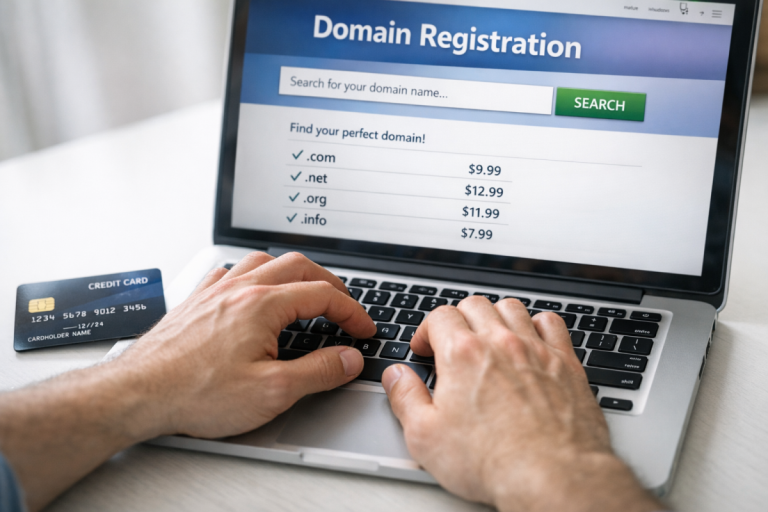
Finally, confirm the domain is actually available before getting attached to it. Many businesses register variations of their brand name, common misspellings, and acronyms proactively to avoid phishing attacks or domain squatting. Just because no website appears at a URL doesn't mean the domain is free - always verify availability through a registrar before planning around a name.
So while you technically can run a blog without a custom domain, all you're doing is saving roughly $15 a year while handicapping your SEO, your credibility, your ad revenue potential, and your long-term flexibility - it's one of the lowest cost-to-benefit investments you can make. I wouldn't skip it.