





Key Takeaways
- Running a blog on a separate domain is rarely beneficial; almost all websites should integrate their blog on the same domain.
- Real-world data consistently shows subfolder blogs (example.com/blog/) outperform subdomains in organic search rankings despite Google claiming equal treatment.
- An integrated blog boosts SEO by earning backlinks, adding indexed content, signaling freshness, and consolidating all ranking value onto one domain.
- A separate blog domain risks Google treating it as an unrelated site, potentially voiding any SEO link value passed between the two.
- A separate blog only makes sense for personal branding or casual content clearly distinct from an official business presence.
There are two different ways you could run a blog for your website. One of them is running it on your website, which is what most do. In this instance, it can either be a subdomain or a subfolder. That is, www.blog.example.com or www.example.com/blog/.
The other option is to run it separately from your standard website. You may have your main homepage and your web store on www.example.com and you'd have your blog on www.exampleblog.com.
Should you ever use the second strategy? It's very rare to see on the web today, which seems to show that it's not a good idea. Of course, there's plenty of bad ideas performed by thousands of people every day, so which is it?
Is There a Reason to Separate Domains?
In short: no. There's no reason you would want to put your blog on a different domain. There are only a few reasons I can think of, in a hypothetical scenario.
This scenario would be where you're using a free website builder for your main site, something like Wix or Squarespace, except one that's limited to just an ecommerce platform with no ability to run a blog and no ability to integrate a blogging platform. This is rare; blogs are the default mode of website building today, and it's usually the ecommerce platform that comes in as an extra that may or may not be supported.
In this rare instance, you might run a blog on a separate domain. You may have example.com as your main site and example.wordpress.com as your blog - it will be legitimate. But it doesn't bring you much benefit. The only way it will improve your marketing is if you didn't have a blog at all before; you can use it to start building some of the value you get from a blog normally.
Another possible reason would be for localization purposes. If you were running a site that sells to the USA, the UK, and Australia, you might create three versions of your shop site and one main blog. The main blog would have its own domain, and you could have other domains for localized sites, like a.com, .co.uk, and .au. However, it's usually better to use other methods for localization, like subdomains or subfolders.
The Non-Business Perspective
If you're not running a business, you might want a separate blog. Likewise, if you're running a few businesses, you might want a separate blog. A personal brand might have its own domain very separately from any connected businesses, just to give you an example.
Of course, the thing to note here is that each of the businesses usually has their own blog as well.

If you want a personal blog, or a blog where you take a casual tone that isn't a good choice for your business, you can do that on a separate blog. That blog can say that you're connected with the business you own or work for. But it isn't an official representation of that brand.
A separate blog on a separate domain helps you build personal authority and recognition, and it gives you more flexibility to blog about topics that wouldn't normally be covered by a business blog. You can make it more personal, you can talk about your personal life, and you don't necessarily have to care too much about SEO.
Subdomain vs. Subfolder: Does It Matter?
Before getting into the wider benefits of an integrated blog, it's worth tackling the subdomain versus subfolder debate. It comes up often and the evidence has become clearer over time.
Google's John Mueller has stated that Google treats subdomains and subdirectories equally, with neither receiving a default ranking improvement over the other. In theory, there should be no difference. In practice, the real-world data tends to show something different.
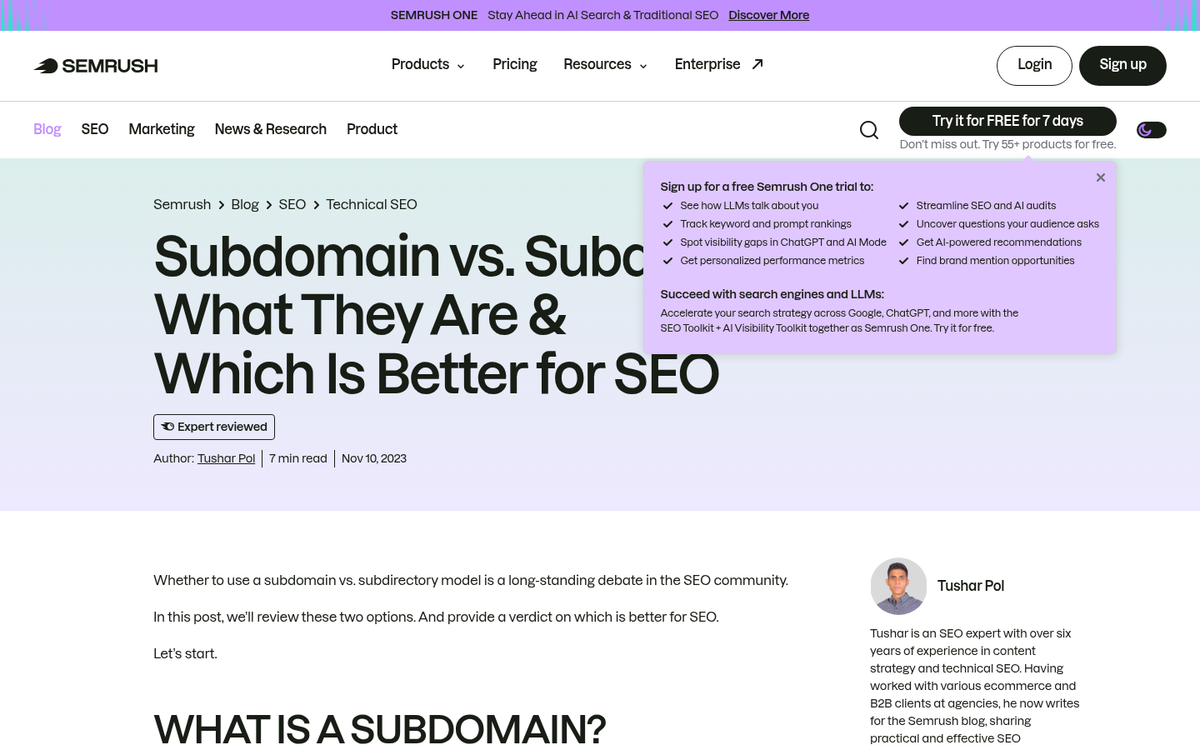
Several well-documented case studies point in the same direction. PinkCakeBox reported a 40% increase in organic traffic after moving their blog to a subdirectory. Salesforce moved their blog from a subdomain to a subdirectory and saw organic traffic double almost overnight. Conversely, IWantMyName moved their blog from a subdirectory to a subdomain back in 2014 and experienced a 47% decrease in organic traffic. A large-scale analysis by GA Agency and SE Ranking, covering over 20,000 keywords across 15 markets, found that subdirectories account for over 20% of top-3 ranking positions globally.
So while Google's official stance is that both are treated equally, the weight of real-world evidence suggests that subfolder blogs tend to perform better in practice. If you're starting from scratch or thinking about a migration, a subfolder setup like www.example.com/blog/ is usually the safer choice.
Advantages of an Integrated Blog
That said, there are far too many reasons to integrate your blog with the same domain as your main storefront, homepage, or site.
A blog helps customers get to know your brand. This works best when the blog is part of your main brand's site. Otherwise there's no way a casual user can find out whether or not the blog is official. People have created fan blogs for businesses they liked and labeled them "the OFFICIAL brand blog" when they were never actually official. There's possible uncertainty you can stay away from just by keeping the blog on your main domain.
A blog on the same domain is easier to access. Users won't be confused as to why a link is taking them to a different domain, and they won't be worried about being hijacked or misdirected. They will be more likely to guess the blog URL if they aren't sure how to get to it.
A blog on the same domain eases suspicion of phishing. One common way of hacking is to get users to a site that looks like yours but secretly steals their information when they try to add it. A blog on a separate domain can teach your users to trust other domains blindly, which makes life easier for phishers - it just makes security that much harder.
A blog is a great way to earn backlinks, which benefit your whole domain. Blogs are helpful link magnets. Every piece of content is a chance for dozens or hundreds of sites to link to you. If the content is bad it might not get any links. But if the content is great, evergreen, and helpful as a source, it might draw in links for years to come. Content that's a few years old can still earn links if it covers a topic well enough.
Google ranks sites higher when they have more content. Larger sites with more content get more SEO value. Every post is something Google indexes. Every post is an opportunity for your site to rank for a keyword. Every post is a new topic and new set of keywords to target. At the same time, the backlinks mentioned above have an effect as well. More backlinks means more SEO value. More pages means more backlinks - it all builds upon itself, and the more content you have, the better off your site will be.

Google ranks sites higher when they have fresh content. Google has been using freshness as a ranking factor for quite some time. Freshness is an interesting metric because it's only relevant for some types of queries - it's a tough system. For example, a query about a recent news event or breaking development should surface fresh results. But a query about a favorite, evergreen topic might not need them at all. Keeping a blog active and updated tells Google that your site is alive and current.
A blog lets you become a thought leader. Blogs have value beyond posting content. High quality content positions you as a thought leader. You become a go-to source when people want an opinion on a trending topic. As time passes, your reputation grows, and more and more people come to trust you and the things you say. That can open up opportunities everywhere from guest posting to speaking gigs to new clients.
It's easier to get from blog to shop when they don't have to leave the site. There's only one instance where you can get someone to go from one site to another and still be interested in buying a product, and that's when you're talking about a very trusted site like Amazon - it's why affiliate marketing has these low conversion rates and it's so dependent on volume, compared to traditional marketing where you're selling products.
You don't have to manage multiple domain names and websites. This one is purely from a mechanical and cost standpoint. One domain doesn't cost much money, usually, though some high profile domains can fetch astonishing prices. At the same time, you might need more than one set of hosting, and you're maintaining more than one site. There are ways to work around this. But you're still working around something instead of just operating with best practices.
Separate Blogs and Link Schemes
There's one giant reason why you might want to stay away from a separate domain for your blog, and that's because of Google's rules on link programs and exploitative link building.
Whenever you link from one website to another, that link passes PageRank, which is the link juice that helps Google choose the search ranking of a site. A site with many links will have PageRank flowing in from a number of sources, which makes it rank higher and be more resilient to losing a few links.
One of the common ways to game the search results, years ago, was to use link programs with networks of blogs. All of these blogs would appear as if they were stand-alone sites on their own domains, and they would link to your "money site," which is the site you actually wanted to use to make money.
Pop quiz: what's the difference between that setup and the concept of running a shop site and a blog on a different domain?
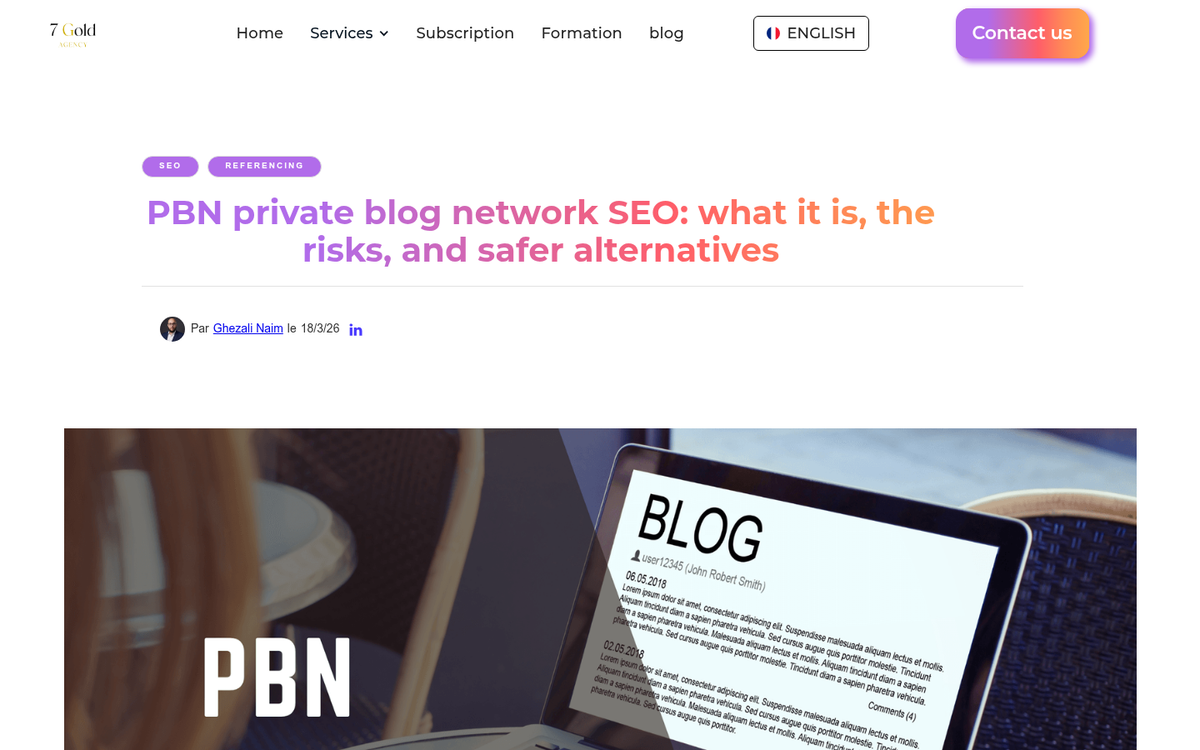
There are two differences that may help, and might not. One is that you're maintaining steady branding and association between them. One hallmark of link programs is hiding your association with the blogs. The idea is that if Google doesn't know you set them up, they look more like legitimate backlinks, and so pass value. If Google does know you set them up, they look spammy, and Google doesn't let them help you at all.
However, with steady branding, Google might determine that the two domains are part of the same site and will allow value to pass between them. Or they might not. You have no way of knowing which path Google will take; only that it's more likely than not that you're going to have trouble passing value from your blog to your site.
The other difference is that you only have one blog, instead of a network of them - again, another sign that your blog and your main site are connected instead of separate entities. However, what you end up with is still two different domains, and Google considers different sites to be sites with different domains.
The fact is, if you're running a blog on a separate domain, it's not going to count as part of your main site. Rather, it's a bit more likely to be considered a separate site - even if it's owned by the same person and has the same branding. Links might or might not pass value. But if they don't, you're in for a hard time while you try to grow two sites with half the value of each, when you could just be growing one.
So at the end of the day, when all is said and done, there are so many benefits to having a blog on your primary domain that to run it on a separate domain is a waste. You waste time and effort basically growing two sites instead of one, with half the power of each of them. When possible, keep your blog on the same domain, ideally in a subfolder, and don't try to reinvent the wheel.


3 responses
Thoughtful replies only - we moderate for spam, AI slop, and off-topic rants.
Very helpful... I've been having this dilema lately for building a blog for my ecommerce site... you showed good reasons to keep it in the same domain. Thanks!
This was super helpful article for me. Do you have any tips on how to best move a blog that has existed on a separate domain for 4 years to a business' main website most effectively for SEO benefits.
Hi Nora! As long as you properly redirect the old links to the new ones, you shouldn't have any issues at all. Redirecting 100% of your old links to the new location on your old site is crucial. Make sure you keep the old site active as well so that those redirects stay in place. If you let the old domain expire / die off, those redirects will stop working and you will see a drop in traffic, rankings, and website authority.