





Key Takeaways
- Textbroker is not a scam, but many negative reviews stem from misunderstandings about contracts, tax requirements, and copyright transfer.
- AI writing tools have drastically reduced Textbroker's client base and available writer assignments, severely undermining its core value proposition.
- Writer pay is poor across all star levels, with Textbroker taking a substantial cut and low-star ratings offering near-unlivable income.
- The star rating system is unstable, based only on five most recent reviewed posts, making it punishing and unreliable for writers.
- In 2026, Textbroker is largely obsolete: AI is cheaper for bulk content, and vetted freelancers are better for quality work.
Textbroker was once the prototypical content mill marketplace, and for a long time it served as a hub for middling and low-quality content at cheap prices. It had flaws, and it only survived because its rates allowed it to collect bulk clients for extremely basic content which was, at best, passable. However, the community has changed dramatically since the widespread adoption of AI writing tools - and Textbroker's relevance has declined sharply as a result. Having experienced it from the writer and the client side, I can tell you quite a bit about where it stands.
Online Reviews
There are still plenty of reviews out there for Textbroker.com, and most of them are negative. Some of the complaints are legitimate. But a fair number are still rooted in the same old misunderstandings that have always plagued reviews of content mill places.
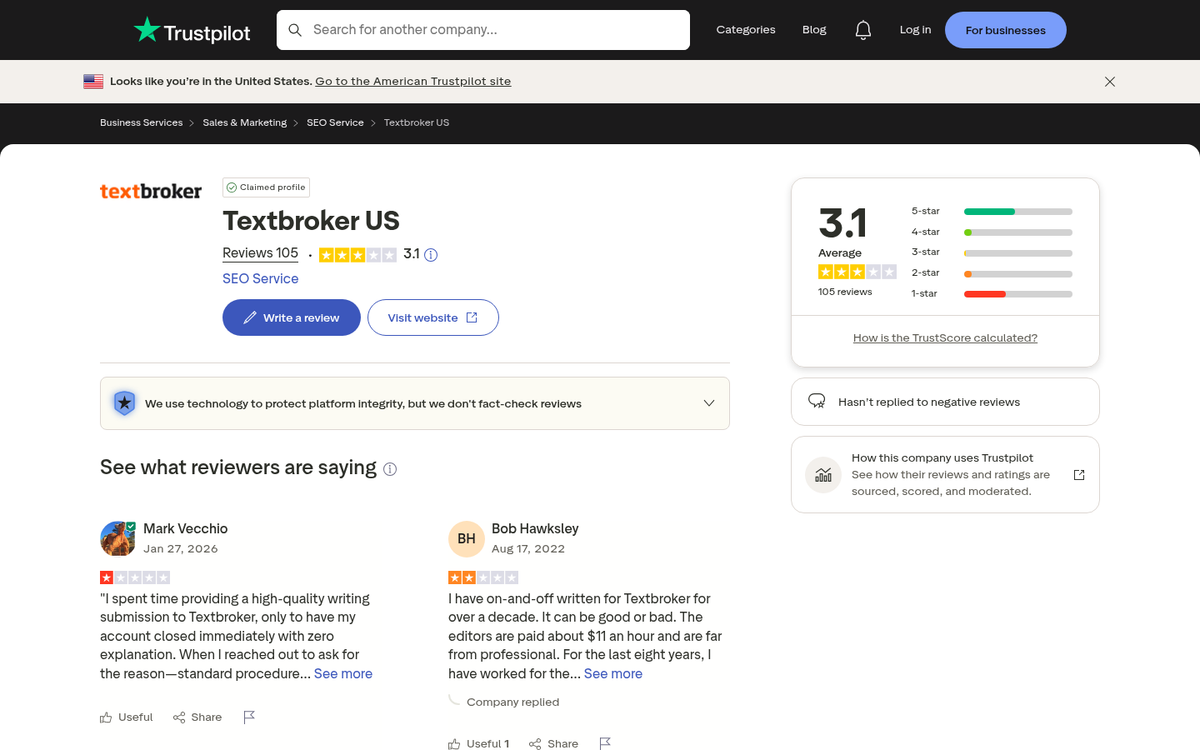
The misinformation comes from people who don't read contracts and don't know what they're getting into. There are some legitimate complaints in these reviews, which I'll get to in a bit. But I'd like to correct some of the recurring inaccuracies.
- The freelance writing platform is not a scam. Writers can pick up assignments, write them, submit them, and get paid. These sites take a cut, yes, but every middleman platform in every industry does that. Textbroker's pay rates are poor, but that's not a scam - it's just a business catering to the lower end of the content market.
- Several complaints relate to the initial review period. New writers write five articles, at which point their account is locked until editors review those articles to assign an initial star rating. Textbroker states this clearly. Anyone claiming they weren't warned simply didn't read the onboarding information.
- Complaints about submitting a photo ID and a W-9 are unfounded. They are a business paying you money. They need your tax information to comply with IRS requirements. This is standard practice across every legitimate freelance platform.
- Some reviewers misunderstand how assignment distribution works. Orders go into a pool - public, team-based, or direct - and writers pick them up based on their star rating. Assignments are not arbitrarily assigned to random writers.
- The copyright confusion persists. Writers producing content through Textbroker are selling the rights to that content to clients, not licensing it. They cannot republish it elsewhere because they no longer own it. This is standard ghostwriting practice and not unique to Textbroker.
Textbroker isn't a very good platform, and the work shown by some of its writers is usually not great, so there's plenty of valid complaints you can make. You don't need to manufacture inaccuracies - the problems speak for themselves.
How Textbroker Works
In order to know the legitimate problems with Textbroker, you first need to know how the site works.
From a client perspective, when you sign up for Textbroker, you're asked to deposit funds first. Textbroker holds funds in escrow to prevent clients from taking content without paying. If you don't reject a post within the review window, you're paying for it regardless. You can't take a post and run without repercussions. Some clients have abused the revision process - requesting multiple rounds and then rejecting - but that behavior falls on the client, not the platform.
When you create an assignment, you can include as much or as little input as you want. Writers appreciate a basic amount of direction. But some clients have gone overboard with multi-page Google Doc briefs for 500-word articles. These writers are paid well below market rates and need to work faster to earn anything meaningful. They are not going to spend two hours reading over notes for a $7 post.
You can also specify keywords and keyword density. By default, these are exact match and required for submission. A 400-word assignment with 10 multi-word keywords, each needed two to three times, gives you an impossible task - clients who do this are usually unaware they've made the assignment unwritable within basic quality standards. If you're unsure how many times you should include keywords in your post, it's worth researching before setting requirements.
You have three options for where to post your assignment.
- The open pool ranges from 2-star to 5-star, representing quality tiers and corresponding pay levels. 2-star is cheapest; 5-star is more expensive in comparison but still inexpensive relative to freelance market rates.
- Teams can be created at any time with fixed pay rates. They can be open or closed, allowing you to curate a group of preferred writers or restrict access based on your criteria.
- Direct orders let you send an assignment to a specific writer, who may accept or decline. Writers on direct orders can set their own rates, which can be significantly higher than pool rates.
There are also managed teams, where a Textbroker staff editor manages a team and vets articles before approving them - usually reserved for large bulk clients. The minimum project budget for managed service is $2,500, so smaller clients shouldn't expect this option to be available to them.
Once a writer picks up your assignment, they have a fixed window to write and submit. If you set a word count of 300-400 words, the writer has to hit the minimum but can go above - though most won't, as they aren't paid extra for extra words, and neither are clients charged extra. If you're wondering whether short articles can rank well on Google, the answer depends on more than just word count.

When you receive the submission, you have 96 hours to accept the post or request revisions. You can't reject on the first draft - this is a writer protection that can frustrate clients working against a tight publishing schedule.
Revision windows are short, usually 24 hours. The second draft allows a rejection if you need it. You won't pay for a rejected post. But the writer may blacklist you. Writers also have the option of dropping the assignment instead of completing the revision, which they may do to avoid the risk of a rejection hurting their rating.
If you let the 96-hour window expire without action, the post is automatically accepted and funds are deducted.
From a writer's point of view, the platform remains a tough environment. Writers are assigned a star level upon joining, write five articles to establish their rating, and are then reviewed. Ratings fall between 2 and 4 stars up front - 5 stars requires passing a separate proofreading test.
2-star and 3-star ratings are dead ends. 2-star has almost no work and pays barely anything. 3-star has slightly more work but at rates that make it near-impossible to earn a livable income, and advancement is slow and uncertain. 4-star is where the majority of writers and work are - cheap for clients, marginally tempting for writers who don't have better options elsewhere. Those exploring alternatives like Contently or iWriter may find different trade-offs worth considering.
To reach 5-star, writers have to pass a proofreading test - 10 multiple choice questions with multiple correct answers per question, requiring a score above 80%. It blends AP style with Textbroker's own stylebook, which makes it legitimately tough. Writers can only retake it once every three months.
Writers pick up assignments from the public pool and can join teams as invited or allowed. Direct orders can be accepted or declined freely. One standard frustration is that clients can see writer screen names, but writers only see clients as anonymous numbers. Textbroker actively censors communication to prevent clients and writers from connecting outside the platform - because direct relationships would cut the platform out entirely.
Star ratings are calculated only from a writer's five most recent reviewed posts, and editors review posts in large batches rather than in real time. A writer can produce hundreds of quality posts but still lose their 4-star rating if three of their five most recent reviewed pieces are rated lower - it's an unstable and punishing system.
Legitimate Complaints
There are quite a few problems with Textbroker. A lot. And in 2026, many of them have become worse - not better.

- The average writer quality remains poor. 2-star content is barely readable. 3-star is thin and forgettable. 4-star is inconsistent - occasionally decent, often not. 5-star can be passable, but is still underwhelming relative to what you'd get from a vetted freelancer. The platform's best writers have largely moved on to higher-paying work or pivoted to AI-assisted content production independently.
- AI has completely disrupted Textbroker's value proposition. As of 2025 and into 2026, clients who previously turned to Textbroker for bulk low-cost content can now generate comparable or better output using AI tools at a fraction of the cost. This has significantly reduced the pool of clients on the platform and, as a result, the available work for writers. Many writers have reported a steep drop in available assignments over the past two years.
- Textbroker's editors review every post - eventually - but take a hands-off approach and cannot make minor corrections themselves. They exist primarily as a quality gate and oversight layer, not as collaborators benefiting either writers or clients.
- Those editors are often hired with limited experience and minimal training, yet their decisions have real consequences for writers' livelihoods. There's no meaningful appeals process if an editor makes a wrong call.
- The Textbroker cut is not insignificant. A client paying 4-star rates pays roughly 2.4 cents per word, but the writer only receives around 1.4 cents. At 5-star, a client pays approximately 7.2 cents per word while the writer takes home around 5 cents. The gap is substantial, particularly given how little writers earn overall.
- Rejections are catastrophic for writers. More than one rejection in a short window can result in account termination. This creates a culture of appeasement - writers drop revisions and absorb the time loss rather than risk a rejection on record.
- The aggressive anti-communication policy creates a suppressive atmosphere on both sides. It's a clear signal that the platform knows its model doesn't survive direct client-writer relationships - and that a better deal is almost always available outside the platform.
- With Google's continued evolution of its Helpful Content system and AI-generated content policies, low-quality content mill output carries real SEO risk in 2026. Bulk Textbroker content published without heavy editing is more likely than ever to underperform or actively harm your site's rankings.
So, at the end of the day, here's where things stand. For writers, Textbroker has a few protections around payment. But the pay itself is minimal, available work has dried up because of AI competition, and the platform's structure is punishing instead of supportive - it can be a place for a beginner to get exposure to web writing. But the window for treating it as an actual income source has largely closed.
From the client perspective, Textbroker made marginal sense a decade ago for cheap bulk content. In 2026, it makes very little sense at all. AI tools can produce comparable or better output for basic content at a lower cost, with more control and faster turnaround. If you still want human-written content with quality - for your main site, for brand content, or for anything that needs to rank and convert - you're better served finding a vetted freelancer. Textbroker sits in an uncomfortable middle ground: too expensive for what AI can now do, and too low-quality for anything that actually matters.



1 response
Thoughtful replies only - we moderate for spam, AI slop, and off-topic rants.
Textbroker has changed the rating system. Now, a single article picked at random can determine a writer's star level. This is even more unfair than the previous method. If someone is demoted from 4 to a 3, they could languish there for months until the rating algorithm chooses one of their articles again.
A small correction: a rejection is not "insanely damaging." It is true that many writers toss articles back rather than revising because the requests are often ridiculous or a ploy to get free content.
All messages on the site are now moderated, which makes communicating with client next to impossible, especially on weekends when no one is there to review messages and push them through. The writer's forum is also completely moderated. Replies to threads often take days to show up.
I work mostly with private clients and through Constant Content now. Much better pay, and I'm treated with respect.