Key Takeaways
- Google's John Mueller confirmed word count is not a ranking factor; write as long or short as the topic needs.
- Backlinko's analysis of 11.8 million results found no direct relationship between word count and rankings.
- Google's Helpful Content Update, now core algorithm, rewards genuinely useful content over content engineered for rankings.
- Match content depth to search intent - simple queries need short answers; complex topics may warrant longer coverage.
- AI-generated content padding word counts is likely to hurt rankings; original perspective and expertise are what differentiate content.
For years, the prevailing wisdom in SEO was simple: write more words, rank higher. Long-form content was king, 2,500 words was the magic number, and anything under 1,000 words was basically asking to be ignored by Google. That world no longer exists. If you're still writing to hit a word count target in 2026, you're optimizing for a version of Google that has fundamentally changed.
Let's rewind briefly to understand how we got here, and then dig into what actually matters.
Where the "Longer Is Better" Myth Came From
Before Google Panda launched in February 2011, the web was flooded with thin, low-value content. Content farms churned out hundreds of keyword-stuffed, two-paragraph articles specifically engineered to rank. A site with 500 shallow posts would outrank a site with 10 legitimately helpful ones purely through volume. Google was losing the quality war, and users were suffering for it.
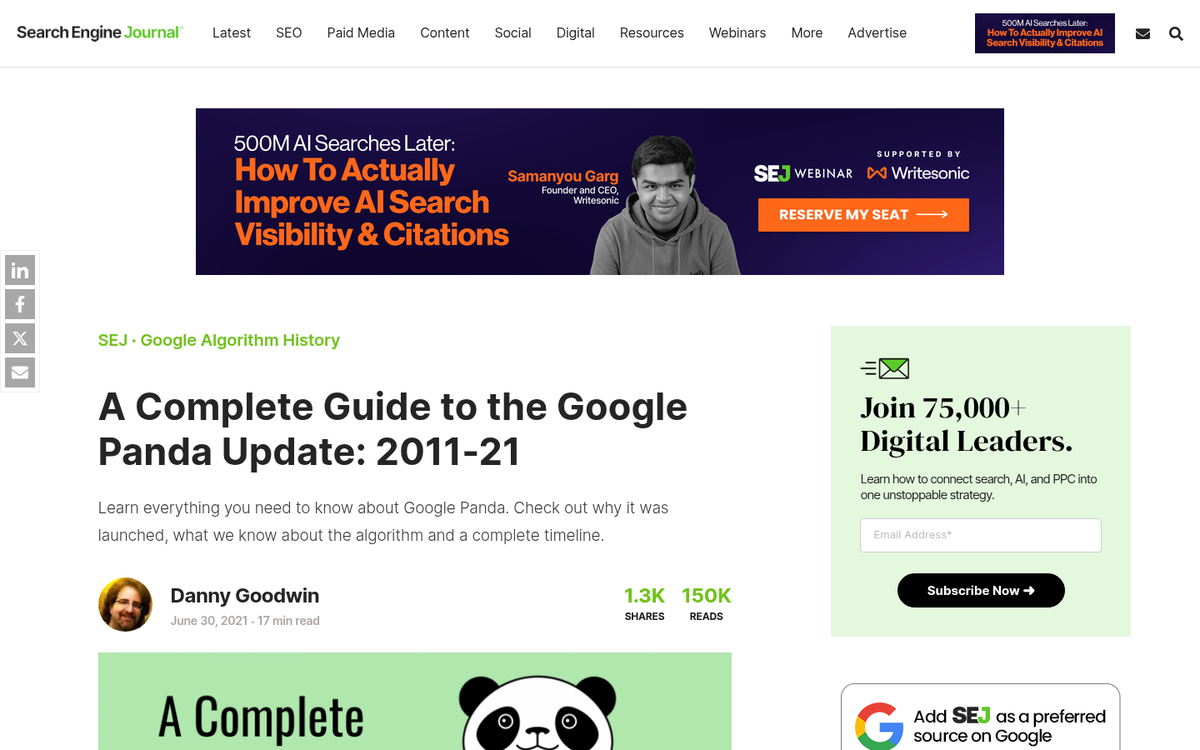
Panda changed everything - it targeted thin content, content farms, and low-quality pages, and it affected roughly 12% of all search results on launch. In the years that followed, it was updated dozens of times before eventually being folded into Google's core algorithm. The message seemed clear: longer content was surviving, shorter content was wiped out.
Naturally, the SEO industry drew what felt like an obvious conclusion: length equals quality. Studies from that era seemed to back it up. SerpIQ data suggested that posts ranking in the top positions averaged around 2,300 to 2,500 words. Correlation was treated as causation, and an entire content industry was built around hitting word count benchmarks.
But those conclusions aged very poorly.
What Google Has Actually Said
Google has been remarkably direct about this, to the point where there's no room for ambiguity anymore.
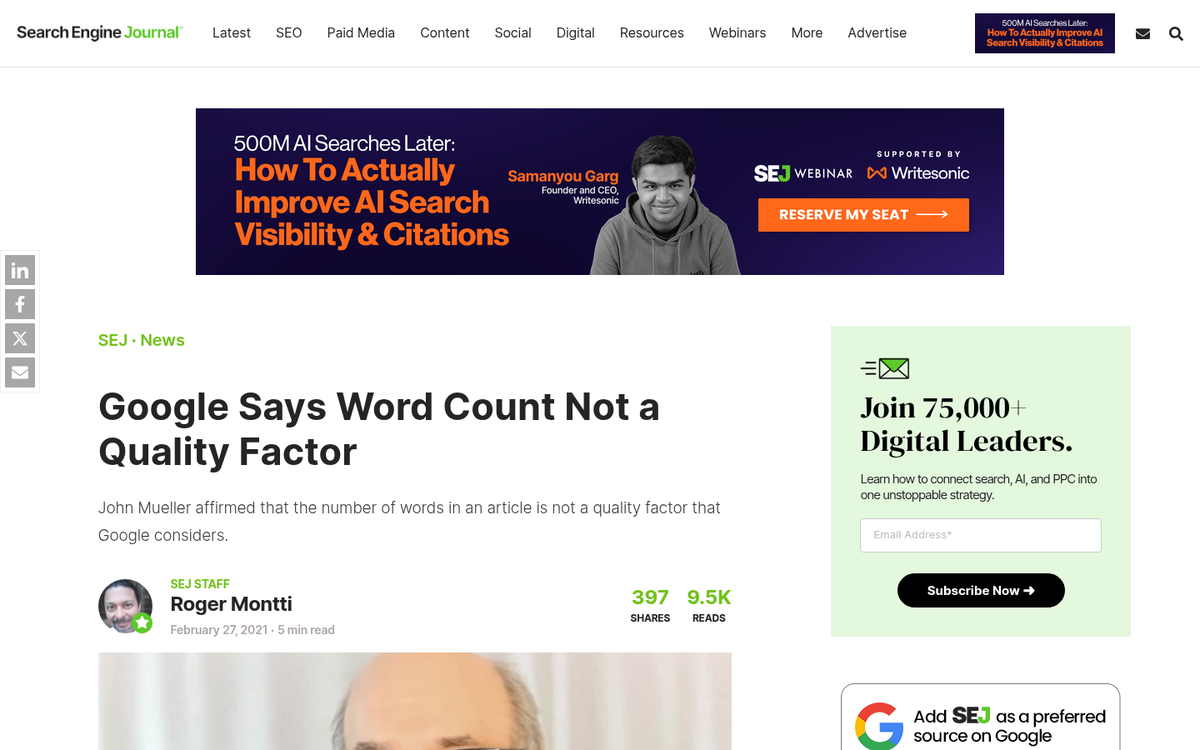
Google's Search Advocate John Mueller stated plainly: "Word count is not a ranking factor. Save yourself the trouble." Google's Search Liaison Danny Sullivan reinforced this in 2023: "The best word count needed to succeed in Google Search is... not a thing. Write as long or short as needed."
Google even removed the section from its official post recommendations page that previously advised that you make sure articles have more than 80 words. The goalpost didn't move. Google took the goalpost away entirely.
In March 2024, Google's Helpful Content Update was integrated directly into its core algorithm - this update formalized what Google had been saying for years: content that legitimately helps users is rewarded, and content engineered to satisfy an algorithm is not. The emphasis shifted decisively from length and keyword density toward demonstrated expertise, usefulness, and relevance to user intent.
What the Data Actually Shows in 2026
The research now available tells a very different story than the studies from the early 2010s.
Backlinko's analysis of 11.8 million Google search results found the average word count of a top 10 result is 1,447 words. But critically, it found no direct relationship between word count and rankings. Short posts with less than 500 words appear at the top of Google results. Long posts with thousands of words routinely sit on page four.

Ahrefs' analysis of over 900 million pages found something even more interesting. There is a positive correlation between word count and backlinks up to around 1,000 words. Beyond that threshold, the correlation actually turns negative. In other words, bloated long-form content does not draw more links just by virtue of being long.
The old playbook has been statistically dismantled.
So What Does Rank Well in 2026?

The things that matter most now are less mechanical and more editorial. They include:
- Genuine usefulness. Does your content actually answer what the searcher is looking for? Google's Helpful Content system is specifically designed to distinguish between content written for people and content written for algorithms. If a user lands on your page and immediately finds what they need, that signal matters far more than whether your article hit 2,000 words.
- Demonstrated expertise. Google's E-E-A-T framework (Experience, Expertise, Authoritativeness, Trustworthiness) has become increasingly central to how quality is evaluated. This is especially true in competitive or sensitive niches. Who wrote it, what qualifies them, and whether the content reflects real-world knowledge all factor in.
- User engagement signals. Click-through rates, bounce rates, time on page, and pogo-sticking behavior all inform how Google perceives the quality of a result. A 400-word post that fully satisfies the query will outperform a 3,000-word post that sends users back to the search results looking for a better answer.
- Content depth relative to intent. This is the nuance that gets overlooked. A search query like "what is a 401k" does not require a 3,000-word essay. A query like "how to build a content strategy for a SaaS startup" might genuinely warrant one. Match the depth to the complexity of the question, not to an arbitrary target.
- AI-assisted content and originality. With the explosion of AI-generated content since 2022 and 2023, the web is now flooded with plausible-sounding but generic text. Google has become increasingly sophisticated at identifying content that lacks original perspective, firsthand experience, or unique insight. If your post reads like it could have been written by anyone about anything, it probably won't stand out.
The Role of AI in Content Creation Today
It would be impossible to talk about content length and quality in 2026 without tackling AI. Tools like ChatGPT, Claude, Gemini, and dozens of purpose-built SEO writing tools have made it trivially easy to produce long-form content at scale. The result has been a massive increase in the volume of content published online, and a corresponding decrease in the average quality of that content.
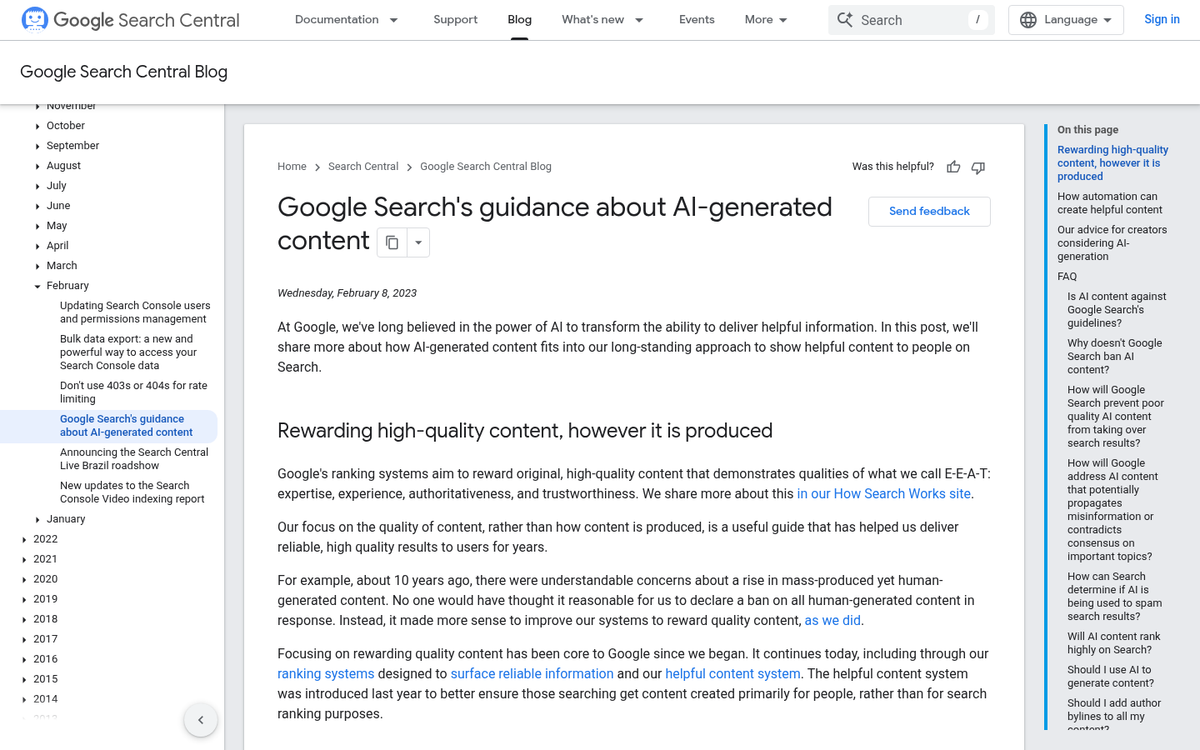
Google has responded. The Helpful Content Update, now baked into the core algorithm, specifically targets what Google calls content that "seems like it was made primarily to rank rather than to help people." AI-generated content that's generic, repetitive, and written to hit word counts is the content this targets.
This does not mean AI tools are off limits - it means using AI to pad word counts or produce boilerplate content at scale is likely to hurt instead of help. AI used to help research, structure thinking, or accelerate drafting while a knowledgeable human adds original information and perspective is a different matter entirely. Content marketing still takes time to work, regardless of how it's produced.
Practical Guidelines for 2026
Given everything above, here is a sensible approach to deciding how long your content should be.
Start with the search intent. What is the person actually trying to accomplish? A simple informational query should have a clear, direct answer. A complex how-to guide needs enough depth to legitimately cover the process. Let the intent determine the length - not the other way around.
Look at what is already ranking. Search your target keyword and review the top results. Not to copy their word counts, but to understand what level of depth the topic requires. If every top result is under 800 words, that's a signal. If they are all long-form guides, that's a signal too.
Ruthlessly cut what does not add value. Fluff is not neutral. Padded introductions, redundant summaries, and sentences that exist purely to increase word count all dilute the quality of your content. A 600-word post that's genuinely substantive will outperform a 2,000-word post padded to length every time.
Add what only you can add. Original data, firsthand experience, a perspective informed by expertise, or a synthesis of ideas that does not exist elsewhere - that is the content that earns links, builds authority, and satisfies the quality signals that Google's algorithm is increasingly adept at detecting.
The goal has never actually changed: give people what they are looking for and do it better than anyone else. What has changed is that Google is now considerably better at determining whether you have done that, and word count has almost nothing to do with it.