





Key Takeaways
- GSA Search Engine Ranker is a black hat link building tool that carries real risk of penalties and deindexing.
- Most GSA reviews are written by affiliates who bury risks and include referral links, making honest information hard to find.
- Google's AI-driven spam detection in 2026 is significantly better at identifying low-quality, spun, and imbalanced link profiles.
- GSA costs a one-time $99 fee with no refund policy, but also requires proxies and CAPTCHA-solving services to function.
- Three usage methods exist: gray hat supplemental use, continuous moderate building with disavowal, and full black hat site abandonment.
Our Honest GSA Search Engine Ranker Review (Updated 2026)
GSA Search Engine Ranker is a piece of software that automates link building for SEO purposes. It's been around for well over a decade now, and while the SEO landscape has changed dramatically since it first gained popularity, it's still being actively sold and used today. Like all gray and black hat applications, there's still a ton of misinformation floating around about it.
I want to say this right up front. GSA is a black hat tool, which means using it carries real risk. It can work - all black hat techniques work to some degree - but it can also be abused and seriously damage your site. This is the core problem with black hat techniques in general. They tend to work for a limited window. After that window closes, your site is likely going to be penalized or deindexed, and you'll be spending time cleaning up damage instead of growing.
This, to me, is the fundamental difference between black hat and white hat tools and techniques. Black hat techniques produce a growth curve that looks like a sine wave - peaks where the technique is working, valleys where it gets caught and penalized. A white hat organic growth curve is a slow, steady incline with some jitters as you experiment. In 2026, with Google's algorithm more sophisticated than ever, that valley after the peak tends to be deeper and harder to recover from than it was even a few years ago.
The Problem of Trust
Why should you trust this review? Why should you trust me? Well, for one thing, I'm not trying to sell you the software. I'm not going to give you a referral link, and I'm not going to sell you a service that uses GSA, like many Fiverr link building gigs still do in 2026.
This is the same problem you'll encounter if you search for GSA reviews today. Many of the highest-ranked reviews are written by affiliates targeting newbie SEOs and marketers. The language is enthusiastic, the risks are buried or omitted entirely, and there's almost always a referral link front and center.
The problem is that this is suspicious language designed to sell a product while minimizing the legitimate risks. You'll notice that almost none of these reviews will tell you about the real risks of using the software, nor will they tell you that Google has become significantly better at identifying and neutralizing the type of links GSA creates. Google's spam detection systems, now powered by more advanced AI-driven algorithms, are considerably more capable in 2026 than they were when most of these glowing reviews were written. Social bookmarking and other older link building tactics have faced similar scrutiny over the years.
There's also a unique irony here. These reviews are all about GSA, a piece of software designed to rank websites. It wouldn't be hard to rank a review site using the very tool being reviewed, and then monetize it through referral commissions. Do you trust it because it's ranking - possibly because of the tool itself - or do you distrust it because it's using misleading language to sell something without giving you the full picture? That's the catch-22 at the heart of why I decided to write an honest review in the first place, and it's just as relevant now as it ever was.
What It Is, What It Does
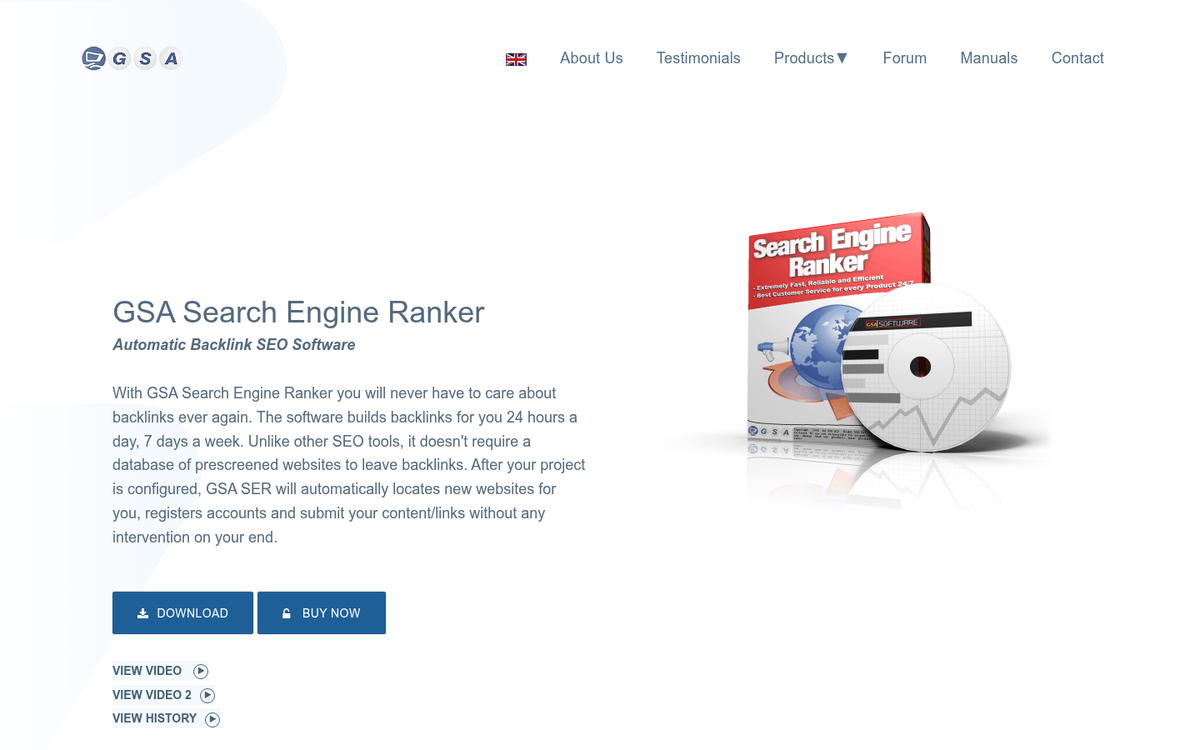
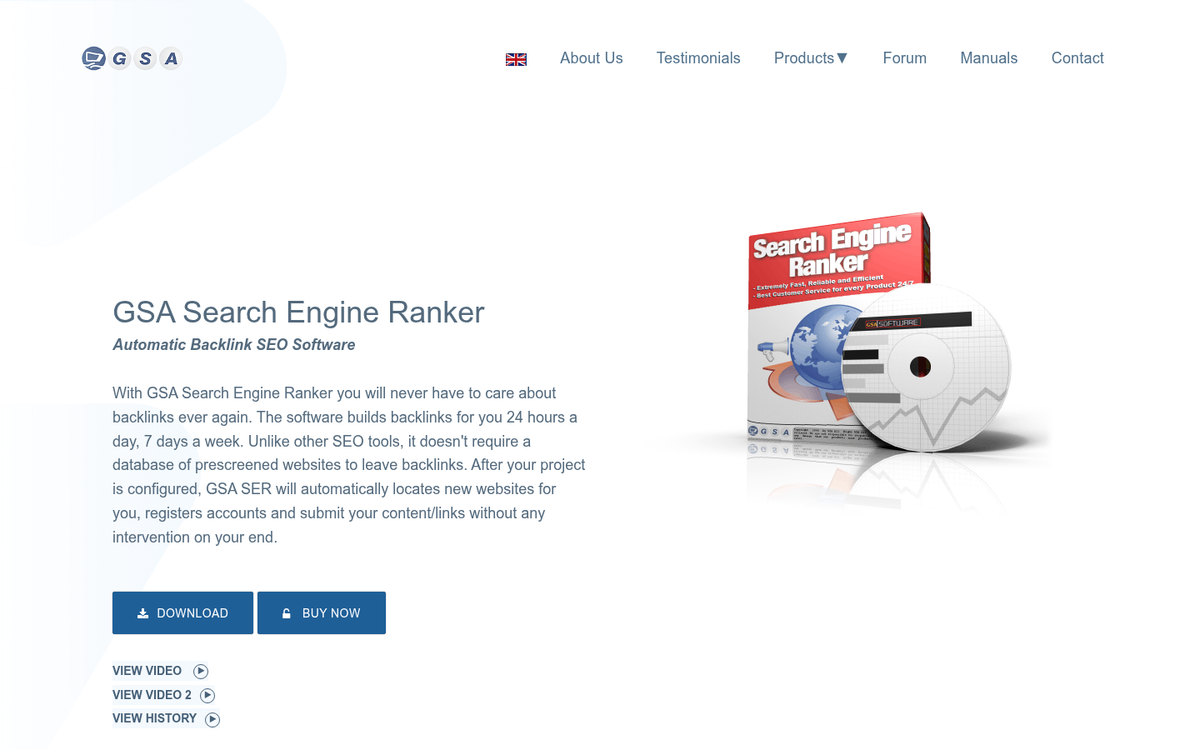
GSA Search Engine Ranker is a link building automation tool. It's designed to help a website rank higher in Google search by building backlinks at scale. It's black hat because of the way it goes about doing that.
GSA is a program that abuses one part of Google's ranking algorithm. Namely, it abuses backlinks. If you're at all familiar with black hat SEO, you already have a sense of where the problems lie.
Google's algorithm determines how relevant a site is to a particular keyword and how valuable the content on a given page is. This calculation is performed for every piece of content across countless potential keywords. Part of that algorithm is a content analysis - Google scans your content for keyword relevance, linguistic authenticity, uniqueness, and signs of manipulation like spinning. It also performs a link analysis, evaluating inbound and outbound links for relevance, context, and quality.
Google also looks at hundreds of other ranking signals - things like user engagement, site authority, brand mentions, Core Web Vitals, and E-E-A-T (Experience, Expertise, Authoritativeness, and Trustworthiness). The algorithm in 2026 is significantly more holistic than it was even five years ago, and that matters a great deal when you're thinking about what GSA actually does.
GSA automates link building by submitting links pointing to your site across a large database of third-party websites. These are categorized by submission method rather than topic - blog comments, article directories, web forums, WordPress pingbacks, RSS feeds, social networks, wikis, and so on. The result is the kind of low-quality links most experienced webmasters know all too well: "great post, very informative!" comments with a random link in the profile section, pingbacks from sites you've never heard of, and forum posts stuffed with spun content.
Many of these links will be nofollowed, but that's not really the point. GSA's play is volume - build enough links fast enough that some of them move the needle before Google catches up.
For submissions that require content, like article directories or forums, GSA relies on an article spinner. You provide a seed article and the software applies synonym swaps and structural changes to produce variations that are technically unique. There are significant problems with spun content in 2026, arguably more than ever. Google's natural language processing has improved dramatically - spun content that might have slipped through in 2015 or even 2020 is now far easier to detect and discount. The arms race between spinning software and Google's detection capabilities has not been kind to the black hat side in recent years.
GSA also includes features that make its spam-oriented nature obvious to anyone paying attention. You can blacklist domains running anti-spam tools like Akismet. You can filter out sites that nofollow their links. You can avoid sites where your links have already been placed. It supports over 30 native integrations with third-party CAPTCHA-solving services, which tells you a great deal about the kind of submissions it's making. It also requires rotating proxies to avoid getting blocked, and includes submission throttling to avoid triggering spam filters. None of this is anything you'd need if you were building links legitimately.
What Isn't Bad
Despite all of the above, GSA has stuck around because it does what it advertises. The pricing is straightforward - it's a one-time fee of $99 with no recurring charges or hidden costs, though it's worth noting there is no refund policy, so be certain before you buy. Unlike a lot of black hat tools that nickel-and-dime you with paid updates, GSA's model is relatively clean on the cost front.
GSA also tracks the links it creates in real time, letting you monitor whether submitted links are live, removed, or no longer passing value. This is genuinely useful if you're running any kind of structured campaign and want to maintain records - particularly for the purpose of later disavowing links if things go sideways.
The Issue of Imbalance
Possibly the biggest problem with GSA is a subtle one: metric imbalance. GSA does one thing - it builds backlinks. And it can build a lot of them very quickly.
The problem is that Google doesn't evaluate backlinks in isolation. Imagine you have 10,000 incoming links, but only a few dozen blog posts, virtually no organic traffic, no real brand presence, and no social engagement. Google's systems - especially in 2026 - are very good at recognizing when a backlink profile is wildly out of proportion with everything else about a site. That kind of imbalance is a red flag, and it increasingly triggers algorithmic and manual penalties.
It's like buying followers on social media. The numbers look impressive until you notice that nobody is actually engaging with the content. Google is essentially doing that same check, and it's gotten very good at it.
GSA spikes one metric in hopes of producing fast rankings. You may see results initially, but the window before detection is shorter now than it used to be, and the penalties when they hit tend to be harsher.
Methods for Using GSA
There are essentially three ways to use GSA. One sits in gray hat territory; the other two are firmly black hat.
Method one is the gray hat approach - combining white hat SEO fundamentals with a very limited, carefully controlled use of GSA. You do everything right for organic growth and use GSA sparingly to supplement it. The idea is that a small number of additional links, built slowly and selectively, blend into what looks like a natural profile. In this context, it functions similarly to paid traffic as a short-term supplement to organic efforts. This is the least risky way to use GSA, though it still carries inherent risk in 2026 given how good Google has become at identifying low-quality link patterns.
Method two is leaving GSA running continuously at a moderate intensity, extracting as much benefit as possible from the links until they start flipping into spam territory and drawing penalties. At that point, you disavow and repeat. This requires keeping a running export of every link GSA creates so you have a clean list ready for Google's disavow tool when the time comes.
Method three is full black hat - build a site, turn GSA on at full blast, ride the rankings spike for as long as it lasts, monetize hard, then abandon the domain when it inevitably gets penalized. This has always been a high-risk, high-effort approach, and the window of profitability has shortened considerably as Google's systems have improved. Many practitioners who used this method regularly five years ago have moved on because the margin for error has shrunk too much to make it consistently worthwhile.
Ultimately, GSA is a legitimate piece of software that does exactly what it claims to do. It builds links at scale and does so efficiently. But the context in which it operates has shifted considerably. Google is smarter, penalties are more severe, and recovery from a damaged backlink profile is time-consuming and uncertain. Whatever method you choose, go in with clear eyes about the risks - because unlike the affiliate reviews out there, I'm not going to pretend they don't exist.
4 responses
Thoughtful replies only - we moderate for spam, AI slop, and off-topic rants.
I really enjoyed reading this useful review..i was going to buy GSA but i'm worried..some told me to build tier 2 and tier 3 with GSA is useful to bring some link juice is it really useful??
is there any software that uses white hat techniques?
I want to learn complete GSA.
Please Help
Hey Jatin! Great that you want to dive deep into GSA Search Engine Ranker - it's a powerful tool with a lot to learn. We'd suggest starting with the basics like setting up your first project, understanding the different platform types, and getting your proxies and captcha solving configured properly. Take it step by step and don't try to learn everything at once. Feel free to ask specific questions along the way!