Key Takeaways
- A real-world test sent 2,585 visitors to a landing page for under $40, recording zero conversions.
- Clicksor's low publisher payouts attract poor-quality publishers, directly hurting audience quality and conversion rates.
- High publisher turnover occurs because many never reach the $50 minimum payout threshold before abandoning the platform.
- Clicksor offers cheaper traffic than Google but has historically faced serious issues including malware-laced ads.
- Experts recommend only small test budgets, careful tracking, and exploring stronger mid-tier alternatives before committing to Clicksor.
What Is Clicksor? An Honest 2026 Review for Advertisers
There comes a time in any young website's life where it turns its gaze outwards and starts looking at the traffic surging around it. When this happens, you start to look for ways to bring in that traffic, to feed the hungry website, and your bank account besides.
One such method is to run contextual ads on other websites. The way it works is simple. You join a network and add your site to the advertisers list. You look for publishers - the people writing content - who work in your industry, or in related industries. You do this via keyword, so you had best know the relevant keywords for your site.
When you find a publisher that fits, you bid on their ad space. You compete against other sites looking to get their ads on that site as well, and the system sets your price at a penny above the next lowest competing bid up to your maximum. Once you've won, your ads go into action. Certain words and phrases in the publisher's content become links that direct users to your site. On paper, it sounds like effortless traffic on a budget.
For contextual advertising, most people immediately think of Google's Display Network. But if you've been paying attention to the title, you'll know we're here to talk about Clicksor - a smaller, older alternative that still quietly operates in 2026.
Why would you use something other than Google? Google's Display Network is enormous, but that size comes with a price - literally. You'll face stiff competition, strict content policies, and the very real possibility of being suspended if Google takes issue with your landing page or niche. Smaller networks like Clicksor can be cheaper and easier to access, even if the volume is nowhere near comparable.
What Is Clicksor, Exactly?
Clicksor was founded in 2004 and is headquartered in Toronto, Canada. It claims to serve 3 million ads per hour across a network of 150,000 publishers. Those are big numbers on paper, but as we'll get into, the quality behind those numbers is a different story.
The platform offers two main targeting methods:
Keyword matching - You select words and phrases relevant to your niche. When those words appear in a publisher's content, they become hyperlinks pointing to your site. This is similar to how Google AdSense and Infolinks handle contextual ad placements.
Channel matching - You browse through 18 broad categories and over 200 subcategories to find relevant publisher niches. It's less precise than keyword targeting but can work for broader brand awareness plays.
Advertiser Perks for Clicksor

Advertiser Perks for Clicksor
Clicksor advertises several perks for advertisers on their platform. They emphasize relevancy through updated algorithms, a curated publisher base, and real-time analytics. Unlike Google, which handles such enormous volume that it often relies on data sampling, Clicksor provides complete, unsampled reporting - which is genuinely useful when you're trying to optimize a small campaign.
The biggest draw for advertisers is cost. Traffic through Clicksor tends to be very cheap compared to Google or even mid-tier networks. That sounds appealing, but cheap traffic and good traffic are not the same thing - and that distinction matters enormously when you're measuring conversions.
Clicksor Conversion Rates
Let's be blunt about what the data actually shows.
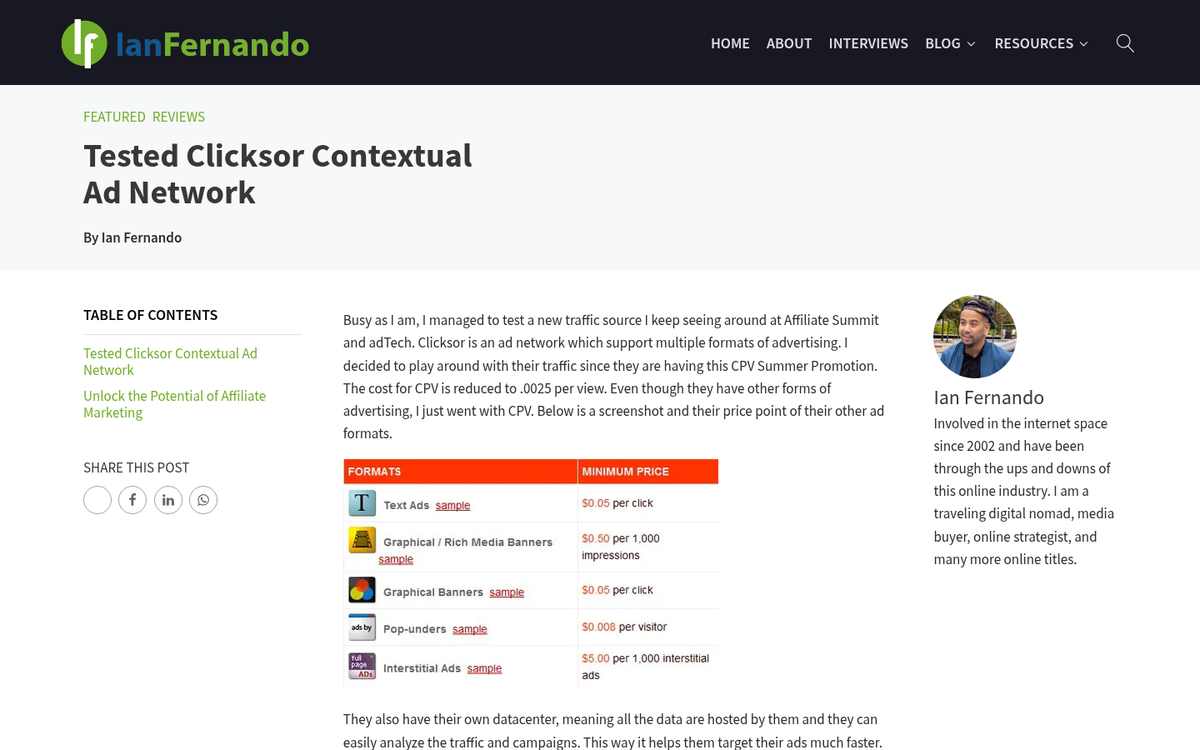
In one documented 3-day test, a marketer sent 2,585 visitors to a landing page and spent less than $40 - recording zero conversions. That's a real-world result, not a fringe case. It lines up with what marketers have consistently reported across forums and blogs for years.
The core problem is that Clicksor's low advertiser payouts make it difficult to attract premium publishers. Without quality publishers, you don't get quality audiences. Without quality audiences, conversions suffer.
Here's how it breaks down by goal:
Affiliate CPM campaigns - Generally not worth it. You'd need view costs to be lower than your payout per thousand impressions, and that gap is hard to maintain consistently.
Lead generation / offer fills - You might get a trickle, but the traffic quality has historically been poor enough that most marketers don't report sustainable results. Buying traffic isn't getting results for many who have tried similar networks.
Direct product sales or affiliate sales - Even harder. You might occasionally pick up a conversion through long-cookie affiliate programs like Amazon Associates, but don't count on it. There are also alternatives to the Amazon Associates affiliate program worth exploring if you're looking for better commission structures.
My advice hasn't changed: run very small tests, no more than a couple of dollars at a time, and measure traffic quality carefully before scaling anything.
Traffic Quality Issues
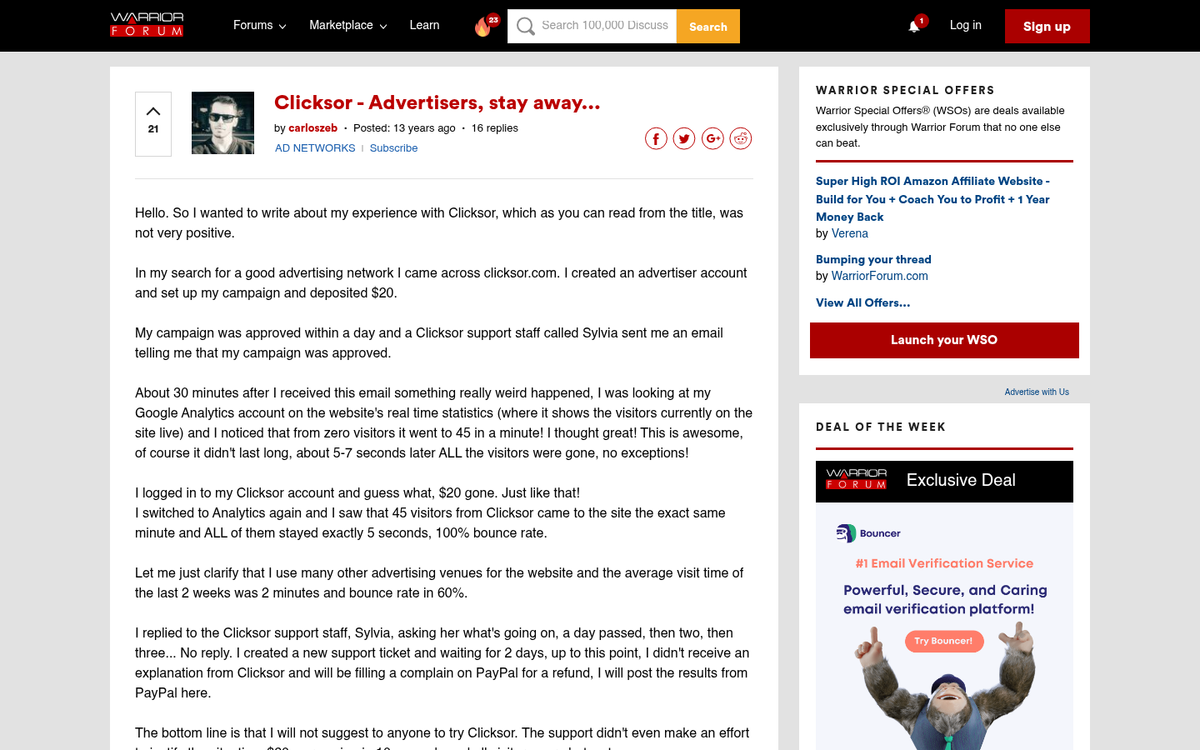
Clicksor has been operating for over two decades now, and in that time it has varied wildly in quality. Historically, the platform saw reports of malware-laced ads and antivirus flags - serious issues that damaged its reputation significantly in its earlier years.
Beyond the safety concerns, the volume-versus-quality problem is the more persistent challenge. The 150,000 publisher claim sounds impressive, but if most of those publishers are low-traffic, low-engagement sites, your ad impressions aren't worth much regardless of how many you're buying. This is a real concern when trying to earn from CPM ads with paid traffic, where traffic quality directly affects your returns.
The minimum payout threshold also creates a structural problem worth understanding as an advertiser. Publishers need at least $50 in their account before they can cash out. Because Clicksor pays relatively little, many publishers never reach that threshold - meaning money cycles through without ever being paid out to the publisher. This creates high publisher turnover, which means the sites you're advertising on today may have quietly dropped Clicksor entirely by next month. It's worth considering whether buying traffic can actually make you money through platforms like this at all.
Should You Use Clicksor in 2026?
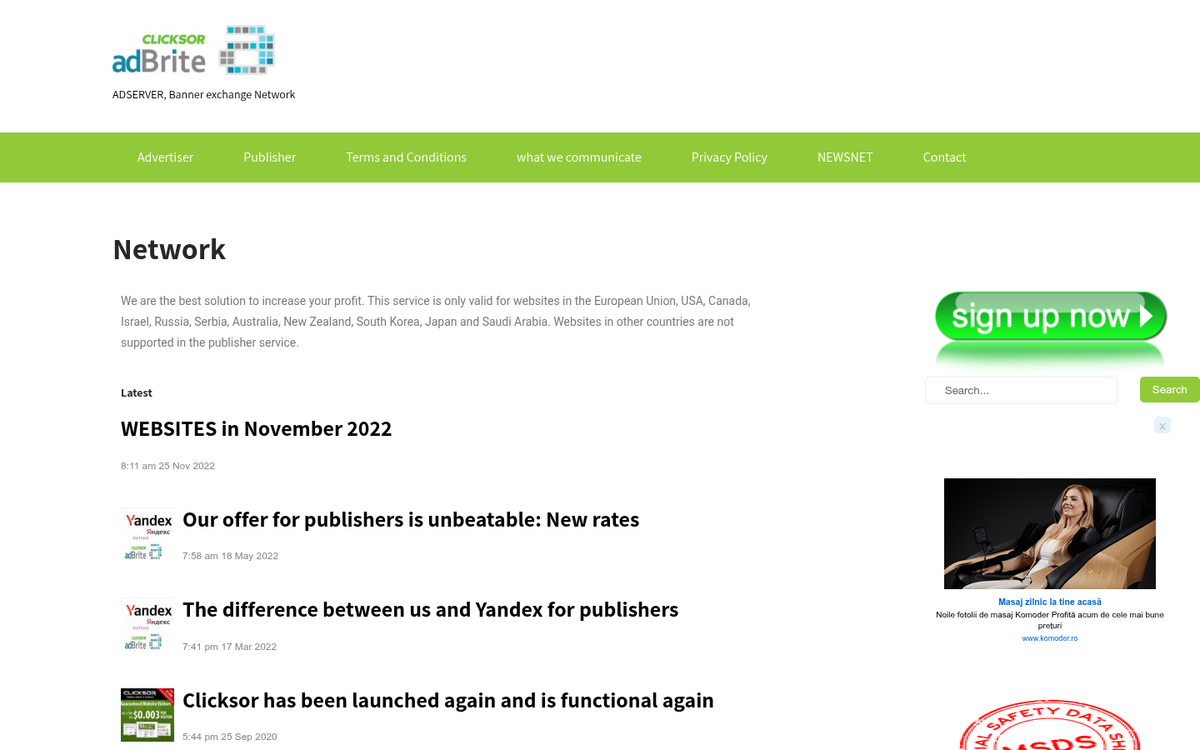
Clicksor still exists and still processes traffic, but it's difficult to recommend it as a primary advertising channel in 2026. The contextual advertising landscape has matured significantly, and there are now more credible mid-tier alternatives worth testing before defaulting to Clicksor - platforms with stronger publisher vetting, better fraud detection, and more transparent reporting.
That said, if you're operating in a niche that's difficult to advertise on Google, have a very tight budget, and want to experiment with cheap traffic, a small Clicksor test won't break the bank. Just go in with realistic expectations, track everything, and don't scale until - or unless - the numbers tell you to.