





When you're looking to earn money from a CPM ad, you're taking the role of a publisher. You're the person with the website, and it's your traffic and your screen real estate put up for ad placement. You have some control over the ads that run, but a lot of it will rely on your topic and content.
CPM, or Cost Per Mille, is advertising that pays per thousand views. The more traffic you have, the more people who see the ads, the more you get paid. To maximize the payments you get, you can shop around for a high quality ad network, one that will place good ads with optimized copy. Low quality ad networks often drop views, showing that a portion of the traffic you referred is "unqualified" for their standards.
Key Takeaways
- CPM rates vary widely by format and niche; finance, insurance, and legal niches consistently exceed $10 CPM.
- Google AdSense fully switched to a CPM-based payment model in 2024, offering publishers a 68% revenue share.
- Publishers can boost earnings beyond impressions through revenue share programs and referral programs offering 10%+ commissions.
- Using PPC to drive traffic for CPM monetization rarely works due to bot traffic and unfavorable cost-to-earnings ratios.
- Many previously prominent ad networks like Chitika, Clicksor, and DoubleClick have shut down or been absorbed into larger platforms.
Payouts

Different CPM networks have different types of ads on offer. Some of them will do anything. Others specialize in, for example, video ads or mobile ads.
A big part of making money through CPM on your site is identifying which types of ads are most likely to be seen on your site, and thus which networks you should pursue. Of course, the best way to do it is just to enroll with several networks and run ads anywhere you can. Still, some will be better than others.
CPM rates in 2026 vary widely depending on ad format, niche, and audience geography. Website display ads remain on the lower end, typically around $1-$3 per thousand impressions for general content. Video ads command more, often in the $3-$10 range. Email newsletter ads continue to be underrated, pulling in averages closer to $5 or more. Mobile ads vary dramatically depending on format - interstitials pay considerably more than standard mobile banners.
For context on just how wide the variance can be: market research companies like Kantar, Nielsen, and Qualtrics pay up to $10.34 CPMs in programmatic auctions, while consumer goods giants like Unilever and P&G range anywhere from less than a penny to over $21 CPM depending on targeting and placement. That range tells you everything you need to know about why network and niche selection matters so much.
What about niches? These can vary dramatically in price depending on the network as well, and it relies a lot on their relationships with advertisers. The sites with higher payouts have better relationships, but they also have higher standards for the sites they accept as publishers.
The lowest-paying niches tend to be entertainment, gaming, beauty, and lifestyle content, often under $1. The highest-paying niches are consistently finance, insurance, legal, and technology - frequently exceeding $10 CPM. Always investigate the networks you're running, and keep an eye out for better offers from other networks.
There are some ways you can boost your earnings in addition to impression-based share. One is revenue share; some networks offer an increased payout based on the value of the conversions coming from your impressions. This turns your CPM ads into hybrid CPM/Affiliate ads, in essence; traffic and views get you paid, but you have a valuable benefit to getting conversions as well.
The other method would be referral programs, where you might earn 10% or more of what the people you refer earn. This incentivizes referring high quality sites that have the potential to earn a lot of money. Catch them early, though; many such sites already have their contracts drawn.
Improving CPM Performance

A lot of CPM networks are going to a programmatic model these days, simply because computer algorithms learn faster, optimize better, and have better judgment than humans. Notably, Google AdSense itself fully transitioned to a CPM-based payment model in 2024, bringing it in line with the broader programmatic ecosystem. So if you're going for a programmatic ad network - which most of the networks on this list are - what can you do to make your earnings grow?
- Give the site more data. The more audience data, the more contextual data, and the more site data you provide, the more accurate the programmatic algorithms will be. Page-level information allows more precise optimizations, so you can look at individual ads to improve rather than making broad, site-wide changes.
- Make changes to your site to support larger, higher priced ad units. High-impact ad units like cross-screen ads and interstitials are much higher converting, but they're also only effective for certain types of sites. If you can change a design to implement them, you can come out with higher CPM rates all around.
- Test. Test ads, test networks, test offers, test designs, test everything you can possibly think of to test.
Obviously, any change you make that brings in more traffic is a chance to make more money. When you're paid per thousand valid views, bringing in more views means bringing in more money. The problem, of course, is finding legitimate ways to bring in that traffic. It's difficult to use PPC to bring in traffic, for two reasons.
For one thing, a lot of times the traffic you get from PPC isn't always going to be valid. You'll encounter a lot of bot traffic and a lot of low quality traffic that falls outside the valid demographics of the ad networks you're using for CPM. For another thing, if you're making $1 per thousand views, but $1 only brings you 50 views from a PPC ad, you're losing money. You need exceptionally high CPM and exceptionally low PPC to make that work, and in almost every situation, it won't work.
Always be aware of your fill rate and your ad density. Fill rate should be as close to 100% as possible, because if you're ever having a page load without an ad, that's a view you're not getting paid for. Ad density, meanwhile, should be low. You're going to want to operate in a quality over quantity mindset, here.
Feel free to explore other ad networks. You can separate different parts of your site into segments and run different ad networks on different segments. So long as you're not misrepresenting your traffic statistics for what you're giving to a network, they generally won't care. You always want to be on the lookout for a good deal.
There's also the step up technique. Many ad networks are stingy with who they let in as publishers, and they want good credentials for past networks and past performance. You won't have that starting off, so you have to go with some lower quality ad networks just to get the "resume experience" so to speak. Work with one for a few months, then apply to a higher tier network. After a while, you'll be able to get into some of the higher tier networks without necessarily having the traffic to back it up, just based on your credentials.
The List

Now, because so many existing lists of CPM networks are out of date, I'm going to try to list the previous names of many of these networks, or the networks they control as holding companies.
This is primarily so those of you with prominent names in mind don't worry when I don't list them; those names may have changed. The world of advertising changes every year, and with it comes a lot of rebranding, a lot of collapsed networks, and a lot of confusion.
- Google AdSense - AdSense remains the gold standard in CPM advertising. Since fully switching to a CPM-based payment model in 2024, it's become even more straightforward to work with. With over 2 million advertisers in its pool and publishers receiving a 68% commission on revenue generated, it's hard to beat for most publishers. No minimum traffic requirement makes it accessible at any stage.
- MGID - Founded in 2008, MGID has quietly become one of the heavyweights in native advertising and CPM. They now serve over 185 billion monthly impressions across 200+ countries, making them a serious option for publishers with international audiences. Their native ad formats tend to blend well with editorial content.
- Index Exchange (Formerly Casale Media) - A well-established programmatic exchange that connects publishers to premium demand sources. Index Exchange is particularly strong for publishers who are already running header bidding setups and want to add more competitive demand to their stack.
- Revcontent - One of the more selective content recommendation networks out there. They require at least 500,000 monthly pageviews to get in, but if you qualify, the payouts are competitive. Payments go out every 30 days with a $50 minimum withdrawal. Their native ad widgets are clean and tend to perform well on content-heavy sites.
- EvaDav - A push notification and native ad network delivering over 2 billion daily impressions across more than 200 countries. Their global scale makes them a solid option for publishers with diverse international traffic. They support multiple ad formats including push, in-page push, and native ads - if you're curious how effective push notification ads really are, the results may surprise you.
- PulsePoint (Formerly ContextWeb, Formerly AdsDAQ) - Now operating more as a health-focused programmatic platform, PulsePoint has carved out a niche for publishers in the medical, wellness, and pharmaceutical space. If that's your audience, they're worth a serious look.
- GumGum - This network remains unique in its focus on contextual intelligence and design-forward ad formats. Their in-image and in-screen ad units are visually compelling, and their contextual targeting technology has only gotten more sophisticated with time. A strong pick for visually-oriented publishers.
- Sovrn (Formerly Lijit) - Sovrn has grown significantly and now offers a full suite of monetization tools beyond basic display ads, including commerce signals and data licensing. Their publisher support is still a strong point, and they work well for mid-tier publishers who want more hands-on relationships. If display isn't enough, there are also other monetization alternatives worth exploring.
- PopAds - One of the few pop-under networks still operating at scale in 2026. Their biggest selling point remains the same: payments within 24 hours, no net-30 delays. Pop-unders are a divisive format, but for the right type of site and audience, they can generate meaningful revenue without cannibalizing other ad units.
- RhythmOne (Formerly Burst Media) - Cross-screen and cross-platform advertising with a strong video component. RhythmOne is a reliable mid-to-upper tier network for publishers with mixed device traffic who want consistent performance across desktop and mobile.
- Exponential (Formerly Tribal Fusion) - Once one of the biggest names in display advertising, Exponential has maintained its reputation for high-quality advertisers and above-average CPM rates. They're selective about publishers, but if you get in, the rates reflect that exclusivity.
- Vibrant Media - Still a solid choice for publishers who want control over what runs on their site. Their category rejection tools and content filtering options remain among the better publisher-facing controls in the industry.
- Gourmet Ads - Hyper-focused on food, beverage, and lifestyle content. If you run a food blog, recipe site, or anything in the culinary space, this niche network will consistently outperform general networks because the advertiser-audience match is tight. Their CPG advertiser relationships are strong.
- Clickbooth - This network focuses on exclusive relationships with advertisers, high performance ads, a lot of testing, and active culling. If you don't perform, you're out. If you do, it's a long and lucrative relationship.
- AdTegrity - Very selective, very clean. They don't allow affiliate or referral sites, pay sites, proxy sites, adult sites, or anything even adjacent to questionable content. But that selectivity is exactly why their CPMs tend to be respectable. If your site qualifies, that's a badge of credibility in itself.
Networks That Have Shut Down or Gone Dark
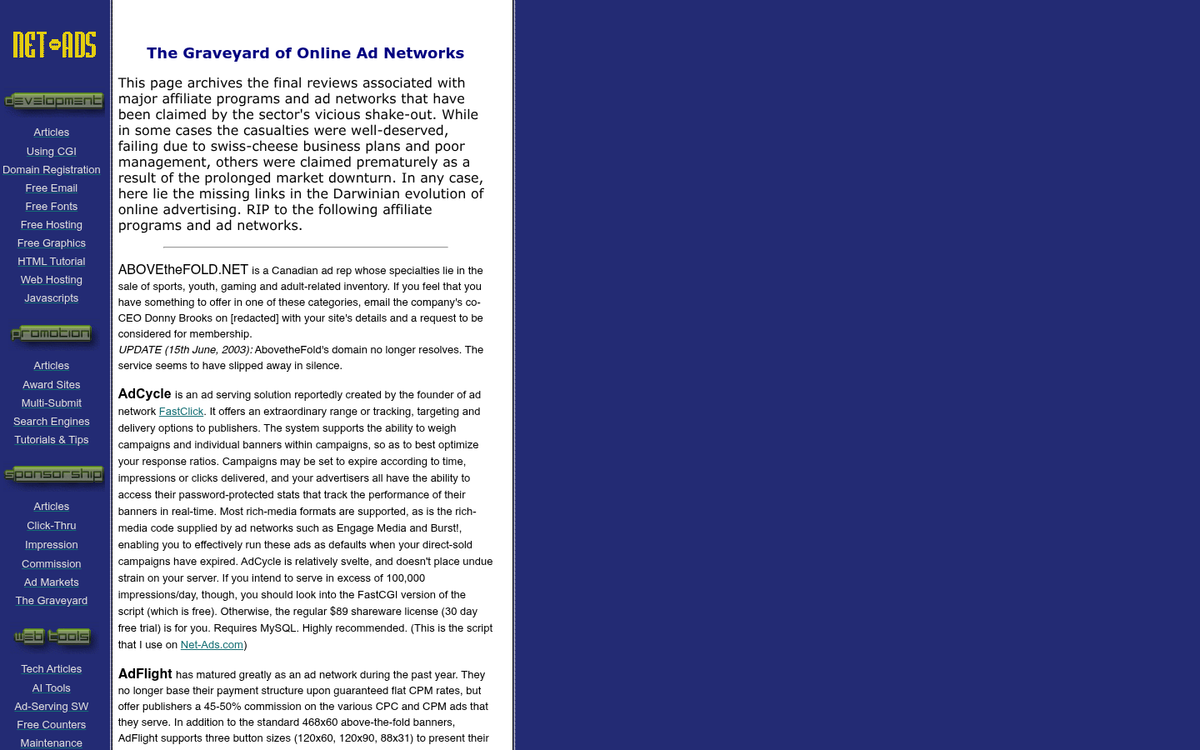
The ad tech industry consolidates fast. Several networks that appeared on older versions of this list are no longer operational or have been absorbed into larger platforms. Here's what we know:
- Chitika - Shut down in February 2019.
- Advertising.com - Folded into Verizon Media (now Yahoo Advertising).
- DoubleClick - Fully rebranded into Google Ad Manager.
- Conversant Media / ValueClick - Absorbed into Epsilon.
- Gorilla Nation - No longer operating independently.
- Clicksor - Shut down.
- BlogHer Publishing Network - The ad network component was wound down following SheMedia's restructuring.
- Technorati Media - No longer operating as an ad network.
- Paid To Promote - Went offline in late 2016 and never returned.
- AdsWisher, Axill, CPMoz, Morning Falls, Infinity Ads, AdPepper, Robert Sherman Media, Sulvo X, IDG Tech Network, Ybrant Digital - All appear to be defunct or unreachable as of 2026.
If any of these have relaunched under a new name or new ownership, let us know in the comments and we'll take another look.

1 response
Thoughtful replies only - we moderate for spam, AI slop, and off-topic rants.
Great list, but you left out Adosia. They are an up and coming competitor that can maximize publisher revenue while providing optimal results for advertisers.