





Key Takeaways
- Google does not penalize sites simply for using affiliate links; the issue is abusive or deceptive affiliate practices.
- Google's 2024 Site Reputation Abuse policy penalized major publishers like CNN Underscored and Forbes Advisor for thin affiliate content.
- Brand authority no longer protects sites; affiliate content must genuinely serve readers, not just generate commissions.
- Affiliate links should use rel="nofollow" or rel="sponsored" tags; cloaking links risks penalties despite short-term gains.
- Legitimate affiliate marketing with honest recommendations, proper disclosures, and real editorial standards remains viable in 2026.
How Affiliate Marketing Works (And What Google Actually Thinks About It)
Affiliate marketing has a long and complicated history as an internet marketing strategy. It has existed pretty much as long as the concept of recommendations and word-of-mouth advertising has existed - which is to say, since the dawn of commerce. As long as there have been people willing to recommend a product, there have been businesses willing to pay for those recommendations.
Part of the reason affiliate marketing has a bad reputation online is because of the strategies used to implement it. To understand those - both good and bad - you need to understand how affiliate marketing actually works.
How Affiliate Marketing Works

Online, modern affiliate marketing works either by URL parameters or cookies, typically cookies. The idea is that you as a marketer register to be part of an affiliate program with a business. Usually, you like that business, and you're willing to genuinely recommend them to other people. It's something you do anyway, so why not get paid for doing it?
So, you have a relationship with a business. That business gives you a special link that you use when you promote them. Instead of saying "hey, www.greatbusiness.com is a great business, check it out!" you say something like "hey, www.greatbusiness.com/A4th57Q is a great business, check it out!" There's not a lot of difference between the two links - one just doesn't look quite as clean. They both take the user to the homepage.
The A4th57Q is your affiliate ID. When a user clicks that link, the business registers "oh, look, Bob sent us this customer." Then they track that customer. If that customer makes a purchase, the business rewards you for the referral - typically as a percentage of whatever the customer spent.
There are a few things that can go wrong along the way:
- If the customer has a script blocker, their visit to the business site might not be tracked, and you wouldn't be paid for the referral.
- If the customer removes your affiliate ID before clicking the link, or navigates to the site directly, your referral isn't registered.
- If the business isn't accurate with their tracking - or is being a little shady - they can "lose" track of the customer and not pay you for a legitimate referral.
On top of that, you have affiliate networks. Affiliate networks are third parties that establish deals with hundreds of businesses and then pass those affiliate opportunities on to you - at a reduced commission. Instead of referring traffic directly to the business, you refer traffic via a link to the affiliate network, which redirects through their affiliate ID and on to the business.
In this situation, the customer clicks your link, is routed through the network, and arrives at the business. They make a $50 purchase, the business pays the affiliate network $5, and the network pays you $3.
This can be both good and bad. On the downside, you're making $3 on a sale where you could be making $5 with a direct relationship. The upside is that the affiliate network can open doors to businesses that don't run individual affiliate programs. The network also offers the business some protection - filtering out fake traffic and unqualified leads.
On the other hand, networks can skim traffic. Maybe one out of every ten customers pays the network but doesn't pay you. Maybe the network has a minimum payout of $100 but finds reasons to terminate accounts at $90. There are also networks acting as middlemen for other middlemen, turning a $5 commission into $1 by the time it reaches you. If you're struggling with these issues, it's worth reading about why you aren't making any money with affiliate marketing.
You can see quickly how this becomes a mess.
Why Affiliate Marketing Has a Bad Reputation

Already, you can see some reasons why affiliate marketing has issues from the marketer's side. When you sign up for a network, you're trusting that the network is legitimate. If they aren't, you may be losing money without even knowing it. It's also easy to inadvertently violate a terms of service clause and lose everything overnight. This leads many newer marketers to be once bitten, twice shy - and to badmouth affiliate marketing as a whole.
There's also plenty that can go wrong between the marketer and the customer, or between the marketer and the business. For example, a marketer who buys cheap overseas traffic for a pay-per-lead offer is gaming the system. Businesses have become increasingly aware of this kind of fraud, and they don't tolerate it.
What this is all leading up to is how affiliate links and Google interact. Google doesn't police referral relationships or monitor your stats for fraud. What Google does care about - deeply - is the relationship between the customer and the marketer.
The reason for that is simple: the vast majority of the time, the customer finds the marketer through a Google search. Someone searches "best construction hammer," lands on a review site, reads a few write-ups, clicks a convenient buy link, and makes a purchase. That buy link is an affiliate link, and the marketer earns a commission. Done right, everyone wins.
But what if the marketer is writing a glowing review for a cheap, unreliable hammer because it pays a higher commission? What if they're hiding the fact that they're being paid at all?
Google has a vested interest in surfacing high-quality, trustworthy content. If users are repeatedly sent to low-quality or deceptive affiliate content, they lose faith in Google's results. That's bad for everyone - except the shady marketer, briefly.
So Google has become increasingly strict about what is and isn't acceptable with affiliate content. Google also has to navigate the legal side of things, including FTC regulations requiring clear disclosure of affiliate relationships. As of 2026, those disclosure requirements have only become more scrutinized - both by the FTC and by Google itself.
How Google Treats Affiliate Links in 2026

Google is not actively hostile toward affiliate links. They run affiliate programs of their own. What they're hostile toward is the abuse of affiliate links - and increasingly, toward thin affiliate content at scale.
Here are some of the ways abuse comes up:
- Forcing users to pass through an affiliate link via a redirect.
- Requiring users to complete an affiliate offer to access content.
- Cloaking the affiliate nature of a link.
- Overloading a single page with affiliate links and little substantive content.
- Misrepresenting social media posts that contain affiliate links.
- Using black hat techniques - exact match domains, keyword stuffing, link schemes - to rank affiliate content artificially.
But in 2024 and into 2025 and 2026, something bigger happened: Google started going after entire site categories built on affiliate content.
In May 2024, Google rolled out its Site Reputation Abuse policy, which specifically targets websites hosting third-party content with little editorial oversight, purely to manipulate search rankings. This was a direct shot at the practice of large publishers creating affiliate-driven shopping sections that operated almost independently from the main editorial brand. The policy was updated again in November 2024 with further penalties impacting content publishers generating affiliate revenue.
The fallout was significant. CNN Underscored, Forbes Advisor, and WSJ Buy Side - massive, well-known brands - had their shopping and recommendations sections largely wiped from Google's search results. These weren't fly-by-night affiliate spam sites. These were household names, and Google still penalized them because the content existed primarily to generate affiliate commissions rather than to genuinely serve readers.
This is a landmark shift. For years, large publishers treated affiliate content as a low-effort revenue stream - spin up a "best of" listicle, drop in some affiliate links, rank on brand authority. Google has made it very clear that brand authority no longer gives you a free pass.
That said, Google's Search Advocate John Mueller has confirmed that websites will not receive a manual penalty simply for using affiliate links without specific markup. The mere presence of affiliate links is not the issue. What matters is whether the content is genuinely useful, editorially independent, and honest - or whether the site exists primarily to funnel users through affiliate links with thin or misleading content wrapped around them.
A few practical notes on affiliate links and SEO in 2026:
You should nofollow or sponsor-tag your affiliate links. Use rel="nofollow" or rel="sponsored" on affiliate links. This is Google's recommended practice and signals that you're being transparent about the commercial nature of the link. It won't hurt your rankings, and it's just good hygiene at this point. You can learn more about how to use nofollow on your blog posts if you want a deeper breakdown.
Cloaking affiliate links to hide them from Google - using plugins or robots.txt directives to mask them - is a practice I still don't recommend. Even if it works in the short term, it's exactly the kind of thing Google's systems are trained to catch. You're not hiding your activity; you're just delaying the consequences.
The Bigger Picture
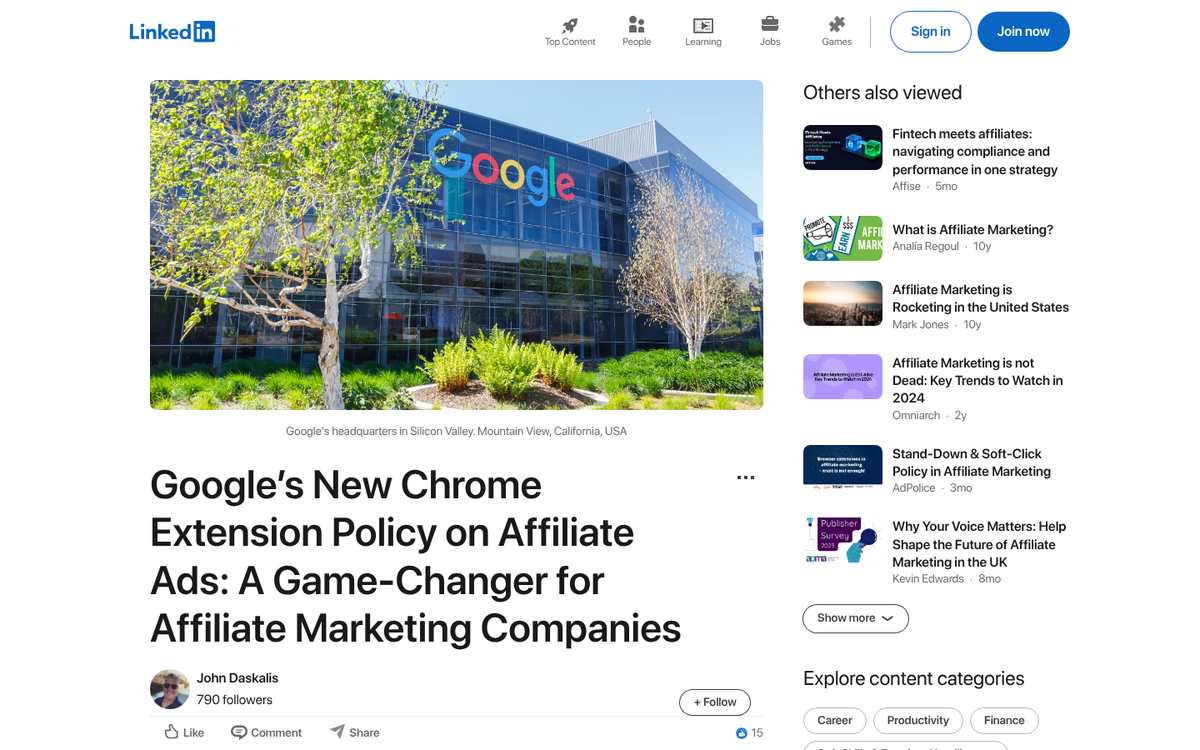
Back to the original question: does Google penalize sites that use affiliate links?
No - not for simply using affiliate links. There is nothing wrong with being an affiliate marketer, nothing wrong with using affiliate links, and nothing wrong with earning a commission for genuine referrals. John Mueller has said as much directly.
But the landscape has shifted meaningfully. Google's 2024-2026 policy changes have made one thing very clear: affiliate content must be genuinely useful content first, and a monetization vehicle second. The era of ranking "best [product]" pages stuffed with affiliate links on the back of domain authority alone is effectively over. Even the biggest publishers in the world learned this the hard way.
The reason people fear Google when they get into affiliate marketing is based on a real pattern of misuse - not paranoia. Deceptive content, black hat techniques, thin pages built purely to earn commissions - these things earn penalties. They always have. What's new is that Google has expanded that scrutiny to publishers who were once considered untouchable.
Using a few affiliate links to honestly recommend products you've vetted? No problem. Running a site built around genuine, well-researched product recommendations with proper disclosures and real editorial standards? Also no problem, and still a completely viable business in 2026.
Just don't treat affiliate content as a shortcut. Learn how to do it properly, and do it with integrity. It takes longer to build something real than to build something spammy - but it's also the only approach that survives the next algorithm update.


2 responses
Thoughtful replies only - we moderate for spam, AI slop, and off-topic rants.
Great article. The question is, how many affiliate links are too many? 10, 20, 30? Can you have 20 links on a 2k word count post?
great post james. I never think affiliate marketing have so many loop holes. thank you so much.