





Key Takeaways
- Fresh domains take 6-12 months to earn Google's trust; aged domains with clean histories can skip that waiting period entirely.
- Over 80% of websites get virtually no traffic, and less than 0.1% of canceled domains have quality backlinks worth pursuing.
- Expired domains can be used three ways: redirect traffic to your site, build a new microsite, or restore the original site.
- Restoring original content raises intellectual property issues since copyright remains with the original author, not the new domain owner.
- After purchasing, act fast-downtime causes deindexing and traffic decay that can be very difficult to recover from.
Expired Domain Marketing: A 2026 Guide to Finding and Using High-Traffic Domains
I like the idea behind expired domain marketing, but it's a little tricky to explain to people. A lot of people feel like the web is somewhat immutable, that it doesn't change in broad strokes. Marketers know that everything is constantly in flux and that sites can disappear in an instant, but that's not the public perception. Sure, content changes from day to day, but Facebook will always be Facebook and that blog you like will never change or disappear, right?
Well, the reality is that sites come and go every day. Sites that have existed with little purpose or content for over a decade might be dying right now. All it takes is one person to decide they want to stop paying for hosting and a domain name, and the site expires. The content disappears and the domain name returns to public availability. In some cases the domain registrar will park the domain; in others, they simply let it go.
The idea behind expired domain marketing is to find the domains that have existed in the past and are expiring soon. This is distinct from registering a domain that has never been registered before, because the domain has a history. One thing worth understanding here: a fresh domain takes 6 to 12 months to earn what Google considers "seed trust." An aged domain with a clean history can skip that waiting period entirely, which is a meaningful head start.
Essentially what you do is look for domains that have some history of existing, because that gives them an SEO boost over a fresh domain. You find domains that come from sites that actually had traffic, and you get an even better boost. If the domain that expired hasn't had a unique hit in five years, the only real value of that domain is its age, which is fairly minor on its own. If, on the other hand, the domain had a few hundred or a few thousand visitors a month, that's a more significant and actionable boost.
One sobering reality check before you dive in: according to recent data, more than 80% of all websites receive virtually no visitor traffic, and only around 9% receive any traffic from Google at all. On top of that, less than 0.1% of canceled domains have quality backlinks worth pursuing. That means the pool of genuinely valuable expired domains is small, and competition for the good ones is fierce. You have to be selective and systematic.
What do you do with the domain, then? There are three main options.
- You can redirect the domain to your chosen site. If the domain is topically relevant to your existing site, you're essentially siphoning off that residual traffic and converting it to your own. Eventually, when the trickle of traffic coming through the redirect slows to nearly nothing, you can let the domain expire again, having captured the value while it lasted.
- You can set up a new microsite - or even a full site - on the domain. This works well when you want to launch a business or blog in the same niche as the site that used to exist. It's like building a fresh site, except you start with some existing monthly traffic and domain authority rather than starting from absolute zero.
- You can try to restore the site that used to exist. After all, there had to be some reason people were visiting it in the first place. Tools like the Wayback Machine can help you recover old content and structure.
The problem with option three is that you run into intellectual property issues. Even though the site no longer exists - assuming it didn't just move to a new domain - the content is not public domain. The original author still holds copyright, so if you want to restore the site, you need permission from the original owner to use that content. Otherwise you'd need to rewrite everything from scratch, at which point option two starts to look a lot more appealing anyway.
Now, the trick with all three of these methods is that you need to start with a domain that actually has traffic and a clean history. If you're just buying any old domain from an auction house or a parked registrar, you're probably not getting much value. The site may have had no meaningful traffic, or worse, it might be carrying a Google penalty. You don't want to inherit someone else's algorithmic problems on day one.
So how do you identify domains with traffic you can actually use? It's a multi-step process.
Step 1: Find Expiring or Expired Domains
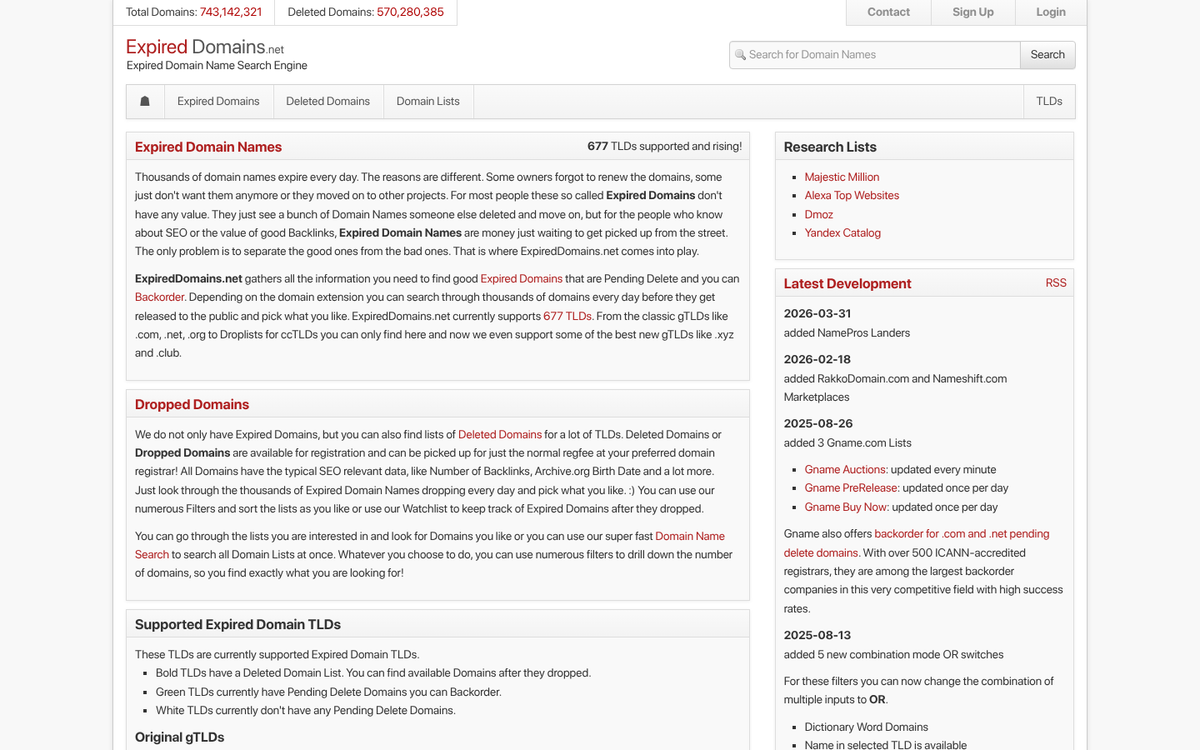
The first thing you need to do is locate domains that are expiring or have recently expired. There are several ways to go about this.
One option is to check the WHOIS information for any domain you're already interested in. This will tell you the registration date and expiration date, though it won't tell you whether the owner plans to renew. This is the least scalable approach, but it works for targeted research on specific domains you've already noticed.
Another approach is to use domain marketplace platforms that list upcoming auctions and recently expired domains. Sites like ExpiredDomains.net aggregate listings from major registrars and auction platforms including GoDaddy Auctions, NameJet, Sedo, and Flippa. You can browse these to get a broad view of what's coming available.
You can also go to those platforms individually and search manually based on keywords or niche phrases relevant to your goals. It's more time-consuming, but you sometimes catch domains before they generate broader interest.
Many registrars outsource their domain auctions to the major auction houses. GoDaddy Auctions, NameJet, and Sedo handle the bulk of the market. Some registrars still manage their own sales, but these three are where most of the volume flows.
Finally, you can use dedicated tools to do much of the heavy lifting for you. DomCop is one of the most comprehensive options available in 2026, providing access to over 10 million domains with more than 90 metrics per domain, including data pulled from Majestic and Moz. To put the scale in perspective, DomCop listed over 150,000 domains as expired in a single day in early 2025. Their plans currently start around $49 per month for the basic tier, with higher tiers unlocking expired and archived domain data. Pricing has shifted over the years, so check their current rates before committing.
The trade-off with using a tool versus doing manual research is that good tools cost money. But given how small the pool of genuinely valuable expired domains is, having access to robust filtering metrics is often worth the investment if you're buying expired domains seriously.
Step 2: Audit the Domain to Identify Key Features
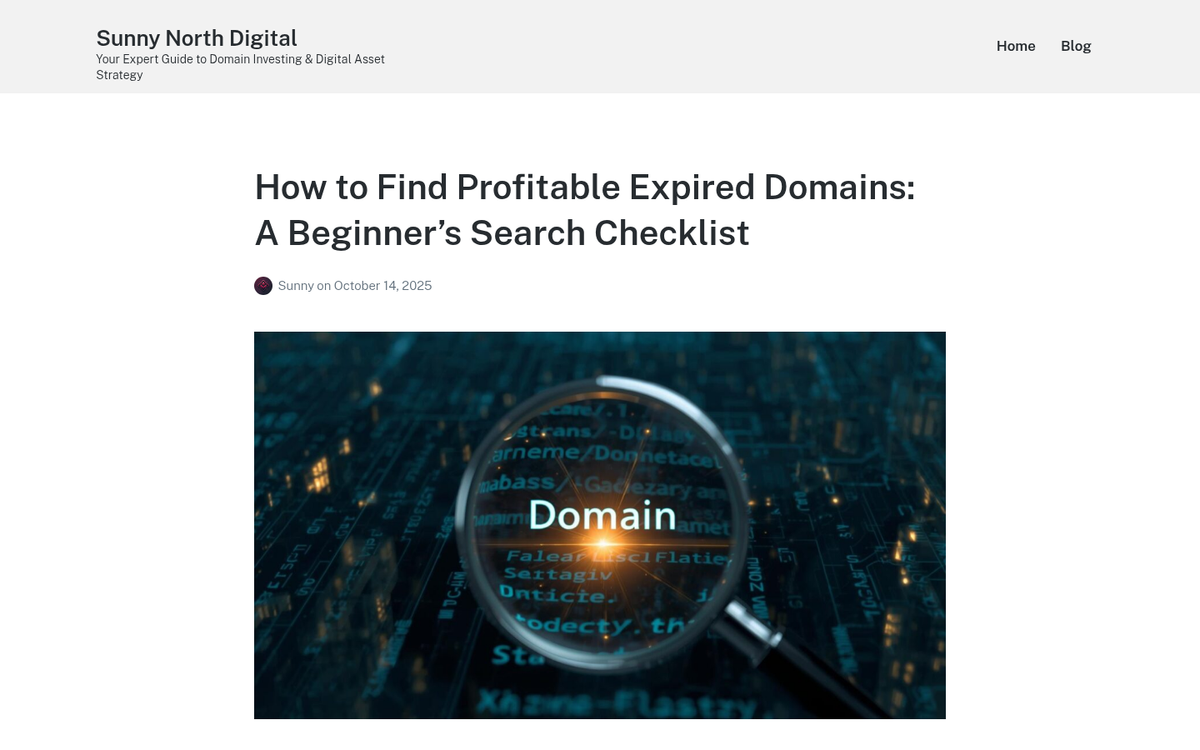
Once you've found some candidate domains, you need to do real due diligence before spending any money. Here's what to check.
- Check the Wayback Machine for past content. This tells you what kind of site used to live on the domain, what topics it covered, and what audience it served. If the old content is completely unrelated to your plans, any residual traffic you inherit won't stick around - it'll just inflate your bounce rate without helping your business.
- Check the backlink profile using Majestic or Ahrefs. Look at the quality, diversity, and relevance of inbound links. Red flags include a large volume of links from just one or two domains, heavy concentrations of spammy or irrelevant links, or patterns that suggest the domain was part of a private blog network (PBN) that got deindexed. Ideally you want a healthy spread of links from relevant, high-quality, and authoritative sources.
- Check the Domain Authority (DA) or Domain Rating (DR). As a general benchmark, aim for a score of 20 or higher when evaluating DA or DR. Anything below that and you're often not getting enough lift to justify the effort and cost. Tools like Moz and Ahrefs make this easy to check.
- Check Google's index of the domain. Type site:yourtargetdomain.com into Google. If the site is still live or recently expired, you should see indexed pages. If nothing comes up at all, that's a strong signal the domain has been penalized or deindexed - a major red flag you should not ignore.
- Check the age of the domain. Older domains generally carry more authority and have had more time to accumulate links and traffic history. Age alone isn't sufficient, but combined with other positive signals, it adds meaningful value.
- Check the current price and bidding activity. Make sure you know the reserve price, current bids, and your own ceiling before you get emotionally invested in a domain. Auction dynamics can push prices well beyond what the domain is actually worth to your specific use case.
- Check when the domain expires or expired. Timing matters. The faster you can stand up a new site or redirect after expiration, the less residual traffic you'll lose during the gap. Extended downtime causes deindexing and traffic decay that can be very difficult to recover.
Step 3: Buy or Pass, Then Repeat

Once you've pulled all of that data together, you should have a clear picture of what the domain is worth to you specifically. You know the content history, the traffic potential, the backlink quality, the authority metrics, and the likely risks. You know what you plan to do with it - redirect, rebuild, or restore.
With all of that in mind, you have one fairly simple decision to make: do you buy the domain or pass?
If the domain has a fixed buy-now price you're comfortable with, the decision is straightforward. If it's auction-only, you're always at risk of being outbid at the last second. Consider setting a firm maximum bid based on your analysis and sticking to it. Auction sniping is real, and it's easy to overpay in the heat of competition for a domain that looked great on paper.
If you buy it, move fast. You have a narrow window - anywhere from a few days to a couple of weeks - before the residual traffic fully cools off and the domain loses its indexed presence. Every day of downtime is traffic and authority bleeding away. Getting the domain indexed quickly should be one of your first priorities after purchase.
If you pass, or get outbid, that's fine. The process starts again. Given that less than 0.1% of canceled domains have quality backlinks worth pursuing, you should expect to evaluate many domains before finding one that genuinely meets your criteria. Getting your new backlinks indexed as soon as possible will also matter once you've rebuilt the site. Patience and discipline here will serve you far better than impulse buying at auction.
The domains that are worth buying are out there - but they are genuinely rare. Build your process, work it consistently, and when a good one surfaces, be ready to move quickly and decisively. If you're unsure whether a recovered domain is worth monetizing yet, it helps to understand how much traffic you actually need before running ads.
3 responses
Thoughtful replies only - we moderate for spam, AI slop, and off-topic rants.
It seems to me that the number of high quality (or even good quality) domains expiring / dropping has gone down significantly in the last 6 months or so. I browse the Namejet, Godaddy and Dropcatch lists frequently but very rarely find anything that I'm super excited about (although I don't really trade the 4L / numerics market). I was wondering if this is just me, or have others also noticed a significant drying up of the market?
Thanks for your explanation but 1 thing is not clear for me.
How important is the time in between the date the domainname has expired and the day I buy it?
If I like to have high traffic it can be max 1 or 2 weeks or so?
How much value has an 11 year old domainname, with a lot of backlinks, from several different domains and a nice number of crawl results?
Compared with simply a complete new domainname that it?
Hopefully you can and will answer this for me. Thanks!
Great questions, Patrick! The time gap definitely matters - the longer a domain sits expired, the more traffic it loses, so acting quickly (within days ideally) is smart.
As for your 11-year-old domain with solid backlinks from diverse sources - that's genuinely valuable! Aged domains with strong link profiles carry significant authority that a brand-new domain simply can't match. You'd essentially be skipping years of SEO groundwork.
Just make sure those backlinks are quality ones and the domain has a clean history. Hope that helps clarify things!