For the most part, eBooks exist to be sold. Sometimes you're "selling" them in exchange for email addresses, occasionally you'll give them away, but most of the time you're trying to exchange your knowledge for money. You want a good return on your investment. It doesn't matter if that investment was in a ghostwriter and graphic designer to create it, or in your own time and energy making it; there's value there, and you want returns.
So why is it, then, that your eBook is sitting on the virtual shelves collecting virtual dust? Why does it languish in the bottom million publications on Amazon? Why is there no interest in it on your site?
Let's cover some of the most frequent reasons:
Key Takeaways
- Poor book quality-including vague advice, rehashed content, bad formatting, or weak writing-is often the primary reason eBooks don't sell.
- Effective marketing requires a sales funnel, pre-release hype, multi-platform distribution, and promotion across social media and podcasts.
- Supplemental content like blog posts, webinars, and short-form videos creates a supportive ecosystem that drives ongoing book discovery and sales.
- Weak presentation-including an unprofessional cover, poor description, missing reviews, or wrong categorization-can kill sales regardless of content quality.
- Pricing too high or too low both hurt sales; the $2.99-$9.99 range maximizes Amazon royalties and balances accessibility with perceived value.
1. Your Book Isn't Very Good
This is the first potential issue you might have to face. Sometimes, despite your best efforts, the product you create just isn't very good. It might have something minor wrong with it, or it might have a lot of issues; I don't know. I recommend soliciting the feedback of someone who is willing to disillusion you and give you a breakdown of what you actually need to fix to make a good book. That means someone other than your mom, wife, or favorite teacher.
Here are some common issues I've seen with eBooks. These are issues that crop up with manuscripts as well, though you see them less often in the wild because manuscripts require passage through an editor before publication, whereas anyone can put anything up on Amazon.
- It's too long. Only fiction authors are typically able to get away with lengthy novels. If you're writing a nonfiction book on a business, marketing, or industry subject, you can't write it to be excessively long. You're probably going to shoot for something in the 50,000-75,000 word range. If you're coming close to 100,000, you're reaching a danger zone. That's not to say that lengthy books don't sell, but they need a different kind of marketing to sell well.
- It's not specific enough to be useful. Don't just say something like "contact an industry expert for a testimonial." Tell me how to find an industry expert, what to say when I reach out to them, and how to ask for a testimonial without seeming pushy. Walk me through the process. I'm paying for the book, I don't want something I can find on a blog for free.
- It's rehashed information with nothing new. If I buy your book and all I see are blog posts copied and pasted with some minor introductory material, I'm not going to be happy. If I buy your book and all I see is advice cribbed from other more authoritative blogs, I'm going to be even less happy. In 2026, with so much AI-generated content flooding the market, readers are especially sensitive to this. Make sure you're bringing genuine insight, original perspective, and real experience to the table if you want to succeed.
- It has no graphic design to it. I've seen a lot of novice bloggers make eBooks that are little more than a .docx file converted into a PDF or epub, with nothing to differentiate it. You have a lot more flexibility with your presentation! Include images, include graphic design, include typography, make it pop. Just make sure your graphic design doesn't get lost on a Kindle, with its black and white screen.
- It's poorly formatted. I've seen this a few times; people make a decent eBook, but when they run it through the conversion process, something breaks. Line breaks disappear or double, spaces go missing, title formatting changes, the works. The problem is, if you don't check and proofread it, it puts a very poor impression forward. Who wants to buy your book when they look inside and see a mess?
- It's poorly written. Sometimes there's no two ways around it; the book you wrote isn't written well. It has grammatical errors, it has spelling errors, it mixes affect and effect, they're and their, and all the rest. It might be time to step back and hire a ghostwriter or a professional editor to do the heavy lifting instead. There's no shame in it; plenty of the content on blogs and on Amazon is polished by people other than the original author.
If you've made it past all of these errors and haven't found them in your book - or haven't had them pointed out to you - you can move on to number two.
2. You're Not Properly Marketing
Your book is a product like any other, and it needs to be marketed as such. You can't create it, throw it up on Amazon or on your blog in a sidebar, and let the sales roll in. You're going to need to do a lot of work to market that book, get attention to it, and get people interested in it. A lot of that work should be done before the book even comes out, too.
You need to establish a sales funnel, which may or may not lead to paid advertising. A sales funnel begins with some form of advertising, whether it's social media, blogger outreach, or good old-fashioned paid ads. They all lead to various landing pages, where you put the squeeze on and get users to decide they really want to know what's inside your eBook. From there, you drag them to the purchase page, and make the sale. That's a vast simplification, of course, but I'm not writing an eBook about eBook marketing right now.
A huge part of successfully marketing an eBook comes with the pre-release hype. The moment you have an idea for an eBook, come up with a title and an elevator pitch. Refine those as much as possible and start mentioning them, hinting at them, and circulating them. Once they start to gain a little traction, reveal the cover design, which you should have professionally created. You can even go a step further and hold polls or contests to select from several cover options, which gives you a chance to gauge public reaction to your topic and your ideas.
From there, it's all about spreading the hype. Mention it everywhere. Guest post about it. Mention it in interviews and podcasts. Post about it on social media. You can even start taking pre-orders as another interest check.
At some point, you can begin to send out preview copies to influential people who might have an interest in it. They get an exclusive bit of content to review, and you get valuable reviews and backlinks.
You also need to think beyond Amazon. According to PublishDrive's 2023 Book Sales Report, 40% of overall eBook sales come from stores other than Amazon - meaning authors focused solely on one platform are potentially leaving nearly half their revenue on the table. Make sure your book is available through multiple retailers and in formats readable across Kindles, tablets, phones, and desktop apps.
3. You Have No Supplemental Content
There's something of a cycle of interconnected content throughout the web and your business that you can use to sell more books. Think of it like a support network that helps people find what they need, while also convincing them that what they need is your book. For example:
- Free content on your site can lead to book sales. People like your business, they like your brand, they like your blog, and they assume that the quality you showcase in those locations will carry over to your eBook. You sell eBooks based on the strength of your non-eBook content.
- Book sales can lead to seminars, webinars, speeches, and consults. If you mention that you do consulting or that you have regular webinars with open enrollment for a fee, you'll have people interested in attending them based on the quality of the content in your books.
- Webinars and the like can lead to more book sales. When you give a webinar, you can mention that you cover certain topics in more detail in your book. Some of your audience will have read the book and will be able to vouch for its utility. Others will then be interested and will buy.
- Short-form video content is now a powerful driver. In 2026, platforms like TikTok, Instagram Reels, and YouTube Shorts have become legitimate book discovery channels. A single well-placed video breaking down one concept from your book can drive more sales than weeks of email marketing. Don't sleep on this.
It's all interconnected and it's all supportive. It builds upon itself and helps you land more sales all around. You just need to make sure everything you offer is sufficiently high quality and that you mention each other spoke of the wheel while promoting the others.
4. Your Presentation is Not Attractive Enough
All else being equal, people will still turn away from your book if the presentation isn't up to par. How many times have you gone to an Amazon page for a digital purchase, only to find barely anything of substance? Who wants to buy an eBook when the pitch is bog-standard and says nothing, the cover looks like it was thrown together in five minutes, and the interior pages look awful?
What does your pitch cover? The description on the Amazon page is your lead-in to why people want to buy it. On major retail platforms, you're going to want to assume the user has no idea who you are or what your reputation is. Only once you have a successful self-publishing career under your belt can you start to leverage that reputation. Until then, you need to showcase the quality of your information and your presentation up front.
Your author blurb. Anywhere you're selling your book other than your own site, you need to set up a profile and fill it out. On Amazon, that means adding a photo - of you, not a logo - and writing a bio. This bio is important because it's what users will read to see if you're really the authority you claim to be. If possible, mention or link to your website to back up that authority.
Your cover. Seriously, it's not hard to get a professional cover designed. You can find talented designers on platforms like 99designs, Reedsy, or even Fiverr if you do your research and look at portfolios carefully. A bad cover in 2026 is even more of a red flag than it used to be, because the bar has been raised considerably.
Your title. In addition to your cover, your title is the first thing the reader sees when browsing. A lot of times you can use the same process you use to write a compelling blog post title, but spend a bit more time on it - your eBook title is that much more important and harder to change once it's out there.
Your categorization. The category you choose on Amazon and other eBook platforms will have an impact on the lists you show up on, the readership that browses those lists, and the searches that will find your book. You also risk being buried or removed from active storefronts if you miscategorize your book.
Your reviews. Most users on a site like Amazon will check reviews to determine if they want to buy a book, even if that book is only $2.99. If you have no reviews, you lose confidence. If you have a handful of mediocre or bad reviews, people will avoid your book.
There are two ways to boost your reviews. The first is to get more positive reviews - solicit them in your book, on your site, and in your email list. If possible, get seed reviews from the industry influencers you reached out to early on. The other method is to address or flag negative reviews that appear to be spam or bad-faith attacks from competitors; try to get them removed on those grounds.
5. Your Price Is Off
Pricing an eBook has always been part art, part science - and it's still one of the most debated topics in self-publishing circles. Get it wrong in either direction and you'll leave money on the table.
A higher priced book might get you more return per unit sold, but digital publishing is largely about volume. Without printing costs, shipping, distribution, and shelf space, your overhead is minimal. That means you have flexibility - but that flexibility can work against you if you price yourself out of the market.
Who wants to pay $150 for your supposed high-quality marketing book when they can get dozens of comparable titles for a fraction of the price?
That said, don't automatically race to the bottom either. Pricing too low can signal low quality, and in some niches - particularly B2B or professional development - a slightly higher price actually increases perceived value. Context matters.
Here are some pricing strategies worth considering:
- The $2.99-$4.99 sweet spot. For most indie authors on Amazon, this range tends to hit the right balance of accessibility and perceived value. Historical data from Smashwords has suggested $3.99 can actually outperform $2.99 in total revenue, so don't assume cheaper always wins.
- Price multiple eBooks differently. If you have one book priced at $4.99 and one at $8.99, some buyers will gravitate toward the cheaper option, while others will assume the more expensive book is correspondingly more valuable. Use that psychology intentionally.
- Scope out your competitors. Find similar books that perform well and price yours competitively. If comparable titles are underperforming, price yours slightly higher and position it as the premium alternative.
- Test prices regularly. You can change your price at any time, either permanently or as a temporary promotion. Adjust up or down and track how it affects your volume and total revenue - not just units sold.
- Use free or deeply discounted periods strategically. A temporary free or $0.99 promotion can jumpstart reviews, boost your Amazon ranking, and introduce your book to a much wider audience. Think of it as paid advertising with a different structure.
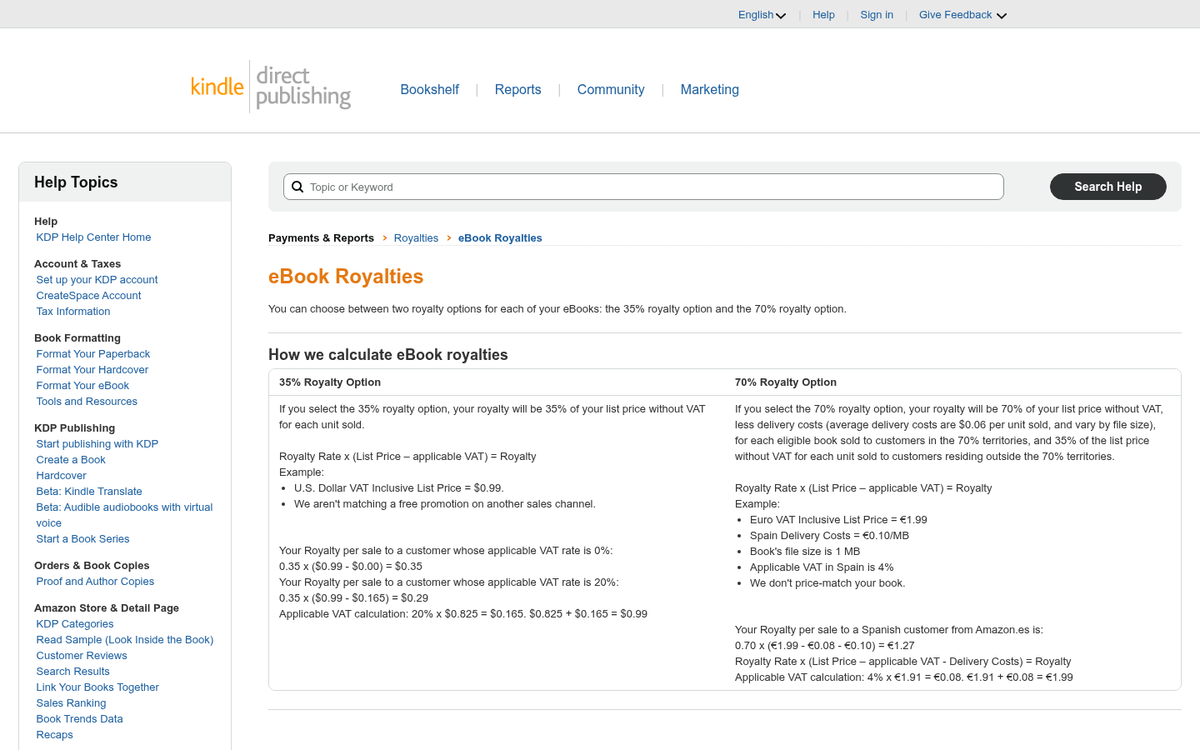
Keep in mind that Amazon's royalty structure still applies: books priced between $2.99 and $9.99 earn a 70% royalty, while anything priced outside that range drops to 35%. For most authors, staying within that window makes the most financial sense unless you have a specific reason to go outside it.
And remember - Amazon is still the dominant force, with over 60% of eBook buyers in major markets like the US, UK, and Germany purchasing there. But with 40% of sales happening elsewhere, a smart pricing strategy should account for how your book is positioned across all platforms, not just one.