




Since Google rolled out AI Overviews broadly in May 2024, the feature has fundamentally changed the search landscape. Millions of queries now return these summaries first, which means the content that gets cited inside them is a new visibility opportunity - and the content that gets ignored is losing ground it might not even know it had.
For website owners and managers, this change matters whether you want it to or not. AI Overviews don't just affect click-through rates; they change how your content needs to be structured, how authoritatively it needs to read, and how directly it needs to answer questions. Getting cited in an AI Overview is quickly becoming one of the most valuable placements in organic search.
This glossary entry breaks down what AI Overviews are, how Google decides what content to pull into them, and what you can do to improve your chances of being featured.
Quick Answer
Artificial Intelligence (AI) refers to computer systems designed to perform tasks that typically require human intelligence, such as learning, reasoning, problem-solving, perception, and language understanding. AI encompasses machine learning, deep learning, natural language processing, and computer vision. Modern AI powers applications like chatbots, recommendation systems, image recognition, and autonomous vehicles. It can be narrow (task-specific) or general (broad reasoning). AI is transforming industries including healthcare, finance, and transportation, while raising important questions about ethics, bias, privacy, and job displacement.
How Google AI Overviews Work
When a query triggers an AI Overview, Google pulls from multiple sources at once, pieces the information together, and generates a written response - then shows that response at the top of the search results page, above the standard organic links.
That word "generated" is doing a lot of work here. An AI Overview is not the same as a featured snippet, which lifts a direct excerpt from a single page. An AI Overview is a synthesized answer, written in the moment by Google's AI based on what it finds across the web. The content you see doesn't exist out there anywhere verbatim before the search happens.
Cited links usually appear alongside the response, and this is Google's way of showing which sources the AI drew from to build its answer. Those links sit within or beside the overview box, so a user can go deeper if they want to. But the answer is already right there, which is what makes this format different from anything Google has done before - and it's closely tied to the rise of zero-click search behavior.
The underlying system is Google's Gemini model, which is built to understand the intent behind a question instead of just matching keywords. So instead of finding the page that best fits a search term, Google is now trying to answer the question directly - it's an actual change in how the results page works.
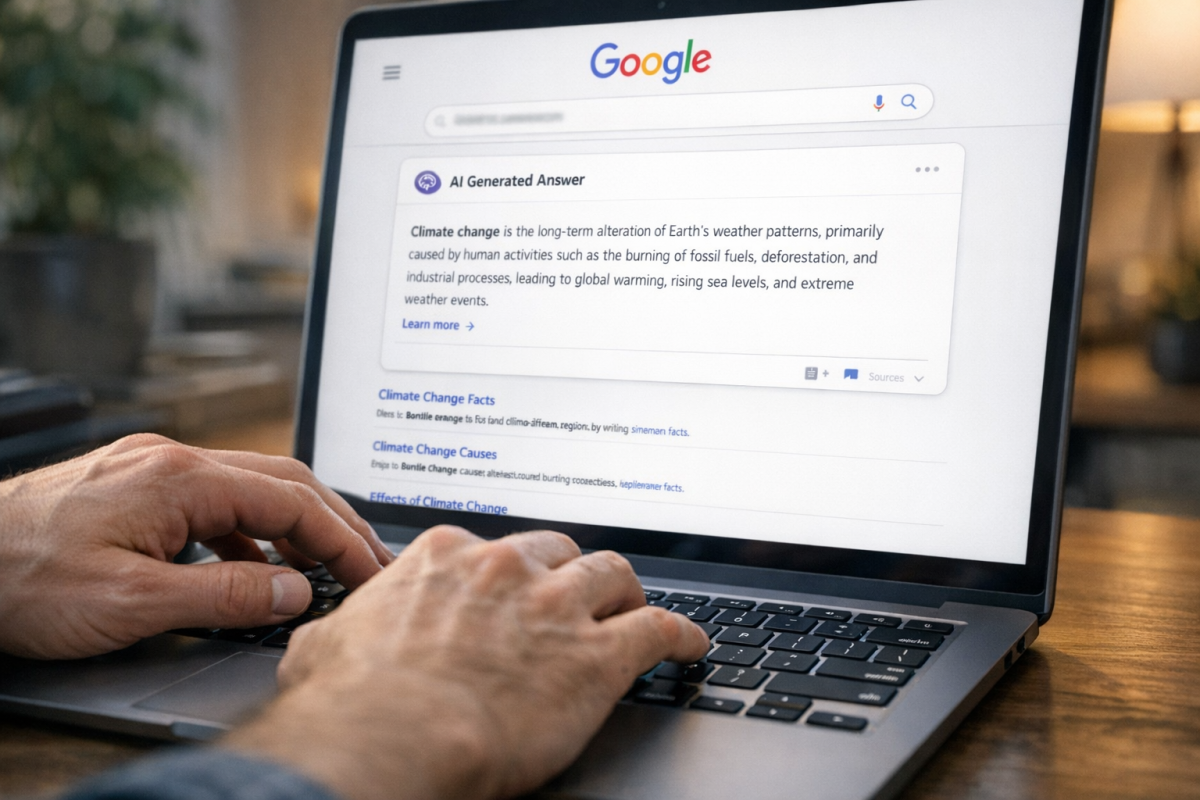
The AI also weighs source credibility as part of this process - it doesn't treat every webpage equally - it draws from content it considers reliable and relevant to the query. That's why the experience can seem polished even when it's pulling from dozens of different places at once.
One more thing worth knowing about: the overview box takes up a decent chunk of the page - it appears before any organic results, and on mobile especially, a user might read the whole answer without scrolling at all. The structure of the results page has changed around it, which has real implications for how your blog appears in Google results overall.
How Often AI Overviews Actually Appear in Search
The numbers are hard to ignore. According to Advanced Web Ranking data from November 2025, AI Overviews appear in roughly 60% of U.S. search queries; it's not a small slice of traffic - it's the majority of searches run every day.
And the growth has been fast. Semrush tracked a 72% increase in AI Overview appearances in just two months during early 2025. To put that in perspective, this feature went from a pretty selective rollout to something that now shows up in more searches than not.
| Time Period | AI Overview Appearance Rate (U.S.) |
|---|---|
| Early 2024 (post-launch) | ~7-10% of queries |
| Mid 2024 | ~25-30% of queries |
| Early 2025 | ~47% of queries |
| November 2025 | ~60% of queries |
The table above shows the trajectory. What started as a limited experiment has scaled into something that touches more than half of all U.S. searches in under two years. That pace of expansion is worth noting.
Not every query gets an AI Overview, though. Google is more likely to generate one for informational searches - questions that start with "how," "what," or "why" - than for transactional ones like "buy running shoes near me." So the 60% figure reflects a combination of query types, and your own numbers will depend heavily on the types of searches that bring people to your content.
That said, if your content answers questions, explains concepts, or covers any how-to territory, there's a good chance an AI Overview is already sitting above your organic listing for a portion of your target keywords - the latest reality for a large part of the web.
What AI Overviews Do to Your Click-Through Rates
The traffic numbers are hard to ignore. Research from Seer Interactive found that organic click-through rates dropped by 61% when an AI Overview appeared at the top of search results. That is not a small dip - it's a direct hit to the number of people who actually visit your site.
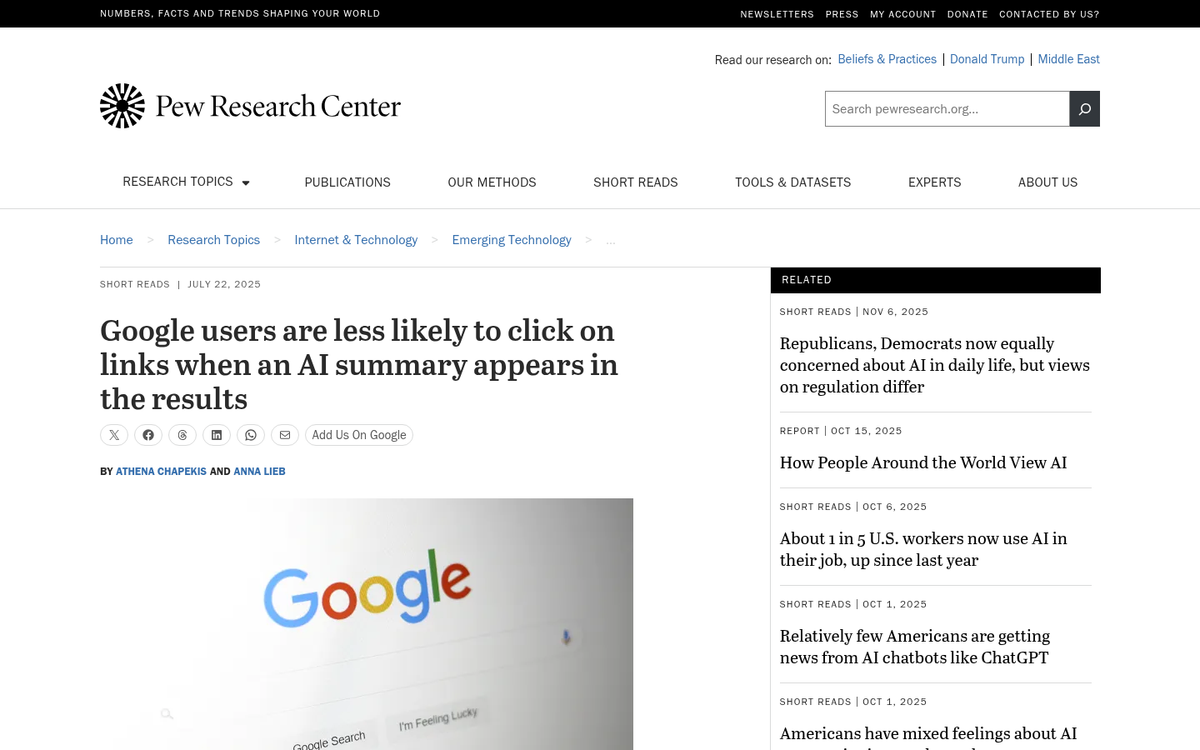
Pew Research put numbers to the behavior too. When an AI Overview was present, only 8% of users clicked a traditional search result. If you don't have one, that number was 15%. In other words, an AI Overview can nearly cut your expected traffic in half just by being there.
If Google's AI has already pulled together a clean answer at the top of the page, most users take it and leave. They got what they came for without ever needing to scroll down to the blue links.
| Condition | Organic CTR |
|---|---|
| No AI Overview present | ~15% |
| AI Overview present | ~8% |
| Overall CTR drop | ~61% reduction |
This is a challenge for site owners and content teams who use search traffic to drive business. Pages that once ranked well and pulled in steady visitors can see a big drop without losing their position in the rankings at all. Your rank is the same but the clicks disappear.
It is worth noting that not every query triggers an AI Overview, so the results are not uniform across all your content. Informational queries - the kind where someone is looking up "how does X work" or "what is Y" - are the ones most likely to get the AI treatment. That is also the type of content that draws the most organic traffic. A popup on your blog posts can compound this problem further if visitors do land on your pages.
Sites that built their strategy around educational, top-of-funnel content are the ones feeling this the most. Product pages and transactional queries are less affected. But informational content is carrying most of the weight here. If you rely on tools like Buffer to drive blog traffic, diversifying your traffic sources becomes even more important in this environment.
How to Get Your Content Cited Inside an AI Overview
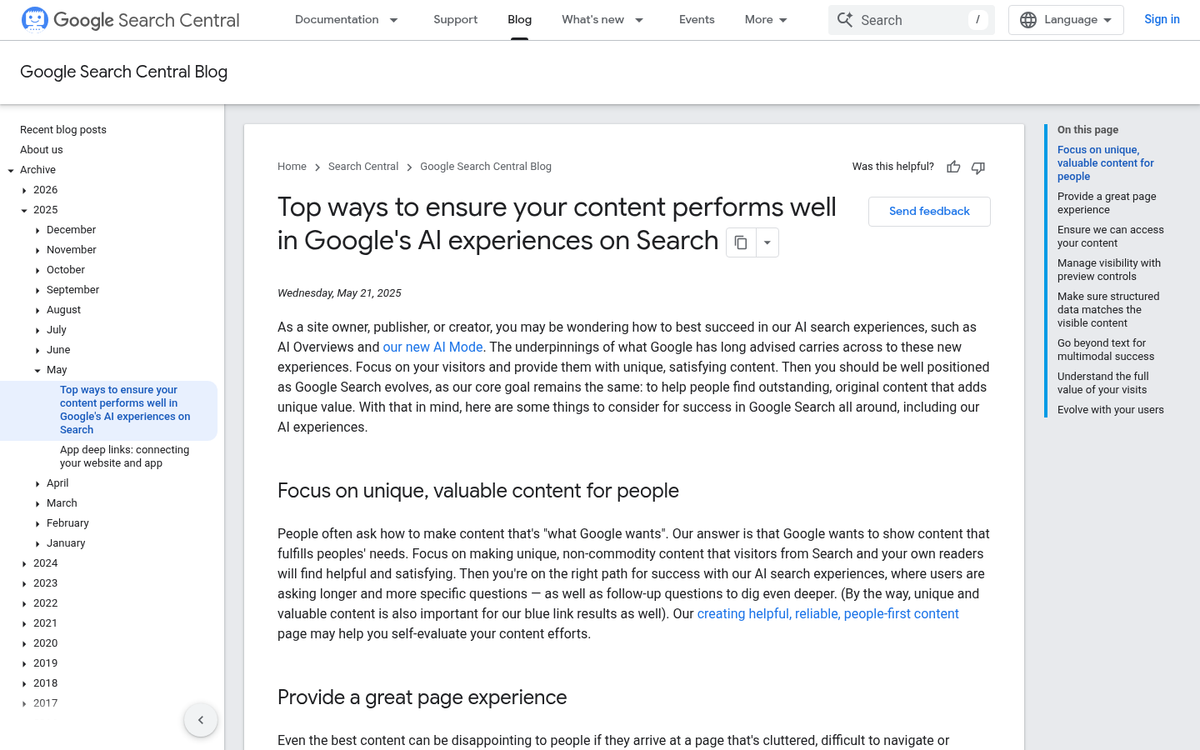
Google pulls from pages that are structured well, answer questions directly, and come from sources it already trusts.
Structure matters more than expected. Pages that use headings, short answer-first paragraphs, and logical formatting are easier for Google to extract from. Think of it less as writing for a reader who scrolls and more as writing for a system that scans for the most helpful sentence on the page.
Direct answers win here. If someone asks "how long does X take," your content should say that in the first sentence of the relevant section - not bury it three paragraphs down. That's the core idea behind Answer Engine Optimization (AEO), which overlaps with traditional SEO but pushes more toward accuracy and directness. You can use an AEO readiness checklist to see how well your pages are set up for this.
What to Focus On
Authoritative sourcing strengthens your opportunities too. Pages that cite credible references, show expertise, and meet E-E-A-T standards are more likely to be treated as reliable by Google's systems. Schema markup is also worth adding, particularly FAQ and HowTo schema, because it gives Google a structured signal about what your content contains.

A page that addresses the main question and then addresses the follow-up questions a reader may have gives Google more to work with. Thin content that answers one thing and stops is less likely to get pulled in.
Paid Placement Is Also on the Table
There is a paid path worth learning about. Ads are appearing alongside AI Overviews at a growing rate - Semrush data suggests that figure is reaching around 40% of AI Overview results by November 2025. For competitive queries where organic placement feels out of reach, paid visibility inside that space is increasingly an option.
The organic and paid strategies are not mutually exclusive. Running ads while you build content authority means you don't have to wait for traction to stay visible in AI-driven results.
Staying Visible When AI Answers First
AI Overviews are not a temporary experiment. They are becoming a permanent fixture of how people find information, and ignoring them means accepting that your content may be seen less, clicked less, and cited less - even if it ranks well by traditional measures. The answer is to start optimizing for them as fast as possible.
A helpful place to start:
- Audit your most important pages with Answer Engine Optimization (AEO) in mind - are your answers clear, direct, and structured?
- Search your target queries in Google and note which ones trigger an AI Overview, then assess whether your content could realistically be cited.
- Test structured formats like concise definitions, numbered steps, and FAQ sections to make your content easier for AI to parse and pull from.
You don't need to overhaul your entire content library overnight. Small, focused changes - a clearer answer in the opening paragraph, a well-structured list, a direct response to a common question - can be the difference between Google's AI citing your site or skipping right past it.
FAQs
What are Google AI Overviews?
AI Overviews are AI-generated summaries that appear at the top of Google search results, synthesizing information from multiple sources to answer a query directly, above traditional organic links.
How do AI Overviews affect my website's click-through rate?
AI Overviews significantly reduce organic click-through rates. Research shows CTR drops by roughly 61% when an AI Overview is present, with only 8% of users clicking traditional results compared to 15% without one.
How often do AI Overviews appear in search results?
As of November 2025, AI Overviews appear in approximately 60% of U.S. search queries, up from just 7-10% at launch in early 2024, representing rapid and continued expansion.
What content types trigger AI Overviews most often?
Informational queries - such as those starting with "how," "what," or "why" - are most likely to trigger AI Overviews. Transactional searches like product or purchase queries are less commonly affected.
How can I get my content cited in an AI Overview?
Use clear headings, answer questions directly in opening sentences, apply structured formats like FAQs or numbered steps, add schema markup, and demonstrate E-E-A-T signals to improve your chances of being cited.