




For website owners, this distinction matters more than it might seem. When an AI answer engine like ChatGPT, Perplexity, or Google's AI Overviews pulls information to respond to a user's query, it's working with systems that use vector-based retrieval under the hood.
When you structure your content to be semantically rich, scoped, and contextually coherent, you're making it easier for AI systems to surface your information as a relevant, honest answer. This post breaks down what vector databases are, why they're central to AI-driven search, and what helpful steps you can take to optimize your content for the way these systems actually work.
Quick Answer
A vector database is a specialized database designed to store, index, and query high-dimensional vector embeddings - numerical representations of data like text, images, or audio generated by machine learning models. Unlike traditional databases that match exact values, vector databases use similarity search (e.g., cosine or Euclidean distance) to find the most semantically similar results. They are commonly used in AI applications such as recommendation systems, semantic search, and retrieval-augmented generation (RAG). Popular examples include Pinecone, Weaviate, Qdrant, Milvus, and pgvector.
How Vector Databases Work Under the Hood
Every part of content - a sentence, an image, a product description - gets converted into a list of numbers before it ever touches a vector database. That list of numbers is called an embedding, and it's not random. The numbers are calculated by a machine learning model that has been trained to capture meaning, so two sentences that say roughly the same thing will produce number lists that look very like each other.
Think about how a music streaming app recommends songs. Vector embeddings work the same way - they compress dimensions of meaning into a single numeric fingerprint that can be compared against others.
When you store data in a vector database, what you're storing is those numeric fingerprints alongside the original content, and each embedding may have hundreds or thousands of numbers in it, and each number represents some learned quality of the content. You don't pick those properties yourself - the model figures them out during training.
Finding the Closest Match
When an AI queries a vector database, it converts the search input into an embedding using the same model. Then the database looks for stored embeddings that are numerically close to the query embedding - this process is called nearest neighbor search.
"Close" here is measured with math - usually something like cosine similarity or Euclidean distance. Cosine similarity checks the angle between two number lists, which is a way to see if two things point in the same conceptual direction even if their raw values can vary. The closer the angle, the more similar the meaning.
A brute-force search would compare the query to every stored embedding, which gets very slow at scale. So vector databases use indexing techniques like HNSW (Hierarchical Navigable Small World graphs) to build a map of the embedding space in advance. That map lets the database jump to the right neighborhood fast instead of checking every point one by one.
What the Database Actually Stores
A vector database usually stores three things together: the embedding itself, the original content it came from, and some metadata like a source URL or a timestamp.
This structure is what makes vector search feel so different from a keyword search. A keyword search looks for exact or close word matches. But a vector search looks for meaning matches. You can search for "affordable places to eat" and get results that have the word "budget" or "cheap" or "inexpensive" - because those embeddings all land in a similar part of the numeric space.
That's the core mechanics. The database is basically a map of meaning, and a query is a request to find what's nearby on that map. If you're building a content-driven site and want to make sure your pages are discoverable, it also helps to understand technical fundamentals like how to locate your feed URL on your WordPress blog so your content can be properly indexed and distributed.
Why AI Answer Engines Rely on Vector Search
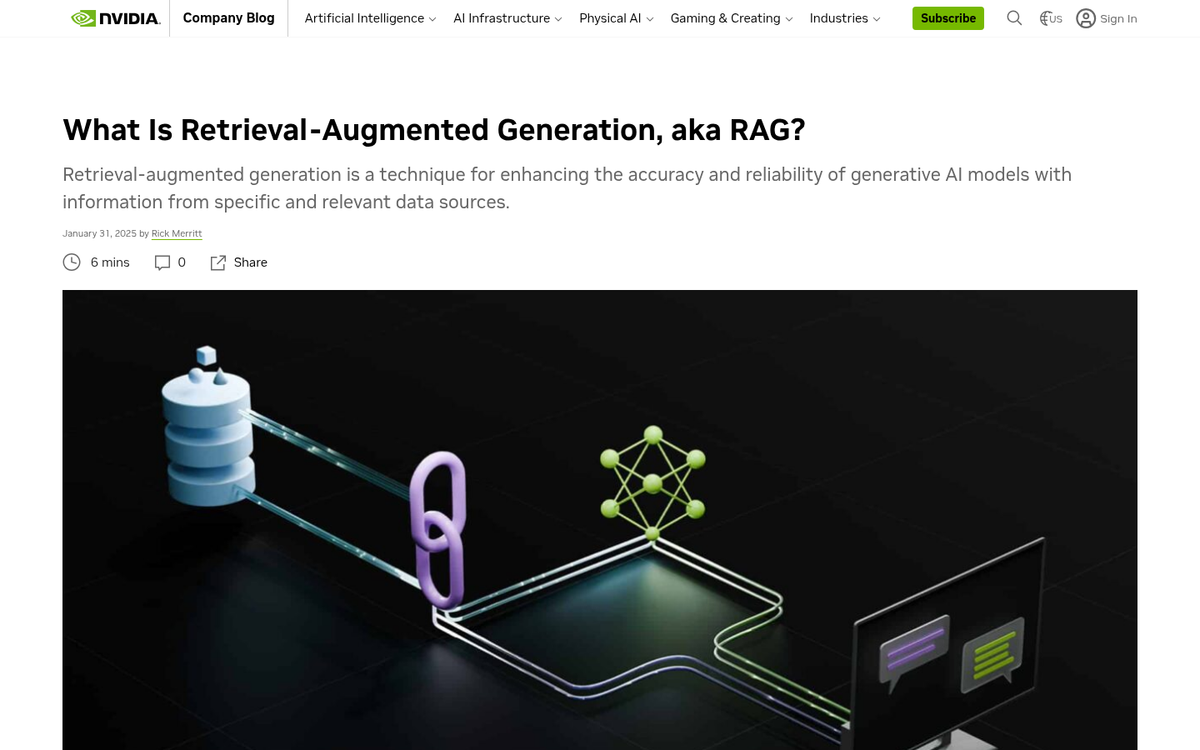
When you ask ChatGPT or Perplexity a question, the answer you get doesn't come from a live web crawl - it comes from a retrieval process that pulls stored knowledge, matches it to your intent, and feeds it into the AI's response. That retrieval step is where vector databases do their work.
The framework behind this is called Retrieval-Augmented Generation, or RAG. An AI model retrieves relevant content from a vector database before it generates a response, which grounds the answer in information instead of guessing. According to the 2024 Menlo Ventures State of Generative AI report, 51% of business AI implementations use RAG. That number is climbing.
RAG exists because AI language models have a knowledge cutoff and can't know everything. By connecting a model to a vector database, developers let it look up relevant, up-to-date content at the moment a question is asked. The model then uses that retrieved content to build its answer.
This is where semantic search becomes important. Traditional keyword search looks for exact or close word matches. But vector search understands meaning. A keyword system might miss a post about "how to lower monthly expenses" when someone searches "save money on bills," but a vector search will connect those two because the meaning is the same. That difference is significant for AI answer engines.
Why Meaning Matters More Than Keywords Now
They don't reward content that repeats a keyword fifteen times - they reward content that legitimately answers the question behind the search. Auto-sharing tools can help surface that content more widely once it's written well.
Vector search makes this possible by embedding content as mathematical representations of meaning. When a user's query is also converted into that same vector space, the system finds content that's semantically close to the question instead of just linguistically similar. The result is a more accurate match between what someone needs and what gets surfaced.
For content to rank well in this environment, its structure and substance matter in a new way. A well-written page with relationships between ideas will map into vector space more cleanly than a page stuffed with disconnected keywords. Logical, coherent writing is no longer just good practice - it's a functional benefit.
This also can affect how AI tools choose which sources to pull from when they generate answers. Relevance, in the semantic sense, is the new currency. Understanding why engagement metrics don't always reflect true reach is part of seeing the full picture.
The criteria for visibility in AI-generated answers is different from traditional search ranking, and that difference is the first step to doing something helpful about it.
What Website Owners Can Do to Stay Visible in Vector-Powered Search
The way AI systems retrieve content has consequences for how your pages get found and used. If a retrieval system is matching meaning instead of keywords, then writing a page that repeats the same phrase twenty times won't help you rank in an AI-generated answer. The systems looking at your content are looking for depth, context, and conceptual clarity.
The most helpful thing you can do is structure your content around questions and concepts instead of search terms alone. Think about what a person actually wants to understand, and then explain it in plain language. Complete thoughts matter here - a sentence like "a vector database stores data as numerical representations to enable semantic search" gives an AI retrieval system far more to work with than a bullet point that just says "semantic search storage."
Entities and definitions also carry weight in vector-based retrieval. When you name an idea, a tool, a process, or a person, it helps to briefly say what that thing is - this gives the system enough context to connect your content to related queries it hasn't seen before, which is how semantic matching works.
Semantic HTML is worth mentioning too. Proper heading tags, logical section labels, and well-organized content all help AI systems parse and chunk your pages accurately. A well-structured page is easier to retrieve from, and that matters when systems are pulling excerpts to build answers. If you're still building out your site's foundation, making sure you install SSL to improve your rankings is a basic step that supports visibility across both traditional and AI-driven search.
| Tactic | Keyword-Based SEO | Vector/AEO-Friendly Approach | Why It Matters |
|---|---|---|---|
| Content focus | Repeat target keywords frequently | Explain concepts fully and clearly | Vector systems match meaning, not frequency |
| Page structure | Optimize title tags and meta descriptions | Use semantic HTML and logical heading hierarchies | Helps AI systems to chunk and retrieve content accurately |
| Writing style | Short, keyword-dense phrases | Complete sentences with defined entities | Full context improves semantic matching |
| Answer coverage | Target one primary keyword per page | Cover related questions and subtopics together | Retrieval systems favor conceptually rich content |
The pitfall to watch for is content that looks good on the surface but doesn't actually say much. Pages padded with keyword variations and thin sentences may still perform in traditional search. But they get passed over when an AI system is looking for a substantive passage to pull into an answer. This is especially relevant for blogs trying to grow a successful presence on content platforms where AI curation plays a growing role.
The helpful change is to cover a topic with enough depth that a reader - human or AI - walks away with something.
Vector Databases Are Already Shaping What AI Knows About You
These developments have implications for anyone responsible for content. The next worthwhile step is an honest audit - not of keywords, but of conceptual being. Ask if your content expresses ideas, uses language that goes well with how people actually think about a topic, and covers the relationships between concepts instead of just listing surface-level facts. These are the properties that translate well into vector space; depth and coherence carry more weight than repetition.
The sites and sources that communicate meaning are the ones AI systems will return to. Building that being now is writing practice and a heavy duty investment in staying relevant inside an ecosystem that's only going to use semantics more heavily over time. If you're also thinking about reach, learning how to use Mix.com to promote your blog posts is one practical way to get meaningful content in front of more readers.
FAQs
What is a vector database?
A vector database stores content as numerical embeddings that represent meaning, allowing AI systems to find semantically similar information rather than relying on exact keyword matches.
How does vector search differ from keyword search?
Keyword search matches exact or similar words, while vector search matches meaning. A query about "saving money on bills" can return results about "lowering monthly expenses" because their embeddings are numerically close.
What is RAG and why does it matter?
RAG stands for Retrieval-Augmented Generation. It connects AI models to vector databases so they can retrieve relevant, current content before generating a response, grounding answers in real information.
How can website owners optimize for vector-based search?
Write content that fully explains concepts using complete sentences, define entities clearly, use semantic HTML, and cover related subtopics together. Depth and clarity matter more than keyword repetition.
Why does content structure matter for AI retrieval?
Well-structured pages with logical headings and semantic HTML help AI systems accurately chunk and retrieve content. Coherent, organized writing maps more cleanly into vector space than disconnected keyword-dense text.