




If you manage a website and you've been optimizing around keywords, this shift matters more than you might think. The old model rewarded pages that contained the right words in the right density. The new model rewards pages that mean the right thing - content that expresses ideas, answers questions, and is structured in a way that AI can interpret with confidence; it's a fundamentally different game, and vector search is how you learn the rules.
Traditional keyword search is losing ground to semantic, meaning-based retrieval. When someone asks an AI a question, that system isn't looking for your exact phrasing - it's looking for the closest conceptual match to the user's intent. Whether your content surfaces in that answer can depend on how well AI can encode and retrieve what you've written; it's the direct line between vector search and your visibility in AI-generated answers.
The sections ahead break down how vector search works, why it's central to Answer Engine Optimization, and - most importantly - what you can do on your own site to make sure your content is the kind AI reaches for first.
Quick Answer
Vector search is a method of finding similar items by comparing mathematical representations (vectors) of data rather than exact keyword matches. Each piece of data - text, images, audio - is converted into a numerical vector using machine learning models. Similarity is measured using distance metrics like cosine similarity or Euclidean distance. This enables semantic search, where results are based on meaning and context rather than literal word matches. It powers applications like recommendation systems, image search, and AI-driven retrieval in tools like RAG (Retrieval-Augmented Generation).
How Vector Search Actually Works (Without the Math Headache)
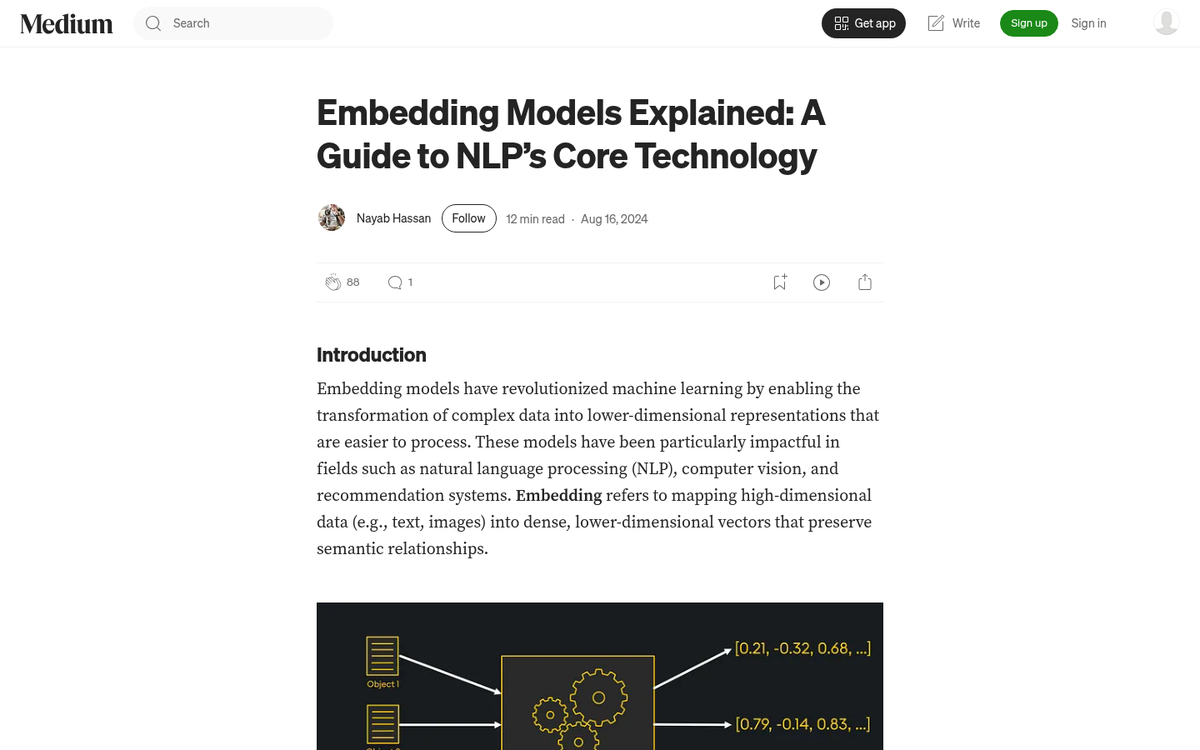
At its core, vector search is about turning words into numbers. An AI model reads a part of text and converts it into a long list of numerical values, which is called an embedding. That list of numbers acts as a coordinate, and it places your content at a point in a big mathematical space.
Kind of like a map where words and phrases get plotted based on their meaning. "Car" and "vehicle" would land very close together on that map because they mean roughly the same thing. "Car" and "banana" would be far apart. Distance on this map equals semantic difference, and closeness equals relevance.
When a user types a query into an AI-powered search tool, that query goes through the same process - it gets converted into its own embedding and placed on the same map. The search engine then looks for content embeddings that sit closest to it and treats those as the most relevant results.
That is what makes vector search fundamentally different from traditional keyword search. Old-school search engines look for exact or near-exact word matches. Vector search looks for meaning, so a page about "automobile maintenance tips" can still rank for "how to take care of my car" without sharing a single keyword.
What Are Dimensions, and Do You Need to Worry About Them?
Each embedding is made up of hundreds or thousands of numerical values, and each value is called a dimension. More dimensions usually means the model can capture more subtle differences in meaning. OpenAI's ada-002 embedding model, just to give you an example, outputs 1,536 dimensions for every part of text it processes.
You don't need to know what each dimension represents. Nobody does - not even the scientists who build these models. What matters is that collectively, those numbers capture the semantic weight of your content in a way that a search engine can measure and compare.
A page stuffed with keywords but thin on substance will produce an embedding that doesn't sit close to anything helpful. A page that closely addresses a topic in plain language produces an embedding that aligns well with the queries it deserves to rank for. This is one reason why building a blog around genuine expertise and useful content tends to outperform keyword-stuffing strategies over time.
Vector databases store these embeddings and run fast nearest-neighbor lookups at scale, which is what lets AI tools retrieve relevant content in milliseconds. The whole system is built to connect intent to information instead of string to string. That is a small technical distinction with very large consequences for how content gets found.
Why Answer Engines Rely on Vector Search to Pull Your Content
When someone asks ChatGPT, Perplexity, or Google's AI Overviews a question, those tools don't run a keyword search. They use vector search to find content that matches the meaning behind the question. That distinction matters quite a bit for anyone who wants their content to appear in AI-generated answers.
These answer engines are built to retrieve the most semantically relevant content they can find and then synthesize it into a response. Your content either fits that retrieval process or it doesn't. There's no middle ground where you rank because you used the right phrase ten times.
A lot of content falls short here. A page can rank well in traditional search because it hits the right keywords, but still be invisible to an answer engine because it doesn't have enough semantic depth. The engine can't find a strong meaning match between your content and the question being asked.
It's worth asking if your content is written for keywords or for meaning. Keyword-focused content tends to answer one narrow question in a formulaic way. Semantically rich content covers a topic with enough context, nuance, and related ideas that the vector representation it produces is a close match to a number of related queries.
Answer engines also favor content that shows depth of a subject. If your page about a product only lists features, it's less likely to be retrieved when someone asks how that product solves a problem.
The relationship between your content and these AI tools is worth taking seriously. Perplexity, as one example, actively pulls from web content to construct answers and cites its sources. If your content is semantically lined up with the questions your audience asks, you have a chance to be one of those sources. If it's not, another page will fill that space.
Google's AI Overviews work in a similar way. They don't pull from pages that rank first. They pull from pages that best answer the question in a contextually relevant way. A page at position six can be featured in an AI Overview if its semantic match is stronger than the pages above it. This same shift in how search works has implications for whether older SEO-focused blog plugins still hold value.
These tools are not reading your content the way a human does. They're measuring how well your content's meaning aligns with a question's meaning. That process happens at a level that keyword density and meta tags can't change.
The difference between traditional SEO and Answer Engine Optimization comes down to this: one game is about words and the other is about meaning. Your content needs to be built for the latter if you want answer engines to find and use it.
Structuring Your Content So Vector Search Can Find It
Making your content work well with vector search doesn't mean starting from scratch- it means writing with more context and less assumption about what the reader already knows.
The biggest thing to get right is semantic meaning. A page about "project management software" that only lists features will score poorly in a vector search because it doesn't answer a question. A page that explains what the software does, who it helps, and what problems it solves gives a model something to work with.
Write the way people talk when they want answers. Someone looking for help with invoice disputes isn't typing "invoice dispute resolution B2B." They're asking something like "what do I do if a client won't pay an invoice?" Your content should match that natural phrasing because vector models are trained on conversational language and respond to it well.
Cover your topics with enough depth to be legitimately helpful. Thin content that grazes the surface of a topic tends to produce vague embeddings that don't match much. Richer content - where you talk about an idea, address related questions, and add context - creates embeddings that are more accurate and easier to retrieve.
It also helps to be explicit about your subject at the start of each page or section. Don't bury the point. If a page is about tenant rights in commercial leases, say that directly in the first sentence. Vector models don't need keyword density. But they do need enough context to place your content in the right conceptual space.
The table below shows how the same topic reads differently when written for keywords versus written for semantic meaning.
| Keyword-Optimized | Semantically Rich |
|---|---|
| Best accounting software for small business | A guide to choosing accounting software when you're running a small business without a dedicated finance team |
| Fast shipping options available | How to get orders delivered within two days and what affects delivery times during busy periods |
| HR software features list | What HR software actually handles day-to-day, from onboarding paperwork to tracking time off requests |
| Dog training tips | Why dogs repeat unwanted behaviors and how to redirect them using positive reinforcement |
The semantically rich versions don't ignore search - they give the content a clearer job and a more specific audience. That combination is what vector models are built to find.
If you want to test how your content performs as an embedding, the cost is very low. Running content through an embedding model currently costs less than $0.02 per million tokens, so experimenting with pages from your site is accessible for most budgets. It's worth applying the same thinking to how you structure monetized pages, since clearer content tends to perform better across the board.
Start with your highest-traffic pages and ask if each one answers the question a reader might arrive with. That single question will point you toward most of the changes worth making.
Your Content Means More Than Your Keywords Now
The vector database market reached $2.55 billion in 2025 and continues to climb at a fast pace, because of the growing demand for AI-native applications that need fast, semantically aware retrieval. Organizations across every industry - e-commerce and healthcare to media and business software - are investing in vector infrastructure because the competitive difference between semantic search and keyword search is becoming too wide to ignore.
The most helpful thing you can do is audit your existing content through a semantic lens. Your best content may be invisible to users because the language on the page doesn't match how those users think and ask. Closing that gap is where vector search delivers its clearest, most immediate value. Start there, and the path forward is much easier to see. If you're also looking to extend your reach, learning how to use Mix.com to promote your blog posts can help surface content to audiences you might otherwise miss.
FAQs
What is vector search and how does it work?
Vector search converts text into numerical coordinates called embeddings, placing content on a conceptual map. Search engines then find content whose coordinates sit closest to a user's query, matching meaning rather than exact words.
How is vector search different from keyword search?
Keyword search matches exact or near-exact words, while vector search matches meaning. A page about "automobile maintenance" can rank for "how to care for my car" without sharing a single keyword.
Why does vector search matter for AI-generated answers?
Answer engines like ChatGPT and Perplexity use vector search to retrieve semantically relevant content. If your content doesn't closely match the meaning of a user's question, it won't appear in AI-generated responses.
How should I write content to perform well in vector search?
Write conversationally, address questions directly, and cover topics with enough depth and context. Avoid thin, keyword-stuffed content, as it produces vague embeddings that don't align well with user queries.
Can older pages rank in AI Overviews despite lower search positions?
Yes. Google's AI Overviews pull from pages with the strongest semantic match, not necessarily the highest-ranked ones. A page at position six can be featured if its meaning aligns better with the question.