




Here's the short version: search engines no longer work by simply matching the words in a query to the words on a page. They've evolved to know meaning - the intent behind a search, the relationships between concepts, and the context a user is operating in. That change is what semantic search refers to, and it has quietly influenced what it means to create content that performs well online.
For website owners and managers, this matters more than ever. If your content is built around keywords alone, those systems are going to have a hard time with it. If it's built around well-structured meaning, you're in a much stronger position.
This glossary entry will explain what semantic search means, why it became the standard, and what it practically means for the way you structure your content and site. No technical language, no assumptions about your background - just a clear explanation you can use.
Quick Answer
Semantic search is a data searching technique that understands the intent and contextual meaning behind a query, rather than just matching keywords. It uses natural language processing and machine learning to interpret relationships between words and concepts, delivering more relevant results. Unlike traditional keyword search, semantic search considers synonyms, user intent, and context to provide accurate answers. It powers modern search engines like Google and is used in e-commerce, knowledge bases, and AI assistants to improve information retrieval.
What Semantic Search Actually Means
Search engines look at intent, context and the relationships between words to return results that match what the person wants to find.
The word "semantic" relates to meaning and that's what this is about. A semantic search engine does not treat a query as a string of words to match against a page - it reads the query as a whole thought and tries to figure out the goal behind it.
Take the search "best shoes for standing all day" as an example. Someone typing that is almost certainly on their feet for work and wants comfortable, supportive footwear. They are not looking for a page that repeats that exact phrase over and over - they want helpful answers to a problem they have. A search engine with semantic understanding can tell the difference.
Context plays a big part here. The word "bank" means something different depending on the rest of the sentence and search engines have become very good at picking up on those distinctions. They use signals from the full query, the user's location, their search history and the wider topic to work out which meaning makes sense.
Relationships between words matter too. Search engines understand that "running shoes," "athletic footwear," and "trainers" all point to the same general thing - it means a well-written page about comfortable footwear for nurses can rank for searches it never directly mentions, because the meaning is there even if the exact words are not.
This also changes what it means to write content. A page that answers a question in a natural way tends to perform better than one built around keyword repetition. That is not an accident - it's what semantic search was built to reward.
It is worth mentioning that semantic search is not a single feature or tool - it's a framework for how modern search engines interpret language and it's baked into how results get ranked. Google's BERT and MUM updates are two well-known examples of the technology that powers this language understanding at scale. This kind of understanding is also part of why zero-click search has become so common in modern results.
How Semantic Search Differs From Keyword-Based Search
Keyword-based search works how it sounds. You type in a phrase and the search engine looks for pages that have that phrase - it's a matching game, and for a long time, it worked well enough.
But it treats language like a list of tokens to match instead of a thought to understand. So if someone searches "my dog won't eat," a keyword system looks for pages with those exact words - it doesn't ask what the person actually needs, which could be advice about a sick pet or tips to make dry food more desirable.
Semantic search takes the intent behind a query and uses that to find the best result - it connects related ideas, so a page about "loss of appetite in dogs" can rank for that search even without the exact phrase. The match is based on meaning, not wording.
This represents a change from how content used to get ranked. For years, the standard playbook was to repeat the target phrase as many times as possible throughout a page. That strategy sent strong signals to keyword-based systems. But semantic search has made it far less helpful.

The table below shows how the two strategies handle the same query differently.
| Query | Keyword Search Returns | Semantic Search Returns |
|---|---|---|
| Best way to sleep better | Pages with "best way to sleep better" in the text | Guides on sleep hygiene, habits, and routines |
| My dog won't eat | Pages containing "dog won't eat" | Vet advice on appetite loss, food preferences, health causes |
| Cheap flights to Spain | Pages with "cheap flights to Spain" repeated | Budget airline comparisons, booking tips, low-cost routes |
In practice, a page written to legitimately help will perform better than a page written to hit an exact phrase repeatedly. Search engines have become much better at reading context and what a topic actually covers. There are practical ways to make your blog posts more effective by writing for meaning rather than chasing exact matches.
Keyword stuffing stopped working - it can now work against you. A page with repetitive phrases can look thin and low-value to a semantic system that's built to read between the lines.
The Technology That Powers Semantic Understanding
A few different technologies work together to make semantic search possible, and understanding them at a basic level helps explain why search engines have become better at reading context.
Natural language processing, or NLP, is one of the foundations - it lets a search engine read a query the way a person would - picking up on word order, phrasing, and implied meaning instead of treating each word as a separate signal. NLP helps the engine understand that "places to eat near me that are good for kids" is a single connected request - not five separate keywords to match.
Entity recognition builds on that. Instead of seeing words, the search engine identifies things - places, businesses, concepts - and understands that those things have relationships with each other. "Apple" the company and "apple" the fruit are two different entities, and the engine uses surrounding context to tell them apart without needing you to spell it out.
Then there's knowledge graphs, which are basically large maps of how topics connect. Search engines use these to link related ideas together so a question about one thing can pull in relevant information from connected topics - it's less about matching text and more about what information logically belongs together.
All of this comes together to create a system that works with language the way humans use it - with gaps, assumptions, and shortcuts included. It's an actual technical achievement, and it explains why the industry behind it has grown so fast.
The technology is also improving at a fast pace. As training data grows and models get better at handling nuance, search engines become more capable of interpreting intent even when a query is vague or unusual. The gap between what someone types and what they want to find grows smaller.
For anyone publishing content online, this has implications for how that content gets found and interpreted - which is what the next section covers.
What Semantic Search Means for Your Website Content
If your content strategy has mostly been about placing the right keywords in the right places, you're working with half a picture. Semantic search doesn't ignore keywords. But it looks at quite a bit more than that.
A page that covers a subject in depth will do better than one that repeats a keyword twenty times without saying much.
Topical authority matters more than keyword density
When a site covers a topic well across multiple pages, search engines start to see it as a reliable source on that subject. This is what's meant by topical authority, and it's worth keeping in mind when you plan your content. A single well-optimized page is less helpful than a group of pages that all connect around the same theme and answer different questions a reader may have.
You want to see what your audience actually wants to know and build content that answers those questions. Short, thin pages that just hit a keyword and move on don't give search engines much to work with. If you're worried about how certain content decisions look to Google, it's worth thinking about quality signals across your whole site.
Structure and meaning signals
This is where schema markup comes in. Schema is a type of code you can add to your pages to tell search engines what the content represents - a product, a recipe, a FAQ, or a business address - it doesn't change what visitors see. But it gives search engines a much clearer signal about the meaning and context of your content.
Even without schema, the way you structure your writing matters. Clear headings, direct answers, and related ideas kept together all help search engines parse your content more accurately.
Full questions deserve full answers
One helpful change you can make is to write content around questions instead of just topics. Instead of a page about "kitchen appliances," a page that answers "what kitchen appliances do I need for a small space" gives the search engine something more helpful to work with - it matches the way people actually search and gives your content a defined job. That combination of meaning, structure, and depth is what semantic search rewards. Tools like Long Tail Pro can help you find the question-based phrases worth targeting in the first place.
How Semantic Search Connects to AIO and AEO
AI Overviews and Answer Engine Optimization didn't come out of nowhere. They are direct products of search engines being good enough at meaning to generate answers on the fly. If you don't have that semantic foundation, these features basically wouldn't work.
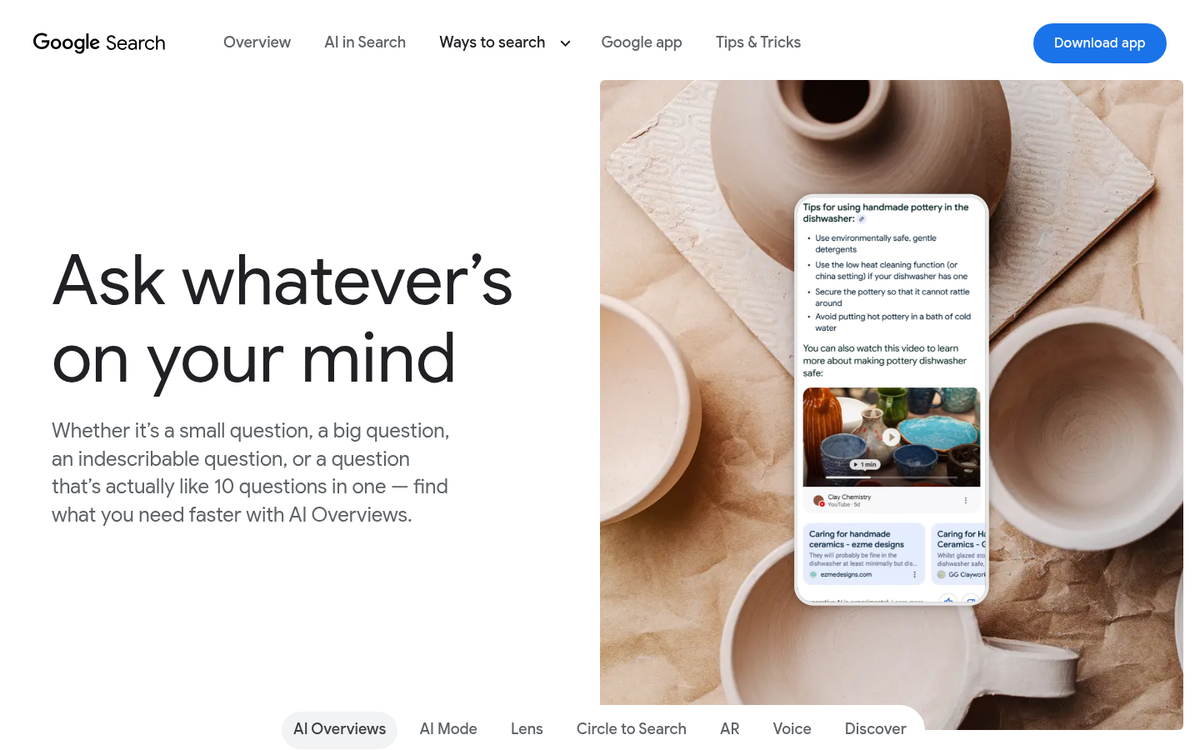
AI Overviews (AIO) are the AI-generated summaries that appear at the top of Google results for searches. Google doesn't pull a single page to show you - it synthesizes information across multiple sources to build a response.
Answer Engine Optimization (AEO) is the practice of structuring your content so it gets selected for those direct answers - this includes featured snippets, knowledge panels, and voice search results as well. The common thread is that these formats reward content that answers questions in a way a machine can read and understand.
Content written with context, logical structure, and well-defined entities already lays the groundwork for AIO and AEO - it's the same work, just with a clearer destination in mind.
| Feature | What It Relies On | Content Goal |
|---|---|---|
| Traditional SEO | Keywords, backlinks, technical signals | Rank on the results page |
| AEO | Semantic clarity, structured answers, context | Get featured as a direct answer |
| AIO | Trustworthy, semantically rich content across the web | Be sourced in AI-generated responses |
Traditional SEO still matters. But it was built for a system that matched queries to pages. AEO and AIO are built for a system that matches queries to answers; it's a difference in what your content needs to do.
To show up in AI-generated replies, your content needs to be the kind that a language model can draw meaning from and trust. That means covering topics with depth, being factually grounded, and making your intent easy to read. Getting Google Sitelinks on your blog is one signal that your content structure is already working in your favor.
Semantic search is the engine underneath it. AIO and AEO are where that engine takes you when your content is built well enough to make the trip.
Where to Start if Your Site Isn't Semantically Optimized Yet
Semantic optimization is a standard, ongoing change - not a box to check once and forget. Search engines get better at language, context and intent with every update, which means the bar for legitimately helpful content will only rise. The good news is that the core principle is simple: create content that actually means something to people, and the algorithms will follow.
FAQs
What is semantic search in simple terms?
Semantic search is how modern search engines understand the meaning and intent behind a query, rather than just matching exact words. It considers context, related concepts, and user goals to return the most relevant results.
How does semantic search differ from keyword-based search?
Keyword search matches exact words in a query to words on a page. Semantic search understands the intent behind a query, allowing pages to rank for related searches even without using the exact phrase.
Does keyword optimization still matter with semantic search?
Keywords still play a role, but keyword density matters far less than it used to. Semantic search rewards content that covers a topic in depth and answers real user questions, rather than repeating phrases repeatedly.
What technologies power semantic search?
Semantic search relies on natural language processing (NLP), entity recognition, and knowledge graphs. These technologies help search engines understand context, identify real-world concepts, and connect related topics intelligently.
How does semantic search relate to AI Overviews?
AI Overviews are a direct result of semantic search technology. Google synthesizes answers from multiple sources, favoring content that is semantically rich, well-structured, and clearly answers the user's question.