





When you're running a website, you want to monetize it. When you want to monetize your website, you want to use a kind of advertising that will get you as much money as possible.
Now, CPM ads are about the bottom end of this spectrum. These are display ads; advertising that pays you when real users see the ads, and don't care whether or not they're clicked. CPM display ads pay less than other kinds of ads, like CPA, CPC, or Affiliate advertising. On the other hand, you have to do the least amount of work to monetize your audience. You don't have to convince people to click, you just have to get eyes on page.
Also, it's worth noting that what we're talking about today isn't strictly CPM. CPM, or Cost Per Mille, usually refers to the amount an advertiser pays to show their ads. The CPM of an ad network, then, is the amount of money you pay to show your ads to a thousand people.
When you're talking about running display ads and earning money - or specifically about the payout rates of an ad network - you're talking about the RPM of the ads. This is the Revenue Per Mille, or the amount of money you make per thousand views.
RPM and CPM are not the same. The ad network you're using will always be taking a cut of the profits, unless they're charging the advertiser for additional services. You often read an ad network talking about paying 80% rates, or what have you; this is the amount you get from what the advertiser pays. If an advertiser pays the ad network $100 for 1,000 views, their CPM is $100. If the ad network then pays you $80 for 1,000 views, your RPM is $80. The ad network has taken a 20% cut of the transaction.
This is, incidentally, why many sites opt to sell their ad space manually or on an open market. If you do the legwork yourself, you can earn more because the ad network isn't taking a cut. On the other hand, that means investing the time and effort of managing your advertisers yourself, which also means implementing fraud protection and other systems to maximize the quality of your traffic. There are tradeoffs with every transaction.
Key Takeaways
- Australia leads YouTube CPM rates at $36.21, followed by Norway at $20.17 and Germany at $18.79.
- CPM and RPM differ significantly; ad networks typically take a percentage cut before paying publishers.
- Numerous factors affect CPM rates, including traffic country, language, ad placement, device type, and content industry.
- CPM data varies widely depending on methodology; Facebook CPM figures ranged from $4.29 to $20.48 for the US alone.
- Artificially targeting high-CPM countries rarely works, as traffic quality and audience relevance heavily influence actual payouts.
Mitigating Factors
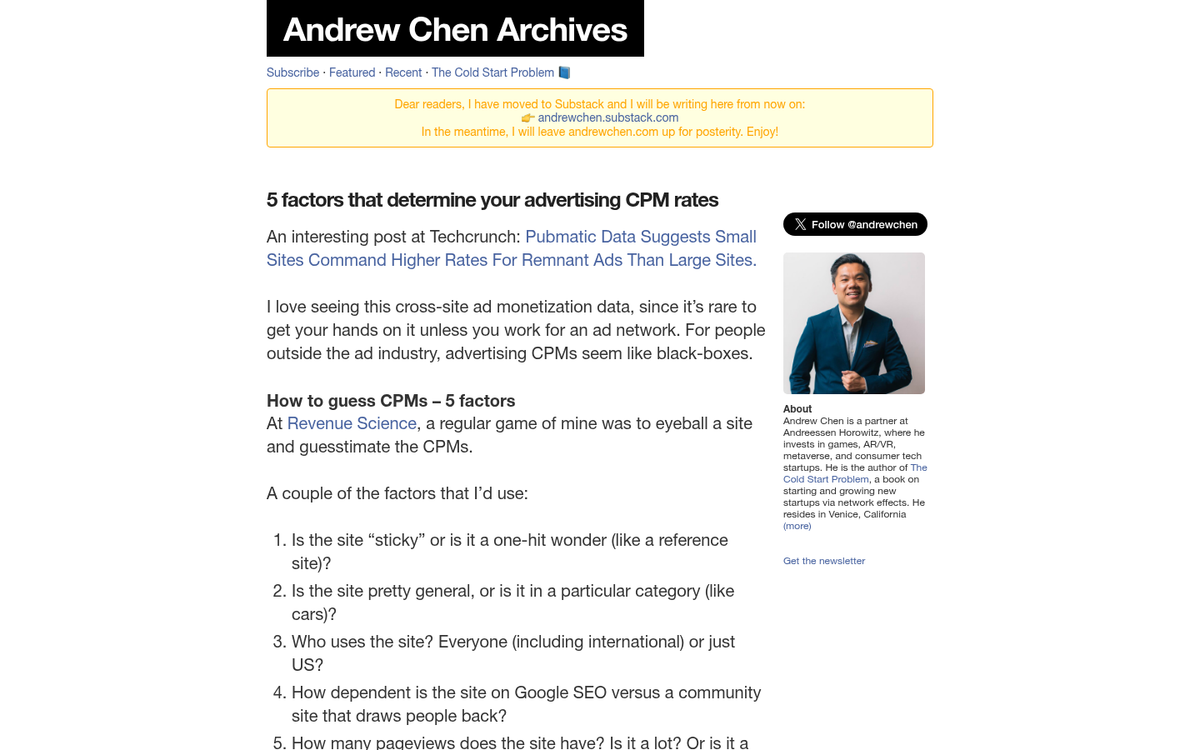
There are, to put it simply, a ton of different factors that go into the calculation to determine your CPM.
Here are just some of them:
- Ad Network. Every ad network will have different CPM rates, even for the same site. This is because they calculate everything based on all of the other factors, up to and including the size and demographics of their advertisers. The same site will get different RPM on different ad networks, even without changing a thing.
- Country of Traffic. The main focus of this article, the country your traffic comes from tends to have a huge impact. Some countries pay better than others, though of course that in turn depends on how well suited the traffic you refer is to that country. If you're a website in Spanish talking about Spain tourism, you're going to get the best ad rates from a Spanish-focused advertising network, rather than something like AdSense.
- Language of Traffic. Similar to the country of traffic, the language of the traffic matters. Generally English-language content will pay the best, though it also often pays the worst depending on competition and niche. As usual, suiting your language and location to the content is ideal. In some areas, secondary languages are useful and can be valuable, such as Spanish content in states bordering Mexico, or French content in ads that target Quebec.
- Display Location. Ads showing above your content in a top bar are going to make more money than ads showing in the footer. Ads in the sidebar are generally, but not always, going to make more than ads showing sporadically within content. The display location matters significantly, and with the rise of Core Web Vitals as a ranking factor, you also have to balance ad placement against page experience scores.
- Device Type. PC ads and mobile ads have different rates, and this will in turn affect rates from other elements on this list. Mobile now accounts for the majority of web traffic globally, but desktop users still tend to convert at higher rates, which influences CPM accordingly.
- Site Statistics. All kinds of demographics and statistics go into calculating the RPM of your potential ads. If you have a lot of traffic, or are highly positioned in your industry, you can likely command higher rates than much smaller sites and generalist blogs. If you have a narrow demographic, your users are more valuable to certain advertisers, and you can get higher rates from those - but lower rates from less relevant advertisers.
- Traffic Volume. Worth noting separately, the more traffic you have, the more doors are open to you. Many of the best, highest paying display advertising networks will only work with sites that have 500,000 or more monthly average views. Some start at a million. These tend to command a premium, because they're large and valuable to advertisers. Smaller sites have to make do with smaller payouts.
- Content Industry. Different general industries tend to have different average rates. Finance, legal, and insurance content tends to have high CPM rates due to the average value of a conversion. Entertainment, gaming, and food content tends to sit lower on the spectrum for the same reason.
- Spam Percentage. The more bots and the more fake views your site sends, the lower your rates are going to be. Beyond minor variance, if you refer too much invalid traffic, most ad networks would rather ban you from their network entirely than deal with the potential reverted payments or unhappy advertisers. Invalid traffic detection has also gotten significantly more sophisticated in recent years, so this is harder to game than it used to be.
So as you can see, there are far too many factors to reliably say anything about any rate. You can isolate one factor and show some metrics for it, but those metrics can have a very wide range based on the other factors.
Looking Into Data

There are a ton of different sources of data for average CPM and RPM rates, and as of 2026 we have more robust data sets than ever before. That said, it's still pretty hard to get a perfectly consistent source of reliable data. Everyone has to work off of the data set available to them, and platforms like Google aren't exactly publishing full transparency reports on their rates.
YouTube CPM rates are among the most closely tracked, and recent 2024 data puts some clear leaders at the top. Australia leads at an impressive $36.21 CPM, which is a striking number and one of the highest reliably reported figures for any major country. Norway comes in at $20.17, Germany at $18.79, Hong Kong at $17.23, and South Korea at $8.88. The United States, while not always at the very top of raw CPM lists, remains one of the most consistent and high-volume markets, making it extremely valuable in aggregate even when individual CPM figures vary.
The Australia figure is worth pausing on. It's high, but context matters here just as it always has. If your content doesn't naturally attract Australian viewers, you're not going to magically earn $36 CPM just because that number exists. Your actual earnings depend on who is watching, not just what rates are theoretically possible.
Facebook Ads CPM tells a slightly different story depending on which data set you look at. One 2024 analysis puts the United States at $20.48 CPM, Canada at $14.03, and Australia at $11.04. European markets like Austria, Belgium, Switzerland, Germany, and the UK cluster in the $9.18-$10.85 range, while Asian markets like Japan, South Korea, and Singapore fall in the $7.09-$8.66 range.
However, a separate Metricool analysis of over 26,000 ad accounts from early 2024 tells a more conservative story: the UK led at $5.98, Germany at $5.33, and the US at $4.29. This variance highlights exactly the problem with CPM data: the numbers shift dramatically based on methodology, time period, industry vertical, and audience targeting. Neither figure is wrong - they're just measuring different slices of the same ecosystem. If you're comparing ad formats, it's also worth understanding whether CPC or CPM ads are actually better for your specific situation.
What's changed most significantly since the early days of display advertising is the dominance of programmatic advertising and AI-driven ad targeting. Platforms are now much better at matching ads to audiences in real time, which has generally pushed CPMs up for high-quality, brand-safe content and pushed them down for lower-quality or harder-to-categorize content. If you're in a well-defined niche with an engaged audience, this shift has probably helped you. If your traffic is broad and unfocused, you may have seen the opposite effect - and high click counts with low earnings can be one frustrating symptom of that mismatch.
Overall Conclusions

I can list off a list of countries with the "highest" CPM payout rates, but honestly the raw numbers only tell part of the story. From what the data consistently shows across platforms, the strongest performers tend to be Australia, Norway, Germany, the United States, Canada, and a cluster of Northwestern European countries like the Netherlands, Switzerland, Sweden, and the UK.
Australia in particular has emerged as a standout on YouTube, which wasn't always the case in older data sets. If your content naturally appeals to Australian audiences, that's worth paying attention to.
That said, your best CPM rates will depend heavily on where you fall amongst all of those mitigating factors mentioned above. Chasing high-CPM countries by artificially targeting them rarely works out, because the traffic quality signals and audience relevance still factor heavily into what you actually get paid. The only reliable way to find out what your rates look like is to run ads for a meaningful period of time and dig into your own analytics data.

5 responses
Thoughtful replies only - we moderate for spam, AI slop, and off-topic rants.
Very good information about cpm
"The fact is, it's not necessary to drive lots of traffic if you are getting high CPC rates."
Great point, Bobby! You're absolutely right that high CPC rates can make a huge difference - quality over quantity! However, it's worth noting that the article focuses specifically on CPM, which *is* traffic-dependent since you earn per thousand impressions. The good news is that combining both strategies - targeting high-CPM regions AND high-CPC niches - can really maximize your earnings. So you don't necessarily have to choose one or the other!
How about this year on 2022
Great question, ibnu! CPM rates in 2022 have seen some interesting shifts, especially with increased digital ad spending post-pandemic. Countries like the USA, UK, Australia, Canada, and Norway continue to top the charts with some of the highest payouts. Rates can also vary depending on your niche and traffic sources. We'll look into updating the article with the latest 2022 data soon!