Web hosting is perhaps one of the most important but least monitored aspects of SEO. A good web host makes the difference between a strong foundation and a weak one. Your web host needs to fit your needs now, as well as your potential needs as you grow throughout the life of your site.
Key Takeaways
- Web hosting significantly impacts SEO; uptime, speed, and TTFB are critical ranking factors, especially with Google's Core Web Vitals.
- Cloudways delivers TTFB under 100ms and 96% customer satisfaction, making it the top performance pick for SEO-focused sites.
- Dedicated or managed cloud hosting is generally recommended over shared hosting for better resources, IP control, and customization freedom.
- GreenGeeks stands out for offsetting 3x its energy consumption while still delivering competitive speed and solid Core Web Vitals performance.
- Backup policies matter; ensure your host supports automated backups, as some providers permanently delete data after payment issues.
What Makes a Good Web Host?

There are a lot of possible criteria in play when choosing a web host. You need to determine what factors are important to you, and what thresholds you need to meet in order to approve of a host. Let's go over some of those factors now.
First of all, you need to know what you need out of a web host. Since you're looking for fast SEO hosting - assuming you paid attention to the title when you came here - I can assume you're building some kind of SEO-focused site. That means a blog and, probably, some kind of e-commerce functionality. Keep in mind that WordPress alone now powers roughly 43% of the entire web and nearly 60% of all CMS-driven sites, so chances are you're building on WordPress.
I will almost always recommend a dedicated server or managed cloud hosting over shared hosting, but sometimes you have budget constraints that make it unfeasible. With a dedicated or cloud-based host, you get your own resources and IP address. Shared hosting shares your IP address with other sites, doesn't give you as much freedom, and limits your customization.
In general, shared hosting is going to be cheaper but less robust. If you have a large site you're migrating over, you have custom configurations you need, or if you want total control over your site, go with a dedicated or managed cloud host. If you're starting from scratch and don't care about customization - like if you're using out of the box WordPress with a few plugins - you don't need more than a mid-tier shared host to start. Remember, of course, you can always upgrade later.
You will also need to determine if the host provides the environment you're looking for. That means Windows or Linux as the environment, it means versions of software like PHP, and so forth. Most hosts will be fine unless you have specific configurations you need for your site.
The second thing you need to look for is host uptime and speed. One of the most important SEO factors when it comes to a web host is uptime, but in 2026, raw speed matters just as much. Google's Core Web Vitals have made Time to First Byte (TTFB) a meaningful ranking signal. Every minute your site is down - or just slow - you're losing business. Research shows that 50% of consumers who found a store's products on search pages visited that business within one day, so slow load times have real-world consequences beyond just rankings.
You should also take a look at pricing. A lot of times, you'll get a nice, low introductory price, but the host will lock you in to a contract and have a steep cancellation fee, as well as a higher than normal renewal. Thankfully, the hosts I'm going to suggest on this list are reasonably transparent about pricing, but there will always be some difference between the introductory rate and the renewal rate.
You should also look at the sort of policies the web host has for data backups and restoration. A friend of mine had an issue with BlueHost, for example, where a single late payment led to a complete deletion of several websites, with no possibility of recovery.
I bring this up not because you should look for a web host that backs up your data for you, but because you need a host that allows some form of backup automation, whether it's their own, a cron job, an auto script, or something else of the sort. Needless to say, you should make sure to make regular backups yourself.
One factor you can generally ignore, at least among reasonable web hosts, is disk space and data transfer capacity. Disk space is the amount of space your website is allowed to take up, and it's going to be more than enough on virtually every web host unless you're going out of your way to find an absolutely terrible shared host. Transfer bandwidth is also likely going to be higher than you need unless you're the target of a DDoS, and if you are, your host should help mitigate it rather than just charge you for it.
There are other possible factors you might consider, like what e-commerce platforms they support, what their customer support looks like, and what the terms of their contract are, but they will largely be similar amongst top tier web hosts. What you need will vary depending on what your site's purpose will be, which is why I'm providing you with seven of the best web hosts out there; I can't recommend one and be right for everyone. You may also want to consider using a free CDN to help speed up your site regardless of which host you choose.
Now, on with the host list itself.
Cloudways

Cloudways has firmly established itself as one of the top managed cloud hosting platforms for SEO-focused sites in 2026. Rather than owning their own hardware, Cloudways lets you deploy on top-tier cloud infrastructure from providers like DigitalOcean, AWS, and Google Cloud. Their plans start at around $14 per month, scaling up depending on the cloud provider and server size you choose.
What makes Cloudways stand out from an SEO perspective is raw performance. Cloudways consistently delivers TTFB under 100ms - and in many configurations, under 90ms - which puts it in elite territory for Core Web Vitals performance. Google's crawl budget and ranking signals respond well to fast TTFB, making this a serious competitive advantage for SEO-heavy sites.
Their customer support earns a 96% satisfaction rating, which is exceptional in an industry where support quality varies wildly. They offer automated backups, free SSL, a built-in CDN add-on, and one-click staging environments. For managed WordPress hosting in particular, Cloudways is hard to beat.
The main downside is that Cloudways is not a beginner-friendly platform. The interface assumes a moderate level of technical knowledge, and you won't find a traditional drag-and-drop website builder here. There's also no domain registration, so you'll need to handle that elsewhere. But if pure SEO performance is your priority and you know your way around a hosting dashboard, Cloudways is arguably the best option on this list.
Namecheap EasyWP
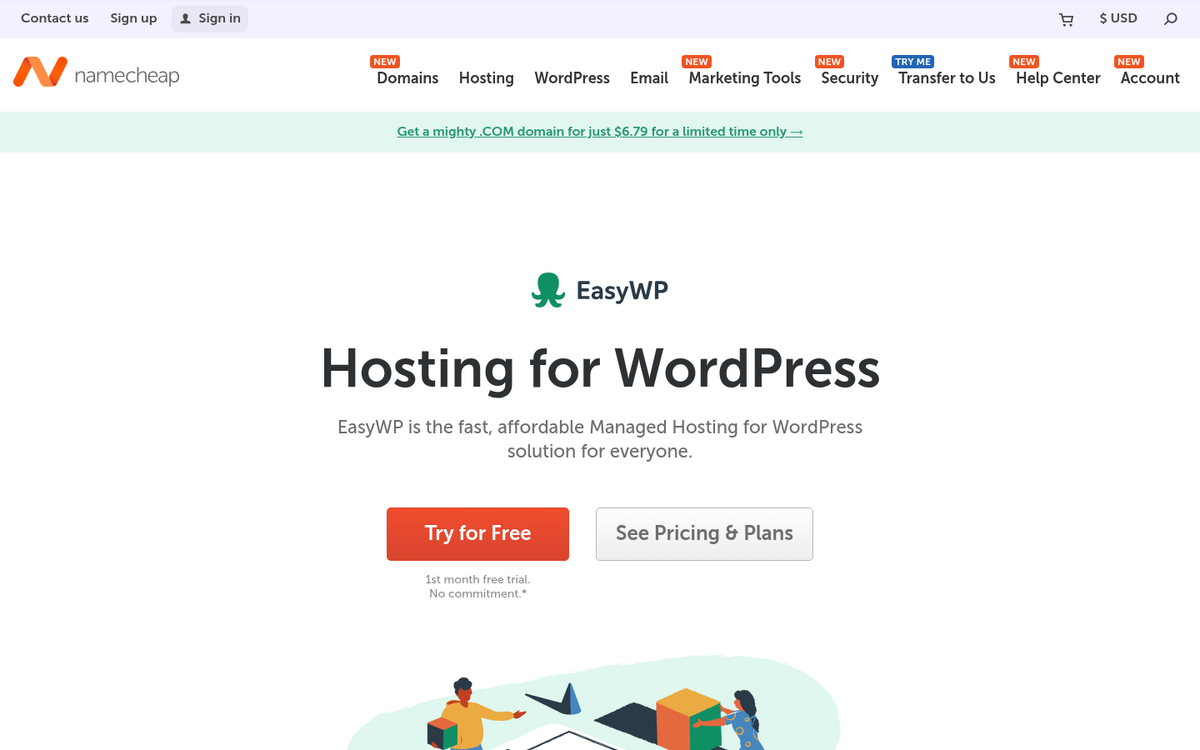
Namecheap is widely known as a domain registrar, but their EasyWP managed WordPress hosting has become a genuinely strong contender for SEO hosting in its own right. Their EasyWP plans start at around $3.88 per month, making it one of the more affordable managed WordPress options available.
From a performance standpoint, Namecheap EasyWP loads a full page in approximately 0.7 seconds with a TTFB of around 192 milliseconds - solid numbers that hold up well against the competition and support healthy Core Web Vitals scores. For budget-conscious site owners who don't want to sacrifice speed, this is a strong value play.
EasyWP is purpose-built for WordPress, which means setup is fast and straightforward. You get automatic updates, daily backups on higher tiers, free SSL, and a clean management interface. It's a particularly good fit if you're running a lean WordPress site and want managed hosting without paying a premium.
The downsides are mostly around scope. EasyWP is WordPress-only, so if you need flexibility to run other software or custom server configurations, you'll need to look at Namecheap's VPS or dedicated options instead. Support, while adequate, isn't as highly rated as Cloudways. Still, for an affordable, fast, and reliable managed WordPress host, Namecheap EasyWP earns its spot on this list.
DreamHost

DreamHost shared hosting starts at around $2.95 per month introductory, with managed WordPress hosting (DreamPress) starting at $16.95 per month. Their dedicated hosting runs approximately $169 per month. It's competitively priced across the board, and the unlimited data transfer on their higher tiers remains one of their strongest selling points for high-traffic or viral sites.
DreamHost does require more setup time than other hosts, so if you're in a hurry, you might want to look elsewhere. DreamHost is also a bit of an advanced platform; they don't make things simple for novice web builders. That means if you don't know what you're doing, it can be kind of daunting to get started.
All things considered, though, DreamHost has some very good features. They have a ton of additional security available, great VPS options, easy domain management, and a solid 100% uptime guarantee backed by service credits. They are also one of the few major hosts that are officially recommended by WordPress.org. Overall, it's a great option with a long track record of reliability.
Hostwinds
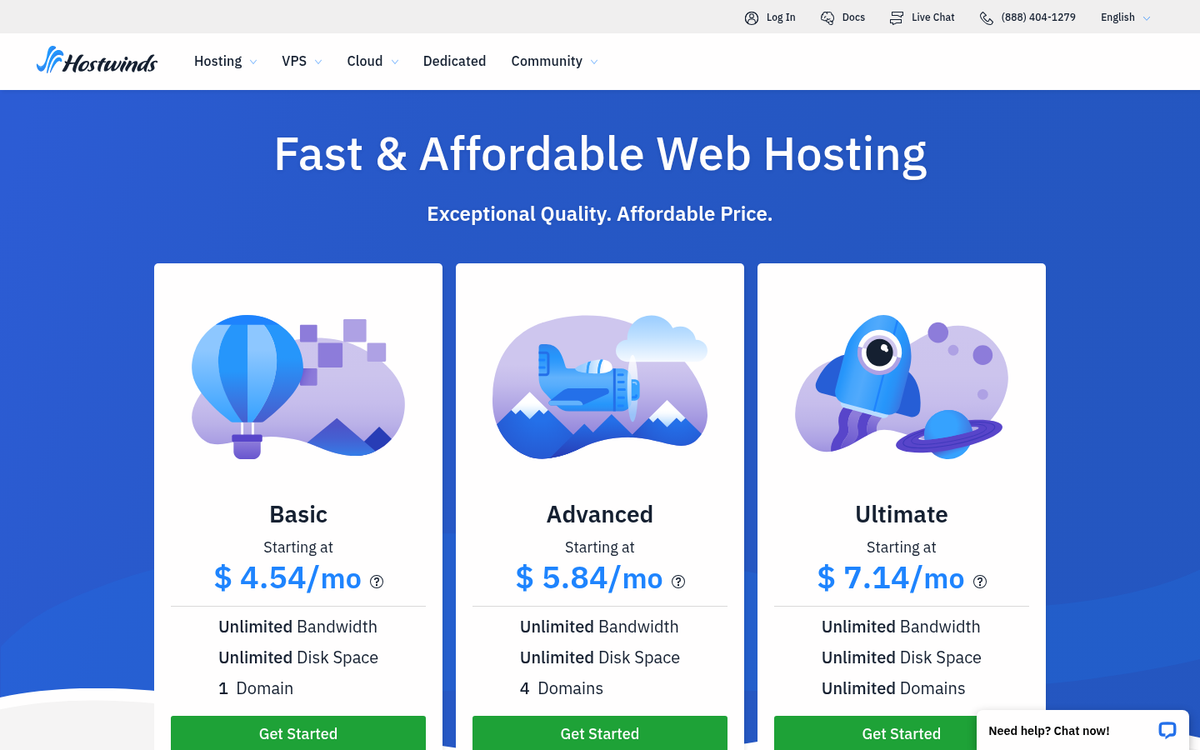
Hostwinds is not a name that comes up much in web hosting, but they've been increasingly prevalent over the last few years. Their shared hosting starts at about $6.99 per month, and their dedicated hosting runs you $122 monthly at minimum. You can, however, customize the hardware to give you better specs, which will run up a correspondingly higher bill.
Hostwinds is unique in that they have several different specialized offerings for their VPS systems and offer both Linux and Windows servers across their plans, which is always a welcome option. You also get unlimited monthly data transfers and unlimited email on most plans. They have solid uptime and responsive customer support.
The primary downside to Hostwinds is that they lack managed WordPress hosting, which in 2026 is increasingly becoming an expected feature. If you're comfortable managing your own WordPress environment, that's fine, but if you want a more hands-off experience, you'll want to look elsewhere on this list. For users who want flexible, customizable hosting with solid specs at a reasonable price, Hostwinds is still a reliable choice.
Liquid Web

Liquid Web is a premium host with one very clear target audience: high-traffic, resource-intensive sites that can't afford downtime. Their managed WordPress hosting starts at around $19 per month, and dedicated hosting starts at approximately $199 per month. This is not the place to start if you're on a tight budget.
Where Liquid Web shines is in the dedicated and VPS tiers. Their dedicated servers are highly configurable and can be scaled to extraordinary specs for enterprise-level needs. Their managed WordPress and WooCommerce hosting is particularly well-regarded, with a strong focus on performance and security out of the box.
Liquid Web offers both Linux and Windows systems, excellent VPS options that scale well, and what they call their "Heroic Support" - which is available 24/7 and is consistently rated among the best in the industry. At the end of the day, Liquid Web isn't for everyone, but once you've grown to the point where performance and reliability are non-negotiable, it's one of the best platforms available. If you're wondering why faster hosting doesn't always mean more traffic, that's a separate consideration worth exploring before upgrading.
GreenGeeks

GreenGeeks has grown into a genuinely compelling option, particularly for site owners who care about sustainability alongside performance. Their shared hosting starts at around $2.95 per month introductory, with WordPress hosting, VPS, and reseller options available as you scale. What sets GreenGeeks apart is their environmental commitment: they offset 3x the energy they consume through green energy credits, making them the most eco-friendly option on this list by a significant margin.
Performance-wise, GreenGeeks holds its own. They use LiteSpeed web servers, SSD storage, and a built-in CDN, which together produce fast load times that support solid Core Web Vitals scores. They offer free SSL, nightly backups, a free domain for the first year, and one-click WordPress installs. Uptime is consistently strong.
The main limitations are around the upper end of scaling. Their dedicated server options are more limited compared to Liquid Web or Cloudways, so if you anticipate very high traffic or complex infrastructure needs, you may eventually outgrow them. But for small to mid-sized SEO sites where performance, price, and values all matter, GreenGeeks is one of the more well-rounded options available in 2026.
GoDaddy

Some people might be surprised to see GoDaddy on a list of web hosts at all, considering they're primarily known as a domain registrar, but that's okay. They have web hosting and it's actually quite competitive on speed. GoDaddy clocks in at approximately 0.8 seconds full page load time with a TTFB of around 200 milliseconds - respectable numbers that put it ahead of many mid-tier hosts.
GoDaddy shared hosting starts at around $5.99 per month, and their dedicated server hosting starts at roughly $149.99 per month. They offer both Windows and Linux servers, solid uptime overall, and a reasonably broad feature set. Their managed WordPress hosting has improved significantly in recent years and is now a viable option for many users.
On the downside, GoDaddy's pricing structure can get complicated quickly, with upsells at nearly every step of the setup process. Their email system is integrated with Microsoft 365, which works well if you're already in that ecosystem but may feel like overkill otherwise. Customer service quality can also vary depending on the channel and the issue.
Overall, GoDaddy is a reliable, fast-enough option that works particularly well if you're already using them for domain registration and want to keep things consolidated and monetized. It's not anyone's #1 pure performance pick, but it remains a consistent top-10 host for good reason.