





Key Takeaways
- Content options range from free interns to premium freelancers charging $1,000+ per post, with quality generally matching price.
- Always use contracts, pay writers fairly, start with small test assignments, and scan for plagiarism and AI-generated content.
- Budget-conscious publishers should prioritize fewer, higher-quality posts since Google rewards depth and helpfulness over publishing frequency.
- Mid-tier freelancers ($100-$300 per post) and vetted content platforms offer the best balance of quality and affordability for most businesses.
- Guest posts can fill editorial calendars at low cost, but require site authority, plagiarism checks, and careful link vetting.
There are practically as many content production services out there as there are writers looking to get paid for their work. Depending on where you look, you can find anything on the scale, from absolute garbage for nearly free all the way up to content that charges premium rates. If you have a limited budget for your content, you don't want to blow it on an overpriced, overconfident freelancer or a scam artist.
I've compiled categories of services so you can find examples of each - by no means a complete list. Again, there are different examples of these options, so you can find something that meets your preferences at any level.
Before We Begin: General Tips
There are some tips I want to cover before we get into the meat of the issue.
First up, remember that the space of freelance writing is fraught with peril. There are a number of businesses that try to scam writers, and writers that try to scam businesses. One way to help alleviate the problem on both sides is by using a contract. Good freelancers and content providers will have contracts you'll have to sign in order to get any work done. Don't be afraid of signing a contract, but make sure that you read what you're signing. Generally, a contract specifies that you'll pay what you're supposed to pay, and the writer will give you the content within the deadline with a possible cycle of revisions if necessary.
As a related point, always make sure that you pay your writers. Unless they've entered into a relationship with your business that specifies unpaid work, like an internship, always uphold your end of the deal. At best, you'll earn a reputation as a scammer if you don't pay writers, which could go viral and demolish your brand. At worst, you could get into legal trouble with the power of a freelancer's union or a content provider sending lawyers after you - it simply isn't worth the issue, no matter how tight your budget is. If you can't afford to pay your writers, you can't afford to contract writing.
Third, start off small. Whenever you're thinking about contracting a new writer or a new service, send one or two test assignments their way. These should be paid, of course, but with no expectation of continued work unless the work is up to par. Make sure the writer is giving you the content you want with a minimum of revisions or issues. There are dangers to watch out for - like possible plagiarism, low quality content, and a writer incapable of following directions or meeting deadlines. Start small to cut back on your possible liability.
Speaking of plagiarism, always scan the content you receive for duplicates. Copyscape remains a reliable tool for this job, though content platforms now have built-in plagiarism detection as well. Use some common sense, though - don't reject content simply because a cited direct quote triggers a filter.
It's also worth mentioning that AI-generated content has exploded since the early 2020s, and low-cost writers use tools like ChatGPT to churn out posts at scale. Always check submitted content with an AI detection tool if originality and voice matter to your brand. AI content isn't automatically bad, but if you're paying for a writer's expertise and perspective, you need to know what you're actually getting.
Finally, if you're ever in a budget pinch, take the right actions. If you try to maintain a busy publishing schedule while cutting costs, quality will drop because you can't draw better writers. The correct course of action is to dial back on quantity, increase the quality of your posts, and find a cheaper break-even point with freelancers or content providers. Google has been heavily rewarding depth, expertise, and genuine helpfulness for years now - publishing two outstanding posts per month will usually outperform publishing mediocre content five times a week.
So, what about the sources of content? Let's start at the cheapest and work our way up.
Option 1: Interns
The absolute cheapest possible source of content is, of course, free content. Taking on an intern and having them write your blog content is one possible path you can take.

However, this path has possible dangers.
- The intern might not be a good writer. If you're in, say, finance, and you take on an intern, you might be getting a finance person who doesn't have the deep command of the written word necessary to write good blog posts. On the other hand, you might be getting an English major who knows what they're doing with a blog, but who doesn't mesh with your financial environment.
- The intern might not have deep, detailed knowledge. Interns are generally either in or fresh out of college, which means they don't have much in the way of practical experience or industry knowledge. They're going to be spending a lot of time on research or, worse, completely fabricating the facts they present. This means your blog will have less factual relevance and less deep insight.
- The intern won't be around forever. Interns are, by their nature, temporary. They might last three months, six months, or a year before they move on, but they will move on. Each time they do, you need to train up a new intern, and they may or may not be able to maintain the quality you expect.
- Interns have specific rules you must follow. The United States has very specific laws about what you can do with an intern to avoid running afoul of labor laws. Basically, the internship is meant to act as training for a job in the industry, not as free unpaid labor of any sort.
Virtually everyone reading this won't be able to go the intern path and benefit from it. So let's move on.
Option 2: Bargain Bin Freelancers
The cheapest possible paid option is ultra-cheap freelancers. You'll find these on sites like Fiverr, Upwork, and Freelancer.com. When you post a project without restrictions, you're going to get a flood of bids at very low rates.
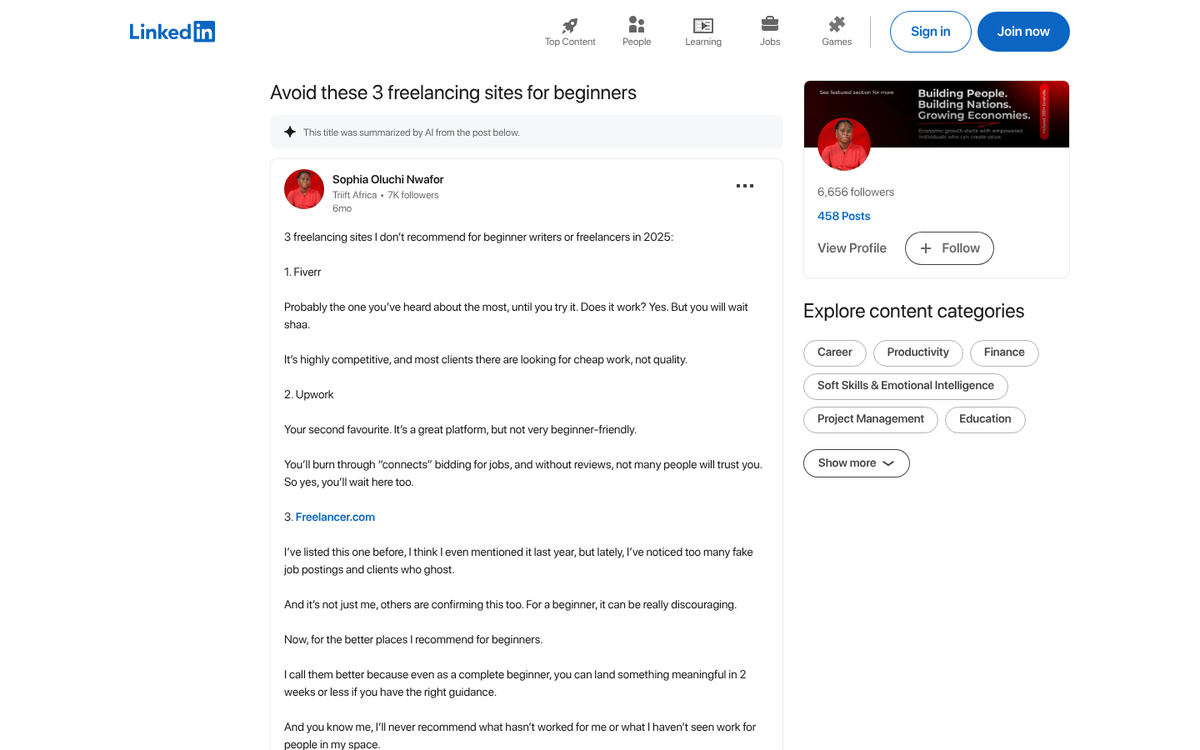
The thing is that the content is usually going to be low quality, poorly researched, or might be plagiarized - and increasingly, it may essentially be AI-generated content with minimal human input. Writers accepting bottom-of-the-barrel rates usually can't afford to spend the time needed to produce something legitimately helpful. You'll usually have to toss a portion of posts outright and do heavy editing on the rest just to make them serviceable.
To put latest pricing in perspective: on Upwork, freelancers usually charge between $15 and $80 per hour, with the average for SEO-optimized content falling around $30 to $50 per hour. Fixed-rate projects start at roughly $50 for short blog posts. Anyone quoting below these figures is almost certainly cutting corners somewhere.
Option 3: Content Mills
One step up from bargain freelancers is the basic content mill. Platforms like Crowd Content, Textbroker, and similar marketplaces give you writing at scale. Crowd Content, just to give you an example, charges roughly $0.03 to $0.15 per word depending on the quality tier you select, which makes it one of the more budget-friendly options available. At those rates, two 2,000-word posts per week might run you anywhere from $120 to $600 per month depending on quality level - a wide range, but there's something for most budgets. Most of these platforms include some minimum quality threshold and built-in plagiarism checks.

The downside is that you're still getting content that doesn't have enough depth or personality. The best writers on these platforms prefer to work through direct orders at higher rates, so the open-marketplace experience can be hit or miss.
Option 4: High-Tier Content Mills and Subscription Services
Some content services give you substantially better quality and a more managed experience. Platforms like Writer Access, Constant Content, Scribly, and Get A Copywriter sit in this tier. Scribly has packages starting at around $0.10 per word, while Get A Copywriter starts at roughly $59 per 400-word post. These services usually give you access to vetted writers with demonstrated expertise in niches, which is a real step up from open content marketplaces.

This tier is where you're more likely to get content that's legitimately helpful and well-written right out of the box - it's also where you can sometimes find a writer who is delivering above their price point, making them worth building a longer-term relationship with. If you find that person, treat them well and compensate them fairly as the relationship grows.
Option 5: Mid-Tier Freelancers
Mid-tier freelancers can be found across places like Upwork and through direct outreach, LinkedIn, and referrals - where writers who have moved past content mills like to settle. Rates in this range usually fall between $100 and $300 per blog post for reasonably experienced writers making well-researched, SEO-conscious content. It's worth mentioning that the most popular pricing model among freelancers is per project, used by roughly 40% of writers, so expect flat rates instead of hourly quotes in this tier.

Quality at this level can vary considerably, but if you take the time to vet candidates and start small with test assignments, you can find writers who will produce strong work over the long term.
Option 6: Blog Production Services
There are a lot of blog management services willing to produce content for you and manage other parts of your content strategy - like SEO optimization, internal linking, and editorial planning.

These range from pretty affordable to quite expensive, so there's something for most budgets. The trade-off is that you're handing over a degree of control over your blog's voice and direction, which isn't always an easy choice - especially for businesses where tone and authenticity matter.
Option 7: High-Tier Freelancers
The highest quality freelancers aren't found through open bidding platforms. They usually have their own websites, work largely through referrals, and write for known publications either under their own byline or as ghostwriters. Their content tends to be closely researched, compellingly written, and built to perform well in search over the long term.
The catch, of course, is the price. Getting a top-tier freelancer to produce something for under $500 per post is increasingly rare, and rates of $1,000 or more per piece are not unusual for writers with a strong track record. For most small to mid-sized businesses, this tier isn't practical on a standard basis - but it can be worth the investment for cornerstone content or high-stakes landing pages where quality has a direct impact on conversions.
Option 8: High Volume Guest Posts
This last option isn't necessarily expensive in terms of money, but it can be time consuming. One way to get high quality content for your site without cash outlay is accepting guest posts. Guest contributors are usually bloggers or industry pros looking for exposure, which means they're motivated to produce their best work.
That said, guest posts aren't free. You need a site with enough traffic and domain authority to make the opportunity interesting to a guest poster, and you're usually expected to give them a followed link back to their site or a relevant page as the primary form of compensation. Low-authority sites don't draw quality guest contributors organically.

All the same quality-control steps apply here as with any freelancer. Vet the content before publishing, run it through plagiarism and AI detection tools, and make sure that you're comfortable with any links being requested. Guest posting has a long history of being exploited for spammy link schemes, so be selective.
You'll also need some of your own original posts, of course. A blog run entirely on guest content tends to lack a steady voice and authority, but filling some editorial calendar slots with strong guest contributions can free up budget to invest more in the posts you do commission yourself.


2 responses
Thoughtful replies only - we moderate for spam, AI slop, and off-topic rants.
I saw a reddit post about somebody complaining about not finding quality writers. It was another one of those people that thinks two cents per word will actually pay the bills for writers. I wonder how many of these people have ever even done any type of calculations on what it would take for a writer to make a living. Let's assume that the income taken in needs to be $3,000 in a month. That'll include whatever comes out for paying taxes.
Let's give the month 30 days.
That means the writer needs to make $100 per day.
When people think that 2 cents per word can pay the bills, that means they want writers to be able to write 5,000 words per day AND that includes doing the research needed to be able to write the article.
Research takes time.
It can take about an hour to write a well-written 300 word article, but since that's not divisible into 5000, I'll be generous and give that 500 words per hour. That's still a ten hour work day.
Writer's deserve better pay, better respect and better treatment.
Hi Bridget, I couldn't agree more. Fortunately, you get what you pay for, and those articles that people are cranking out for 2 cents per word are not going to be great at all.
I remember ordering a cheap article on one of those content mills, and it was about VPNs, something like "Why My VPN is Showing a 'Connection Not Established' Error".
Something technical for VPN users.
Literally 60% of the article was spent telling the user what a VPN is, the benefits of a VPN, how much they are, how to get one, etc.
The user is searching for this specific error, they already have a VPN and know what it is. The intent and topic of the article is incredibly important, but most people just buy cheap articles, and if it looks good at first glance, they post it, even if it isn't useful in the slightest.
Sigh. Live and learn I guess.