For decades, webmasters have been trying every trick in the book to boost their traffic. This includes every form of automatic traffic generator you can think up. Many of these generators still exist and are in operation today. The question is, do they work, how do they do what they do, and are they at all effective?
Key Takeaways
- Traffic generators produce robotic visits that increment counters but never convert into real customers or business value.
- Bot traffic exceeded human traffic in 2024, accounting for 51% of all web traffic, with malicious bots at 37%.
- Methods include robotic refreshing, rotating proxies, clickfarms, hijacked site redirects, and spun article submission networks.
- Advertisers wasted over $71 billion globally on invalid traffic in 2024, a 33% increase from 2022.
- Black hat SEO tactics violate search engine guidelines and risk serious penalties that outweigh any short-term traffic gains.
Do Traffic Generators Work?

Yes. Well, no. It's a complex question, and it relies on the changing definition of traffic. What do you mean by traffic? Do you mean any hit that loads your website and increments your visitor counter by one? Or do you mean any user that loads your page to read a piece of content?
If you answered the first option, then yes, traffic generators work. Most of these programs are the equivalent of robots, refreshing your page over and over as many times per minute as possible. Some platforms, like TrafficPeak, simulate sessions lasting 30 seconds to 5 minutes per page, spanning up to 10 pages per session, with caps reaching as high as 25,000,000 page visits per month. It looks impressive on paper. It means absolutely nothing in practice.
If by traffic, you mean engaged users who may potentially convert into paying customers, then no. Traffic generators are robotic traffic, plain and simple. The traffic they generate does nothing to help your website, and the numbers have grown staggering. According to Imperva's 2025 Bad Bot Report, automated bot traffic surpassed human-generated traffic for the first time in a decade, accounting for 51% of all web traffic in 2024. Malicious bots alone now make up 37% of all internet traffic, up from 32% in 2023. Akamai Technologies similarly reports that bots compose 42% of overall web traffic, with 65% of those bots classified as malicious.
The financial damage is just as alarming. In 2024, advertisers were projected to waste over $71 billion globally on invalid traffic, a 33% increase from 2022. A Firebrand research case found that up to 21.31% of one client's hits in Q1 were potentially fake website traffic. If you're buying traffic or relying on inflated metrics to make business decisions, you are almost certainly being misled.
How Do They Work?

There are a number of ways that traffic generator programs work. Some are purely robotic, while others are more elaborate schemes that, while technically sophisticated, violate search engine guidelines and can earn your site serious penalties. In every case, you should avoid using such programs.
Robotic refreshing. This is the first and most basic method. Imagine sitting in front of your computer, on your website, hitting the F5 button over and over. That is all a bot does, except it does it several times per second. This quickly increments your hit counter, but nothing else. Long ago, in the early days of pay-per-view affiliate links, robot refreshers could generate significant income for unscrupulous marketers. This was before affiliates caught on and began blocking repeated traffic from the same IP address.
Traffic routed through rotating proxies and spoofed user agents. This was the solution to IP-based blocking. Rather than hammering your site from one address, bots cycle through rotating IP pools and simultaneously spoof user agent strings, making each visit appear to come from a different browser and device configuration. Today's traffic generator platforms have refined this considerably, simulating realistic session behavior including time-on-page, scroll depth, and multi-page navigation sequences. The goal is to fool both analytics platforms and ad verification systems into treating bot visits as legitimate human sessions. It does not work for generating real business value, but it is effective enough at deceiving basic tracking tools to remain a widespread problem.
Clickfarm traffic. Clickfarms replace robots with real people, typically low-wage workers in developing countries, paid to visit websites, click ads, like social media posts, or watch videos. Clickfarms are a significant problem across both paid advertising and social media metrics. Real humans or not, these visitors have zero interest in your content, your products, or your services. They will never convert. Many ad networks and affiliate programs have taken aggressive steps to identify and filter clickfarm traffic, but it remains a persistent issue feeding the billions in wasted ad spend reported annually.
Hijacked traffic from hacked or redirected sites. This is legitimate traffic, shamefully stolen from real websites. A hacker compromises a legitimate domain and redirects its visitors to a site of their choosing. This occasionally happens when purchasing traffic through shady third-party brokers. Unlike robots and clickfarms, these visitors are real and engaged. They are also confused and angry, expecting to land somewhere entirely different. The reputational damage alone makes this one of the more harmful scenarios a site owner can unknowingly stumble into.
Automatic article submission and content spinning. A staple of older black hat SEO playbooks, this method involves taking a single piece of content, spinning it algorithmically into dozens of variations, embedding your links throughout, and blasting those articles across directories, spam blogs, and scraped content sites. The traffic passing through these properties is rarely legitimate or engaged. Google has long since devalued or deindexed most of these distribution networks, making this approach largely obsolete as an SEO tactic, though it persists in low-effort link spam campaigns.
A Look at Black Hat
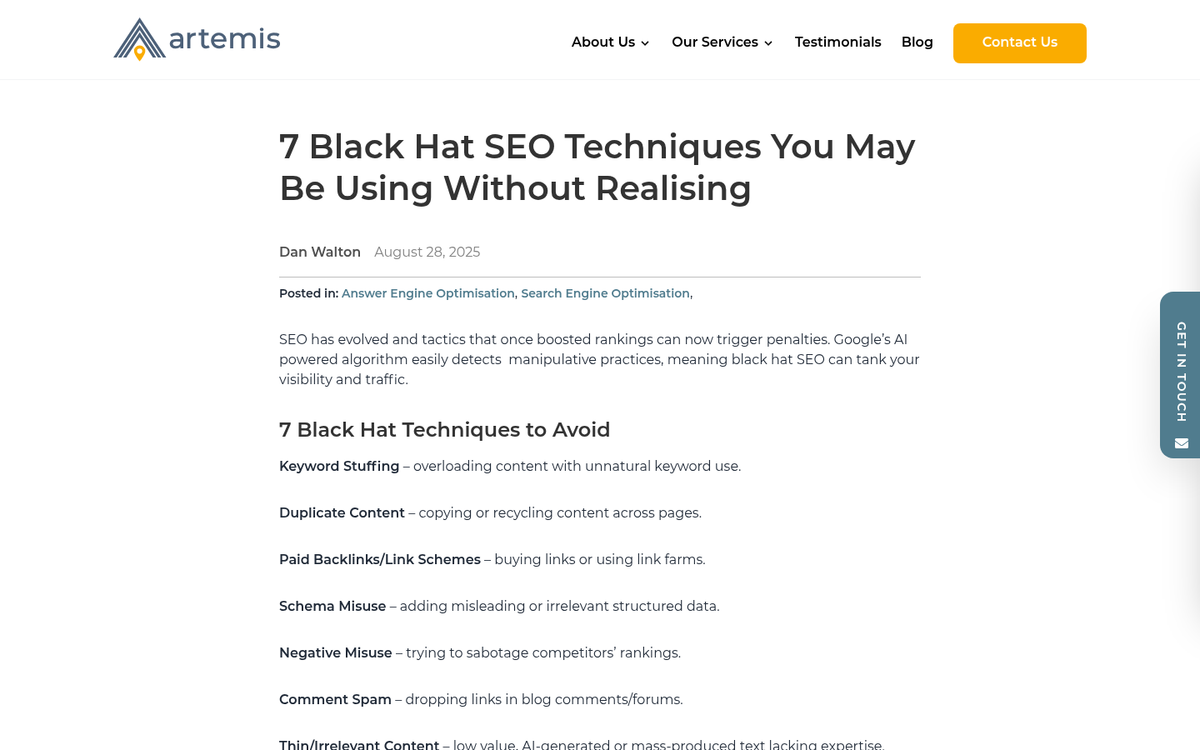
Article spinning and directory submission are just scratching the surface of black hat SEO. Automated software can generate entire networks of spam blogs filled with scraped or AI-generated content, all engineered to funnel link authority toward a target site. These tactics have only become more sophisticated in recent years, with some operators using generative AI to produce more convincing content at scale.
Black hat techniques all share one defining characteristic: they work against the guidelines Google and other search engines have established for how websites should be built, promoted, and linked.
- Using keywords unrelated to your content to rank for terms your site has no business targeting.
- Hiding text from users while making it visible to crawlers, typically used alongside keyword stuffing to inflate perceived relevance.
- Cloaked or deceptive links that appear to point one place but redirect users elsewhere, often to the operator's monetized landing pages - a tactic explored further in our guide on generating cloaked shortened links.
- Duplicate or spun content networks created solely to point links back at a primary domain, exploiting link authority calculations until search engines identify and discount the scheme.
- Link pyramids and tiered link schemes, where layers of progressively lower-quality sites link upward through the chain, with the intent of laundering spam-level link juice into something that resembles organic authority.
Much of this can still be automated, and with the advent of AI-generated content, the barrier to entry has dropped considerably. The problem is that the risk has not dropped alongside it. Google's spam systems have grown more capable, manual penalties remain very real, and the long-term cost of a penalty far outweighs any short-term traffic bump. Any program or service that promises a shortcut to traffic and profit is, without exception, a scam. The numbers behind invalid traffic and bot activity in 2024 and 2025 make clear that the problem is larger than ever, but so is the industry built around detecting and penalizing it.