




For website owners and managers, this matters more than it might seem. Answer engines like Google's AI Overviews, ChatGPT and Perplexity don't pull a random snippet from your page - they reason through available information to construct replies. If your content is structured in a way that supports that reasoning process, you're far more likely to be cited, referenced, or surfaced as a trusted source.
You can optimize your content to meet the way AI systems think - making it easier for them to follow your logic, validate your claims, and finally use your site as a building block in their answers - this post breaks down what that looks like in practice and what you can start doing.
Quick Answer
Chain-of-thought reasoning is a technique where AI language models generate intermediate reasoning steps before arriving at a final answer, mimicking human problem-solving. Instead of jumping directly to a conclusion, the model breaks down complex problems into sequential logical steps. This improves performance on tasks requiring math, logic, and multi-step reasoning. It can be prompted explicitly (e.g., "think step by step") or emerge naturally in larger models. Chain-of-thought reasoning enhances accuracy, transparency, and interpretability of AI outputs.
How AI Models Actually Use Chain-of-Thought to Form Answers
When an AI model gets a question, it doesn't pull an answer from thin air - it works through a sequence of smaller logical steps first, and each step informs the next one until the model arrives at a final response.
Kind of like long division. You don't write down the answer - you work through each part of the problem in order, and the steps themselves are what make the answer honest. AI models do something structurally similar, and the quality of each intermediate step can affect everything that follows it.
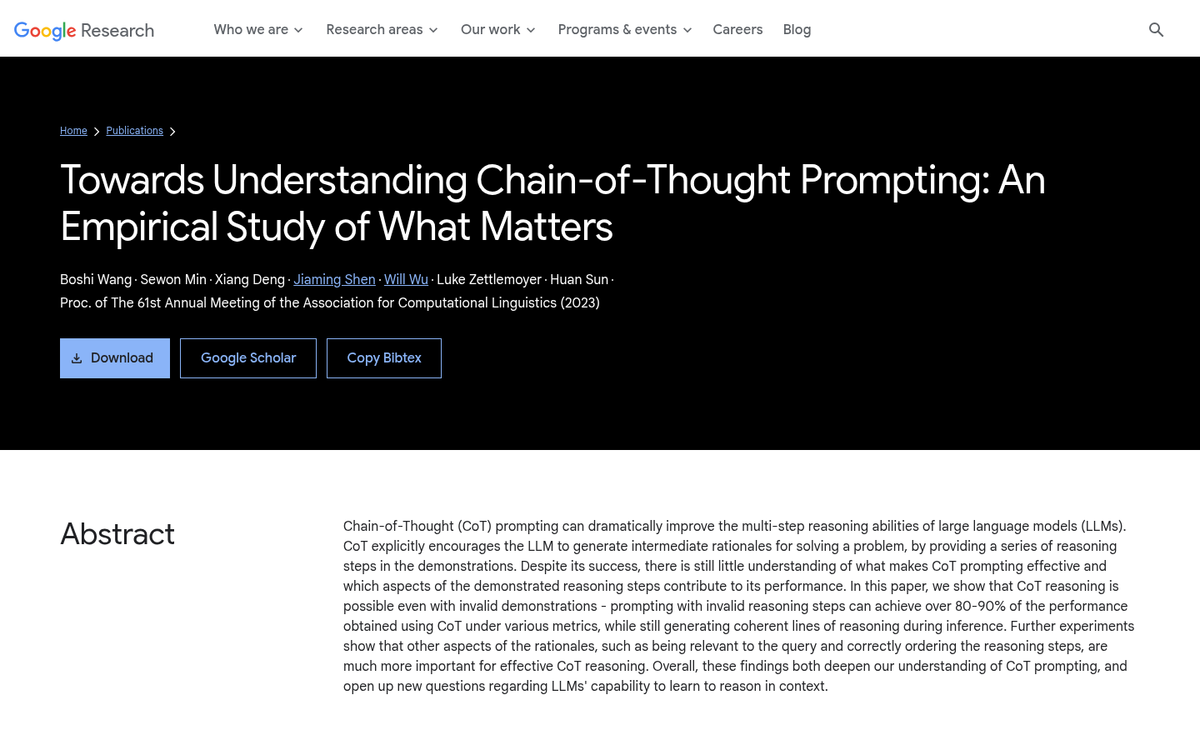
A landmark 2022 paper from Google Brain tested what happened when models were prompted to show their reasoning steps versus just produce a final answer. On a math benchmark called MultiArith, accuracy surged from 17.7% to 78.7%.
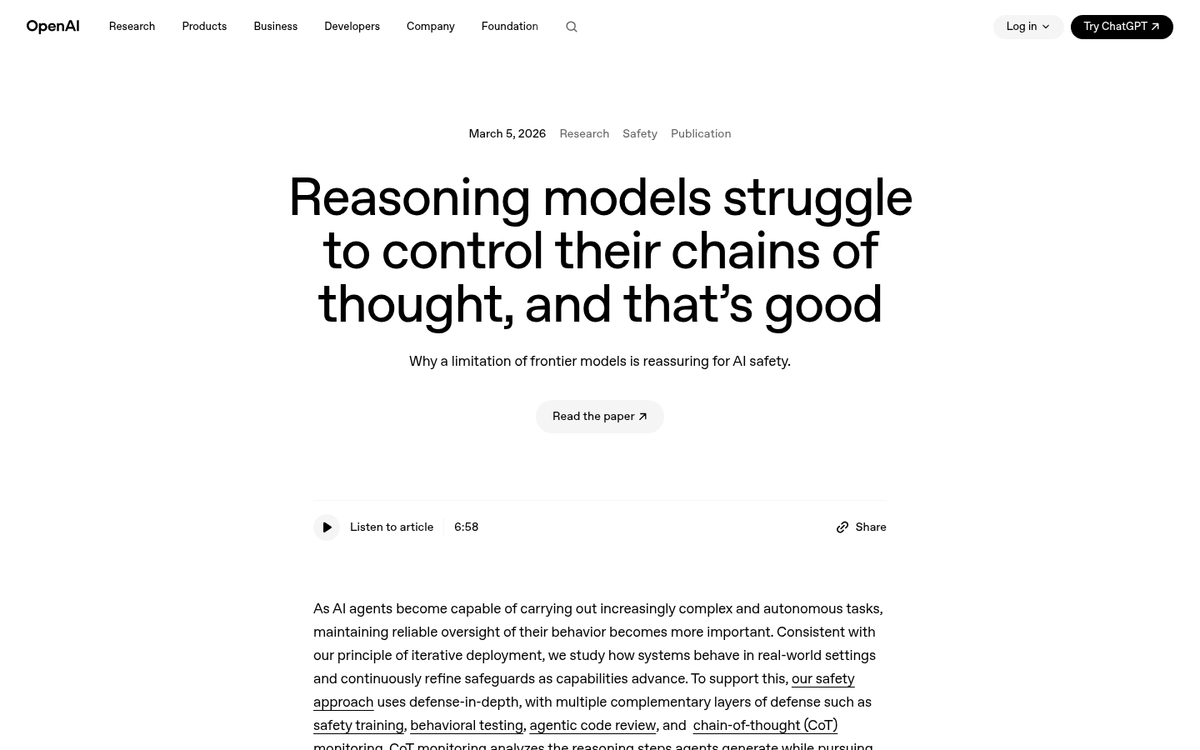
Since then, this has moved from an experimental prompting technique to something built directly into AI systems. OpenAI's o1 model, released in September 2024, applies chain-of-thought reasoning automatically before it generates a visible response. The user doesn't see the intermediate steps. But they happen regardless - the model reasons through the problem internally before it commits to an answer.
This matters for anyone who publishes content online. The AI isn't skimming your page for a quick answer to copy - it builds a logical path through the information it finds, and the structure of that information shapes the path it takes.
A few things change how well that process goes for your content specifically. If you're running a Squarespace blog or a self-hosted WordPress install, the way you organize your content at a structural level has real consequences for how AI models interpret and use it.
| Factor | What It Affects |
|---|---|
| Logical flow between ideas | Whether the model can connect one point to the next without filling in gaps itself |
| Specificity of claims | How confidently the model can use your content as a reasoning anchor |
| Sentence and paragraph structure | How easy it is for the model to extract distinct, usable steps |
The model isn't passive when it reads your content - it actively constructs meaning from the order and structure of what you've written.
Why Your Content Structure Affects AI Reasoning Paths
AI doesn't move through your content the way a search engine does - it isn't hunting for keyword matches or counting how many times a phrase appears - it's following a logical thread, and if that thread breaks, the reasoning stops too.
When a page jumps straight to a conclusion without building up to it, a human reader might fill in the gaps from their own knowledge. But an AI model needs the steps to actually be there - it builds answers by moving from premise to evidence to conclusion, and your content either supports that path or it doesn't.
Fragmented content is a problem here. If your page covers a topic in scattered chunks - a definition here, a tip three paragraphs later, context buried at the bottom - the AI has a harder time connecting those pieces into a helpful answer. The logical thread gets loose, and a loose thread is easy to drop.
Well-structured arguments tend to be more helpful because they mirror how chain-of-thought models actually process information. You state a point, you back it up, and you connect it to what comes next; it's good writing practice and the kind of content an AI can follow and reproduce in a response.
It's helpful to ask yourself if your content thinks out loud. A page that walks through its reasoning step by step gives the AI ground to stand on. A page that assumes the reader already knows the context leaves gaps that the model might not fill the way you'd want it to.
Supporting evidence matters quite a bit in this context. AI models respond well to content that pairs a claim with a reason and then connects that reason to a helpful point. That three-part structure - claim, support, connection - maps closely onto the way chain-of-thought reasoning moves through a problem.
It shapes the reasoning path an AI can take through your page, and that can affect how your content gets used in generated answers.
Structuring Web Content to Match Step-by-Step AI Logic
Think about how each part of content builds on the one before it. AI reasoning systems work by linking premises to conclusions, so your content should do the same thing - state a fact, back it up, and land on a point.
Start with a claim your reader needs to know, then add one or two sentences that explain why it's true, then move on. When your content follows that pattern, an AI has a much easier time tracing the logic and representing your page accurately in a generated response.
What This Looks Like in Practice
For FAQ sections, the goal is to make each answer self-contained. The question sets the context, the answer gives you a direct response, and a follow-up sentence can add the reasoning behind it. That three-part structure gives an AI system something to actually reason with instead of just quote.
For how-to content, numbered steps work well because they signal sequence, and each step should name the action first, then briefly explain what it achieves. The logic flows forward - action gives you outcome, outcome leads to the next step - which is how chain-of-thought reasoning moves through a problem. If you run a WordPress video blog, this kind of structured step logic is especially useful for tutorial content.

Explanatory paragraphs are a bit harder to get right. The most common mistake is burying the main point mid-paragraph after a few sentences of setup. Put the core claim first, then support it. One strong claim per paragraph is usually the right amount.
CoT-Friendly vs. CoT-Unfriendly Content
| Content Type | CoT-Unfriendly Version | CoT-Friendly Version |
|---|---|---|
| FAQ Answer | "It depends on several factors and your situation may vary." | "Most users need Plan B. It includes X, which handles the most common case." |
| How-To Step | "Make sure everything is set up correctly before you continue." | "Save your settings first. This lets the system apply your changes before the next step runs." |
| Explanatory Paragraph | Background context for three sentences, then the actual point at the end. | Lead with the point, then add two sentences of supporting detail. |
None of this requires technical knowledge to apply - it's mostly about being more deliberate with the order in which you present ideas - premise first, support second, and a clean landing point to move on. The same principle applies when setting up auto-posting on WordPress, where a clear sequence makes the process far easier to follow.
The Trade-Off Between CoT Depth and Answer Engine Speed
There's a tension that doesn't get talked about enough: the more reasoning steps an AI has to work through, the longer it takes to return an answer. Research from Wharton Generative AI Labs found that chain-of-thought requests took 20-80% more processing time compared to easier prompts, and in some cases that figure climbed as high as 600% longer; it's not a small gap.
For site owners, this creates a calibration challenge. Deeply structured content that walks through every comparison, condition, and consequence is legitimately helpful for tough queries. But if a user asks an easy question, a page with layered reasoning steps can add friction without adding value to the AI's job.

The helpful strategy is to match your content depth to query difficulty. A page about picking between two software pricing tiers warrants an overview because users arrive with uncertainty and competing things to weigh. A page that answers "what does X term mean" does not need the same treatment - a direct, well-structured answer gets the job done faster and works much better for AI retrieval.
You can map your pages roughly into two groups: ones that answer easy informational queries, and ones that support tough choice-making. The first group should stay lean and direct. The second group is where reasoning earns its place.
| Query Type | Recommended Content Depth | Why It Works |
|---|---|---|
| Simple definitions or facts | Direct answer, minimal structure | Faster AI processing with no loss of accuracy |
| Comparisons and trade-offs | Step-by-step reasoning with context | Matches how AI builds multi-part answers |
| How-to or process queries | Sequential structure with clear stages | Mirrors the logical flow AI engines follow |
| High-stakes decisions | Deep layered content with conditions | Supports nuanced, accurate AI responses |
Getting this balance right means your content stays helpful to AI without slowing it down unnecessarily. Depth is a tool to use with intention - not a default setting to apply everywhere.
Make Your Content Think, and AI Will Follow
Structuring your content with logical flow is not a technical SEO trick - it's a demonstration of genuine expertise. Every supported claim, every explained step, every "here's why this matters" sentence is a signal that your page is worth quoting.
The most helpful next step is a small one: pick one existing page and read it the way an AI would. Ask if the reasoning is visible, if claims are backed, and if a reader could follow your logic without already knowing the answer. If the page jumps straight to conclusions without showing the work, that's your starting point. A few targeted edits to surface the thinking behind your content can make a measurable difference in how AI systems perceive and cite it.
FAQs
What is chain-of-thought reasoning in AI?
Chain-of-thought reasoning is when AI models work through a sequence of logical steps before generating a final answer, rather than pulling a response directly. This internal reasoning process improves accuracy and helps AI construct more reliable, well-supported responses.
How does content structure affect AI-generated answers?
AI follows logical threads through your content, so fragmented or poorly ordered writing makes it harder to construct accurate answers. Content structured with clear premises, supporting evidence, and conclusions gives AI a reliable reasoning path to follow.
What content format works best for AI reasoning?
Lead with your main claim, follow with supporting evidence, then connect it to a conclusion. For how-to content, numbered sequential steps work well. FAQ answers should be self-contained with a direct response followed by brief reasoning.
Does deeper content structure always help AI retrieval?
Not always. Simple informational queries are better served by lean, direct answers. Deeply layered reasoning is most valuable for comparisons, decisions, and complex how-to content where nuance genuinely matters.
How can I audit my content for AI readability?
Read your page as an AI would - check whether claims are supported, reasoning is visible, and logic flows without assumed context. If your page jumps to conclusions without showing the work, restructure to surface the reasoning behind each point.