




If you've ever wondered what's actually happening "under the hood" when ChatGPT answers a question or when Google's AI Overview summarizes a topic at the top of the search results, the answer is a Transformer Model. This architecture is the engine powering virtually every AI language tool in use, from Google's Gemini to Microsoft's Copilot to Anthropic's Claude - it's the reason these systems can read a 2,000-word post and pull out a precise, confident answer in seconds.
For website owners and content managers, understanding what a Transformer Model is - even at a basic level - changes how you think about content creation. These models don't rank pages the way traditional search algorithms do. They read your content, evaluate how well it answers a question, and determine whether it's worth citing in a response; it's a fundamentally different challenge, and it's what Answer Engine Optimization (AEO) was built to help you meet.
This entry breaks down how Transformer Models work, why their design directly affects whether your content gets surfaced by AI tools, and what you can do to make your site's content more legible - and helpful - to these systems.
Quick Answer
A Transformer is a deep learning model architecture introduced in the 2017 paper "Attention Is All You Need." It relies on self-attention mechanisms to process sequential data in parallel, rather than using recurrence or convolution. Transformers encode relationships between all elements in a sequence simultaneously, making them highly efficient and scalable. They form the foundation of modern large language models like GPT and BERT, excelling at tasks such as translation, text generation, and summarization.
How Transformer Models Actually Work
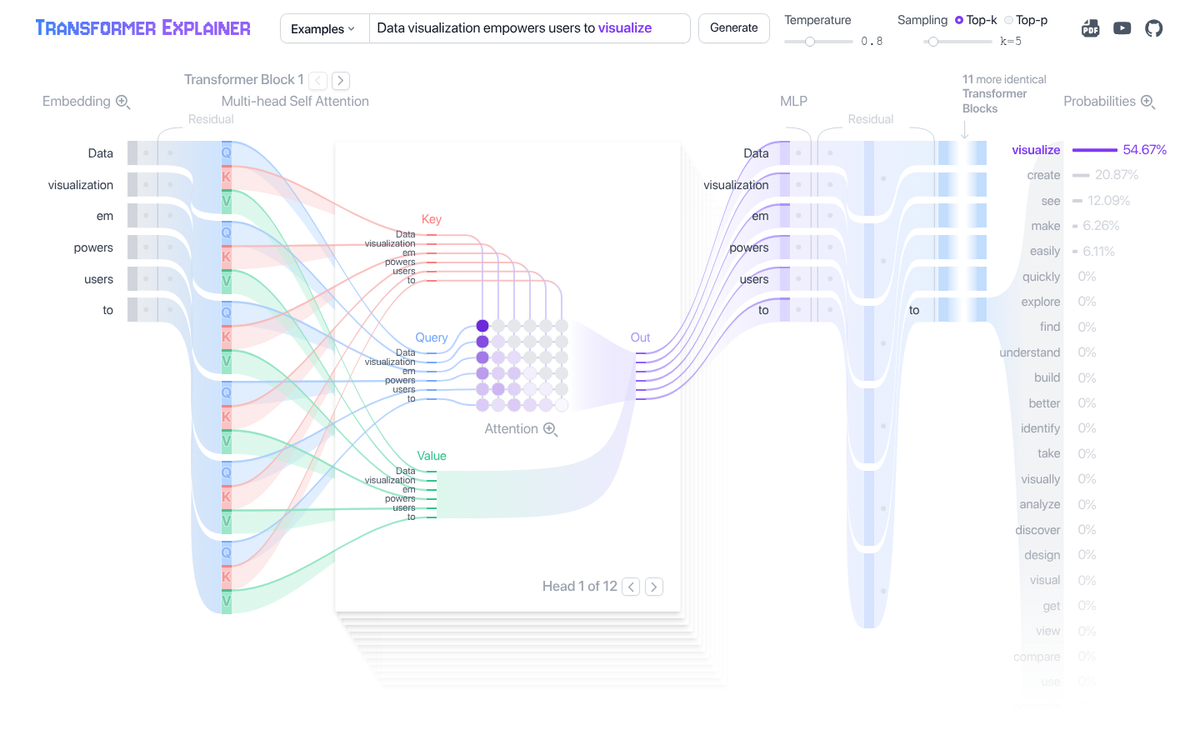
The core idea behind transformer models is something called an attention mechanism- it lets the model look at every word in a sentence at the same time and choose which words matter most to each other.
Think about how you read a sentence like "The bank by the river flooded." You instinctively connect "bank" to "river" instead of to money, because the surrounding words point you there. A transformer does something similar- it assigns a weight to every word relationship in a sentence and uses those weights to understand context. The higher the weight between two words, the more the model treats them as connected.
This is a departure from how older models worked. Recurrent neural networks, or RNNs, processed text one word at a time in sequence - like reading left to right with no ability to look back without effort. That made it hard to connect a word at the start of a long sentence to one near the end. Convolutional neural networks had similar limits with long-range relationships in text.
In June 2017, a research paper called "Attention Is All You Need" changed the direction of AI language modeling. The paper, published by scientists at Google, introduced the transformer architecture and showed that attention mechanisms alone could outperform the sequential strategy. That same year, the IEEE recognized the architectural change as an actual move away from recurrent models.
The transformer reads everything at once and builds a relationship map across the whole input, and each word gets to "ask" if it's relevant to every other word, and the model updates its understanding based on those relationships together.
There are two main parts to the original transformer design. The encoder takes in the input and builds that relationship map. The decoder uses that map to produce an output, whether that's a translation, a summary, or an answer to a question.
Modern models like GPT use a version of this that leans heavily on the decoder side. But models like BERT use the encoder. The underlying attention mechanism is the part they share. If you're exploring ways to put these tools to work, there's a solid guide to earning money from Medium.com articles worth reading.
Why Transformer Models Dominate AI Answer Engines
Transformer models didn't become the default by accident. They outperformed every competing strategy on SuperGLUE, which is one of the most respected language benchmarks in the field. That performance gap tends to end debates faster.
The data supports this at scale too. Around 70% of AI research papers published on arXiv now reference Transformer-based architectures; it's not a trend - it's a near-total change in how the research community builds and thinks about language AI.
For answer engines specifically, this matters more than it seems. Older search systems were built to retrieve - they matched keywords and returned links. Transformer-based models don't work that way. They predict the most statistically likely answer based on everything they learned during training, and they synthesize a response from that reasoning.
That's a meaningful difference. A retrieval system finds a document that seems related. A predictive model constructs an answer that fits the question. The AI responding to your customer's query isn't pulling a pre-written sentence from a database - it's generating a response based on patterns it learned from a giant amount of text.
That's where it gets helpful for anyone who creates content. Structure, clarity, and context all feed into that prediction process.
If an AI is predicting the best possible response to your customer's question, that changes how you should write your content - and the next section gets into that.
What Transformer Models Look for in Your Content
Transformer models don't read your page the way a person would. They look for patterns, relationships between words, and tells that tell them what a piece of content is actually about.
A 2024 Google DeepMind finding showed that top-1 predictions from transformer models lined up with N-gram rulesets between 68% and 79% of the time. To explain it, that means that language following steady, recognizable patterns gets picked up more reliably. Write in a predictable, structured way and the model has an easier time understanding what you mean.
Semantic consistency matters quite a bit here - not about keyword stuffing, but saying what you mean in a way that stays steady throughout the page. If your heading is about an answer, the paragraph that follows should deliver it. Wandering off-topic or burying the point in extra sentences works against you.

Structured content also gives transformer models helpful tells. Headers, short paragraphs, and direct answers help the model find which part of your page answers which question. Structure is a way to label your content for the model. Certain design choices can also affect how well your content gets read, so it's worth thinking beyond just writing style.
The table below breaks down the content characteristics that help or hurt AI comprehension at a glance.
| Content Trait | Helps AI Comprehension | Hurts AI Comprehension |
|---|---|---|
| Answer placement | Direct answer at the start of the section | Answer buried after long preamble |
| Language consistency | Same terminology used throughout | Switching between synonyms unpredictably |
| Sentence structure | Short, focused sentences with one idea each | Long compound sentences with multiple clauses |
| Heading relevance | Headings that match the content below them | Vague or clickbait-style headings |
| Topic focus | One topic per section | Multiple unrelated points in one block |
A strong opening that matches your headings and body content sends a steady signal throughout. Inconsistency across a page is one of the fastest ways to lose that signal. Even small decisions - like whether to use a popup on your posts - can disrupt the experience and dilute the clarity of your content's message.
Structuring Pages So Transformer-Based AI Can Extract Answers
Transformer models don't read your page the way a person does. They break content into chunks and look for the parts that best match a query, so how you arrange information matters just as much as what you write.
Headers are a place to start. A descriptive header tells the model what each section is about before it even processes the text below it, and each header acts as a label that helps the model choose if that chunk of content is worth pulling from.
Paragraphs should be short and focused on one idea. When a paragraph tries to cover too much, the answer the model is looking for gets buried inside a wall of text. Put your most important point at the start of the paragraph and build from there.

FAQ-style formatting is one of the most helpful structures you can use. A direct question followed by a direct answer is the pattern transformer models are trained to find and extract. You don't need a dedicated FAQ section for this - question-led subheadings work throughout your page, answered immediately in the first sentence or two.
Schema markup can add context that models can use. FAQ schema, in particular, tells AI systems that your content contains question-and-answer pairs worth surfacing - it won't replace writing, but it reinforces the structure you've already built. How you present your content visually also plays a role in how cleanly structured your page feels to both readers and models.
A helpful exercise is to ask yourself what a model would pull if it had to summarize your page in one sentence. If you can't point to a sentence or short paragraph that would work as that summary, your most important information is probably too scattered to extract cleanly.
| Page Structure Element | Impact on AI Answer Extraction |
|---|---|
| Descriptive headers | Helps the model label and categorize each content chunk |
| Short focused paragraphs | Makes key points easier to isolate and extract |
| Question-led subheadings | Matches the query patterns models are trained on |
| Direct answer in first sentence | Reduces the need for the model to scan deep into the text |
| FAQ schema markup | Flags structured Q&A content to AI systems directly |
None of this needs to feel mechanical. Good structure and writing go together, and a page that's easy for a model to parse is usually easier for a person to read too. If you're building out your site's foundation, understanding whether a hosted or self-hosted setup suits your needs can also affect how much control you have over your page structure.
Optimizing for the Model Behind the Answer
The helpful change is smaller than it looks. Writing that serves a Transformer well looks almost identical to writing that serves a human reader well: a point made early, supporting details that follow logically, and language that does not make the reader work harder than necessary. The sites that perform well inside AI-generated answers are not the most technically optimized - they are the most clearly written.
To act on this now, make three small moves this week:
- Pick one important page and rewrite the opening paragraph so the core answer appears in the first two sentences.
- Break up any walls of text into shorter paragraphs or a simple list so the structure itself signals meaning.
- Read the page aloud - if a sentence sounds tangled to your ear, a Transformer will struggle with it too.
Answer Engine Optimization is not a technical challenge waiting for a technical answer - it's a writing challenge. The websites that win are the ones that respect the reader's time enough to get to the point, and that turns out to be just what the models are looking for too. If you want more readers finding those pages, pairing clear writing with smart auto-sharing tools for new blog posts can help extend your reach once the content is ready.
FAQs
What is a Transformer Model in AI?
A Transformer Model is the core architecture powering AI language tools like ChatGPT, Gemini, and Claude. It uses an attention mechanism to read entire inputs at once, building contextual relationships between words to generate accurate, relevant responses.
How does the attention mechanism work?
The attention mechanism assigns weights to relationships between every word in a sentence simultaneously. This allows the model to understand context, such as connecting "bank" to "river" rather than money, based on surrounding words.
How should I structure content for AI answer engines?
Use descriptive headers, short focused paragraphs, and question-led subheadings with direct answers in the first sentence. FAQ schema markup can also signal structured Q&A content directly to AI systems.
Why do transformer models dominate AI answer engines?
Transformer models outperformed all competing architectures on major language benchmarks like SuperGLUE. Unlike retrieval-based search, they generate synthesized answers by predicting the most statistically likely response based on trained patterns.
What content traits help AI comprehension?
Consistent terminology, direct answers placed at the start of sections, short focused sentences, and headings that match the content beneath them all improve how reliably transformer models understand and extract information from your page.