





Key Takeaways
- CommentLuv automatically displays a commenter's latest blog post as a link, incentivizing participation but setting no quality threshold.
- The plugin is abandoned, untested against recent WordPress versions, and poses genuine security risks for live sites.
- From nearly 973,000 downloads, only around 10,000 active installations remain, effectively eliminating the network effect it once offered.
- Open comment links with DoFollow attributes risk Google penalties, and AI-assisted spam makes moderation harder than ever.
- Better 2026 alternatives include modern platforms like Disqus, community tools like Discord, and focusing on E-E-A-T signals instead.
CommentLuv was once one of the most prominent comment modification plugins available for WordPress. It offered a legitimately good idea - no other plugin did what it did. But quite a bit has changed since its peak, and in 2026, recommending it without caveats would be doing you a disservice. This post helps you understand what CommentLuv actually is, why it's largely fallen out of favor, and if there's any case left for it at all.
So what is CommentLuv, what does it do, and is it still worth using on your site?
What Does CommentLuv Do
First of all, CommentLuv is a plugin that only works with WordPress. It has two versions - a free and a premium - and both are limited to that one platform. This isn't usually a dealbreaker since most blogs run on WordPress. But it's worth knowing about first if you're on a different CMS.
The base level of functionality for the free CommentLuv plugin is straightforward. It can add a new field to your comments section that's automatically populated with the most recent blog post published by the commenter on their own site. The commenter links to their site either through their Gravatar account or the URL field provided. While they write their comment, the plugin fetches the most recent post from that user's site and shows it at the bottom of the comment field. The commenter can then choose whether or not to include that link.
In addition to requiring WordPress, you also need to be using the default WordPress comments system. CommentLuv is incompatible with Disqus, Facebook comments, JetPack, or any other comment-modifying plugin. That compatibility limitation alone has pushed site owners away over the years.
Those of you familiar with SEO and link spam will immediately spot the red flag here. Unfiltered comments with outbound links, left by random users, is a recipe for issues. And you'd be right to be concerned. CommentLuv incentivizes people to leave comments. But it sets no minimum quality threshold. Someone can drop a "Great post!" comment and walk away with a link on your page.
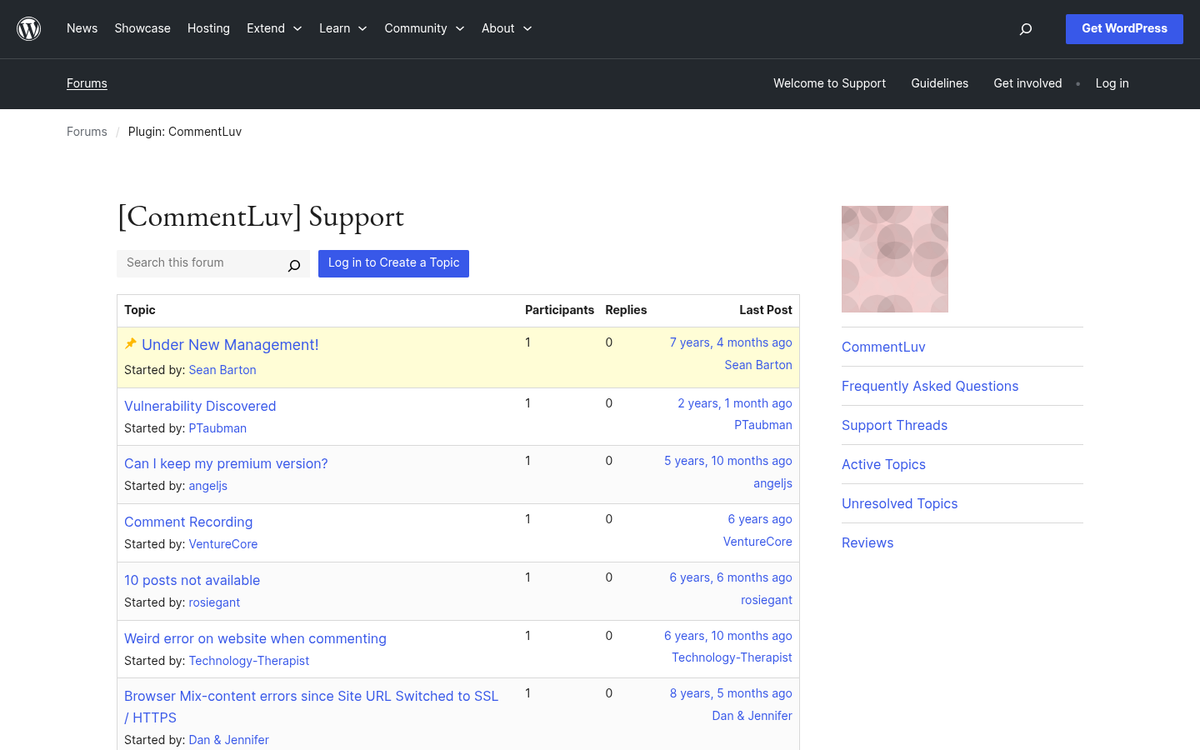
Traditional anti-spam tools like Akismet can block the worst offenders. But they won't stop borderline comments that are technically "legitimate" while adding zero value. The only answer is careful, steady manual moderation - which is manageable for small blogs but can become increasingly tough at scale.
CommentLuv was designed to welcome comments and give an incentive to post. Combined with strong moderation practices, it could build a decent community. But it never did anything for readers who don't have a site to promote. If your audience is primarily other site owners and bloggers, it had some appeal. Otherwise it had very little.
CommentLuv's Decline: What Happened
Here's where the conversation needs to be updated for 2026.
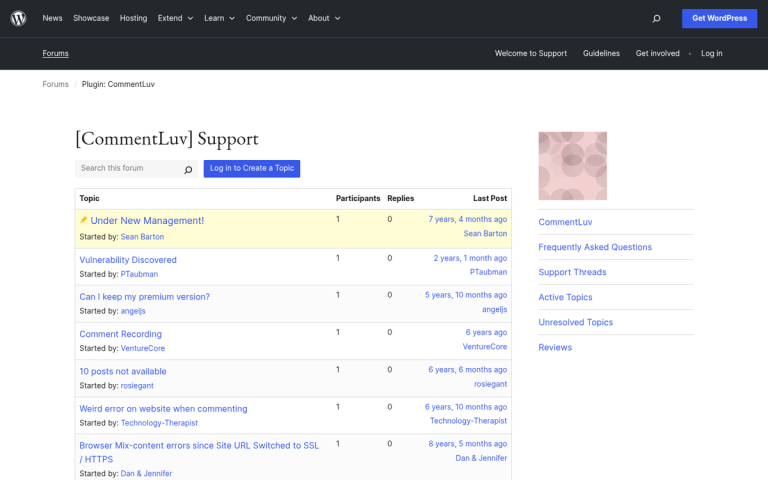
CommentLuv has been abandoned. The plugin's developer, Andy Bailey, stepped back from the project because of health problems - specifically, he has been battling multiple sclerosis (MS) since 2012. As a result, development on the plugin stalled and eventually stopped.
The numbers tell the full story. The free version of CommentLuv has been downloaded over 973,000 times in total. But as of now it has only around 10,000 active installations. That means roughly 960,000+ copies have been uninstalled or disabled over the years - a staggering drop that points to a mass exodus from the plugin. It currently holds a 4.4 out of 5 star rating on WordPress.org based on just 21 reviews. But that rating reflects its peak years - not its current state.
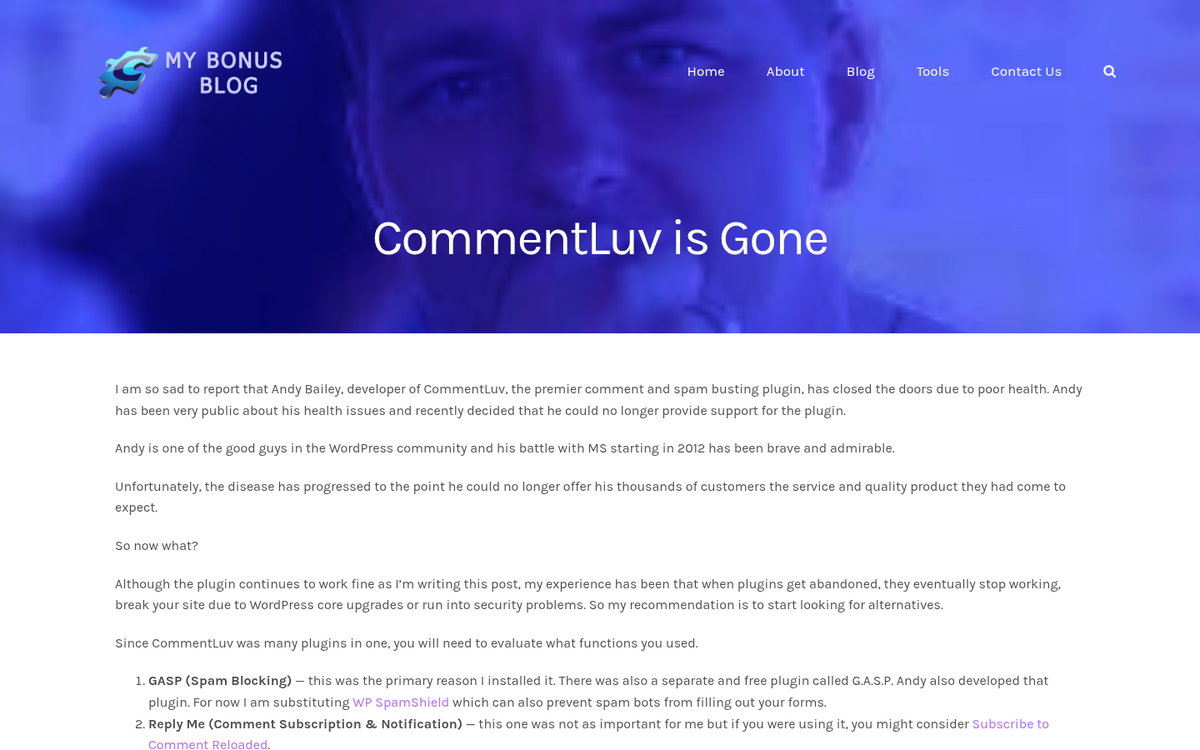
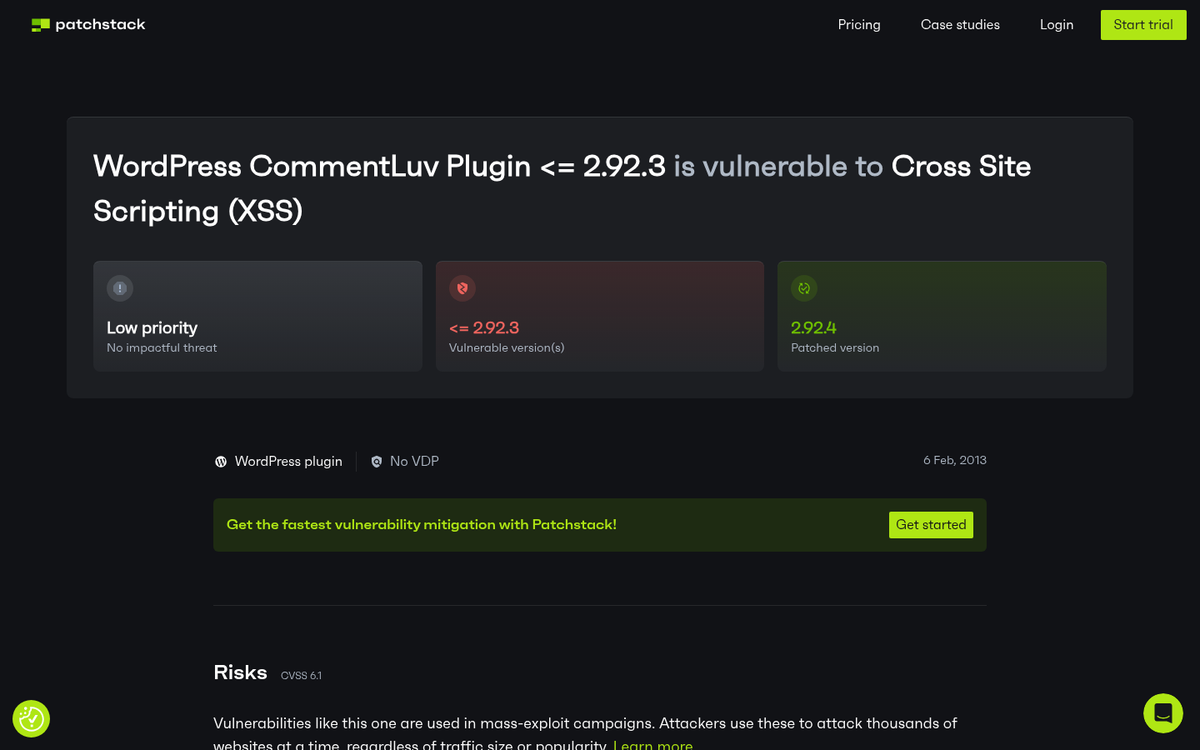
Most critically from a practical standpoint: CommentLuv has not been tested with the last three WordPress releases, each of which included important bug fixes and security patches. Running an untested, unmaintained plugin on a live WordPress site is a genuine security risk, and most respected hosting providers and security auditors will flag it.
The premium version, which was once sold as a one-time license purchase, is no longer being actively developed or supported either. If you paid for it, you might still have access to what you purchased. But you should not expect updates, compatibility fixes, or support going forward. If you're looking for alternatives, there are ad-free commenting options worth considering, or you can explore what the best commenting plugin for WordPress might be for your site in 2026.
What the Premium Version Offered
For historical context, here's what the premium version of CommentLuv added over the free version:
- Expanded post choice. Rather than being locked to the commenter's most recent post, it allowed them to choose from several recent posts - giving them the ability to promote something more relevant or more strategically useful.
- Social media integration. Commenters could link their Twitter, Facebook, or Google+ accounts and share social posts instead of blog posts.
- Advanced DoFollow/NoFollow controls. One of the most important features. It allowed site owners to require commenters to have posted a minimum number of times before their links became followed links - a key protection against casual spam. Learn more about how nofollow links work on your blog.
- Sticky posts for commenters. If you owned the premium plugin yourself, you could hand-select up to five posts to always be available for promotion when commenting on other CommentLuv-enabled blogs.
- Bundled anti-spam plugins including GASP (anti-bot and spam blocking), KeywordName (blocks keyword-stuffed commenter names), TwitterLink (Twitter-specific controls), and ReplyMe (reply notifications and redirect features for new commenters).
- Lifetime updates - though given the plugin's current state, this benefit no longer has any practical value.
These were legitimately helpful features at the time. The DoFollow controls in particular were what made the premium version worth thinking about - without them, you were basically running an open link-building target on your site.
NoFollow vs. DoFollow in 2026
This part of the conversation hasn't changed much. But it's worth revisiting in light of how Google's approach to links has evolved.
A NoFollow attribute on a link tells Google not to pass authority through it. It was designed for situations like user-generated comment links - where you can't vouch for the quality or relevance of every destination. DoFollow links pass authority and can be a signal of endorsement.
Google has become increasingly refined about recognizing and discounting unnatural link patterns. Google explicitly discourages artificial link-building activities and treats them as a violation of its guidelines. A comment section full of followed outbound links to unrelated sites is the kind of signal that can trigger a manual penalty or algorithmic demotion.
The nuance here is that even NoFollow links aren't entirely without value - they can still drive referral traffic, and Google has moved toward treating NoFollow as a "hint" instead of a hard directive. But the risk-reward calculation for DoFollow comment links has only become worse over time - not better. If you want a deeper look at how to apply this across your content, our ultimate guide to using NoFollow on blog posts covers the topic thoroughly.
The SEO Risk/Reward Decision in 2026
Let's be direct: the case for installing CommentLuv on a new site in 2026 is very weak.
The plugin is unmaintained, untested against the latest WordPress versions, and carries security exposure. The community that once made it helpful - thousands of active blogs all running CommentLuv and giving you a network of reciprocal linking opportunities - has largely dissolved. With only 10,000 active installations remaining, the network effect that once gave CommentLuv part of its appeal basically no longer exists.
Beyond the plugin's own decline, the wider SEO community has shifted dramatically. AI-generated content, AI-assisted spam, and increasingly refined bot traffic mean that an open comment system with link incentives is harder to moderate than ever. What used to require a dedicated spam bot network can now be executed at scale with minimal effort and cost.
If you're still running an older site with CommentLuv installed, the most responsible advice is to audit it:
- Review your existing comment section for thin or spammy comments with outbound links that may already be hurting your rankings. Deleting low-quality content can actually increase traffic over time.
- Consider whether the plugin's security vulnerabilities - given it hasn't been tested against recent WordPress releases - represent an acceptable risk for your site. It may be worth using a tool to scan your WordPress blog for bad external links as part of that review.
- Evaluate whether the comments being generated are actually adding value to your content, or whether they're mostly low-quality entries from link-seekers.
What to Use Instead
If your goal was always to build a more involved comment community and drive quality conversation on your blog, there are better paths in 2026:

- Manual community building. Respond to every comment personally, especially in your early stages. Nothing drives more comments than an author who visibly participates in discussion.
- Modern comment platforms. Tools like Disqus or Commento offer spam protection, threading, and notification features without the link manipulation risks.
- Community platforms. Moving deeper discussions to a Discord server, a Substack community, or a dedicated forum keeps your audience engaged without creating an SEO liability on your main site.
- Schema markup and structured engagement. Rather than relying on comment volume as an SEO signal, focus on content depth, E-E-A-T signals, and earning genuine editorial links - all things that matter far more to rankings in 2026 than they did when CommentLuv was at its peak.
CommentLuv was an interesting experiment in incentivized community building, and in its day it had merit. But between its developer's health-related departure from the project, its compatibility problems with the latest WordPress versions, the collapse of its active user base, and the change in Google's link evaluation, it's a plugin that has had its time. For most site owners, the risks outweigh any remaining benefits, and there are better options available.

13 responses
Thoughtful replies only - we moderate for spam, AI slop, and off-topic rants.
Well, what can I say after reading this post on how beneficial comment luv can be, and then I get to the bottom of it and I find Disqus... which one should I be using?
A blogging acquaintance of mine was complaining about spam. He said he had to delete 4900 spam comments so he went to Disqus. I personally find this amazing and also probably a lie since his blog had almost no real comments on it at all to begin with before going on Disqus, was only 3 months old with no PR, a very low DA and a somewhat respectable Alexa rank, although that is highly manipulable just by loading up a toolbar on one browser and visiting all your post every day.
The thing that irritated me is I was going to great lengths to help this guy, with reading and sharing and liking and tweeting all over the bloody place and before he has any popularity level at all, he flips over to Disqus, which for some niches could be a good choice. But for his I think was very bad.
When your blogging about blogging, SEO, WordPress and other topics that will attract webmasters doing the same, they expect some give and take. If I am going to read your post and share it around, then the least I should be able to do is make a comment about it that has a little bit of return clout in it, even if it is a weak ass nofollow backlink.
And there was another guy I was promoting all over the place. His Facebook page and Twitter account didn't even have likes, comments, shares, tweets without me doing it. And he is optimizing his comment section so much he is barely approving any at all unless they meet his exacting standards. So his comment section is almost devoid of interaction also. When he declined my comment doing this, I had enough. No more will I deal with these kinds of bloggers that think its all about them, but they want support.
I hope his turning down a perfectly legitimate comment was worth it to him as that straw that broke the camels back. Because that one cost him a crap ton of back links, several good referring domains, and a host of likes, shares, follows, on his social media. By the end of the night, him deciding he needed to be a anal retentive comment Nazi had cost him hundreds of referrals.
I need to write a post about bloggers and what some of them do with comment sections, because if they think they are going to be in the blogging about blogging niche, WordPress, SEO and such, and massively restrict their comment sections, remove them, or go on Disqus and maintain popularity or gain it, I think they are going to find out otherwise.
Hi William, your comment about bloggers deleting your comment after you promoted them literally left me in stitches lol. It felt like a blog post.
This is such a helpful post, so thank you very much. I am currently running Comment Luv on my blog and my wife's blog. It is a great plugin that I really enjoy using.
I have worried about the link situation slightly but my solution is to closely monitor the comments. I figure that if the comment is real and adds value, it can pass thru. If it doesn't and it is obviously there for the link, I delete it.
This may not be the best SEO approach but it feels like a good human approach.
CommentLuv is definitely useful like DISQUS and WordPress. It actually one of the top social media app that one has to consider when creating a website for internet marketing.
Commentuv seems dead, especially on a post that extolls its virtues but uses Disqus.
Thanks for sharing valuable information with us.
The main reason for CommentLuv for me is to be able to get some good relevant comments but also give back to those valuable readers in the form of a link. It's also a great way to learn about other blogs and network with other bloggers.
CommentLuv is certainly valuable like WordPress. It really one of the best web-based life application that one needs to think about while making a site for web promoting.
Hi Roy! Do you use it on your site? Has it helped your site grow?
hey james, yes i use it on my site and its help me little to grow my site.
Nice article Kenny Novak, comment luv is still useful nice to know. Is comment blogging link building is still useful? Or this link are follow or no-follow. Please let me know.
I was finding blog comments sites manually. But your blog post help me a lot. Thank you so much.
Great article! The discussion about whether the CommentLuv plugin is still valuable for SEO was really insightful. I agree that while it may not have the same impact it once did, leaving genuine, high-quality comments is still a great way to build relationships, drive relevant traffic, and increase your online presence. SEO has evolved, and creating valuable content and engaging naturally with other blogs is much more effective than relying on plugins alone. Thanks for sharing such a balanced perspective!
Thanks so much for sharing your thoughts, Robert! You've nailed it - genuine engagement will always outperform any plugin on its own. Building real relationships through thoughtful comments creates lasting value that no algorithm update can take away. It's refreshing to see bloggers focusing on authentic connection over shortcuts. Keep up the great work engaging with the community!