Most users scroll past privacy policy updates without a second thought. But buried in the fine print is something worth mentioning: with X, you've likely agreed to have your data used for AI training purposes. Whether that's a fair trade or a quiet overstep can depend on how much you knew going in.
This piece breaks down how X actually uses your data, what the platform's terms say about AI training, and what it means for the average person who just wants to post without becoming an unwitting contributor to a machine learning dataset.
Key Takeaways
- X's updated terms grant a royalty-free license to use your content for AI training, including posts, likes, bookmarks, and reposts.
- Passive activity like bookmarks and likes provides strong intent signals, meaning you contribute training data without posting a single word.
- EU regulators used emergency GDPR powers to force X to pause AI data collection, a protection unavailable to users in most other countries.
- Individual posts minimally impact Grok's behavior, but collectively, user content holds real commercial value - Reddit licensed similar data to Google for $60 million.
- Users can opt out via Settings, but this only applies going forward; past posts may already be processed, and public content remains accessible to scrapers.
What X's Updated Terms Actually Say About Your Content
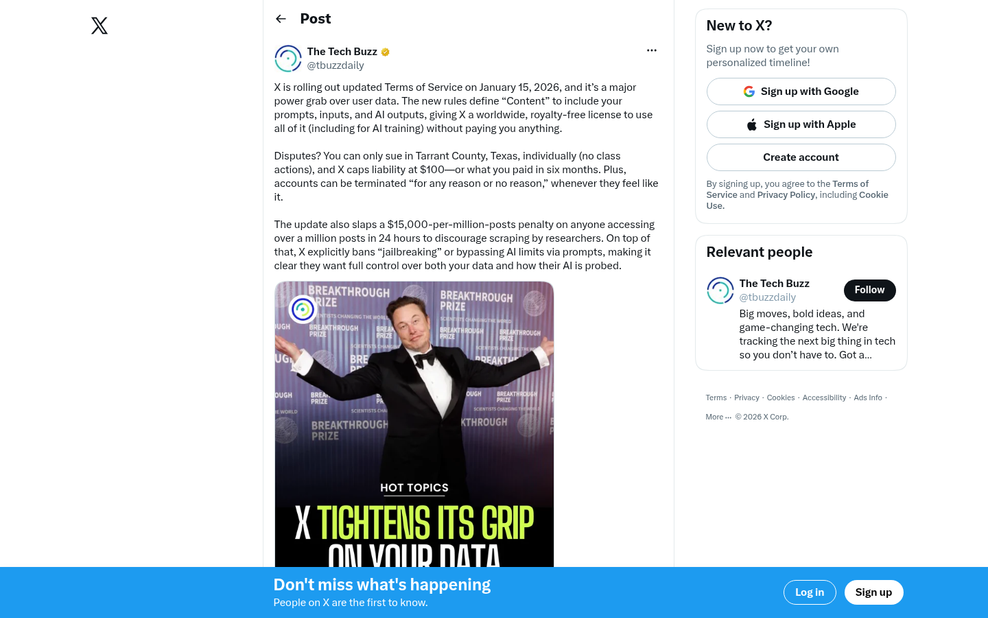
X updated its terms of service on November 15, 2024, and most users clicked "agree" without a second thought; it's not a criticism - almost everyone does it. But it's worth learning about what you actually agreed to.
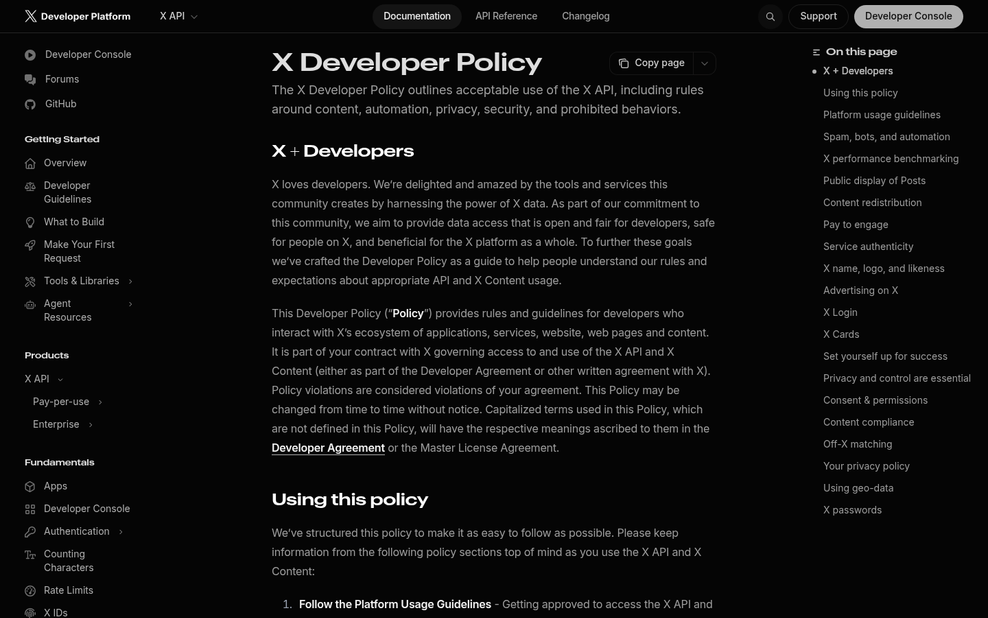
The phrase that matters in the terms is that you grant X a "worldwide, non-exclusive, royalty-free license" to use your content. In plain language, that means X can use what you post. But you still own it and can post it elsewhere. They don't have to pay you, and they can use it anywhere in the world.
The non-exclusive part does matter - it means X doesn't get sole rights to your content, so you're free to publish the same text in other places. What you're giving them is permission to use it - not ownership.
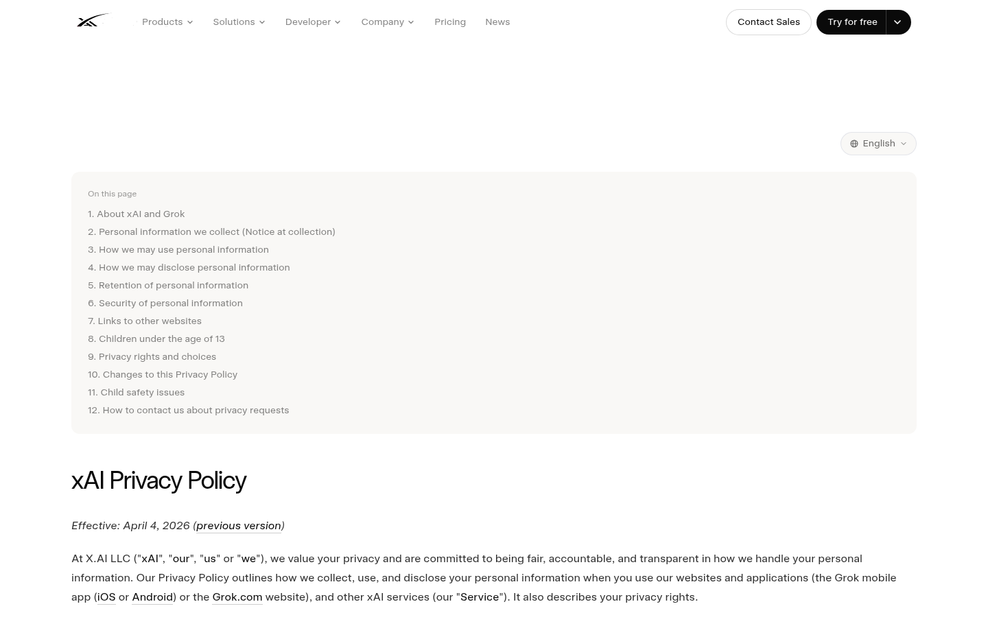
X's privacy policy, updated September 29, 2024, takes things a step further - it says that collected data may be used for machine learning and AI development. Your tweets are combined alongside data about how you use the platform, which includes your interactions, preferences, and behavior patterns.
The phrase "publicly available information" is doing a lot of work in these policies - it likely covers more than just your posts. Things like your display name, bio, and even the accounts you follow could fall into that category if your profile is set to public.
None of this is exclusive to X - most large platforms have similar language buried in their terms. The difference here is that X has been more transparent than others about using that data to train AI models, partly because of how openly the company has talked about its Grok AI assistant and the data it relies on.
So yes, your public activity on X is fair game under the terms you agreed to. The more interesting question is which types of activity feed into that process.
Which Types of X Activity Feed Into AI Training
X collects more than what you publish. The platform gathers a much wider range of activity- like things you do quietly in the background without ever posting a word.
The table below breaks down the main types of activity and where they stand in relation to AI training data.
| Activity Type | Included in AI Training Data | Why It Matters |
|---|---|---|
| Posts / Tweets | Yes | The most direct form of content you create |
| Reposts | Yes | Shows what content you want to amplify |
| Likes | Yes | Signals personal preference and approval |
| Bookmarks | Yes | Reveals intent and what you find worth saving |
| Replies | Yes | Adds conversational context around a topic |
| Profile information | Yes | Used to build user identity context |
Posts and replies are easy - they are text you deliberately write and put out into the world. Likes and bookmarks are a different signal altogether. They tell an AI model what you find helpful, interesting, or worth returning to, without you needing to say a single word about it.
That's what makes passive activity so helpful for training. A bookmark in particular is a strong indicator of intent- it means you thought something was worth keeping, and that preference data helps AI systems learn what users actually care about instead of just what they say.
Reposts sit somewhere in the middle. They are an action- not original writing. But they still communicate endorsement. An AI can learn quite a bit about a user's worldview just from the content they share forward.
You don't have to be an active poster for your data to feed into training. Using the platform in any meaningful way puts you in the picture.
The EU Fought Back - and Won (For Now)
When X started pulling EU user data to train Grok, regulators didn't send a strongly worded letter. Ireland's Data Protection Commission stepped in and used emergency powers - something it had never done before - to force X to stop collecting data from EU users for AI training purposes.
That's worth sitting with for a second. These powers existed on paper. But no situation had ever pushed regulators to actually use them until X and Grok came along.
X agreed to pause the data collection and cooperated with the investigation. That looks like a win for EU users - and it was one. The GDPR gave regulators the teeth to act fast and X had no choice but to respond.

But this is the part that matters for everyone else - this protection applied to EU users specifically because of GDPR. Users in the US, the UK, Australia, and most other countries had no equivalent legal framework to trigger that response. Their data kept flowing into Grok's training pipeline without any emergency brake being pulled on their behalf. If you want to understand how Grok handles your data and performance signals, the defaults are worth examining closely.
The fact that it took emergency intervention - not a scheduled process - to pause this tells you something about how these systems work. Data collection happens first. The legal reaction comes later, if it comes at all. For users outside the EU, "later" has so far meant never.
X has since updated its privacy settings to let users opt out of data use for AI training in some regions. But the default setting still leans toward participation instead of protection, and most users never dig into their privacy settings at all. The EU situation showed that the right legal environment can create accountability. But it also showed how uneven that accountability is depending on where you live. When platforms set participation as the default, verifying what AI systems actually do with that data becomes more important than ever.
How Your Posts Shape What Grok Learns (And What They Don't)
To be honest: one person's posts are not going to change how Grok behaves. AI models train on billions of data points, and your account is a drop in that ocean. But the relationship between user content and model behavior is still real - it just works at scale.
Volume matters quite a bit. The more data a model sees on a given topic, the better it gets at handling that topic. Topic diversity matters too, because a model trained mostly on tech and politics will have a hard time with niche subjects that don't get as much coverage on the platform. That's why X's full firehose of content is so helpful to xAI.
Signal quality also factors in. Likes, reposts, and replies are feedback signals that can show which content is worth learning from. A post that gets engagement carries more weight than one that no one interacts with. So the things people collectively respond to shape what the model absorbs.
To put that in perspective, Reddit struck a deal worth around $60 million with Google to license user-generated content for AI training. That tells you something important: the things people write online have genuine monetary value to AI developers. X users are contributing something similar, just without any compensation or formal agreement. If you want to understand why some content gets prioritized in AI systems over others, the answer often comes down to exactly these kinds of signals.
That raises a fair question about use. Individually, users have very little leverage. But collectively, the people who post on X are handing over a resource that businesses are willing to pay money for elsewhere. The ethical implications are a separate question - but it's worth knowing that your content isn't just background noise.
What you post, how much you post, and how people respond to it all feed into a system that's actively being used to build a commercial AI product; it's the reality of the current arrangement. This is also part of why platforms like Reddit are being used to build brand entity signals - the value of community-generated content to AI training has never been higher.
How to Limit What X Uses Without Deleting Your Account
X does give you some control over how your data feeds into AI training. But the settings are buried enough that most users never find them; it's worth knowing about.
To get there, go to Settings, then Privacy and Safety, then Data Sharing and Personalization. You'll find a toggle labeled "Allow your posts to be used to train Grok." Turn that off. It's the most direct opt-out available to standard users right now.
It also helps to set your account to private if you're willing to make that trade-off. Private accounts limit who can see your posts, which cuts back on how broadly your content circulates and gets picked up by third-party scrapers outside of X's own systems.
The honest part, though: opting out through settings doesn't scrub anything retroactively. Posts you made before changing the setting may already have been processed. The opt-out applies going forward, not backwards, and X's policy language leaves room for some data use to continue even after you opt out.
Public posts are harder to protect than private activity because they're accessible to more than just X's own data pipeline. Researchers, third-party developers, and other AI companies can access public posts through the API or through web scraping. No in-app setting blocks that.
If you want to go further, you can submit a data deletion request through X's privacy tools. This asks X to delete the personal data it holds on you, though it won't necessarily remove your content from models that have already trained on it.
The difference between what opting out promises and what it delivers is real, and it's reasonable to feel frustrated by that. These controls are a real step but not a complete answer. Knowing what they do and don't cover puts you in a much better position to choose how you want to use the platform going forward.
So, Should You Post More - or Just Post Smarter?
Zoom out and the picture changes. Collectively, the millions of postings on X every day are contributing to a living dataset that shapes how large language models learn to communicate, reason and align with human behavior. The patterns in that data - the slang, the arguments, the misinformation, the nuance - all of it feeds the machine. In that sense, the crowd does matter - even when the individual person doesn't.
That leaves a quieter question worth sitting with: what content are you putting into that collective pool? You might not be able to move the needle on AI performance single-handedly. But you are part of the bigger signal. If that means anything to you personally - if it changes what you post or how you engage online - is entirely up to you.