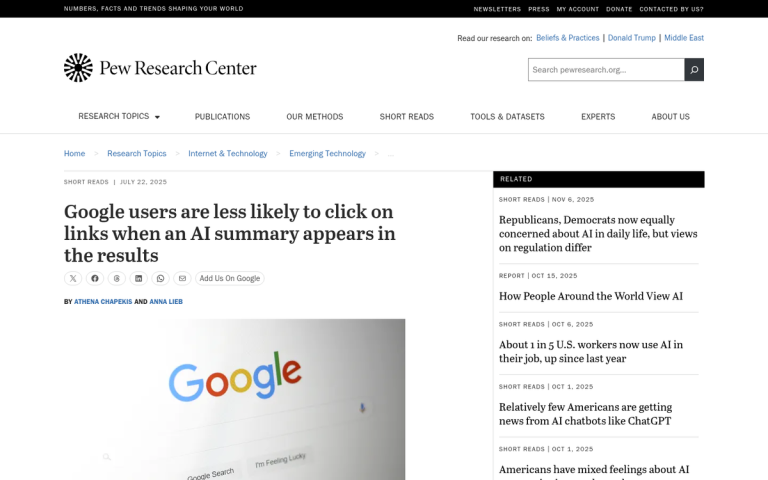
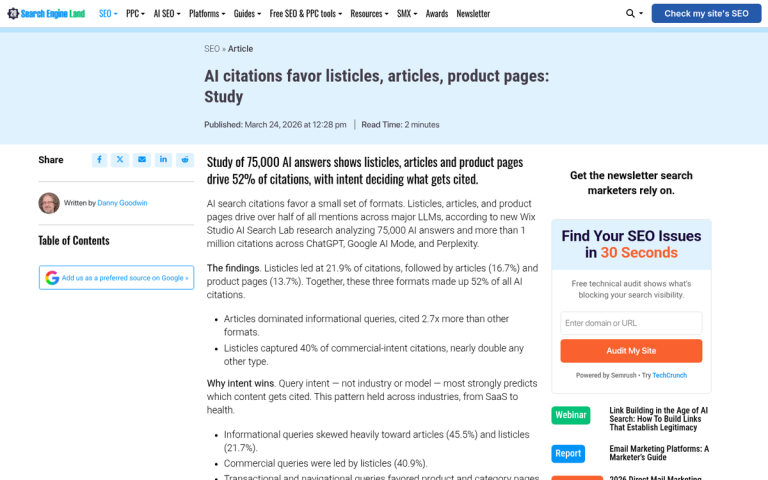
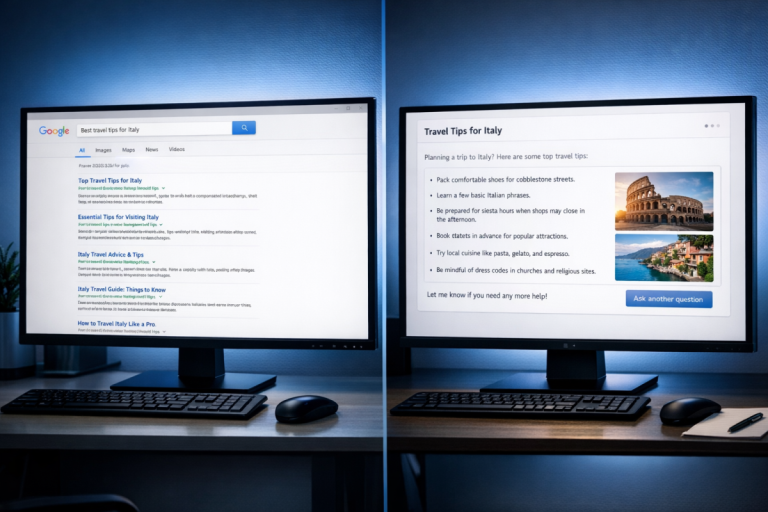
AI Overviews are Google's on-page summaries that appear above traditional search results, pulling information from across the web to answer a query directly. They're not going away. Since rolling out broadly in 2024, they've become a fixture at the top of results for a giant number of searches - and the businesses that get cited inside them are seeing a measurable benefit. Research from Seer Interactive found that businesses mentioned in AI Overviews earn 35% more organic clicks and 91% more paid clicks than the ones that aren't. Being cited isn't just a visibility win - it's a signal of authority that carries across a user's entire session.
That difference between the businesses Google trusts enough to cite and everyone else isn't random, and it isn't purely about who has the biggest budget or the most backlinks. There are identifiable reasons why some sites get pulled into these summaries and others don't - and most of them come down to how content is structured, how a brand's expertise is communicated, and how well a site lines up with what the AI is actually trying to do when it generates an answer.
What follows breaks down the most common reasons your competitors are showing up in AI Overviews and you're not - and what you can do about it.
Key Takeaways
- Only 12% of URLs cited in AI Overviews appear in Google's traditional top 10, meaning standard SEO rankings don't guarantee AI visibility.
- Brands with more web mentions receive up to 10 times more AI citations than those with fewer external references across the internet.
- 44% of AI citations come from a page's first 30%, so burying answers deep in content significantly reduces your citation chances.
- Businesses with profiles on Trustpilot, G2, or Yelp are roughly three times more likely to appear in AI Overviews than those without.
- Closing the gap requires auditing content structure, building third-party presence, earning authoritative mentions, and monitoring citation patterns separately from rankings.
Why AI Overviews Don't Work Like Traditional Search Rankings
Most businesses believe that ranking well in Google's top 10 is the answer to showing up in AI Overviews too- it's a basic assumption. But the data shows something different.
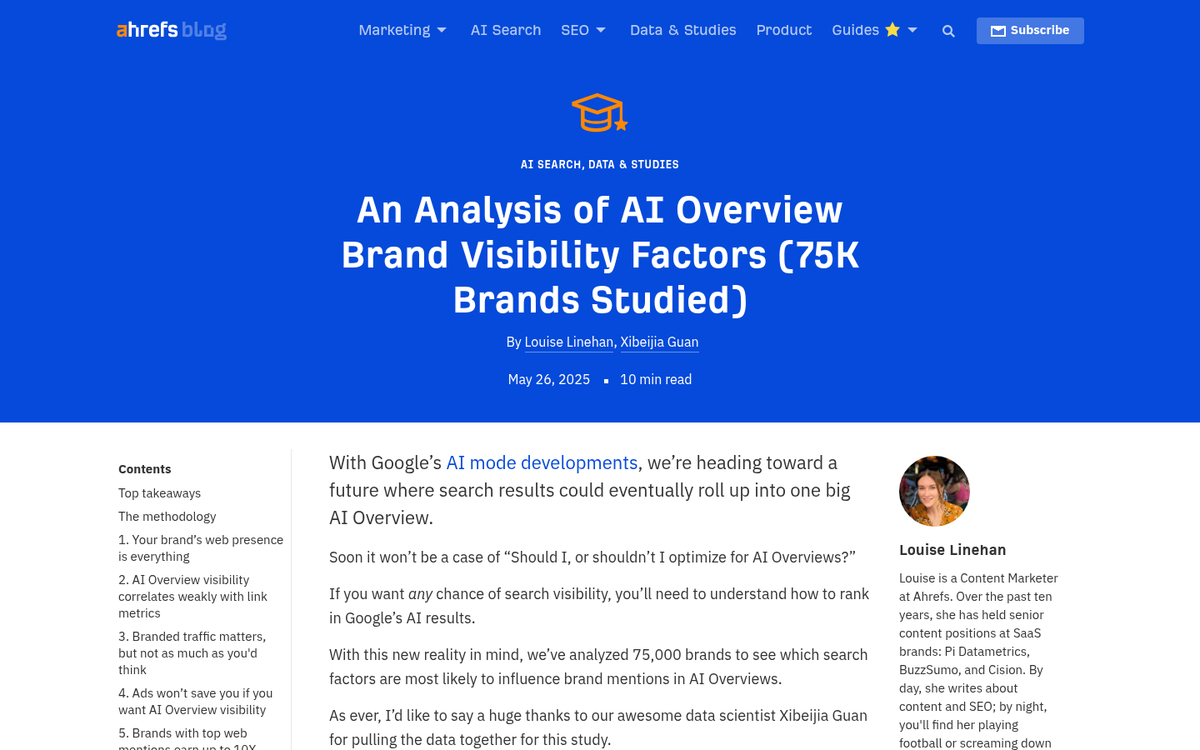
Research from Ahrefs found that only around 12% of URLs cited in AI Overviews actually appear in Google's traditional top 10 results. Even Google's own data shows that AI Overviews overlap with standard blue-link results only about 38% of the time. That means the two systems are pulling from largely different pools of content.
This matters because SEO work is built around climbing the traditional rankings ladder. Getting to page one is still helpful. But it doesn't automatically qualify your content for AI-generated answers. The selection logic is different, and the content that gets pulled in is usually serving a different job.
AI Overviews are designed to answer questions directly, so Google leans on content that actually does that. Data shows that 88.1% of queries that trigger an AI Overview are informational - meaning the user is trying to learn something, understand an idea, or figure out how something works. Transactional content built to drive sales doesn't get much traction here.
Question-based content has a structural benefit in this context. A page that directly answers "how does X work" or "what's the difference between X and Y" is a much stronger candidate for citation than a product page or a generic homepage.
It also helps to know that AI Overviews aren't ranking pages in the traditional sense. They put together answers from multiple sources and pull in the pieces that best fit the question. A page doesn't have to be number one to get cited - it just has to be the most helpful reference for a part of the answer.
So if your content strategy has been focused heavily on ranking for commercial keywords, you might have a gap in the type of content that AI systems are actually looking for. The businesses showing up in AI Overviews aren't necessarily beating you in traditional SEO - they're making content that fits a different set of criteria. If you're also wondering why your blog content isn't ranking well, the answer often ties back to these same gaps in content strategy.
The Web Presence Gap Between You and the Brands Getting Cited
If traditional rankings don't explain who gets cited, then something else is doing the work. That something is web presence - how often a brand is mentioned, linked to, and referenced across the internet.
Research from Ahrefs found that businesses in the top quartile for web mentions receive as many as 10 times more AI citations than businesses with fewer mentions; it's not a small gap.
SE Ranking data can add to this picture. Sites with 32,000 or more referring domains are 3.5 times more likely to be cited by ChatGPT than sites with a fraction of that number. Referring domains are a measure of how many different websites link to you, and that number points to something deeper than SEO.
Consider what a large referring domain count actually tells you - it means hundreds or thousands of independent sources have decided your brand was worth mentioning. To a human reader, that's a credibility indicator. To an AI model trained on large amounts of web data, it works in the same way - a brand that appears everywhere feels more established and trustworthy as a source.
Framing this as purely an SEO problem misses the point. You can have a technically well-optimized site and still be invisible to AI systems if your brand doesn't have a strong footprint outside your own domain. The businesses that get cited tend to be the ones that get written about in trade publications, referenced in forums, mentioned in comparison posts, and linked to from a number of sources.
AI models are essentially asking: does the web at large seem to know who this brand is? If the answer is no, or not convincingly, your content may never make it into a response - no matter how well-written it is; it's a credibility signal problem.
The difference between you and the businesses getting cited may be less about what your site says and more about how little of the wider web points back to you.
How Your Content Structure Either Invites or Blocks AI Citations
The gap isn't always about how many pages you have or how many sites link to you. Sometimes it can depend on how your content is written and where the content lives on the page.
Kevin Indig's analysis of 1.2 million AI answers found that 44.2% of ChatGPT citations came from the first 30% of a page; it's a big deal. If your best answer is buried three scrolls down, AI is less likely to find it helpful enough to cite.
The same research found that 72.4% of cited blog posts had what's called an "answer capsule" - a tight, self-contained paragraph that directly answers a question and doesn't make the reader dig around. It doesn't need a label or a format - it just needs to land the answer fast, in one focused block of text.
Consider your own content for a bit. Do your posts open with context and backstory before they get to the point? That structure works fine for human readers who are browsing. But AI systems like to pull from wherever the clearest answer lives. If that answer isn't near the top, you're at a disadvantage.

The research also found that 52.2% of cited content featured original data - it makes sense because AI systems want to attribute something worth attributing. A page that restates common knowledge doesn't give an AI much reason to cite it specifically.
A quick audit of your own content gives you an idea about where these gaps are. Look at your top pages and ask if each one has a direct answer in the first few paragraphs, if that answer is self-contained, and if the page includes any data or findings that belong to you.
| Content Trait | Cited Content | Non-Cited Content |
|---|---|---|
| Answer placement | Within the first 30% of the page | Buried further down the page |
| Answer format | Self-contained answer capsule | Answer spread across multiple sections |
| Original data | Present in over half of cited posts | Mostly restated or general information |
| Opening structure | Gets to the point quickly | Heavy on intro context before the answer |
Your competitors who are cited have likely structured their content this way - even if they didn't do it with AI in mind.
Why Third-Party Platforms Are Quietly Deciding Your Citation Odds
Most businesses focus all their energy on their own website and never ask a more revealing question: where does your brand show up when someone searches for you somewhere else?
That question matters more than most know. Research from SE Ranking found that businesses with profiles on places like Trustpilot, G2, or Yelp are roughly three times more likely to be cited in AI Overviews than the ones without them; it's an actual gap, and it comes down to how AI models actually learn about the world.
Review sites, directories, and editorial sources are heavily crawled and carry trust signal weight. When a brand appears across those sources, it starts to look more like an established, verifiable entity to an AI model instead of a name it has only seen in one location.
Your website tells your story. But third-party places help confirm it. A Trustpilot page with reviews, a G2 listing with customer feedback, or a Yelp profile with consistent information all give AI systems a clearer picture of your brand across the web. That breadth of presence is part of what AI systems use to determine if a source is worth citing.
This goes beyond just review sites. PR mentions in trade publications, podcast appearances, and citations in niche industry directories all add to the same picture. Even a reference on a Wikipedia-adjacent source or a known aggregator can strengthen how AI models perceive your authority in a given space.
The practical implication is that citation potential is not built in one location. A brand that publishes great content but has no external footprint is working at a disadvantage compared to one that has built a recognizable presence across the web.
It is also worth noting that this presence tends to compound over time, and each new external mention, review, or directory listing can add another data point that reinforces your brand's credibility to AI systems trained on that same web. The businesses showing up in AI Overviews are not necessarily making more content - they are just more visible in more places.
How to Close the Gap Before Your Competitors Get Further Ahead
If you're not sure where to start, prioritize in this order:
- Audit your on-page content structure first. This is within your direct control and delivers the fastest signal - clear definitions, direct answers, and logical formatting give AI systems something to actually pull from.
- Build or clean up your third-party presence. Listings, review profiles, and industry directories are low-effort relative to their impact on corroboration signals.
- Pursue mentions and links from relevant, authoritative sources. This takes longer, but web mention volume and referring domain quality are among the strongest predictors of who gets cited.
- Monitor citation patterns separately from rankings. Track which queries surface AI Overviews in your category and audit who is being cited - then reverse-engineer why.
None of this happens overnight. But it's a winnable game. The businesses showing up in AI Overviews didn't get lucky - they checked the right boxes first. The boxes are still there, waiting on you.