




In plain terms, when an AI is deciding which sources to pull from when generating an answer, it favors content that actually adds something new to the conversation. If your page says what everyone else is already saying, it has little to no information gain. But if your content introduces a new angle, a concrete example, original data, or a clearer explanation compared to what's already out there, it can become far more helpful to the model.
For website owners, this is a change worth mentioning. Traditional SEO rewarded keyword density and topical coverage. Answer Engine Optimization raises the bar - you now need to consider whether your content legitimately teaches something, clears up something, or resolves something that competing sources don't. That distinction is what separates content that gets cited by AI from content that gets passed over.
This entry will talk about what information gain actually looks like in practice, why AI systems are wired to reward it, and how you can start applying it to your own content strategy.
Quick Answer
Information gain measures the reduction in entropy (uncertainty) achieved by splitting a dataset on a particular feature. It is commonly used in decision tree algorithms (like ID3) to select the best feature for splitting at each node. Calculated as the difference between the entropy before a split and the weighted entropy after the split, higher information gain indicates a more useful feature. It is based on Shannon's entropy formula from information theory.
Where Information Gain Comes From (And Why It Still Matters)
The concept has roots in a 1948 paper by Claude Shannon, published in the Bell System Technical Journal. Shannon wasn't thinking about search engines or AI - he was trying to figure out how to transmit messages efficiently over communication channels. But the framework he built turned out to be useful for applications far beyond that original goal.
His core idea was to measure uncertainty - specifically, how much uncertainty gets removed when you receive a piece of information. He called this entropy, and the formula he used was H(X) = −∑P(xᵢ) log2 P(xᵢ). You don't need to memorize that to know what it means in practice.
Shannon found that a random string of letters carries about 4.7 bits of entropy per letter because each character is unpredictable. English text, on the other hand, carries around 2.62 bits per letter because the language has structure - letters follow others in patterns we can predict. That structure cuts back on uncertainty, and lower uncertainty means less new information is being delivered per letter.
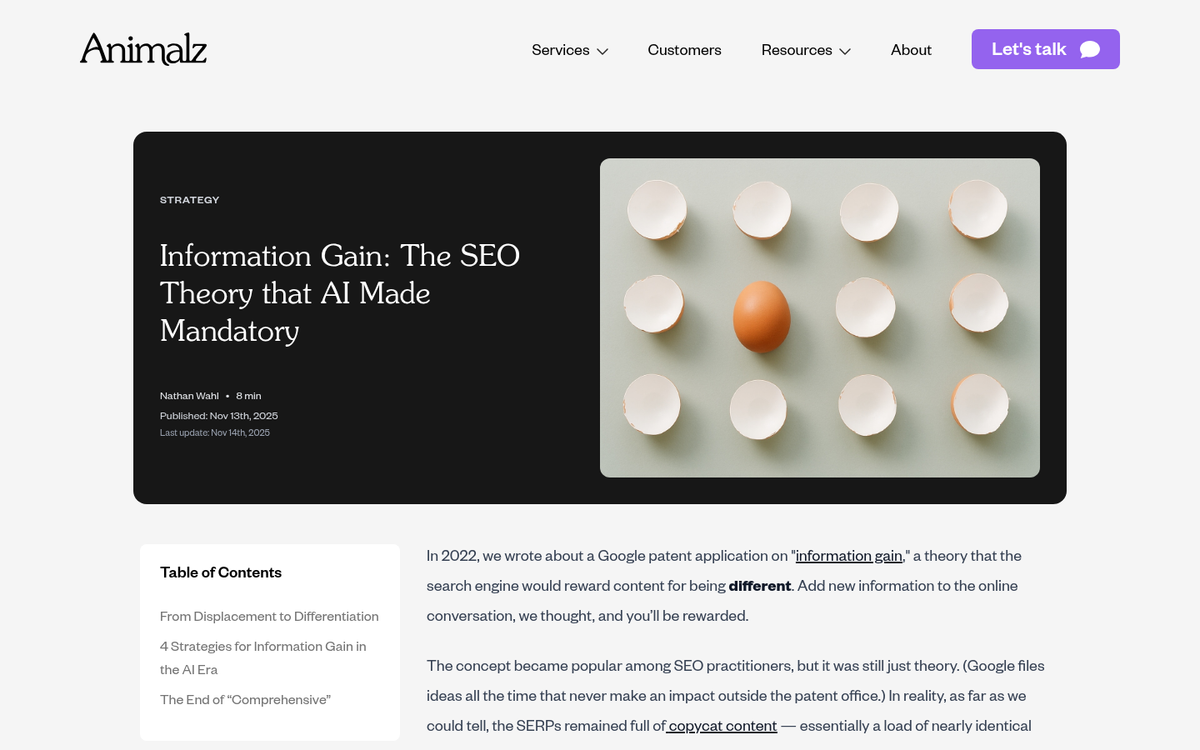
That's the part that matters for content. High entropy isn't always better. What Shannon was measuring is the relationship between what you already expect and what you actually get. A message with redundant or predictable content doesn't cut back on much uncertainty - it just repeats what the reader already knows.
Information gain is the step past entropy - it measures the reduction in uncertainty that comes from a piece of new data. In decision theory and machine learning, this got applied to things like building decision trees - where you pick the variable that cuts back on the most uncertainty at each step. The logic is simple: the more a piece of information narrows down the unknown, the more helpful it is.
Applied to text, the same principle holds. Content that restates commonly known facts doesn't cut back on much uncertainty for the reader. Content that introduces a new angle, a finding, or a connection the reader hadn't made yet moves the needle. Shannon gave us the math. But the underlying idea is something we already understand intuitively: learning something you already knew isn't learning anything at all.
How AI Answer Engines Use Information Gain to Rank Responses
AI systems don't look for keywords. They review if a piece of content can add something that wasn't already known. That process is rooted in the same information gain logic used to train decision trees.
The C4.5 algorithm, one of the most commonly used decision tree models in machine learning, uses information gain to choose which data points are worth splitting on - it asks if this variable tells us something new. That same principle carries into how modern AI answer engines review content. The model has already absorbed a vast amount of text, so it's always comparing what it knows against what your content can add.
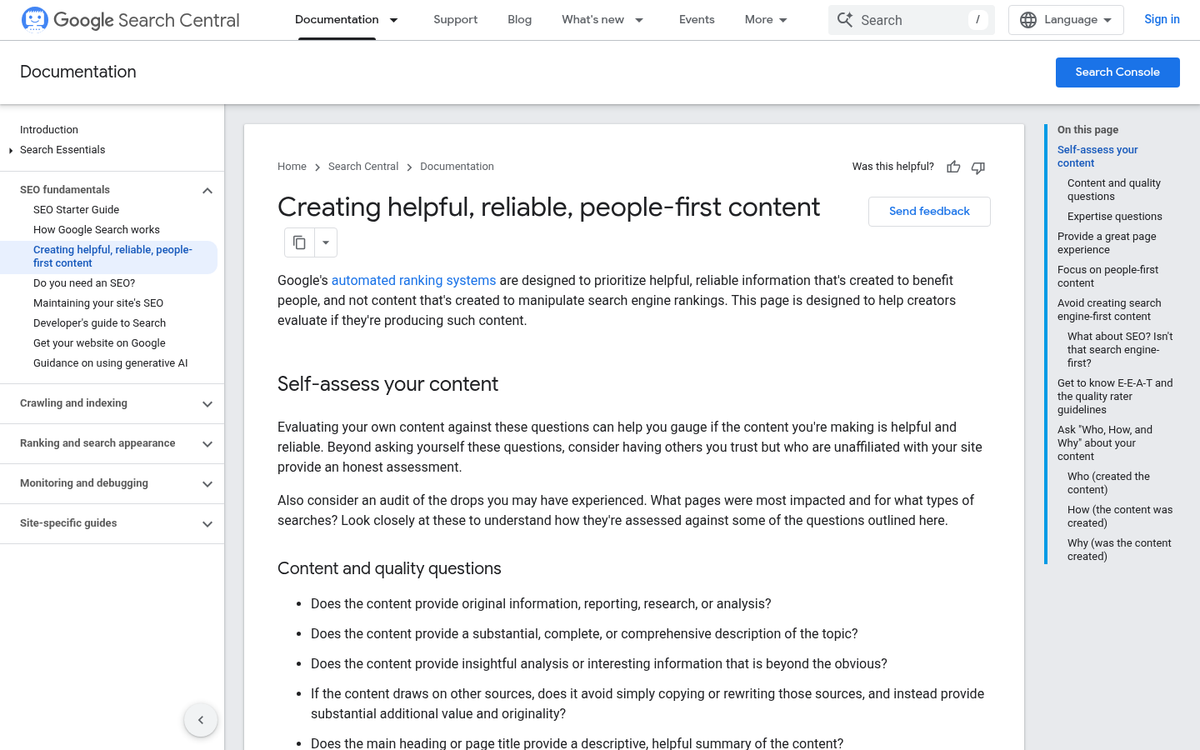
If your page says the same thing as a hundred others, the information gain is low. The AI has nothing new to work with, so your content contributes little to the response it builds. Pages that add a data point, a contrasting view, or a more precise answer to a narrow question give the model something to actually use. This is worth understanding whether you're writing for a personal blog aimed at earning money or building content for a larger publication.
| High Information Gain Content | Low Information Gain Content |
|---|---|
| Answers a specific question with original data or a clear position | Repeats widely available definitions without adding context |
| Covers an angle that competing pages don't address | Mirrors the structure and substance of top-ranking results |
| Uses precise language tied to a real-world outcome or process | Uses broad language that fits any situation but commits to none |
| Connects a concept to its practical implications | Explains what something is without explaining why it matters |
Answer engines are designed to synthesise - not to copy. So they pull from sources that each contribute something different to the final response; it's why two pages on the same topic can perform very differently - one gave the model a new part of the picture and one didn't. The same logic applies when publishing on platforms like Medium, where standing out requires more than restating what's already widely covered.
Information gain is not an abstract ranking factor buried in an algorithm - it's the core logic that determines if your content gets used at all.
What Low Information Gain Content Looks Like on Your Site
The easiest way to check your own content is to ask one honest question: if an AI has already processed thousands of pages that say the same thing, what does yours add? If the answer is "not much", that's the problem.
A lot of sites have FAQ pages that restate the question as the answer. "What is content marketing?" followed by "Content marketing is a strategy where brands create content to attract an audience." That's a definition that no one could get from a dictionary, and AI systems have seen it a hundred times already.
Blog posts that open with a term definition and then spend 800 words rephrasing Wikipedia are in the same category. There's no original angle, no data, no reasoning that comes from experience or research. The post exists. But it doesn't contribute anything new to the conversation about that topic.
Keyword-stuffed pages are another version of this. They're written to match a search query instead of to answer a question closely. You can usually tell because the information stops right before the nuance, the trade-offs, or the helpful thing that would actually help.
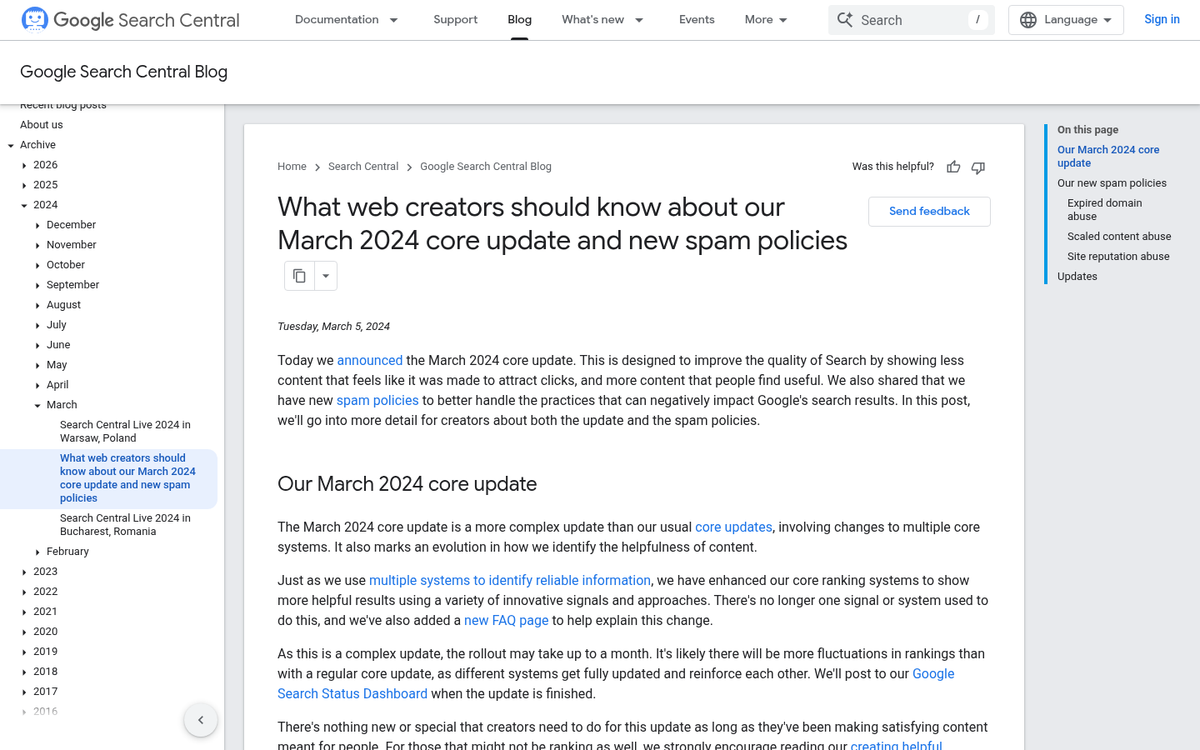
Generic "how to" content is worth looking at too. A post titled "How to Write a Product Description" that lists five bullet points without any context about audience, tone, or what separates a weak description from a strong one is technically on-topic but adds little value - it mirrors what every other surface-level post on that topic already says.
The pattern across these is the same. The content matches existing information instead of extending it. There's no point of view, no depth, and nothing that would make an AI prefer it over any other source that covers the same ground.
AI systems are weighing whether a source can add something to the table. A page that only confirms what's already widely known is easy to pass over in favor of one that fills a gap or takes the conversation further.
It's worth going through your most important pages with that lens before thinking about what signals actually tell AI your content is worth citing.
Signals That Tell AI Your Content Is Worth Citing
AI systems rank content partly on something called shared information - a measure of how much a page can add to what's already known. If your page says something that dozens of other pages already say, its independence score hovers near zero. You want to push that score up and give the model something it can't get elsewhere.
Named entities are one of the strongest tells you can use. Specific places, studies, products and dates anchor your content to reality and make it harder to substitute with a generic summary. A sentence like "conversion rates dropped 18% after the March 2024 core update" carries far more weight than "conversion rates can change after updates."
Original data works the same way. If you ran a survey, pulled numbers from your own platform, or tracked a trend over time, that data belongs only to you. AI engines treat it as a non-redundant source, which is what raises a page's information gain score.
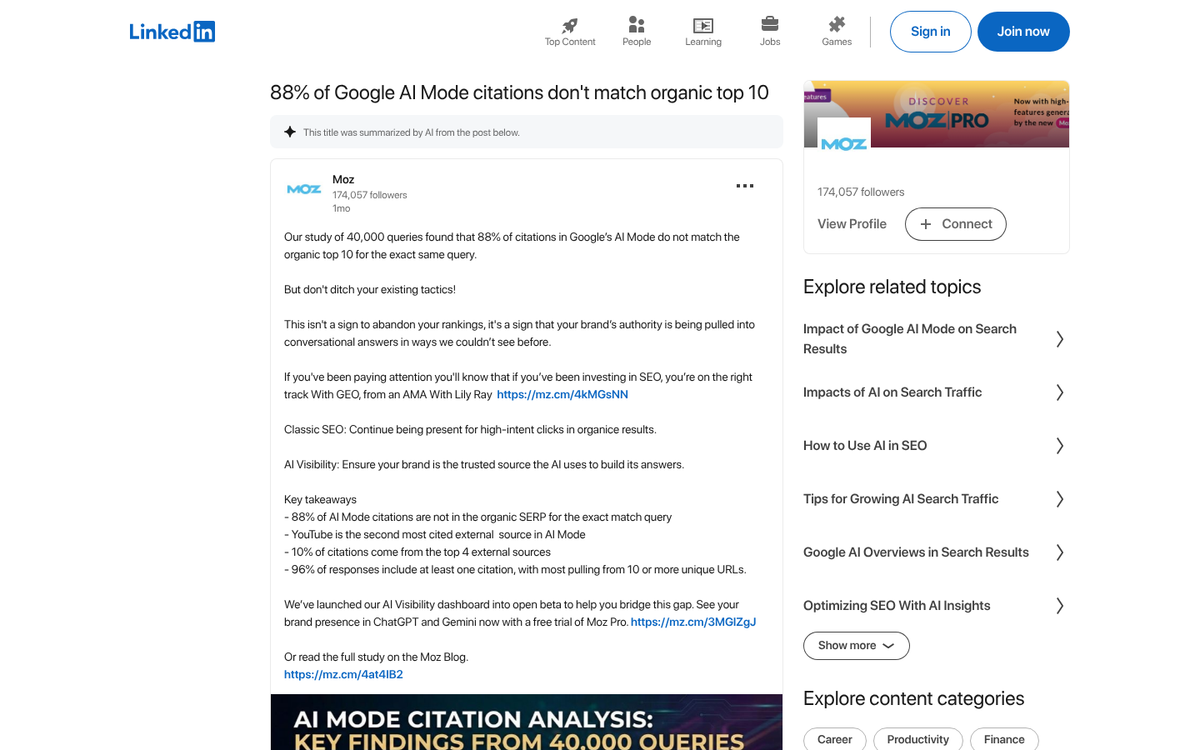
Structured answers help too. When you frame a direct question and answer it in a focused paragraph, you make it easy for a model to extract a clean, attributable response. Depth on a narrow topic is more helpful than large coverage of a wide one - a page that explains one concept tends to score higher than a page that lightly covers ten. If you're publishing data-driven content, tracking how posts are liked and shared can itself become a source of original, citable numbers.
| Low-Signal Element | High-Signal Alternative |
|---|---|
| Vague claim: "Many businesses struggle with this." | Cited stat: "62% of SMBs reported cash flow problems in Q1 2024 (source: XYZ report)." |
| Generic advice: "Focus on your audience." | Specific framing: "Pages targeting a single buyer persona outperformed broad landing pages by 34% in this A/B test." |
| Reworded definition from Wikipedia | Original explanation based on first-hand experience or internal data |
| Unattributed opinion: "Experts say this works." | Named source: "According to Dr. Jane Smith's 2023 study on attention spans..." |
Every high-signal ingredient in the pattern above is traceable, specific and hard to replicate. That is what makes a page worth citing.
Turning Information Gain Into Your Content's Competitive Edge
A helpful place to start is to choose one page on your site this week and read it with fresh eyes. Ask yourself: does this tell something they couldn't have pieced together from the first few results on Google? Does it include a data point, a real-world example, a counter-intuitive finding, or a perspective that only your experience could produce?
The websites that earn citations, direct answers, and long-term visibility in AI-driven search are not necessarily the biggest or the oldest. They are the ones that put something on the table - original information, detail, honest analysis. That is what high information gain looks like in practice, and it's well within reach for any site willing to prioritize substance over volume.
FAQs
What is information gain in AI content ranking?
Information gain measures how much new, useful information your content adds beyond what AI systems already know. Pages that introduce original data, unique angles, or clearer explanations are favored over those repeating widely available information.
Where does the concept of information gain originate?
Information gain stems from Claude Shannon's 1948 paper on communication theory. Shannon developed a framework for measuring uncertainty reduction, which later became foundational in machine learning and AI content evaluation.
How can I tell if my content has low information gain?
Ask whether your content adds anything beyond what thousands of similar pages already say. Common low-gain examples include restated definitions, keyword-stuffed pages, and generic how-to posts that lack original data or perspective.
What signals indicate high information gain to AI systems?
Named entities, original data, specific statistics, and structured direct answers all boost information gain. Content anchored to real-world specifics-like named studies or precise figures-is harder for AI to substitute with generic alternatives.
How does information gain affect AI citation of my content?
AI answer engines synthesize responses by pulling from sources that each contribute something unique. If your content mirrors existing sources, it offers little value. Distinct, original content increases the likelihood of being cited.