




In the context of Answer Engine Optimization (AEO), trust signals carry serious weight. AI engines look for patterns that show reliability: steady authorship, third-party references, transparent policies, structured data, and more. If your site is missing those tells, the algorithm has little reason to surface your content over a competitor's.
For website owners and managers, this presents a helpful challenge. You may have content. But if your site doesn't look honest to an AI system, that content won't get pulled into answers. Trust tells are how you close that gap - they translate the real-world credibility of your brand into a language that AI engines read and act on.
This entry breaks down what trust tells are, why they matter specifically for AEO, and what steps you can take to strengthen them across your site. Whether you're starting from scratch or auditing an established presence, these tells are foundational to showing up in AI-generated answers.
Quick Answer
A trust signal is any element that helps establish credibility and confidence with your audience. Common examples include customer reviews, testimonials, security badges, certifications, guarantees, social proof, media mentions, and transparent contact information. These signals reassure potential customers that a business is legitimate and reliable, reducing hesitation and increasing the likelihood of conversions. Strong trust signals are especially critical in e-commerce and online services where customers cannot physically verify a business.
Why AI Answer Engines Care About Trust Signals
AI answer engines make a judgment call about which sources are worth citing and which ones aren't. That process is more deliberate than you might assume.
These systems are trained to prioritize sources that show credibility. Think of it less like a search engine ranking pages by popularity and more like a researcher picking whose work is worth quoting. The AI is weighing up if a source looks authoritative, if other credible sources reference it, and if the content itself holds up under scrutiny.
Google's E-E-A-T framework is a helpful lens here - it stands for Experience, Expertise, Authoritativeness, and Trustworthiness - and while it was built for human quality raters to review web content, it maps closely onto how AI systems look at sources too. A page written by someone with demonstrated first-hand experience in a subject is more likely to be cited than a generic overview written by no one in particular.
The authoritativeness piece matters quite a bit. If other known sites link to your content or reference your brand, that tells an AI system something real about your standing in a given space - it's a signal that your content has been validated by external sources instead of just self-declared. Building links from high-authority directories is one practical way to start earning that kind of external validation.
Trustworthiness goes a step further than just having credentials - it includes things like accuracy, transparency about who created the content, and consistency over time. An AI system has no way to verify every fact on a page. But it can look at whether a site behaves like an honest source based on a number of indirect tells.
That's where citation likelihood can become a helpful concept. When an AI generates an answer, it doesn't always cite a source - but when it does, those citations tend to go to content that scores well across these dimensions.
It's also worth mentioning that different AI systems handle this slightly differently. Perplexity, for example, pulls from live web results and tends to surface pages with attributable authors and structured information. Google's AI Overviews draw on content that already performs well in traditional search, so E-E-A-T signals carry weight. ChatGPT's browsing mode and GPT-based plugins also factor in source reliability when they retrieve external content.
The underlying logic is consistent across them. These tools are designed to produce answers that users can use, so they're inclined to pull from sources that seem reliable. The more your content shows genuine expertise and earns external validation, the more it looks like the source an AI would want to use.
That's the core of why trust signals matter in this context - and the next step is what forms they take.
Types of Trust Signals That Influence AI Visibility
Trust signals don't all carry the same weight, and they don't all work the same way. Some tell AI systems that real users have validated your business. Others tell them that your site is structurally credible and worth referencing.
The main types of trust signals that AI answer engines pick up on fall into a few categories, each communicating something different.
Reviews and Star Ratings
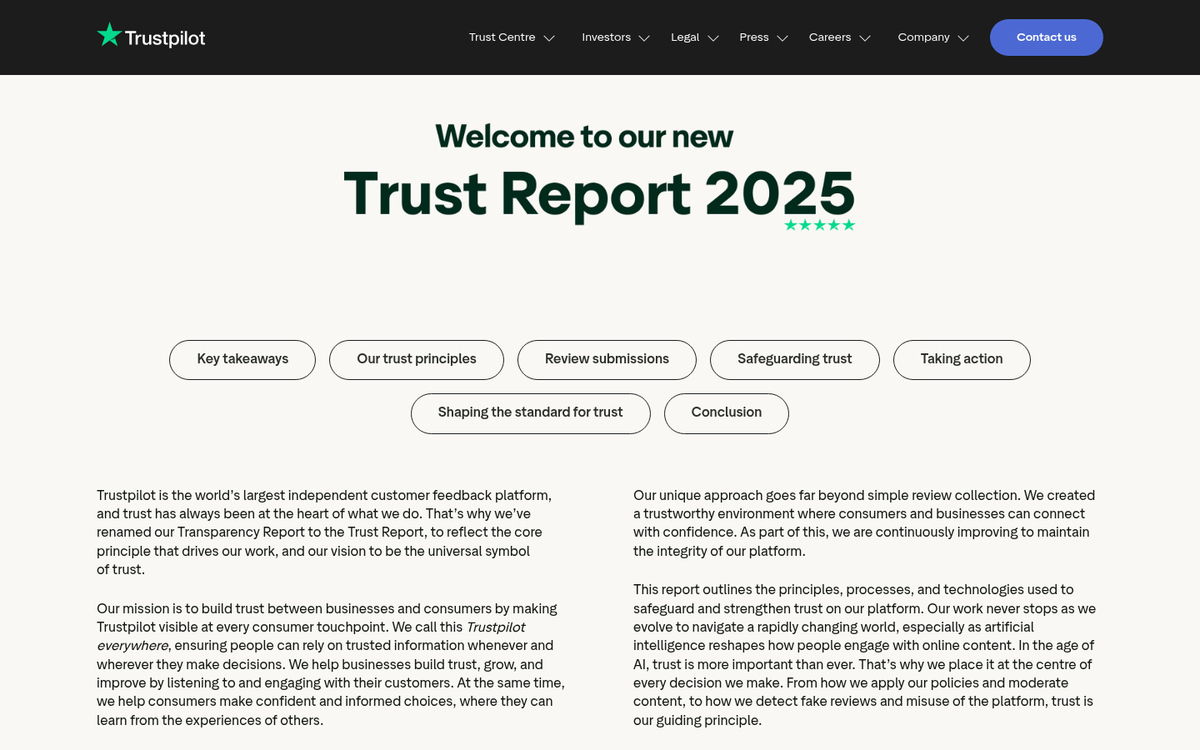
Trustpilot research found that 82% of consumers pointed to star ratings as their top trust symbol, and AI systems are trained on the same human-generated data that reflects this. When an AI model has learned from millions of web pages that trust businesses with strong ratings, it carries that pattern into how it evaluates sources.
Google reviews, Trustpilot, G2, and Yelp all feed into this picture. Volume matters as much as score - a business with 400 reviews at 4.3 stars reads as more credible than one with 6 reviews at 5 stars.
Author and Expert Credentials
AI systems look for signals that content was written by a qualified person. Author bios with credentials, links to professional profiles, and a steady publishing history across your site all provide this - it aligns closely with Google's E-E-A-T framework, which AI models trained on Google-indexed content are indirectly shaped by.

Technical and Security Signals
HTTPS, privacy policies, and contact information are baseline expectations. A site without these loses user trust and gets filtered out early by automated systems before any content quality gets considered.
Backlinks and Third-Party Mentions
When credible external sites link to or mention your business, it acts as a vote of confidence that AI systems can detect.
Schema Markup
Structured data tells AI systems what your content is about - it removes ambiguity and makes it easier for automated systems to categorize and surface your information accurately. It's one of the more technical signals, but it has a direct line to how AI indexes your content.
| Trust Signal | What It Communicates to AI | Relative Impact |
|---|---|---|
| Star Ratings and Reviews | Real-world validation from actual users | High |
| Author Bios and Credentials | Content has a qualified human source | High |
| Backlinks and External Mentions | Third parties find the source credible | High |
| Schema Markup | Content is structured and easy to interpret | Medium-High |
| HTTPS and Security Badges | Site is safe and professionally maintained | Medium |
| Privacy Policy and Contact Info | Business is transparent and reachable | Medium |
The signals in the high-impact rows tend to reinforce each other. A site with strong reviews, credentialed authors, and backlinks builds a layered case for credibility that's harder for AI systems to ignore than any single signal on its own.
How to Audit and Strengthen Your Site's Trust Signals
A self-audit doesn't need to be tough. You're just walking through your site with fresh eyes to check if the tells that build credibility are actually there and doing their job.
Start with the basics
The first thing to check is your SSL certificate. If your site still loads over HTTP instead of HTTPS, that's a problem worth fixing - installing SSL to improve your rankings is one of the easier wins available, and 61% of consumers have abandoned purchases because a site didn't feel protected. AI systems learn from that behavior, so an unsecured site is a red flag on multiple levels.
Next, look at your About page. A thin paragraph with no names, no credentials and no backstory does very little to set up trust. The fix is easy: add the names and relevant backgrounds of the people behind the content or the business.
Check your content for author accountability
Anonymous content is one of the most common gaps on otherwise decent websites. If your articles and posts have no named author, no bio and no links to credentials or professional profiles, that's a weakness - it's worth going back to add author information to existing posts and making it a standard part of your publishing process going forward.
Author bios don't need to be long. A sentence or two that explains who the author is and why they're qualified to write on the subject is enough to help.
Look at your reviews and third-party mentions
Sparse or outdated reviews can undermine trust just as much as no reviews at all. Check when your last review came in and think about if you have an active way to collect new ones from customers. If you have press mentions, case studies, or partnerships, make sure they're visible on your site instead of buried or missing entirely.
A quick reference for common gaps
| What to Check | Common Gap | How to Fix It |
|---|---|---|
| SSL certificate | Site running on HTTP | Switch to HTTPS through your host |
| About page | No names or credentials | Add real people and their backgrounds |
| Author information | Anonymous content | Add bios and link to professional profiles |
| Reviews | Old or very few reviews | Build a consistent way to collect new ones |
| Third-party mentions | Press and partnerships not shown | Feature them prominently on relevant pages |
Most of these fixes are not technically tough. The gap is usually that no one has gone looking for the problem yet.
Once you've identified what's missing, it's easier to choose what to fix first based on what will have the most impact for your site and audience. If you're also thinking about how to automatically inject ads into your WordPress posts, getting your trust signals right first will make those monetization efforts more effective.
The Signals You Send (And the Ones You're Missing)
Rather than overhauling your entire presence at once, pick one or two tells to strengthen this week. Tighten the author credentials on your most-visited pages. Add a verifiable statistic with a citation. Make your organization's contact information and expertise easier to find. Small, deliberate improvements applied will move the needle far more reliably than a single sprint of changes.
The wider change worth keeping in mind is this: AEO visibility is increasingly a credibility game, and credibility compounds. Every transparent source you cite, every claim you back with evidence, and every signal that tells an AI - or a human - this content can be trusted builds on the last. The sites that earn prominent placement in AI-generated answers over the next few years will not necessarily be the loudest or the most prolific. They will be the ones that made trust a habit.
FAQs
What are trust signals in Answer Engine Optimization?
Trust signals are indicators that show AI engines your content is reliable and credible. They include things like author credentials, third-party reviews, backlinks, HTTPS security, and structured data markup.
Why do AI engines prioritize trust signals over content alone?
AI answer engines act like researchers selecting sources worth citing. They favor content that demonstrates expertise, earns external validation, and behaves transparently, rather than simply existing on the web.
Which trust signals have the highest impact on AI visibility?
Star ratings and reviews, author credentials, and backlinks from credible external sites carry the most weight. These signals layer together to build a stronger credibility case than any single signal alone.
How do I audit my site's trust signals?
Check for HTTPS, named authors with credentials, an informative About page, recent reviews, and visible third-party mentions. Most gaps are easy to fix once identified.
Does schema markup really affect AI content visibility?
Yes. Schema markup removes ambiguity by telling AI systems exactly what your content is about, making it easier for them to categorize and surface your information accurately in generated answers.