





Off and on for a while now, we've been reviewing various ad networks with as little bias as possible. We've covered networks like Yahoo's Gemini, AdBlade, and TrafficVance, and now it's time for another review. This time, let's talk about Propeller Ads.
Key Takeaways
- Propeller Ads offers multiple ad formats including pop-unders, push notifications, native ads, interstitials, and survey monetization.
- CPM rates range from roughly $0.50 to $5+, with Tier 1 traffic commanding around $5 per 1,000 impressions.
- Average CTR is around 14%, while CPA campaigns yield approximately 0.2% conversion rates based on published case study data.
- SmartCPA campaigns use machine learning to optimize conversions, but underperforming campaigns automatically switch to CPM billing.
- Propeller lacks built-in deep analytics, requires third-party trackers, and targeting is less granular than platforms like Meta or Google.
What is Propeller Ads?

Propeller Ads is an advertising network that has been around since 2011. They're based in the UK, and have a sizable presence in most English-speaking nations. They are an "alternative traffic source" initially operating entirely within pop ads. Pop ads, in case you're not sure, are generally pop-under windows. You know those times where you close your browser and see a website in a new window you don't remember opening? That's a pop-under.
Over the years, they have expanded well beyond just pop-unders to include several additional forms of advertising. Their on-click ads are the traditional pop-under; a user clicks on a page and that click opens the pop-under as well as whatever they had intended it to do.
Additionally, they have native ads, which are ads designed to look similar to on-site related post widgets. Any time you've seen a bank of "related posts" that lead to other sites, chances are that's a native ad display. They have native interstitials as well; this combines the timed pop-over lightbox technology with native advertising. Instead of the pop-over pitching a service or newsletter, it shows a few "related" posts as advertising.
They also offer push notifications, both standard and in-page push. Standard push notifications appear in a user's browser or device notification bar, while in-page push ads mimic the look of push notifications but display directly on a webpage - meaning they reach users regardless of whether they've opted into push notifications. Since an increasingly large number of people use mobile devices to browse the web, both formats have become central to what Propeller does.
More recently, Propeller has expanded into interstitial ads and survey monetization, rounding out a fairly comprehensive suite of ad formats for both publishers and advertisers.
All of this is backed by targeting capabilities designed to reach users most likely to be interested in your brand. Propeller has a self-service platform, automates a decent amount of ad optimization through machine learning, and operates its own fraud prevention engine to filter out fake or bot traffic and ensure advertisers receive quality traffic.
Propeller works for traditional businesses advertising themselves, and they have agency-level lead generation options for agencies trying to advertise their clients. They handle links to other ad networks with RTB/XML, and they allow affiliate marketers to use their platform as advertisers as well.
A lot of mobile and affiliate advertising companies partner with Propeller. They work with HootMobi, YeahMobi, STM, AffLift, AdCombo, and many more. Ad fraud and bot traffic remain significant concerns across the industry, making such prevention engines increasingly important for advertisers.
How Does It Work?

So how does all of this work? Well, from the publisher's side, all they need to do is categorize their site and their country of origin for the purposes of tracking and traffic distribution. The publisher chooses which type of ad they're going to use, and plugs it into their website. As the ad runs, they earn.
From the advertiser side, you need to generate your postback code and use it with your tracker or network. You customize the information in your configuration, including your IDs and custom variables for accurate tracking - offer value, campaign IDs, that kind of thing.
When you want to create an ad, you can choose between a few campaign models. One is the traditional Cost Per Mille (CPM) ad. You pay for impressions, and you hope your ad is optimized to convert those impressions into clicks and customers. It's all very standard.
The alternative is to use a SmartCPA system. This is a Cost Per Action system, where your goal is to get conversions. There are a few quirks to this system.
On the cautionary side, when you run a SmartCPA campaign, the performance of your campaign is analyzed. If it falls below a certain threshold of performance, it transitions into a CPM campaign. Basically, if the campaign is successful, you only pay for the actions taken. On the other hand, if the campaign is not successful, you will be charged for the impressions as if it were a CPM campaign. This means you can't intentionally run a bad campaign to get free impressions and exploit the system.
On the positive side, the "Smart" part of SmartCPA is a machine learning algorithm that optimizes your ad offers over time. You run an initial campaign so it can gather benchmark data, and then it optimizes itself to further boost your conversions over time. Their machine learning engine is reasonably effective, though it might make choices you wouldn't normally make yourself. It's up to you to analyze and decide if it works for your goals.
When you're running CPA ads on Propeller Ads, you need to set a conversion price for your campaign. Propeller recommends something around 70-80% of your payout. So if you're running ads for an affiliate offer that earns you $1 each time someone converts, Propeller would recommend that you set a price of 70-80 cents. Sure, this reduces your per-conversion earnings, but remember these are sales you wouldn't have gotten otherwise. All of the traffic you get from Propeller ads is incremental traffic, so you're not losing potential sales - you're gaining raw sales.
You can generally adjust the pricing of your conversion to influence your traffic volume. The more you're willing to pay, the more publishers will run your ads, and the more traffic you get. In SmartCPA campaigns, if your generated revenue doesn't exceed the cost of the traffic delivered, Propeller will charge you for the difference. This is why you should always have extra funds on hand in case a campaign underperforms.
When creating a campaign, you can use Propeller's publisher network, or you can activate Traffic Boost, which pulls in traffic from Propeller's broader partner network as well. Think of it like the difference between running Google Ads strictly on search results pages versus across the entire display network.
Propeller Ads also has frequency capping, which is a very useful feature to make sure you don't end up with a ton of redundant impressions. It's usually a good idea to keep it active, though you can disable it if you want.
As with most ad networks, in Propeller you can choose your target countries, your bid, your budget caps, and your campaign schedule. Scheduling works on a dayparting level, meaning you can choose to start and stop during specific parts of the day rather than just toggling on or off by calendar date.
As far as specific targeting goes, you have a solid range of options. You can segment by mobile device type - Android or iOS, phones versus tablets - and by operating system for desktop. You can target by connection type for mobile, such as 3G, 4G, or WiFi. You can also now target by user interests, which is a meaningful addition. A Propeller Ads case study showed a client running a US Android Chrome utilities offer increased their conversion rate from 0.33% to 0.61% simply by layering in interest-based targeting - a nearly 2x improvement.
You can include or exclude individual targets, creating a whitelist or blacklist depending on how narrow or broad your targeting needs to be. You can also filter proxy traffic as a baseline way to reduce potentially fraudulent traffic.
It's worth noting that advertisers must start with a minimum deposit of $100 via credit card or $1,000 via wire transfer. On the publisher side, the minimum payout is $5 for most payment methods, $20 for Payoneer, and $550 for wire transfers.
Propeller Ads Pricing and Conversions

What kind of pricing might you expect, and what kind of conversion rates can you get out of it? As with all things in advertising, much of the specifics depend on your offer, your site niche, and your budget.
As far as CPM goes, you can expect CPMs ranging from roughly $0.50 to $5+ depending largely on traffic tier and site niche. According to Blognife data, Tier 1 traffic (US, UK, Canada, Australia, etc.) commands CPMs of around $5 or higher, Tier 2 traffic comes in around $1.50 per 1,000 impressions, and Tier 3 traffic drops to approximately $0.30. Entertainment blogs tend to sit at the lower end of the range, while gaming and finance niches see higher CPMs.
Your CTR will, all things being average, likely range somewhere around 14%. For some niches with CPM ads you're going to get near-zero clicks, and that's fine when you're paying for impressions. For others, like music, you might see CTRs as high as 50-60%. Mobile generally ranges around 10-20%.
For CPA campaigns, a Business of Apps case study found that 24,021 conversions were generated from 12 million impressions, yielding an overall conversion rate of approximately 0.2%. This is a realistic baseline to calibrate your expectations, though interest-based targeting and campaign optimization can push that figure considerably higher, as the case study above on interest targeting showed.
All of these numbers are reflective of real-world data points from published studies and experiments. Your own results will vary depending on your offer, niche, and how well you optimize.
Problems with Propeller Ads

There are a few potential issues with Propeller Ads worth covering.
First up, it's primarily a pop-under and push notification network, which not everyone appreciates. A lot of people are consistently irritated by pop-unders, and that can reflect on your brand. Personally, I can't fault Propeller for offering the format since there's clearly demand for it, though I also block most of those kinds of ads by default - so I'll acknowledge the hypocrisy there.
Another issue is that while targeting has improved in recent years (interest-based targeting being a notable addition), it still isn't as granular as what you'd get from platforms like Meta or Google. For a network so heavily focused on mobile traffic, there are still limitations. You can target Android as a whole and specific OS versions, but sub-version targeting isn't available. This matters when your offer is specifically relevant to one OS iteration over another.
As with all ad networks, geographic targeting is hugely important. Targeting Tier 1 countries like the US, UK, Canada, and Western Europe will generally yield the best results, while Tier 3 regions will have lower CPMs and often weaker conversion rates depending on the offer.
Propeller also doesn't offer built-in deep analytics. Rather than providing an all-in-one analytics suite, they require you to use a third-party tracking platform for your offers. That means an additional dashboard and additional configuration to manage. This isn't necessarily a dealbreaker - many serious advertisers use dedicated trackers anyway - but it does mean Propeller is not an all-in-one platform solution.
There's also the user interface itself. While it has improved over the years, it remains relatively utilitarian. It works, but it's not particularly slick or intuitive compared to more modern ad platforms.
Is Propeller Ads a Scam?
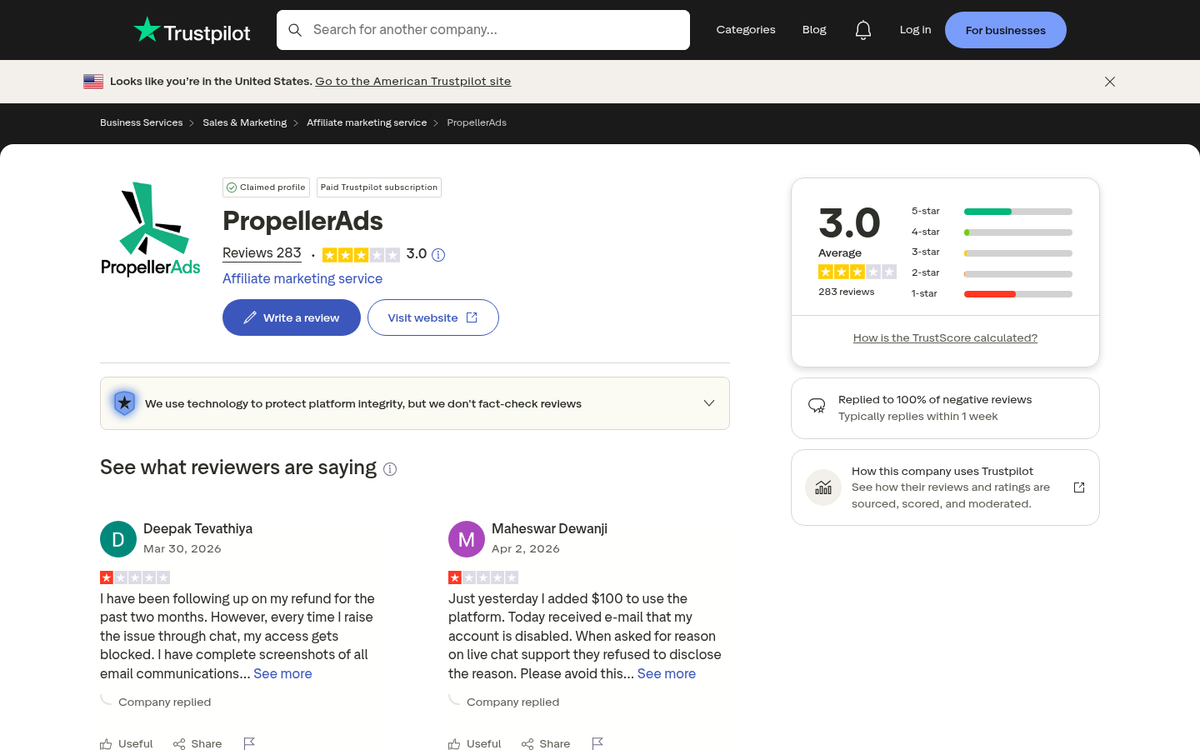
When you search for Propeller Ads reviews, you'll inevitably come across complaint threads and negative reviews claiming that Propeller locks accounts with funds inside or finds reasons to cancel accounts and withhold money.
Is this legitimate? I can't tell you for certain. I haven't had that experience personally, and many of the complaints come from anonymous sources. What I can say is that negative reviews are a near-universal feature of any ad network operating at scale. Every platform will have users who - intentionally or not - violated terms of service and faced consequences. Every platform will have vocal detractors.
Propeller Ads has been operating continuously since 2011 - that's now over 14 years in a notoriously competitive and turbulent industry. A pure scam doesn't last that long or maintain the kind of affiliate and agency partnerships Propeller has built. That said, read their terms carefully before funding an account, and start with a smaller test budget until you're comfortable with how the platform operates. Your experience may differ from mine, and it's always worth going in with your eyes open.


3 responses
Thoughtful replies only - we moderate for spam, AI slop, and off-topic rants.
I hadn't heard of this company until my credit union sent a fraud alert for a $200usd charge from them this morning. Thankfully they automatically froze my card until the issue was resolved and will now be sending me a new card.
its actually realy working even i was confused at first , now iam using it also with adsense no issues !
thanks for clarification,iam itself a publisher from past 2 year , always on time payments ,even if there is a delay they mail me
thank you propeller ads.
That's awesome to hear, Nitesh! Two years as a publisher is solid experience, and it's great that you're successfully running both PropellerAds and AdSense together without any conflicts. The on-time payment reliability you mentioned is definitely one of the things publishers appreciate most. And yes, their proactive communication about any delays really does make a difference - it shows they respect their publishers. Thanks for sharing your real-world experience, it'll definitely help others who are on the fence about giving it a try!