Paid surveys are an interesting beast. From the consumer's end, they're a way to rack up a little cash. Sites like Ipsos, Survey Junkie, SurveySavvy, and others are survey networks where a user signs up, is sent surveys, and ends up making a modest supplemental income at best. Survey Junkie themselves note that completing three surveys daily can earn up to $40 monthly - explicitly supplemental, not anything close to full-time income. Now and then a larger market research project comes along, paying $50 or $100, but most people don't qualify.
Surveys are a kind of dream for newbies starting out making money online. Often they have just lost a job or are growing frustrated with the lack of easy opportunities around, but don't trust themselves to dive headlong into actual internet marketing or product sales. There's an element of instant gratification; you can sign up and make a few bucks almost immediately.
None of this is relevant to the other side of the coin; promoting paid surveys. The "money-making" audience is not your target demographic. Instead, you're looking to capture the attention of people who are willing to pay with their opinion for some reward.
Getting paid to promote paid surveys is an affiliate's game. As with most affiliate marketing, it comes down to two things; finding the right trustworthy programs, and pumping an incredible amount of volume through it.
Key Takeaways
- Promoting paid surveys is an affiliate marketing game requiring massive traffic volume, as commissions are very low ($0.50-$3 per lead).
- Authority blogging is the most effective promotion method, but the make-money-online niche is extremely saturated and competitive.
- Paid advertising can work, but modest per-lead payouts make it hard to profit without significant upfront investment and scale.
- Automated promotion is essentially spam and typically results in banned accounts with minimal actual traffic gained.
- Due diligence on survey affiliate programs is critical; promoting untrustworthy companies that don't pay out will quickly destroy your credibility.
How It All Works
If you want to promote paid surveys, what you need to do is set up some channel where you have people who would be interested in those surveys. You find the companies that provide those surveys and locate their affiliate programs. Then you get to promoting. This can happen generally in two ways.
The first way is with surveys that have some kind of intangible, non-monetary payment attached to them. You often find these attached to free to play games and other sorts of referral programs. The company promotes the survey with something of their own attached; you might get a free trial of a streaming service and some in-game credit if you fill out the survey and they accept your data.
I always find these to be the least effective and sketchiest of the options. One reason is that you're giving away value in exchange for the survey, and you're hoping the data is accepted. If you give away $1.50 and only make $1, what good does it do you? The other reason is that these kinds of offers have a pretty bad reputation. Often you'll find your audience is very skeptical of filling out these surveys, because they or people they know have spent time filling them out and never been given the reward at the end of the line.
The alternative is to promote individual survey sites and survey programs from an authoritative point of view. You're not trying to incentivize individual surveys, you're promoting survey networks, like the ones mentioned above.
There are two ways this can go. The first is the low-effort, low-quality route - think thin exact-match domain sites stuffed with keyword variations, stock photos, and near-zero useful information. These are the sites that exist purely to funnel clicks. You know them when you see them:
- A basic layout with bright colors, poor design, and generic stock photos.
- A list of links for "articles" that are all the same thing with slight keyword variations.
- Very little useful information.
- Ever-present, pushed calls to action.
This is the lowest of the low. Sites like this get hammered by Google for thin content and keyword spam, and they've become increasingly rare in search results as algorithm updates have continued to clean house.
The second way you can approach the issue is through genuine authority content - think long-form, experience-driven posts that mention specific survey companies as examples without reading like a sales pitch. The most important part is that specific survey sites are referenced naturally, within the larger context of a useful piece of content. While doing so, you already get the implication that it's a higher quality company.
And, of course, the links to every survey site are affiliate links. When the user is convinced, clicks through, and signs up for the service, the site owner gets the affiliate referral and makes some money. If you're just getting started with this approach, learning how to build an affiliate site with little to no experience can help you hit the ground running.
Specific Methods for Promoting Paid Surveys
If you're really hoping to promote paid surveys and earn money via affiliates yourself, you have some options, but keep in mind that these are generally very low commission. You're going to need extremely high volume to make any significant money.
Option 1: Social Media Shares. This is probably the easiest but also the least effective method. Everyone who ever gets hooked into a pyramid scheme, affiliate network, or other promotional earner ends up sharing to their friends and family on Facebook relentlessly. A few will bite, but most will probably ignore it or even block you.
You also have to contend with filtering algorithms. Facebook will quickly see that people are ignoring your survey links and will limit who sees them, and you'll see diminishing returns.
You can, however, take this one step further. Instead of simply sharing to friends and family, you can build a community - or find one that already exists. Find online groups dedicated to making money, dedicated to surveys, or just looking for opportunities. Step into those groups and promote your surveys.
As with any social group marketing, you run the risk of being blocked by admins depending on how transparent you are about it. It's simply one of those markets that is so saturated with spam that it's difficult to find a foothold as a legitimate affiliate.
Option 2: Content Lockers. This method requires you to have a resource that is itself valuable. In fact, the resource needs to be valuable enough to get people interested in paying for it with their actions.
The standard content locker is a simple script that requires the user follows you on a social platform or completes some other action before they can access the content. Usually this content is part of an article, an ebook, or some kind of template resource.
If you have this kind of content and want to make money off of it, switching your content locker to a survey can do it. If you properly frame it, you can even convince people that they're getting value by signing up for the survey site themselves. After all, they can make money too, right? Unfortunately, it's a lot more to ask of a person that they sign up for paid surveys with their personal information, as opposed to a simple social media follow. Content lockers also come with SEO considerations worth understanding before you commit to this approach.
Option 3: Paid Advertising. As the saying goes, you have to spend money to make money, right? Paid advertising can work for survey affiliate promotions, but the math needs to work in your favor from the start. Given that per-lead payouts are relatively modest - Survey Junkie pays $3 per lead, Unique Rewards pays $2 per lead, and Panel Place pays just $0.50 per lead - you need serious volume to justify meaningful ad spend. At $0.50 to $3 per conversion, a $1,000 ad spend requires hundreds of sign-ups just to break even, and that's before accounting for ad platform fees and audience targeting costs.
So, you know. Paying to promote an affiliate link can work, but only if you are in the right situation. You need:
- To be able to handle the loss if the investment doesn't pan out.
- To be able to afford the initial investment on a large enough scale to earn maximum payouts.
- To accurately identify the target audience of your survey, find a suitably large platform that will run an affiliate ad, for an amount of money that can get you a return.
You can't just drop $10 and expect to get $100 out of it. One day you might, and the next you might get nothing. You never know who you're reaching with your ads, and only large-scale experimentation can keep you going. It's a precarious game, as mistakes can be very costly.
Option 4: Authority Blogging. The most effective method of affiliate marketing these days is to create a blog designed to help people with something, and use affiliate links to resources that can help them. Links to ebooks, links to other blogs, links to services and products, even links to surveys.
When you're promoting paid surveys, you need to think of who is going to be your target demographic. It's not people interested in sharing their opinion - those people can post in any comments section in the world. It's people who are after the money. That means you're going to be creating a blog based around making money online.
The downside here is that there's a ton of competition for that niche already. You have big marketing sites, marketing communities, and that's not even scratching the surface. Work-at-home and side-hustle content is an incredibly saturated space in 2026, with massive media brands and well-funded affiliate sites dominating the top of search results. Breaking in as a new player requires either a very specific niche angle or a serious long-term content investment.
Option 5: Automated Promotion. Let's be honest here. What is "automated promotion" but spam? If you want to go this route, you're basically just programming a spambot to share your affiliate link all over the web. You're going for the ultimate in high volume, low return strategies, and it's probably not going to work.
The primary problem with a spam technique like this is just that your account will end up shut down after a while. Affiliate networks don't want to be associated with spam, for obvious reasons, so they'll shut down anyone they notice sending shady referral links. Plus, of course, you'll get very little actual traffic.
Option 6: Traffic Sharing. If you can't beat 'em, join 'em, right? One technique you can use is to work with the people who already own big name sites. Work-at-home and side-hustle sites will often take guest posts or interviews, and you might be able to convince them to share your affiliate link in a post. You might offer them a cut of the profits, or negotiate a straightforward placement, and make your own money. The trick is just that you need to have something of value on offer, which generally means having your own site already. It's not really a technique you can dive right into.
Finding Good Survey Affiliate Programs
For the end here, I'll talk briefly about finding the right affiliate programs you can actually promote. You need to do your due diligence; if you promote a survey that doesn't pay out, or a company that harvests and sells personal information, you're going to lose your trust very quickly.
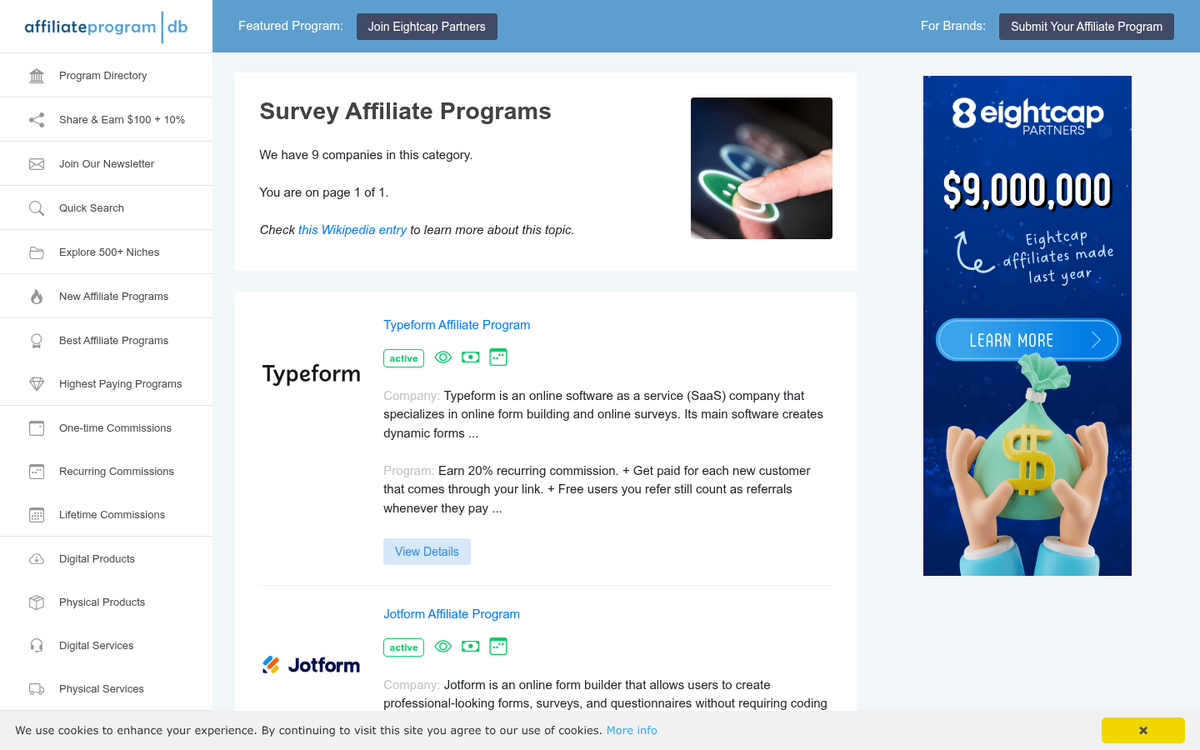
It's not difficult to find a large list of market research companies that do surveys - you can find large lists out there on all of the work-at-home and side-hustle sites. Look for their affiliate programs and see what kind of terms you find. Pay close attention to payout structure, because it varies wildly:
- Survey Junkie pays $3 per lead, making it one of the better flat-rate options.
- Unique Rewards pays $2 per lead.
- Panel Place pays $0.50 per lead - very low, requires enormous volume.
- E-Research Global pays 15% of each referral's reward earnings, with a $25 minimum payout via PayPal. If your referral earns $5, you get $0.75 - slow to accumulate.
If you're looking beyond pure survey platforms, it's worth noting that adjacent tools like Zoho Survey offer 15% revenue share for the first 12 months on referred customers, while Typeform offers 20% recurring commission and Jotform offers 30% commission on new users for a full year with a 60-day cookie window. These are B2B-oriented programs targeting people who create surveys rather than take them, but they're worth knowing about if your content audience skews that direction. You can also find affiliate programs with monthly recursive commissions worth exploring in this space.
You'll also want to search for reviews of both the survey site and their affiliate network. The worse the reviews, the harder a time you'll have trying to get people to sign up, and the lower your payments will be.
At the end of the day, you certainly can make some money with promoting paid surveys, but it's not much money unless you either have a huge initial investment, or you have a ton of traffic to leverage in the right industries. And, well, if you have those, there are better ways to increase your revenue earnings with them.