Affiliate marketing remains one of the most accessible ways to make money online, and it doesn't necessarily take a ton of experience or a massive upfront investment. I've put together a practical tutorial on going from nothing to a functional affiliate site with no prior affiliate marketing experience. I will, however, assume you have at least a little experience with the internet in general. I'll be glossing over most topics and linking to more detailed posts on each subject for further reading. Gloss over the sections you already know, dig deeper into the ones you don't, and let's get to building something profitable.
One honest word of warning before we dive in: the majority of affiliate marketers - around 57% - earn less than $10,000 per year. Only about 12% crack six figures. This isn't meant to discourage you; it's meant to set realistic expectations. The people who succeed treat this like a real business, not a passive income shortcut.
Key Takeaways
- Amazon Associates holds 46% of affiliate market share and is the most beginner-friendly starting point for new marketers.
- About 78% of affiliate marketers rely on organic search, making SEO and keyword research the core of traffic strategy.
- Choose a niche that's focused but not too narrow; trend-based niches earn nearly 47% more than commission-only choices.
- Product reviews make up 56% of affiliate content; each post should be at least 1,500 words targeting distinct buyer-intent keywords.
- Experienced marketers earn 9.5x more than beginners, proving patience and consistency matter more than budget.
Step 1: Understand How Affiliate Marketing Works
Affiliate marketing is essentially being a paid recommender for another company. You create a website and content around products or services, recommending them to your audience. You work to bring people to your site, they click your links, head over to the retailer or service provider, and make a purchase. The store or platform recognizes that the traffic came from you and pays you a cut of the sale, a fixed bounty, or some other agreed-upon payment.
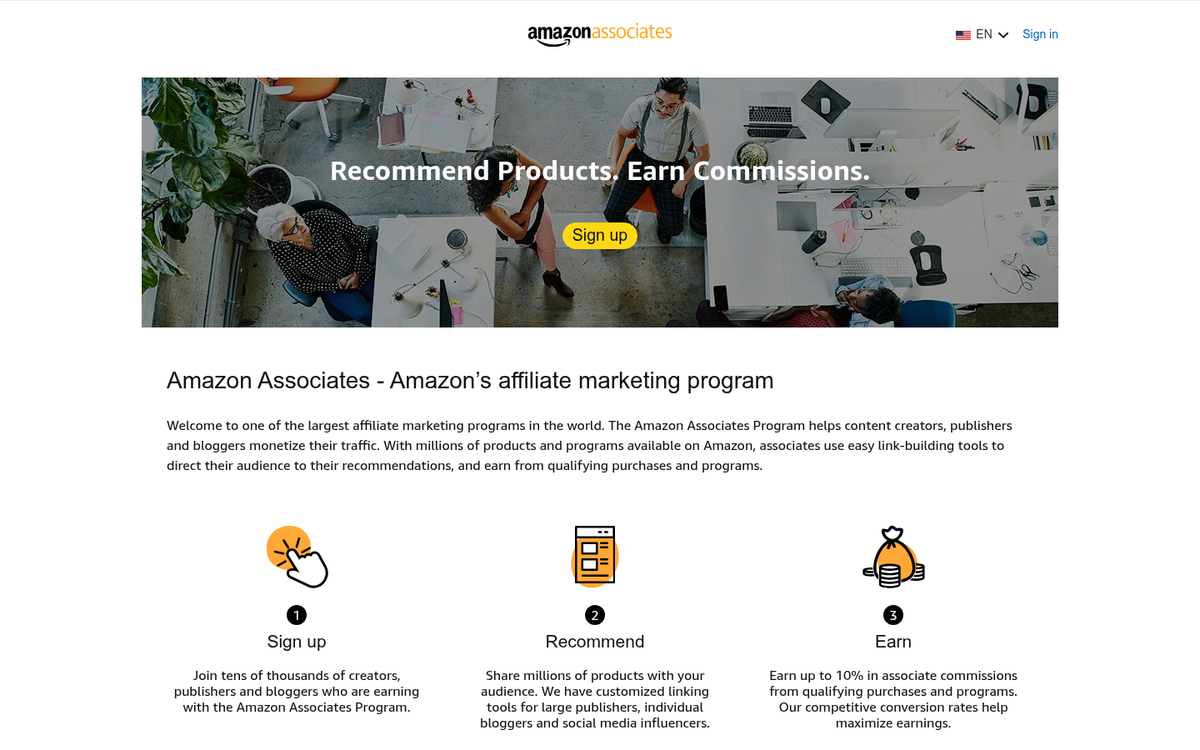
There are a ton of different affiliate networks out there, each with their own perks and payout structures. For this post, we'll primarily be talking about Amazon Associates, because it's the most beginner-friendly program available and holds by far the largest market share - around 46% of the entire affiliate marketing space. The next largest networks (Rakuten, Awin, ShareASale, and CJ Affiliate) each sit under 8% individually.
Amazon's biggest draw for beginners is that you earn a commission on everything a referred visitor buys during their session, not just the product you promoted. Send someone to look at a $15 phone case and they end up buying a $900 laptop? You get a cut of that too.
To have a successful affiliate site, you need:
- Content that attracts targeted traffic.
- Affiliate offers that are genuinely relevant to your audience.
- A focused niche that ties everything together.
- Consistent promotion to grow your traffic over time.
Everything comes down to traffic, which is why so much of affiliate marketing revolves around SEO. About 78% of affiliate marketers rely on organic search as their primary traffic source. Getting your site onto the first page of Google for the right keywords is where the real work lives - and it takes time, so set your expectations accordingly.
Step 2: Pick a General Niche
The first real decision you need to make is your niche. A niche is a focused slice of a broader market - specific enough to attract buyers, but broad enough that you have plenty of products and topics to work with. You're not trying to be a general information hub; you're trying to attract people who are actively considering a purchase.
Let's look at three example niches:
- Home Appliances
- Washing Machines
- Stainless Steel Washer/Dryer Combo Machines
The first is far too broad. You'd be competing with major retailers and massive review sites, and your audience would have wildly different needs. Someone searching for a gas oven and someone looking for a dishwasher are completely different buyers.
The second is roughly the right level of focus. There's enough product variety to write a lot of content, but the audience is clearly defined. (Whether washing machines are an ideal niche is a separate conversation - big, heavy products with complex shipping aren't always ideal - but the targeting is sound.)
The third is too narrow. Your conversion rate might be high, but the total addressable audience is tiny, and you'll run out of content angles quickly.
One important angle worth mentioning in 2026: data now shows that affiliate marketers who choose their niche based on current trends earn nearly 47% more revenue than those who choose based on commission rates alone or simply personal interest. That doesn't mean chase every trend blindly, but it does mean you should research whether your chosen niche has real momentum before committing.
Your niche should be something you can write about authentically, or something you can find good writers for. Pick something with genuine demand, manageable competition, and products people actually buy online.
Step 3: Register for an Affiliate Network
You can sign up for multiple affiliate networks, but don't stuff your site with affiliate links - Google will penalize you for it, and readers will notice. Quality and relevance matter far more than volume.
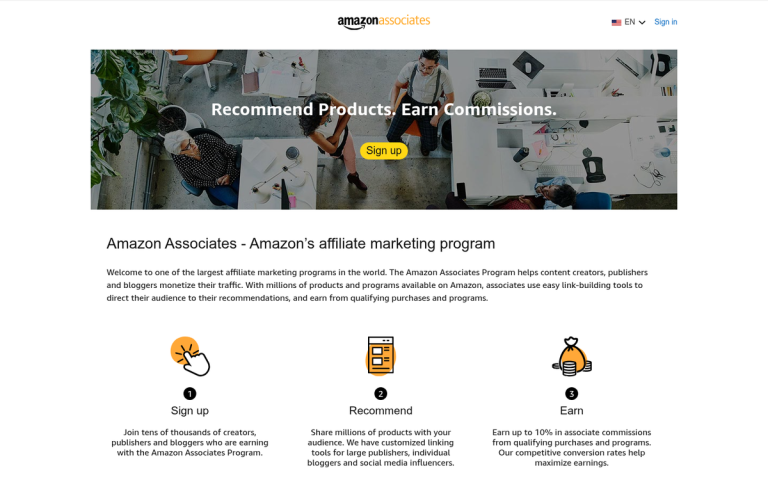
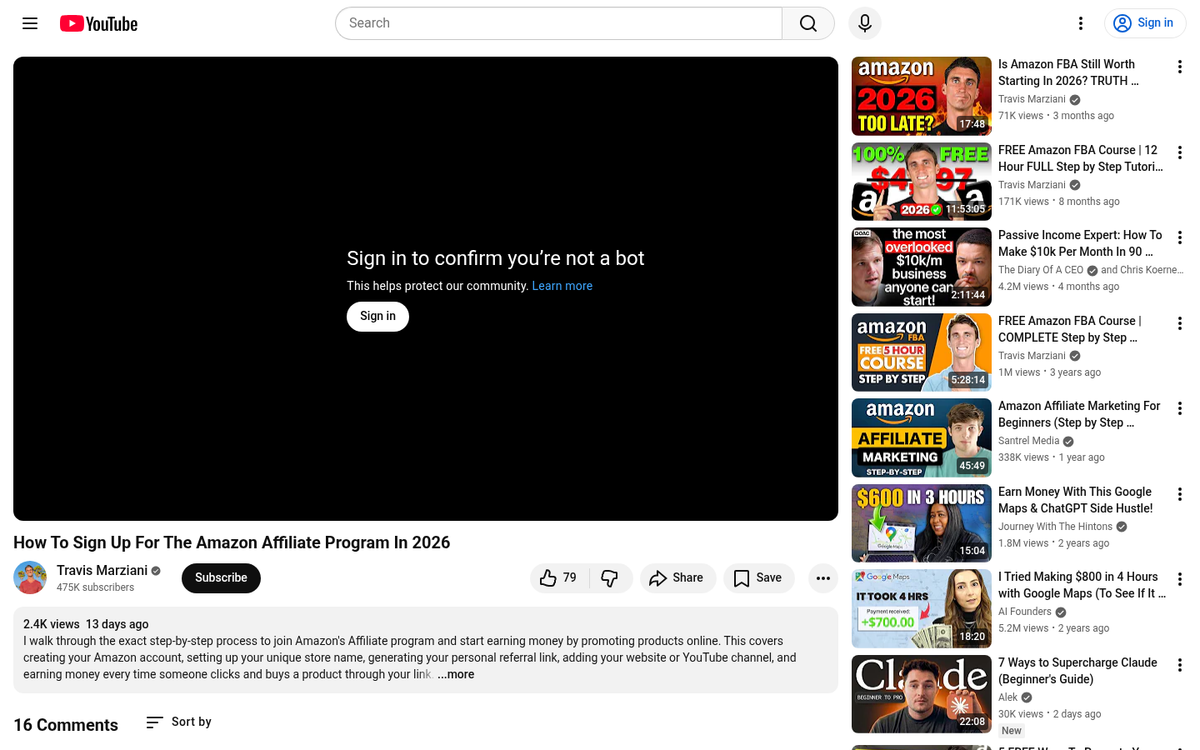
For most beginners, Amazon Associates is still the right starting point. The commission rates aren't the highest in the industry, but the program is easy to get into, the reporting is solid, the conversion tracking is reliable, and Amazon is a name people trust. You can sign up at affiliate-program.amazon.com.
That said, Amazon isn't always the best fit depending on your niche. If you're in software, SaaS, online courses, or subscription services, you'll likely find much better commission structures on dedicated networks. Platforms like ShareASale, CJ Affiliate, Awin, and Impact all have strong rosters of brands across a huge range of categories. If you want recurring commissions - where you get paid every month a referred customer stays subscribed - look specifically for programs with that structure, as they can be significantly more lucrative over time.
Start with one network that fits your niche well. You can always expand later once you understand what's converting.
Step 4: Set Up a Website
You need a website. Fortunately, getting a basic affiliate site up and running in 2026 is easier and cheaper than ever. You don't need anything fancy to start - a clean, fast, trustworthy-looking site is all you need.
The core components break down like this:
- Domain Name
- Web Hosting
- Content Management System
- Theme and Plugins
Your domain name matters more than people think. Avoid exact match domains like "bestwashingmachines.com" - Google has long since devalued those, and users don't trust them. Go for something brandable: something like TheWasherReport.com or CleanMachineReviews.com. Stick to .com. If your preferred name is taken as a .com, move on and find something else - competing with the existing owner isn't worth the hassle.
Web hosting is widely available and inexpensive. Prioritize uptime reliability and decent support. In 2026, well-regarded options include SiteGround, Cloudways, WP Engine, and Kinsta - particularly if you want managed WordPress hosting that takes the technical headaches away. Shared hosting still works fine for a new site with minimal traffic.
Your CMS should be WordPress. Go to wordpress.org, download it, and install it through your host - or choose a host that handles the WordPress installation for you, which most do now. It remains the dominant platform for affiliate sites and has the broadest plugin and theme ecosystem by far.
For your theme, prioritize speed and readability over flashiness. Google's Core Web Vitals are a real ranking factor now, so a bloated, slow theme will hurt you. Lightweight options like GeneratePress, Kadence, or Astra are popular choices in the affiliate space and won't slow your site down. Elegant Themes (Divi) is still around and still functional, but heavier themes require more optimization work. If you want a deeper look at your options, see our guide on the best WordPress theme for an affiliate site.
For plugins, keep it lean. The essentials are: an SEO plugin (Rank Math and Yoast SEO are both solid choices in 2026), a caching/performance plugin, a security plugin, and something for social sharing. Rank Math in particular has become increasingly popular over Yoast for affiliate sites due to its built-in schema markup options. Don't go overboard installing plugins - each one adds overhead.
Step 5: Create Content
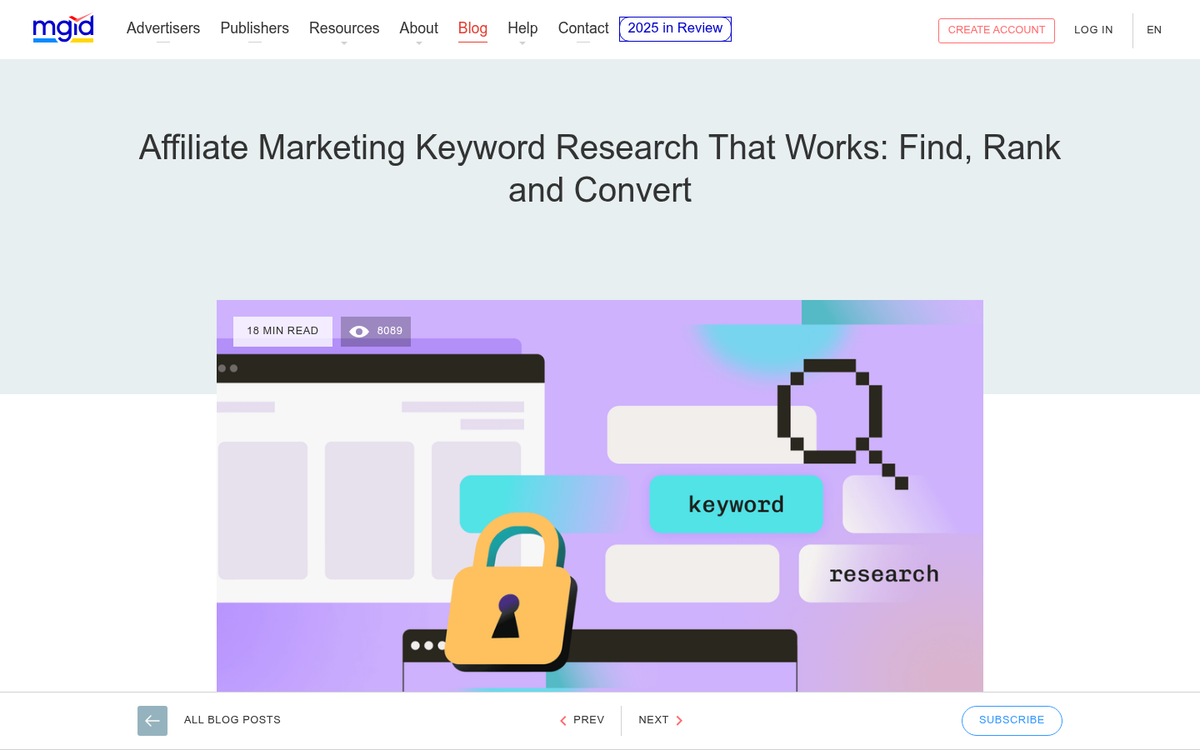
Content is the engine of your affiliate site. It's what Google ranks, it's what attracts readers, and it's where your affiliate links live. No content, no traffic. No traffic, no income.
You can write it yourself or hire ghostwriters - both approaches work. What you cannot outsource, however, is keyword research. Understanding what people are searching for, and why, is the strategic foundation of the entire project.
Your target keywords need to check several boxes:
- Enough monthly search volume to make ranking worthwhile.
- Low enough competition that a new site has a realistic shot at ranking on page one.
- Clear purchase intent - someone searching "best washing machines under $800" is much closer to buying than someone searching "how do washing machines work."
- Tight relevance to the products you're promoting.
Tools like Ahrefs, Semrush, and LowFruits are the go-to choices for keyword research in 2026. If budget is a concern, the free tiers of Semrush and Google Search Console can get you started. Spend real time here - this step is where most affiliate sites win or lose before they even publish a word.
Once you have your keywords, you need to match them to the right content format. Data from 2024 shows that about 56% of affiliate content is product reviews, and 22% is how-to guides - and those formats exist in those proportions because they convert. A reasonable content plan for launching a new site might look like:
- Five in-depth product reviews targeting specific buyer-intent keywords.
- Three comparison posts (e.g., "Brand A vs. Brand B") targeting people who are nearly ready to buy but still deciding.
- Three tutorial or how-to posts that capture related informational searches and build topical authority.
- Two or three list posts (e.g., "The 7 Best Washing Machines of 2026") that target high-volume head terms.
Each post should be at minimum 1,500 words, with your more competitive targets pushing 2,500 or more. That's not padding for the sake of padding - it's because comprehensive, well-structured content consistently outranks thin content for competitive keywords. Every post should target a distinct primary keyword and include properly disclosed affiliate links where relevant.
One note on AI-generated content: yes, you can use tools like ChatGPT or Claude to help with drafts. In 2026, Google has gotten significantly better at identifying and deprioritizing content that reads as generic, templated AI output with no real expertise or original perspective behind it. Use AI as a tool to assist your writing, not replace your thinking. First-hand experience, specific product knowledge, and genuine opinions are what separate the affiliate sites that rank from the ones that don't.
Step 6: Promote Your Site

Publishing content and waiting is a losing strategy, especially for a new site with no authority. You need to actively promote your site and build links to it - this is what signals to Google that your content is worth ranking.
Start with on-site SEO. Make sure every post has a proper title tag, meta description, and internal linking structure. Your SEO plugin (Rank Math or Yoast) will walk you through the basics for each post.
From there, promotion options include:
- Link building - Reach out to other sites in your niche for guest posting opportunities or resource link placements. This is still one of the most effective ways to build domain authority. You can also look into finding expired domains for link building to strengthen your profile further.
- Social media - Sharing content on relevant Facebook groups, Reddit communities, Pinterest, and niche forums can drive early traffic and signal engagement.
- Email list building - Even a small email list gives you a direct line to readers you've already earned. Tools like ConvertKit or Beehiiv make this straightforward to set up.
- Paid ads - Facebook and Google ads can accelerate growth, but be careful running paid traffic to affiliate content at the start. Learn what converts organically first, then amplify with paid spend.
Promotion is a deep enough topic that no single post covers it fully. Identify one or two channels that make sense for your niche and focus there rather than spreading yourself thin across every platform.
Step 7: Iterate, Invest, and Grow

At this point, a live site with solid content and consistent promotion should start earning you some traffic and, eventually, some commissions. What you do next determines whether it stays a small side project or grows into something substantial.
Use your analytics data to understand what's working. Which posts are getting traffic? Which are generating clicks? Which are actually converting into sales? Double down on what works and cut or improve what doesn't.
Post new content consistently - roughly one post per week is a sustainable target that keeps your site growing and signals freshness to Google. Use some of your early profits to invest in better tools, paid promotion for your best-performing content, or outsourcing content creation so you can scale faster.
One thing the data makes clear: experience compounds in affiliate marketing. Marketers with more than three years in the game earn nearly 9.5 times more than beginners. The sites that win in 2026 aren't necessarily the ones with the biggest budgets - they're the ones that stuck with it long enough to build real authority and learn what actually converts in their niche.
Build something worth building. Be patient. Iterate constantly.