




The concept that helps explain this gap is called Entity Authority. It's not about how much content you have or how well-optimized your pages are - it's about whether search engines - and increasingly, AI systems - recognize your brand, your website, or your business as a trusted, well-defined source on a given topic. If you don't have that recognition, even your best content can get ignored in favor of sources that search engines have already learned to trust.
This matters more now than it ever has. As AI-powered search features like AI Overviews (AIO) and Answer Engine Optimization (AEO) change how people find information online, the question of who gets cited comes down less to page rankings and more to whether an AI can confidently understand what your site stands for, who's behind it, and why it should be trusted. Entity Authority sits right at the center of that decision-making process.
This glossary entry will cover what Entity Authority means, why it matters for your visibility in AI-driven search, and what you can start doing to build it. If you're wondering why your content isn't getting the traction it deserves, this is a good place to start looking for answers.
Quick Answer
Entity authority refers to the established, trusted source used to uniquely identify and disambiguate entities-such as people, organizations, or places-in information systems. It provides standardized identifiers and controlled vocabulary to ensure consistency across databases and catalogs. Common examples include the Library of Congress Name Authority File (LCNAF), VIAF (Virtual International Authority File), and ISNI. These systems prevent confusion between similarly named entities and enable reliable data linking, particularly in library cataloging, linked data, and knowledge graph applications.
What Entity Authority Actually Means
An entity is anything Google can find and categorize as a thing. That includes places, organizations and concepts - basically anything with a defined identity that can be separated from other things.
The word "authority" is where it gets more interesting. Entity authority combines recognition with trust - it's the degree to which Google trusts that your entity is legitimate, well-defined and worth surfacing in its results.
To understand why this matters, it helps to know about a change Google made back in 2012. That was the year Google announced its Knowledge Graph with the phrase "things, not strings." Before that, Google worked by matching text strings - your search query to words on a page. The Knowledge Graph changed that by teaching Google to know real-world entities and the relationships between them.
So instead of just seeing the word "Apple" as a string of letters, Google learned to distinguish between Apple the tech company, apple the fruit and Apple Records. Context, connections and identity became part of how Google processes information.
That's why keywords alone don't tell the whole story anymore. A page stuffed with the right words can still leave Google unsure about who or what is behind it.

When Google can find your brand or website as an entity - with a steady name, a defined purpose and verifiable connections to other trusted sources - it has more to work with. That recognition is the starting point for authority to build.
Google is always trying to answer the question of who is behind a site and if it can be trusted. Entity authority is the answer to that question. The clearer and steadier that answer is across the web, the stronger your position can become.
Entity authority isn't a score you can look up in a dashboard - it's a judgment Google makes based on signals gathered from multiple places - your website, third-party mentions, structured data and more. You may also want to consider ways to improve your blog's E-A-T score before learning how to build it. That foundation matters because the strategies only make sense when you understand what you're working toward.
How Google's Knowledge Graph Connects to Your Website
Google's Knowledge Graph is basically a massive database of facts about places, businesses, topics and events - it holds billions of data points and always maps how those things relate to each other. Your website either fits into that web of connections - or it sits outside of it.
That distinction matters more than you might realise. When your site has ties to entities that Google already recognises and trusts, it benefits from those relationships. Google's systems are designed to reward websites that exist within a known, verifiable context instead of ones that seem to float in isolation.
Google is not reading your content word by word - it's asking if your website belongs to a recognised entity, if that entity has connections to other trusted entities and if those connections are steady across the web. A local business that appears in directories, has a Wikipedia-linked industry category and is mentioned alongside known businesses is much easier for Google to place and trust.
Your site's position within this relationship map can directly affect how much authority Google assigns to it. A website with a well-documented entity gets the benefit of that entity's credibility. A site with no recognisable entity connections has to work much harder to earn the same level of trust.
| Entity-Connected Sites | Entity-Disconnected Sites |
|---|---|
| Google can verify who or what is behind the site | Google has limited context about the site's origin or purpose |
| Benefits from associations with trusted entities | Must rely almost entirely on on-page signals |
| More likely to appear in Knowledge Panels and rich results | Less likely to get enhanced search features |
| Trusted across a wider range of queries | Visibility tends to be narrow and inconsistent |
Google is also looking at how your site connects to recognised entities through the content you publish. If you write about topics, people, or organisations that are already part of the Knowledge Graph, your site starts to build a place within that structure. The connections accumulate over time and help Google understand where you fit in the wider picture. Getting Google Sitelinks on your blog is one sign that this recognition is starting to take hold.
The Link Between Entity Authority and AI-Generated Search Results
Google's AI Overviews don't pull from pages with the most backlinks or the highest domain ratings. They pull from sources that Google has already decided are authoritative on an entity or topic; it's an actual distinction because it changes what you actually need to build.
When Google generates an AI Overview, it's basically making a trust choice in real time - it needs to choose a source to cite, and it gravitates toward sites where the Knowledge Graph data is backed up by external signals. Research into AI Overview citation patterns shows that Google prefers sites with concentrated, externally-backed authority on an entity instead of sites that cover a number of loosely connected topics.
This is where entity authority stops being an abstract SEO concept and starts being something with consequences. If your entity isn't well-defined in Google's model of the web, you're much less likely to get cited in an AI Overview - even if you rank on page one for the same query. Rankings and citations are not the same thing anymore.
Answer Engine Optimization, or AEO, is built on this idea. The goal is not to show up in a list of results but to be the source that AI reads out, summarizes, or links to when someone asks a direct question. To get there, your entity needs to be recognized, trusted, and well-connected within Google's data. Tools like the AEO Content Grader can help you evaluate how well your content is positioned for this.
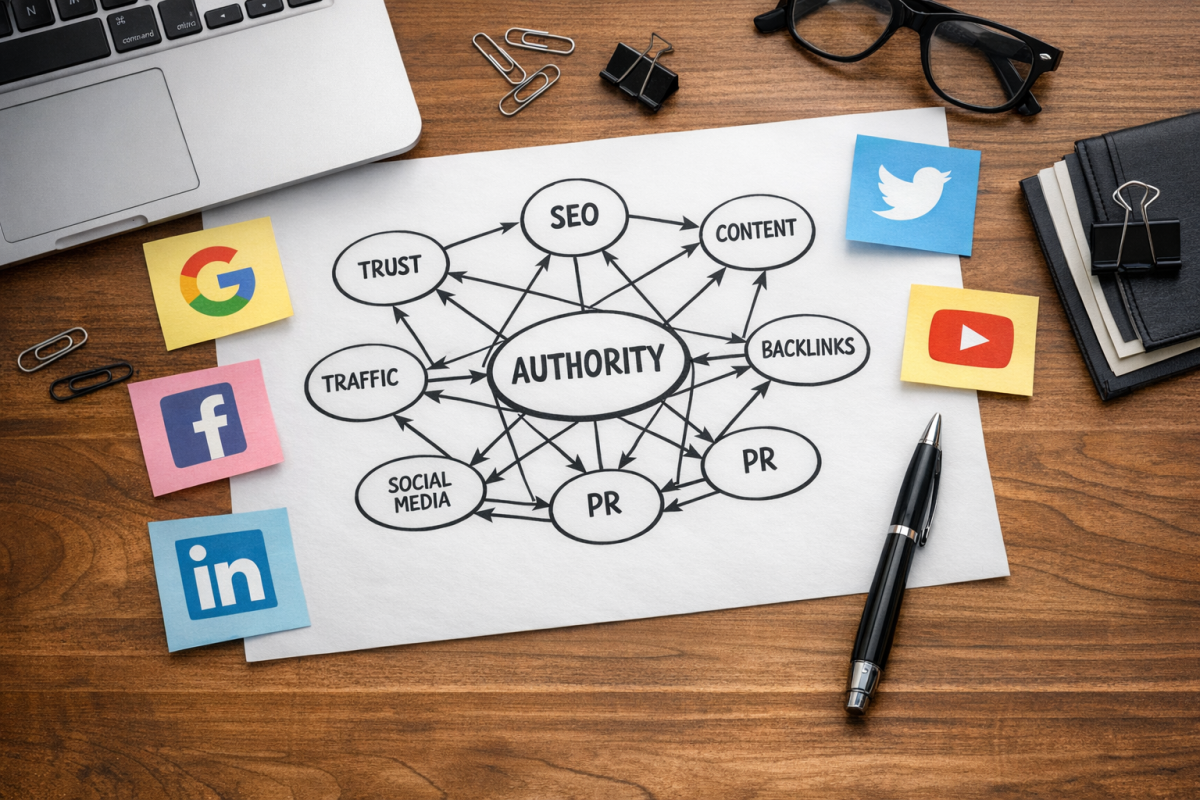
A Surfer SEO study found that 88% of SEO pros now see topical authority as a big part of their strategy. That number reflects a wider change in how search works - and topical authority is closely tied to entity authority. When you own a topic in Google's eyes, it's usually because your entity is defined and supported across the web. This shift also connects to the rise of zero-click search, where users get answers without ever visiting a site.
So the stakes go beyond where you rank on a results page. Being cited by Google's AI is basically being named the trusted source on a subject. That visibility is harder to win and harder for competitors to take from you once you have it.
The more helpful question is whether Google has enough information about your entity to trust you as a source. If the answer is uncertain, that gap is what entity authority work was built to close.
Signals That Build or Weaken Your Entity Authority
Google pulls from a number of tells to choose how much authority to assign to an entity. Some of these are things you directly control, and some come from how the rest of the web talks about you.
One of the clearest positive tells is steady brand mentions across the web. When your name, business name, or product appears the same way across directories, news sites, social profiles, and third-party content, it reinforces that you are a familiar and recognizable entity. Inconsistency - different spellings, outdated addresses, conflicting facts - quietly chips away at that confidence.
Structured data markup is another signal worth taking seriously. Adding schema to your pages tells Google what entity you are and how different pieces of information relate to each other - it's not a magic fix. But it does remove ambiguity, and that tends to work in your favor.
Author credibility matters more than many realize. When content is associated with a person who has their own established presence on the web, that content carries more weight. A named author with bylines on recognized publications, a linked profile, and relevant credentials gives Google something concrete to review.

Internal linking also factors in. When your site links related content together, it helps Google understand what topics you actually cover and how. A site that treats each page as an island sends a weaker signal than one where the content is organized around related ideas. If you're building out that structure, it helps to think about how sitemaps and SEO plugins support your site's overall architecture.
On the other side, there are patterns that weaken entity authority. Thin content on topics that are central to your business is a common one. If you claim to be an authority on a subject but your coverage of it is shallow or incomplete, that gap is significant. Association with unrelated entities can also dilute your authority - it can become harder for Google to place you in a context it trusts.
| Strong Signals | Weak Signals |
|---|---|
| Consistent brand name and details across the web | Inconsistent or conflicting brand information |
| Structured data markup on key pages | No schema or poorly implemented markup |
| Named authors with external credibility | Anonymous or unverifiable authorship |
| Citations from recognized, relevant sources | Links from unrelated or low-trust sites |
| Internal linking that reflects topic depth | Isolated pages with no topical connection |
| Deep, thorough coverage of your core topics | Thin or surface-level content on key subjects |
Mapping Your Site's Entity Coverage
A good starting point is to list every topic your site covers and then check if your content actually defines and explains the core entities in each topic, or just mentions them in passing. There is a difference between a page that references "technical SEO" and a page that explains what it is, what it includes, and how it connects to other concepts.
Go through your main pages and note which entities are central to each one. These could be places, concepts, products, or processes - anything with an identity. For each one, check if your site has a dedicated page or section that treats it as the main subject instead of a supporting detail.
Once you have that list, look for gaps. Your site might talk around an entity quite a bit without ever giving it a home. That is worth fixing because search engines connect entities to sites that take ownership of them - not sites that only gesture at them from the edges of other content.
Research has supported this too. Sites with strong entity coverage are far more likely to rank in the top three positions for related searches. That is not about volume of content - it is about whether the full picture of a topic is present and well-connected across your site.

It's helpful to think in topic clusters instead of individual keywords, and each cluster has a main entity at its core, with related entities branching off from it. You want to make sure your site covers that main entity and then links out to the supporting ones in a way that feels logical. Long Tail Pro is one tool that can help you identify those keyword and entity relationships across a topic.
An easy audit table helps you see where you stand. When reviewing your content structure, it's also worth checking which SEO plugins best support entity-rich content on your site.
| Entity | Dedicated Page? | Clearly Defined? | Linked to Related Entities? |
|---|---|---|---|
| Core service or product | Yes / No | Yes / No | Yes / No |
| Key concept in your niche | Yes / No | Yes / No | Yes / No |
| People or brands you reference | Yes / No | Yes / No | Yes / No |
Fill this in and patterns will start to appear. You will probably find a handful of entities that your site orbits around without ever claiming as its own territory.
Becoming the Entity Google Reaches For
AI-powered search isn't slowing down. Google's AI Overviews, ChatGPT, Perplexity and Gemini are all leaning harder into entity signals to choose whose content gets surfaced and whose gets buried. The sites doing this work - building structured knowledge, earning topical authority and telling a coherent entity story - are the sites AI will reach for when someone asks a question in your niche tomorrow; it's not speculation; it's already how it works.
FAQs
What is Entity Authority in SEO?
Entity Authority is the degree to which search engines recognize your brand as a trusted, well-defined source on a given topic. It's based on how clearly your entity is defined and connected across the web, not just how much content you publish.
How does Entity Authority affect AI search results?
AI-powered features like Google's AI Overviews prefer to cite sources with strong, externally-backed entity authority. Even if you rank on page one, you may not get cited if your entity isn't well-defined in Google's Knowledge Graph.
What signals build or weaken Entity Authority?
Strong signals include consistent brand mentions, structured data markup, credible named authors, and deep topic coverage. Weak signals include inconsistent brand information, anonymous authorship, thin content, and links from unrelated or low-trust sites.
What is Google's Knowledge Graph and why does it matter?
Google's Knowledge Graph is a massive database mapping relationships between real-world entities. Sites connected to recognized entities within this graph benefit from increased trust and are more likely to appear in rich results and AI-generated answers.
How can I audit my site's entity coverage?
List every core topic your site covers and check whether each has a dedicated, clearly defined page with links to related entities. Sites with strong entity coverage are significantly more likely to rank in top search positions.