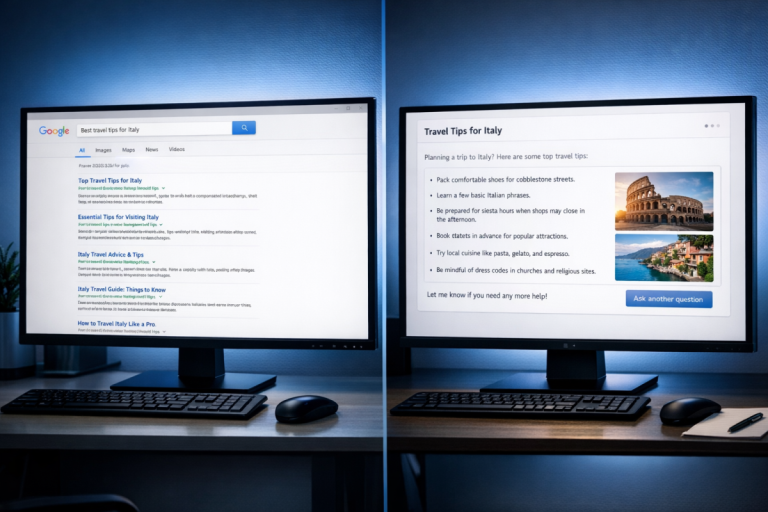
The culprit most people are pointing to is AI Overviews - Google's shift toward synthesizing answers directly in the search results, often before a user ever considers clicking a link. For programmatic SEO, which was specifically engineered to capture high volumes of long-tail queries at scale, that's an actual threat. The whole model can depend on clicks. When Google starts absorbing those queries into a summarized answer at the top of the page, the math changes.
But here's where it gets tough. Programmatic SEO has always lived and died by targeting the right queries - ones with genuine informational gaps, user intent, and enough specificity that a well-structured page could actually satisfy them. AI Overviews don't cover everything equally, and they don't perform equally well across every query type. That nuance matters, and it's lost in the panic-driven takes circulating right now.
So the question isn't if programmatic SEO is dead - it's if the version of it that worked in 2021 can survive in a search environment that looks fundamentally different - and what a viable version of the strategy actually looks like from here.
Key Takeaways
- AI Overviews cause a 61% CTR drop for informational queries and 58% reduction for position-one pages, per Seer Interactive and Ahrefs.
- AI Overviews appear on 99.9% of informational keywords, directly targeting the query formats programmatic SEO was built to scale.
- Transactional and e-commerce queries trigger AI Overviews only 4% of the time, giving programmatic SEO significant room to operate.
- Sites cited inside AI Overviews earn 35% more organic clicks and 91% more paid clicks compared to non-cited businesses.
- Rebuilding templates with structured data, entity clarity, and direct-answer formatting improves citation eligibility in AI Overviews.
What AI Overviews Have Actually Done to Search Traffic
The numbers are real, and they are worth taking seriously. Research from Seer Interactive found that AI Overviews cause a 61% drop in click-through rates for informational queries. That is not a small dip - it's half your possible clicks disappearing before a user even considers your link.
Ahrefs data adds another layer to this. Pages that rank in position one see a 58% reduction in CTR when an AI Overview appears above them. Historically, the top organic result was the most valuable piece of real estate in search. That benefit has shrunk considerably.
To understand why this happens, consider what AI Overviews do. They pull a direct answer to the user's query and display it at the top of the results page. For informational searches, that answer is enough. The user gets what they need and leaves without clicking anything.
This does not mean organic search is broken. Google still sends enormous amounts of traffic to websites every day, and AI Overviews don't appear on every query type. But the data does tell us that certain kinds of pages - especially those built to answer easy questions - are now working much harder to earn the same number of clicks they used to get passively. If you've been wondering whether your rankings could drop from inconsistent blogging, the pressure from AI Overviews makes that question even more relevant.

It is also worth mentioning that being cited inside an AI Overview does not reliably replace that lost traffic. Some studies have tracked the sources Google pulls into these summaries and found that inclusion does not translate to actual click volume in most cases. This is closely related to what answer engine optimization is designed to address.
The key point here is that AI Overviews have structurally changed how clicks are distributed across the results page. The pages hit hardest are not random - there's a pattern to which content types lost the most visibility, and that pattern points directly at one of programmatic SEO's most popular use cases.
Why Programmatic SEO's Informational Content Got Hit Hardest
Not all content got hit equally. Informational queries took the biggest loss, and that's a problem because most programmatic SEO builds are almost entirely made up of them.
Ahrefs found that AI Overviews now appear on 99.9% of informational keywords. That number is about as close to "all of them" as you can get. They also found that 46% of the keywords are long-tail and 57.9% are question-based - which describes the exact query formats that programmatic templates are built to target. If you're researching long-tail keyword tools, Long Tail Pro is worth a look for understanding how these queries are structured.
A site with 10,000 pages built around "what is X," "how to do Y," or "best Z for [audience]" has built its entire traffic model on the query types that AI Overviews cover most. Google doesn't need to send users to a page when it can answer the question directly in the search results.
Templated content farms were designed to scale by repeating the same informational format across thousands of variations. That strategy worked because search engines used to reward coverage. Now the engine can generate its own answer on the spot, and the incentive to click through drops sharply. This is one reason automating your blog content is a terrible idea - scaled templating leaves you exposed when the rules change.
It's worth being honest about what that means for site owners who invested heavily in these patterns. Thousands of pages targeting "what is a term deposit" or "how to remove a stripped screw" are now competing with an AI answer that sits above every result. The pages are still out there and can still rank. But they're getting less of the traffic even when they do.
The query formats that made programmatic SEO so scalable are the same ones that AI Overviews were basically built to manage; it's not a coincidence - informational intent is the lowest-friction use case for a language model to help with.
Where Programmatic SEO Still Has Room to Run
Not every corner of search has been affected the same way. The damage to informational content is real. But transactional and commercial queries are a very different story.
E-commerce and transactional searches now trigger AI Overviews just 4% of the time; it's a dramatic drop from 29% when AI Overviews first rolled out. For anyone building programmatic pages around products, services, or purchasing decisions, that's an actual gap in exposure to the problem.
This matters quite a bit for the types of templates that programmatic SEO was always a good choice to build. Product pages, location-based landing pages, and comparison pages targeting buyers instead of browsers are all in a much stronger position. A page targeting "best project management software for small teams" is looking at a very different landscape than one trying to answer "what is project management software."
| Query Type | AI Overview Trigger Rate | CTR Risk Level |
|---|---|---|
| Informational | ~99.9% | High |
| Question-based (7+ words) | ~57.9% | High |
| All tracked queries (avg) | ~48% | Medium |
| E-commerce / Transactional | ~4% | Low |
The table above makes the strategic case pretty plainly. Informational queries are almost certain to generate an AI Overview. Transactional ones almost never do. That gap is where programmatic SEO has genuine room to work.
This is actually a realignment toward what programmatic SEO does best. Pages at scale work best when each one serves a commercial intent. A searcher looking to buy, compare, or hire is far less likely to get their answer from an AI summary and move on. They want to click through, see pricing, read reviews, and choose.
The playbook isn't gone - it just works way better in some places than others.
How Getting Cited in AI Overviews Changes the Equation
Most conversations about AI Overviews focus on the clicks you lose. But there's another side worth looking at - when your page gets cited inside one.
Seer Interactive found that businesses cited in AI Overviews earn 35% more organic clicks and 91% more paid clicks compared to businesses that aren't cited; it's not a small difference. Being pulled into an AI Overview can actively drive more traffic than a standard ranking alone would produce.
This reframes the whole conversation. Programmatic SEO teams need to start tracking citation rate as a KPI alongside rankings and impressions. Using UTM parameters to track your blog traffic makes it easier to identify which pages are actually driving results from these placements.
The pattern prefers pages that are structured, authoritative, and entity-rich - content with factual claims, well-organized information, and strong signals that connect the page to a recognizable topic or brand. Thin pages that technically rank tend not to make the cut.

This is where programmatic SEO has an opportunity to adapt. A lot of programmatic content is built for volume, and entity and structure signals get deprioritized. But if citation now determines part of your traffic outcome, those signals deserve more attention in how templates get built.
Pages that define terms, link to authoritative sources, and present information in a format that's easy to parse perform better in citation contexts - it's not a dramatic rebuild, but it does mean raising the baseline quality of what gets published at scale. Getting the basics right - like how you use H1, H2, and H3 tags - contributes more to citation eligibility than most teams realize.
Citation is also measurable. You can track which pages appear in AI Overviews, which get cited, and what traffic behavior looks like for each group. That data should be informing your templates, and that's what the next section gets into.
Rebuilding Programmatic SEO Templates Around AI Visibility
Citation is the goal now, and the template is where the work actually happens. Most programmatic builds were designed to rank, not to be quoted. That is a real difference, and it changes what a template looks like.
Start with structured data. Pages that get pulled into AI replies tend to have clean, well-labeled information that a model can parse without guessing. Schema markup for FAQs, how-tos, products, and local entities all give AI systems a clearer picture of what a page is about. If your existing templates don't use structured data, that's the first thing to fix.
Entity clarity matters too, and each page in a programmatic build should make it obvious what the main subject is and how it connects to related topics. Vague or bloated templates that try to cover too much ground in one place tend to get ignored. Tighter pages with a defined focus are easier to cite.
Direct-answer formatting is another lever worth pulling. AI Overviews pull from pages that state answers plainly and early. Think of it less like a blog post and more like a reference card.

Depth over volume is worth keeping in mind when you audit your existing build. Page types that address a question with enough substance to be helpful tend to hold up better than pages that are out there just to cover a keyword. Look at which templates in your build actually have something to say, and which ones are thin by design. It's also worth considering how long it takes new pages to rank before drawing conclusions from early performance data.
An audit should ask two questions for each page type. First, would a person actually find this page helpful? Second, is the information presented in a way that makes it easy to extract a direct answer? Pages that fail both tests are the ones most at risk. For content that relies heavily on quotes or sourced material, it's also worth understanding whether using quotes can hurt your rankings.
Programmatic SEO Isn't Dead - It Just Needs a New Blueprint
The opportunity here is actual and it belongs to whoever moves first. Query categories that trigger commercial comparisons, local intent, or procedural input still surface traditional results alongside AI Overviews - and programmatic content built with depth, schema markup and sourcing tells is what gets pulled into those answer panels; it's not a consolation prize. For businesses willing to trade raw volume for citation-worthy quality, programmatic SEO in 2025 can drive more qualified visibility than it ever did before.
That transition takes work, though - the kind that's hard to scale without the right process behind it. At BlogPros, we've built our entire workflow around this new reality: combining AI-powered efficiency with human editorial review to produce content that's structured for answer engines, optimized with schema and actually worth referencing across Google, ChatGPT, Perplexity and beyond. If you're rethinking your programmatic strategy and want to see what content engineered for this environment looks like in practice, start your free month with BlogPros - no contracts, no credit card, no commitment. Content built for where your customers are already searching.