This is happening to businesses right now, across industries, and the frustration cuts both ways. Customers feel misled when the price doesn't match what an AI told them with total confidence. Business owners are left doing damage control on pricing they've long since updated - it's an awkward conversation that no one should have to have - and yet it keeps coming up.
The core problem is that AI tools like ChatGPT, Gemini and others are trained on snapshots of the internet. They pull from websites, directories, press releases and review places - but that data has a shelf life. When your pricing changes and old figures are still floating around the web, AI doesn't know which version is latest - it just knows what it learned, and it presents that information with the same calm authority whether it's from last month or three years ago.
I'll break down why this happens - and what you can do about it. Whether you've already run into this problem with a customer or you want to get ahead of it, there are concrete steps you can take to cut back on how often AI gets your pricing wrong.
Key Takeaways
- AI tools cite outdated pricing because they train on web snapshots, not live data, making old figures equally credible as current ones.
- Businesses that recently changed pricing face the biggest risk, as outdated third-party sources vastly outnumber newly updated official pages.
- Wrong AI-cited prices erode customer trust, create support burdens, and may cause silent drop-offs that businesses never directly observe.
- Your pricing page must be fresh, structured, and authoritative-not just accurate-to win AI citation over high-authority third-party sources.
- Schema markup, visible date stamps, canonical tags, and correcting third-party listings are the highest-impact fixes available to businesses.
Free Citation Risk Checker
How AI Tools Actually Pull Pricing Data (And Where It Goes Wrong)
Most AI language models are trained on large snapshots of the web taken at a point in time. They don't browse live websites or pull real-time data when answering a question. So when a user asks an AI what your product costs, the answer comes from whatever was in that training data - not from your website as it stands right now.
That distinction matters more than most people know. The training process doesn't weigh all sources equally, and your official pricing page isn't automatically the most trusted source in the mix. Third-party review sites, software aggregators, and old blog posts that mention your pricing can carry just as much weight - sometimes more - because they accumulate links and engagement over time.
Think about how many sources might reference a price you charged two years ago. A listicle comparing your tool to competitors. A Reddit thread where someone mentioned your old plan. A review on a software directory that was last updated before your pricing changed. All of that content exists in training data, and AI models don't have a reliable way to know which source is the most recent or the most accurate.
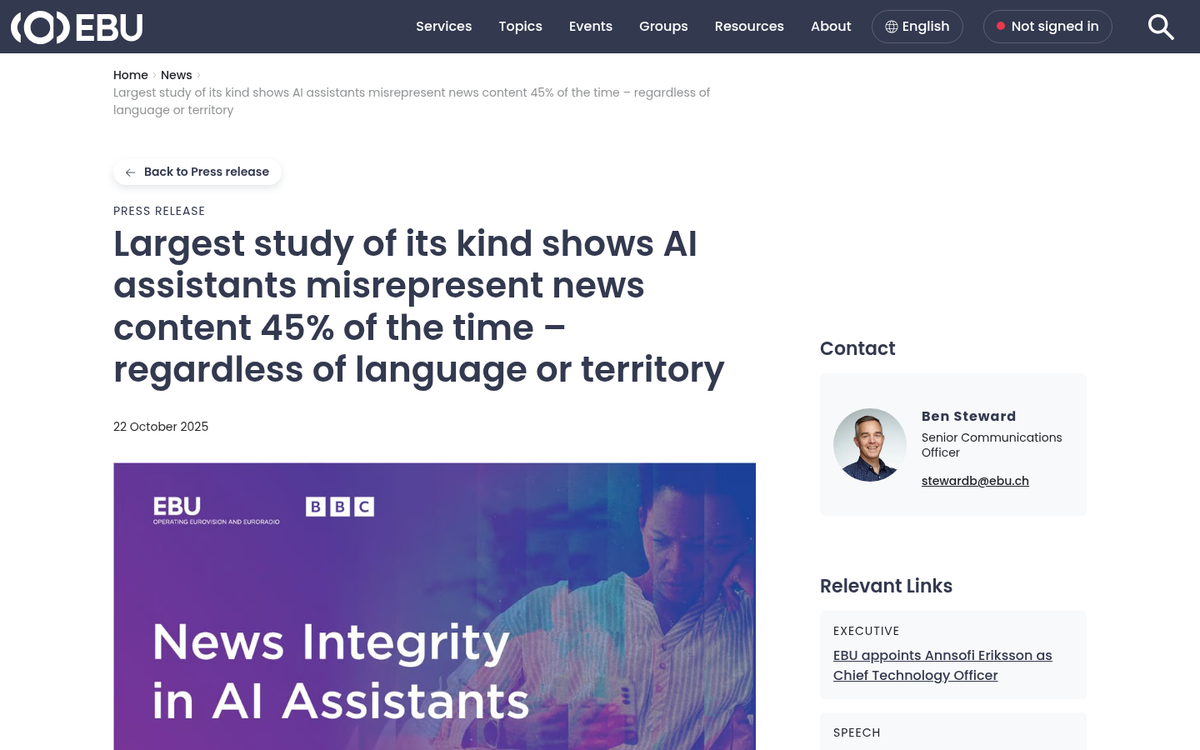
There's also the hallucination problem to factor in. A 2025 report from AllAboutAI found an average hallucination rate of around 9.2% across AI tools - that's roughly 1 in every 11 replies containing something fabricated or incorrect. Pricing figures are especially vulnerable to this because they're numerical, and models sometimes generate a plausible-sounding number when they don't have a confident answer.
It's worth being clear about what "hallucination" means here - it's not necessarily an invented number. Sometimes it's a price from an outdated source presented as the latest fact, with no indication that it might no longer apply. From a user's perspective, that's hard to detect.
The result is a system where the most visible and frequently cited version of your pricing is the one that gets reinforced - not the most accurate one. A competitor's comparison page from 18 months ago can overwrite your own messaging in an AI's output. Because users trust AI replies to be reasonably up-to-date, they don't think to double-check before acting on that information.
Why Businesses That Recently Changed Pricing Are Hit Hardest
If you updated your pricing in the last 18 months, you are in an especially tough position right now. Your new pricing lives on your website. But the internet hasn't forgotten your old numbers.
Third-party sources take a long time to catch up. Comparison sites, press releases, directory listings, and cached pages can hold onto old figures for months or years. And in many cases, there's basically more of it.
Consider how many places online still carry your previous pricing. A product launch announcement from two years ago. A review site that scraped your prices before the change. A blog post that mentioned your old tier structure. All of that content is still indexed and still accessible to AI systems building their answers.
This gives you a difference between what you charge and what AI says you charge - it's the natural result of how information accumulates online over time.
The financial exposure here is worth noting. Research compiled across AllAboutAI, Deloitte, and Testlio puts widespread business losses from AI hallucinations at around $67.4 billion. Pricing misinformation is one of the more direct contributors to that number because it shows up at the exact moment a customer is ready to choose.

The more dramatic your price change was, the wider that gap tends to be. A modest adjustment might not cause much uncertainty. But a restructured pricing model or a large increase can create a sharp contrast between what AI surfaces and what customers see when they arrive at your site.
Businesses that haven't changed pricing in years have an advantage here. Their information is stable across dozens of sources and AI tools are more likely to return steady results. A business that just updated pricing has newer information in fewer places and older information almost everywhere else.
That imbalance is what makes recently updated pricing so vulnerable to misrepresentation by AI. The internet's memory is long and slow to update, and AI tools tend to go with the weight of the historical record instead of just the most recent version of the truth.
The Trust Problem When a Customer Quotes the Wrong Price
Picture this: a customer contacts your team ready to buy, referencing a price they got from an AI tool. That price is wrong - it's months out of date - and now someone on your team has to break the news. That second feels small, but it does damage.
The correction itself isn't the hard part. What's hard is that the customer trusted the information they found. They built a choice around it.
This matters more than it used to. A recent Salesforce study found that 62% of consumers say trust matters to their brand engagement, up from 56% in 2023; it's an actual shift in a short time, and it tells you that customers are paying closer attention to whether businesses feel reliable.
The downstream effects of a pricing mismatch go beyond one awkward conversation. A customer who feels misled - even if the fault sits with an AI tool, not your business - is less likely to buy. They're also less likely to come back. And if they share the experience, it shapes how others see you before they've even reached your site. This is the kind of thing that makes you wonder whether your business can survive without reliable traffic sources when word spreads.

There's also the support burden to consider. Every customer who contacts you with wrong pricing information is a ticket your team has to manage, an explanation they have to give, and goodwill they have to work to rebuild.
Most business owners don't find out this is happening until a customer brings it up - by then, the wrong price has already circulated. You have no way to know how many saw it, believed it, and quietly walked away without saying anything. Understanding the difference between good traffic and bad traffic can help clarify why some visitors convert and others disappear without a trace.
What makes this especially frustrating is that your business did nothing wrong in the conventional sense. You updated your pricing. You made the right call. But the difference between your pricing and what AI tools repeat back to customers gives you a problem that lands in your lap anyway.
That's the part that stings - and it's why getting ahead of it matters before the next customer shows up with a number you stopped charging six months ago.
Why Your Official Pricing Page May Not Be Winning the AI Citation Race
Having an accurate pricing page is not the same as having a pricing page that AI models will actually use. That distinction matters more than most businesses know.
AI systems don't pull from the most recent source they can find. They weigh a combination of things: how fresh the content is, how honest the domain appears, and how the information is structured. A third-party review site with strong domain authority and well-formatted content can outrank your own pricing page in an AI's internal confidence score - even if that review site hasn't been touched in two years.
Content freshness is a big part of this. Pages that have been meaningfully updated within the last 30 days receive AI citations at more than three times the rate of pages that haven't been touched in a while. The word "meaningfully" is doing a lot in that sentence. A small grammatical fix or a backend metadata change doesn't tell a crawler that your pricing is fresh. An actual content update does.
Did the page get new text, new numbers, or new context? If you can't remember, that's probably the answer.
Domain authority can add another layer to this. A high-traffic competitor, a large SaaS review platform, or a well-linked industry blog will carry more weight than a pricing page on a pretty new or low-traffic domain. You can't fix domain authority overnight. But it helps to know why you could be losing the citation game even when your information is correct.

Content structure factors in too. AI systems do better with information that's unambiguous to parse. A pricing page that buries its key numbers in dense paragraphs, or that uses vague language like "pricing starts from" without any specifics, gives AI less to work with than a page that states prices plainly and clearly.
Accuracy is the baseline - the minimum requirement - not the deciding factor. What determines if AI cites your page or reaches for something else is a combination of how fresh, how authoritative, and how readable your content seems to be.
That's the gap worth closing, and there are concrete ways to address it.
Structured Markup, Freshness Signals, and Other Levers You Can Actually Pull
Some of these fixes are within your control and don't take a developer team to pull off. The place to start is schema markup - specifically PriceSpecification or Offer schema added directly to your pricing page - this gives AI crawlers a structured, machine-readable signal that says "this is the price, and it lives here." Without it, models have to guess based on text patterns alone, which is where errors sneak in.
Pair that with a visible, updated date stamp on your pricing page. A "Last updated: [date]" line near your pricing information tells crawlers and AI systems that the content is fresh. Pages without any freshness signal get treated as potentially stale by default, and that works against you.
Canonical tags are worth a look too, especially if your pricing information lives across multiple URLs. Duplicate or competing pages split the authority signal that AI systems use to choose which version to trust. A canonical tag on your primary pricing page tells crawlers to consolidate that trust in one location instead of spreading it thin.

Then there's the third-party problem. Review sites, comparison sites, and affiliate directories sometimes hold onto old pricing for months or years.
Below is a quick overview of the main fixes and what you can realistically expect from each one.
| Fix | Effort Level | Impact on AI Citations |
|---|---|---|
| Add/update schema markup | Medium | High |
| Refresh pricing page with date stamp | Low | High |
| Correct third-party listings | Medium-High | Medium |
| Canonical tag cleanup | Medium | Medium |
The date stamp and schema markup are the highest-return starting points because they directly shape how AI systems read and rank your page. Third-party corrections take more effort to coordinate but remove a competing source of wrong information. Canonical cleanup is a supporting move that strengthens everything else you do.
Make Freshness a Habit, Not a Scramble
Staying ahead of outdated pricing information doesn't need a big overhaul every quarter. Small, steady actions compound over time: keeping your structured data current, refreshing the language on your pricing page, and periodically checking what third-party sources are saying about your rates. None of these tasks take long on their own. But done regularly, they combine into a reliable defense against outdated information spreading through AI-generated replies.
A helpful push worth thinking about: when did you last update your pricing page? You want to review the copy, check the schema markup, and double-check that what's published matches what you're actually selling. If you have to think hard about the answer - or if you can't remember - it's your signal. Today is the day to find out. If you're also unsure how your website's traffic sources may be affecting your visibility, that's another good place to start.