At first glance, setting up an affiliate system for your business sounds like a ton of work. There's just so much you have to do! You need to have some way of allowing the creation and management of affiliate accounts. You need to track traffic coming in from affiliate sources, and you need to verify that the traffic is legitimate and not fraudulent. You need to come up with rewards for affiliate goals, be it incoming traffic, sales, or leads, and you need to assign payments for each of them. You need to track how much each individual earns, issue payments, deal with issues with payments, and avoid fraudulent information. It's a lot!
Thankfully, there are a bunch of different plug-and-play systems you can use. These are out of the box solutions that essentially allow you to install a plugin or app on your site to manage all of the above for you. I've found five of them you might be interested to try. Below, I've listed each of those five, the benefits and drawbacks, and my impression of making use of them.
Key Takeaways
- Five plug-and-play affiliate platforms exist that handle tracking, payments, fraud prevention, and affiliate management automatically.
- AffiliateWP is recommended for WordPress users, offering unlimited affiliates and real-time reporting starting at just $99 annually.
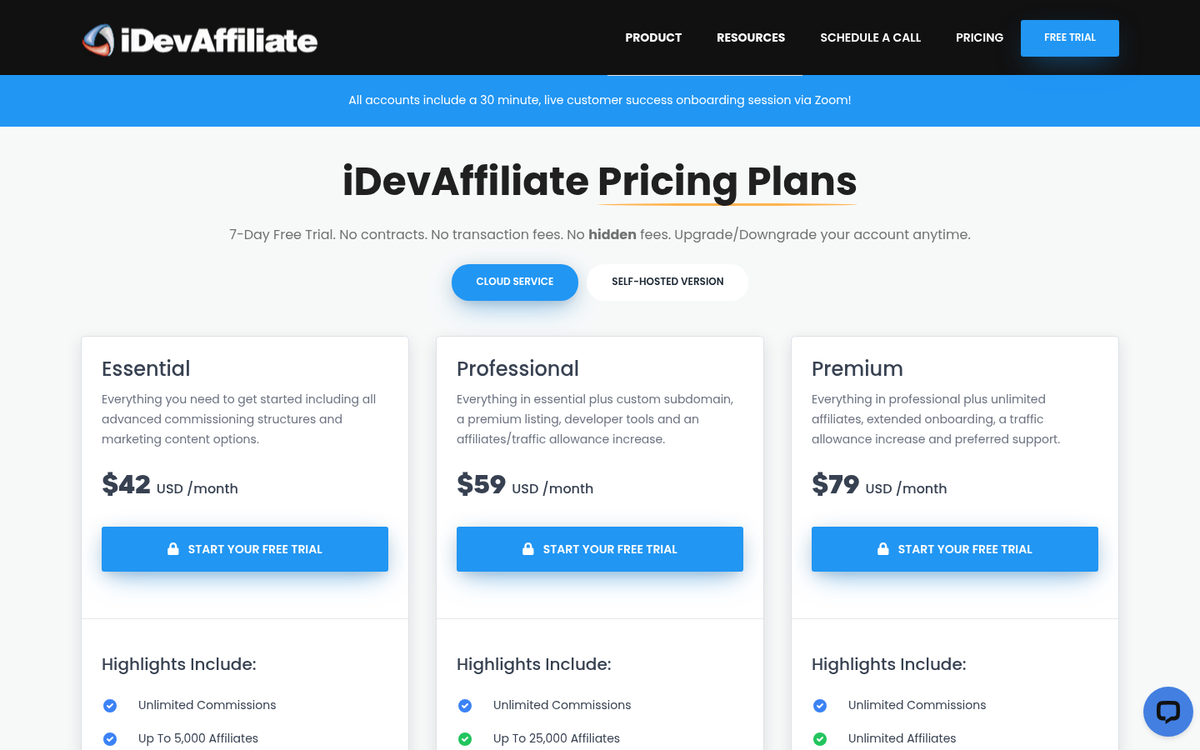
- iDevAffiliate offers unique flexibility with a one-time $199 self-hosted option or cloud plans starting at $39 monthly with unlimited affiliates.
- Ambassador is enterprise-focused, historically costing several hundred dollars monthly, making it unsuitable for smaller businesses.
- LeadDyno prices tiers based on monthly unique visitors rather than affiliate count, which impacts costs as your traffic grows.
1. Omnistar Affiliate

Also known as OSI Affiliate, Omnistar is one of the larger and more established platforms you can use for managing an affiliate program for your business. Their system has been adopted by thousands of businesses across a wide range of industries, from SaaS companies to e-commerce brands.
Their package contains all of the core features you'd expect from a solid affiliate platform, including built-in fraud prevention, account creation and tracking, and performance data to keep an eye on how your affiliates are doing.
In addition, OSI includes a social sharing widget to help with social promotion of affiliate offers, a coupon and discount code system, and smart rewards that scale based on performance. You can set it up to reward customers for referrals and even run feedback surveys for both your customers and affiliates.
OSI offers tiered monthly pricing, so the better your affiliates perform, the more value you extract from each plan - and they don't take a cut of your commissions, which is always a plus.
Entry-level plans start around $47-$57 per month depending on current promotions, with caps on the number of affiliates and tracking requests. These are generally sufficient for small businesses just getting started. Higher tiers unlock more affiliates, more tracking volume, and additional conversion tools like exit-intent pop-overs and opt-in forms. At the top end, there's an agency-level package - if you're operating at that scale, it's worth reaching out to their sales team directly for a custom quote.
Pricing and plan structures do shift over time, so I'd recommend checking their site directly for the most current tiers before committing.
2. Ambassador

Ambassador has long been one of the more powerful referral and affiliate platforms on the market, used by recognizable brands like Hulu, Logitech, and Zillow. However, it's worth noting that Ambassador has gone through some significant changes in recent years - the platform has evolved and in some markets has been repositioned or rebranded under different ownership, so it's worth verifying their current offering directly before building a strategy around it.
Historically, one of Ambassador's primary strengths was the ability to segment affiliates into groups with different perks and commission structures - a level of flexibility that few platforms matched. It also supported multiple referral program types simultaneously: refer-a-friend programs, partner programs, traditional affiliate programs, and advocacy campaigns all under one roof.
I should be upfront: Ambassador has never been aimed at small businesses. Even their entry-level pricing has historically started at several hundred dollars per month, making it firmly an enterprise or mid-market tool. If you're running a larger operation and need that kind of flexibility and white-label customization, it's worth investigating. If you're a smaller business, one of the other options on this list will serve you far better at a fraction of the cost.
3. iDevAffiliate
iDevAffiliate is one of the older platforms on this list - it's been around for over two decades, which gives it a long track record of stability and continuous improvement. Longevity in this space matters; you want a platform that's going to be supported and updated as the web evolves.
One of the more unique aspects of iDevAffiliate is the choice between a self-hosted version and a cloud-hosted version, which gives you flexibility depending on your infrastructure preferences.
The self-hosted version is available as a one-time fee of $199, which includes the software and a license key to install on your own server. It's a solid option if you want to avoid recurring monthly fees - though keep in mind that updates are only included for the first year. Still, even if you renew annually for updates, it can work out cheaper than a monthly subscription over time. Note that this option requires your own hosting environment, so it's not suitable if you're running on a fully hosted platform like WordPress.com or Wix.
The cloud-hosted version comes in multiple tiers with monthly fees. All tiers include unlimited affiliates, unlimited traffic tracking, and unlimited commissions - which is genuinely impressive compared to platforms that cap these features at lower price points. The differences between tiers come down to bundled add-ons: starting around $39 per month for the base cloud platform with SEO link tools and language support, $49 per month adds QR codes, private sign-up options, customizable coupon codes, and social media marketing plugins, and $59 per month adds custom subdomains and geographic targeting.
iDevAffiliate may not be the flashiest platform out there, but its combination of a low-cost self-hosted option and genuinely unlimited cloud plans makes it one of the better value propositions on this list, especially for businesses that don't need all the bells and whistles.
4. LeadDyno

LeadDyno is a straightforward affiliate platform that's well-suited for smaller businesses looking for an easy out-of-the-box setup. One thing that has always made LeadDyno a bit unusual is that its pricing tiers are based on monthly unique visitors to your site rather than the number of affiliates or commissions - which is worth keeping in mind as your traffic grows.
They offer a free trial period, which is a nice touch and better than several competitors that don't offer any trial at all.
Pricing has shifted over the years, so I'd recommend checking their site for the latest numbers, but historically their plans have been affordable for small businesses, starting in the range of $49-$79 per month depending on your traffic volume, with enterprise options available for larger operations.
The platform covers the core essentials: lead and conversion tracking, unlimited affiliates, and access to their affiliate network to help you find and recruit affiliates. It's not the most feature-rich option compared to something like Ambassador, but it's also not trying to be. For a business that wants a clean, simple affiliate setup without a steep learning curve, LeadDyno is still a reasonable choice in 2026.
5. AffiliateWP
AffiliateWP remains one of the best options available if your site runs on WordPress - and given that WordPress still powers a massive portion of the web, that covers a lot of ground. As the name suggests, it's a plugin that integrates directly into your WordPress dashboard, making setup and day-to-day management genuinely intuitive.
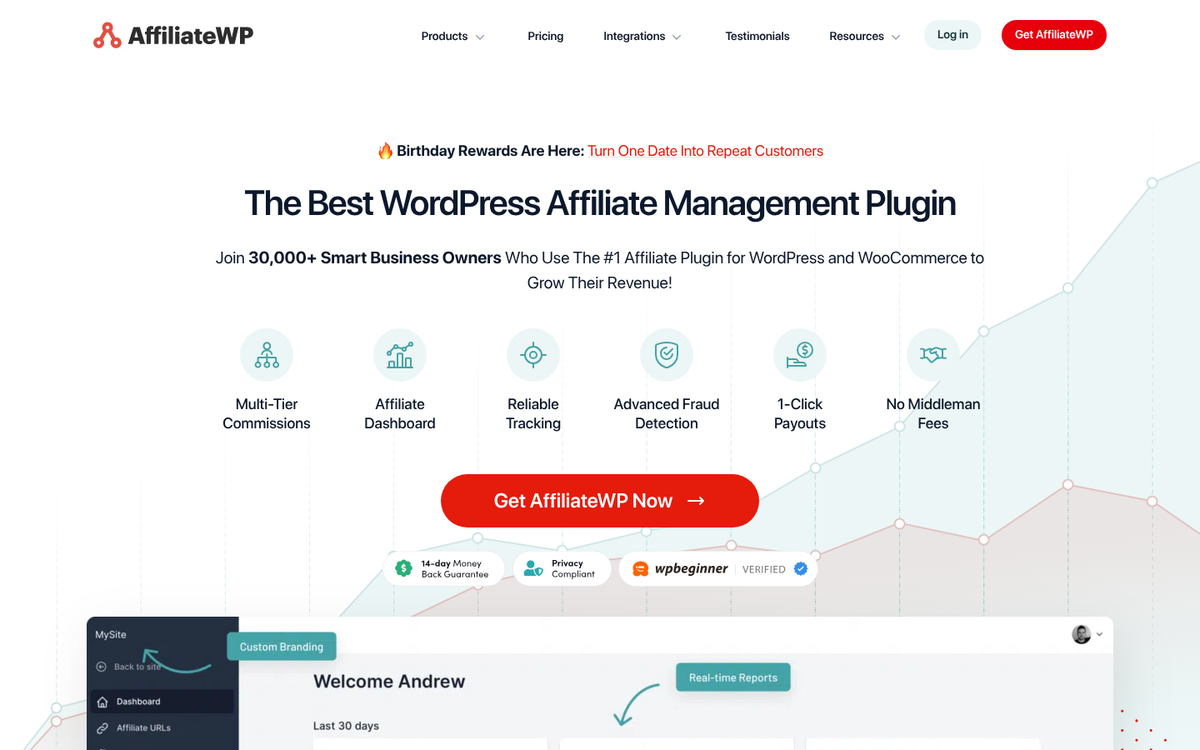
AffiliateWP works with the major WordPress e-commerce and membership platforms, including WooCommerce and various subscription plugins. You get real-time reporting, unlimited affiliates, unlimited creative assets in your library, and coupon tracking. Affiliates also get their own separate dashboard, so there's no risk of them accessing your WordPress backend.
Pricing is annual rather than monthly, which makes it one of the more cost-effective options on this list. The entry-level plan is $99 per year and covers one site with access to their core features and free add-ons. A mid-tier plan at $149 per year extends that to three sites. At $249 per year, you get access to all pro add-ons plus unlimited sites - a significant jump in value. And their top-tier plan at $499 per year includes lifetime updates, all plugins permanently, and ongoing unlimited support.
The add-on ecosystem is worth understanding before you buy. Free add-ons include things like affiliate leaderboards, dashboard customizations, commission restrictions by product, and shortcodes. Pro add-ons bring in more powerful functionality: Zapier integration, REST API access, dedicated affiliate landing pages, and integrations with popular form builders like Gravity Forms. Whether the pro tier is worth it depends entirely on how sophisticated your setup needs to be.
For WordPress users especially, AffiliateWP offers an excellent balance of price, ease of use, and functionality. It's my top recommendation for most small to mid-sized businesses running on WordPress in 2026.
Did you find a system you want to use? If not, feel free to check out another list for some additional options. There's a little bit of overlap, but we've covered a range of different tools, so you might find something that fits your needs there. Alternatively, if you have a favorite affiliate system you've been using, feel free to let me know in the comments and I'll check it out!