




Topical Authority refers to how thoroughly and consistently your website covers a particular subject.
This matters even more now that AI-powered search features - like AI Overviews (AIO) and Answer Engine Optimization (AEO) - are changing how people find information online. These systems are designed to surface answers from sources they trust. If your site hasn't established itself as an authority on a topic, it's far less likely to be pulled into those high-visibility results, regardless of how strong any single piece of content could be.
This page breaks down what Topical Authority means, why it has become an important factor in modern search visibility, and - most importantly - what you can do as a website owner or manager to start building it intentionally. Think of it as a working definition you can put to use.
Quick Answer
Topical authority is the level of expertise and credibility a website or content creator establishes on a specific subject. Search engines like Google recognize sites that consistently produce comprehensive, high-quality content around a particular topic as authoritative sources. Building topical authority involves creating interconnected content that thoroughly covers a subject from multiple angles, using internal linking, and demonstrating depth of knowledge. Strong topical authority improves search rankings and organic visibility by signaling to search engines that your site is a trusted, go-to resource for that subject.
What Topical Authority Actually Means
Topical authority is about becoming the most trusted source on a given subject within your niche. It requires covering a topic so thoroughly that search engines learn to associate your site with that subject area.
Think of it this way: if someone searches for anything related to your core topic, the goal is for your site to be the place that comes up. That recognition doesn't happen by accident - it builds over time as you add depth, answer follow-up questions, and connect related ideas across multiple pages.
A lot of website owners hear this and assume it's just another way to talk about domain authority. The two are not the same thing. Domain authority is a broad score based largely on the number and quality of external links pointing to your site. Topical authority is more focused - it measures how much expertise your site shows on a particular subject, regardless of how your domain scores.
You could have a high domain authority and still rank poorly for a topic because your content is too scattered. Equally, a newer site with a lower domain score can outrank bigger competitors by going deep on one focused subject area.
The foundation of topical authority is content that covers a subject from multiple angles. A single pillar page isn't enough on its own. Supporting content needs to address the questions, subtopics, and use cases that sit around your main topic - all linked together in a way that makes the full picture easy to follow.
It's less about volume and more about completeness. Search engines and AI tools are better at recognizing when a site legitimately understands a subject versus when it has just published a handful of loosely related posts. One way to strengthen this signal is by improving your site's E-A-T score across your content. The difference in how they treat those two types of sites is big.
Why Google and AI Systems Reward Subject Depth
Search engines are built around one core goal: to send users to the most honest, relevant source for their query. A site that covers a subject in depth gives Google far more signal to work with than one that touches on dozens of topics at a surface level.
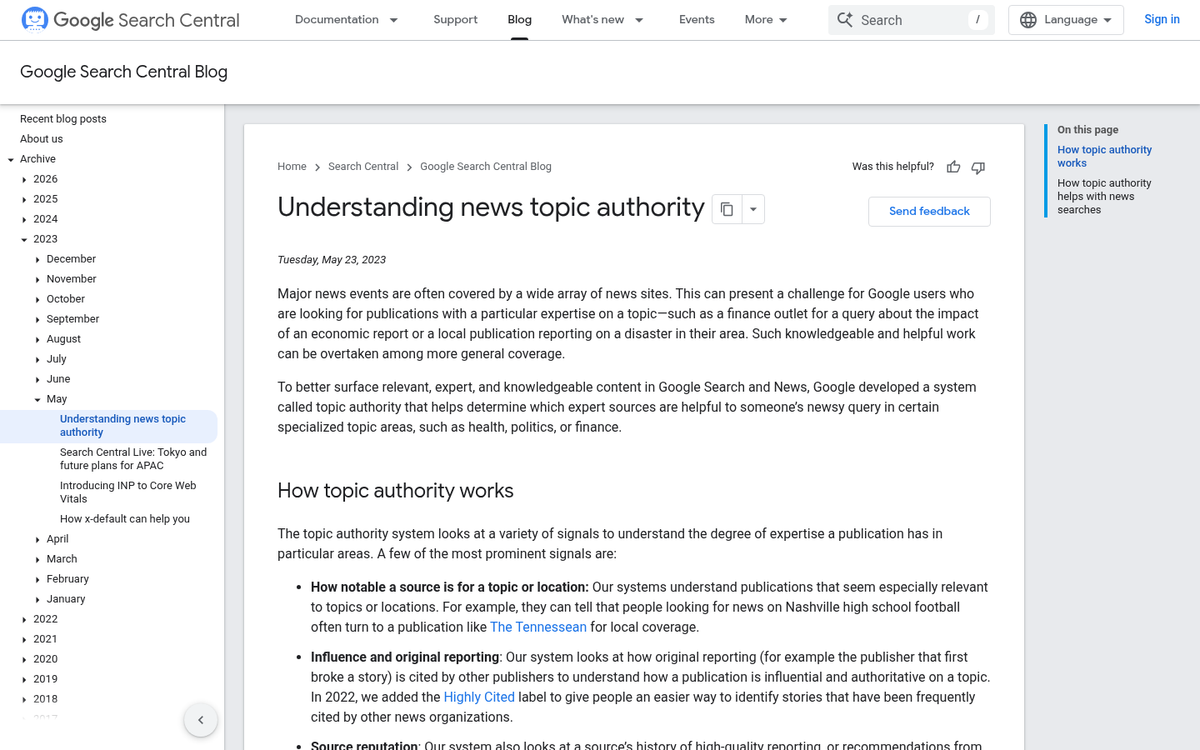
Google confirmed in May 2023 that it uses a topical authority system to rank news sites.
This matters even more now that AI-powered answer engines are part of the picture. When tools like Google's AI Overviews or other AI answer systems pull information to respond to a query, they draw from sources that have demonstrated knowledge on that subject. A site with one post on a topic is a much weaker candidate than a site with twenty well-developed pieces that connect and build on each other.
From the AI's perspective, it should have a reliable source to cite or synthesize, so it will favor the site that has shown, across pieces of content, that it understands a subject from multiple angles. Zero-click search trends make this even more critical, as AI systems increasingly answer queries without sending users to a site at all.
A helpful question to ask yourself here is whether your site looks like a specialist or a generalist. A generalist site might get traffic. But it cannot become the favorite reference that search engines and AI systems return to again and again. Specialist sites earn that position because their content demonstrates expertise at scale.
The relationship between depth and trust is straightforward. Google and AI systems are trying to cut back on the danger of sending users to unreliable information. A site that covers a subject well, across related queries, cuts back on that danger and earns a stronger position in traditional search results and AI-generated answers. This is also why low-quality outsourced content can seriously damage your SEO - thin, generic writing works against the depth that authority requires.
How Content Depth and Clustering Build Your Authority
Building topical authority starts with how you plan and group your content. Instead of writing disconnected articles on loosely related subjects, you build around a core topic and create supporting content that fills in the gaps around it, and each piece links to the others, and together they create a content hub that signals depth to search engines.
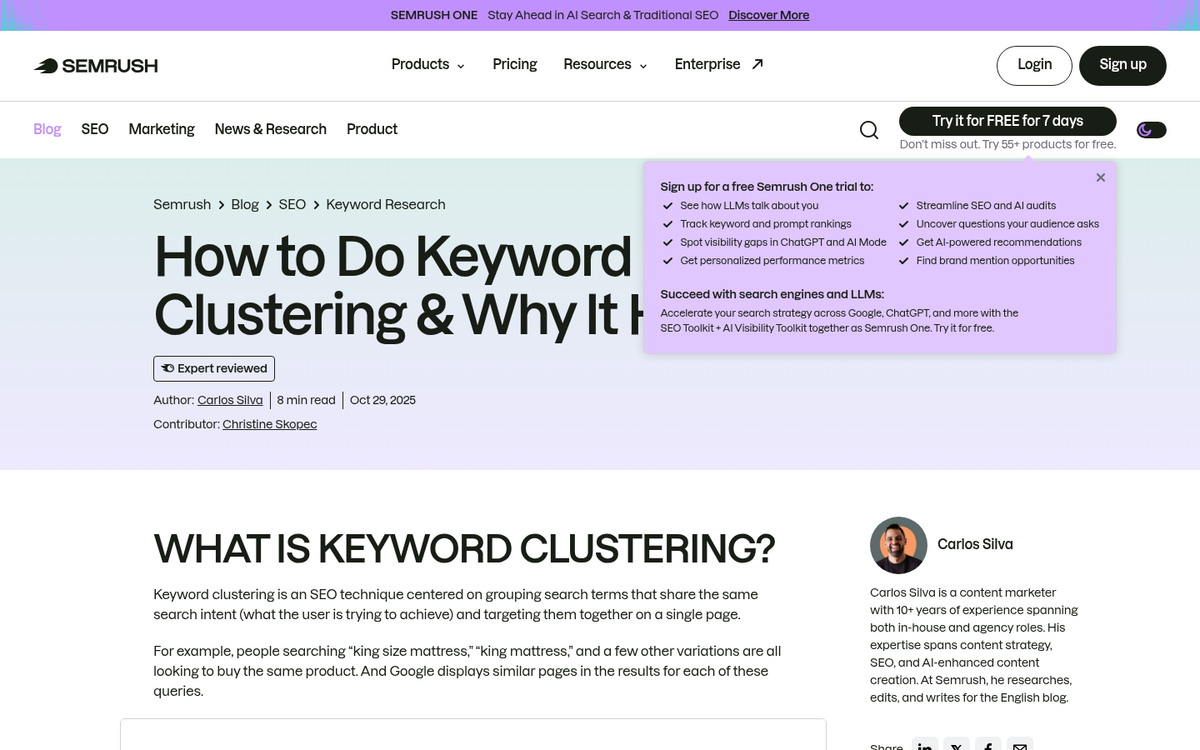
Keyword clustering is a big part of this - it means grouping related search terms together so your content covers a subject from multiple angles instead of repeating the same ground. According to Surfer SEO, 98% of SEOs rate keyword clustering as medium-to-high value. That number tells you quite a bit about how central this practice has become to content strategy.
That said, 35% of SEOs name content planning as their biggest hurdle - it takes time to map out which subtopics to cover and how they connect. But that planning work is what separates a scattered site from a focused one.

The table below shows what that difference looks like in practice.
| Scattered Content Approach | Clustered, Topic-Led Approach |
|---|---|
| Articles written on whatever ranks or trends | Articles planned around a central topic and its subtopics |
| Little or no internal linking between posts | Strong internal links connecting related content |
| No clear subject focus for the site | A recognizable area of expertise that builds over time |
| Each page competes independently for rankings | Pages support each other and lift the whole cluster |
Internal linking is the part most people underestimate. When you connect your content intentionally, you help search engines understand the relationships between your pages - it also keeps readers moving through your site to find answers to follow-up questions they didn't know they had. There are WordPress plugins that can help boost your rankings by making this process more systematic.
You want to cover a subject well enough that there's no obvious gap a competitor could fill.
What Strong Topical Authority Can Do for a Smaller Site
A large domain with thousands of backlinks will always have a benefit in a large sense. But topical authority changes the math in a way that actually works in your favor. When you own a niche, Google starts to treat your site as the favorite place for that subject. That trust has measurable results.
RetroDodo is a great real-world example of this. The site covers retro gaming and handheld devices with depth and focus. Its Domain Rating sits at just 47, which is modest by most standards. But it pulls over one million monthly clicks and brings in more than $50,000 in monthly revenue. That performance from a pretty small domain comes down to one thing: the site has built genuine authority within its niche.
There's also a speed benefit worth learning about. Research from Graphite found that high topical authority cuts back on the time it takes for a new post to earn its first impression and first click in search results. In other words, when your site is already trusted on a topic, new content you publish on that topic gets picked up faster. You're not starting from zero every time.
This matters quite a bit if you're working with a newer or smaller site. You don't need to compete across the entire internet - you just need to be the most reliable source in your corner of it, an achievable goal for almost anyone with a well-defined focus. If you're building something from scratch, coming up with the right name for your blog is an early step that helps establish that focus.
The revenue and traffic numbers from a site like RetroDodo aren't an isolated thing. They follow naturally when a site commits to covering its subject from every helpful angle over time. Google rewards that consistency with visibility, and visibility brings traffic that converts. Understanding how to see who has liked and shared your posts can help you measure which content is resonating most.
Size and age still matter to some degree. But they're not everything. A focused, well-structured site can outrank much bigger competitors on the topics it has earned the right to own.
Signals That Show Your Site Lacks Topical Authority
Sometimes the signs are soft. But a quick look at your own site can tell you quite a bit. You might rank well for one keyword but get almost no traction on anything related to it. That difference between your one strong page and everything around it is worth mentioning.
Another sign is slow visibility for new content. A study by Graphite looked at 332 URLs across 12 domains and found that sites with stronger topical coverage got new pages indexed and ranking much faster than the ones without it. If your new articles sit in the dark for months, that pattern is worth noting.
Thin coverage of subtopics is a big one too. If you write about a large subject but leave most of the related angles untouched, search engines have less to work with when picking what your site actually knows. Having content is not enough - you need enough of the right content to fill in the picture.
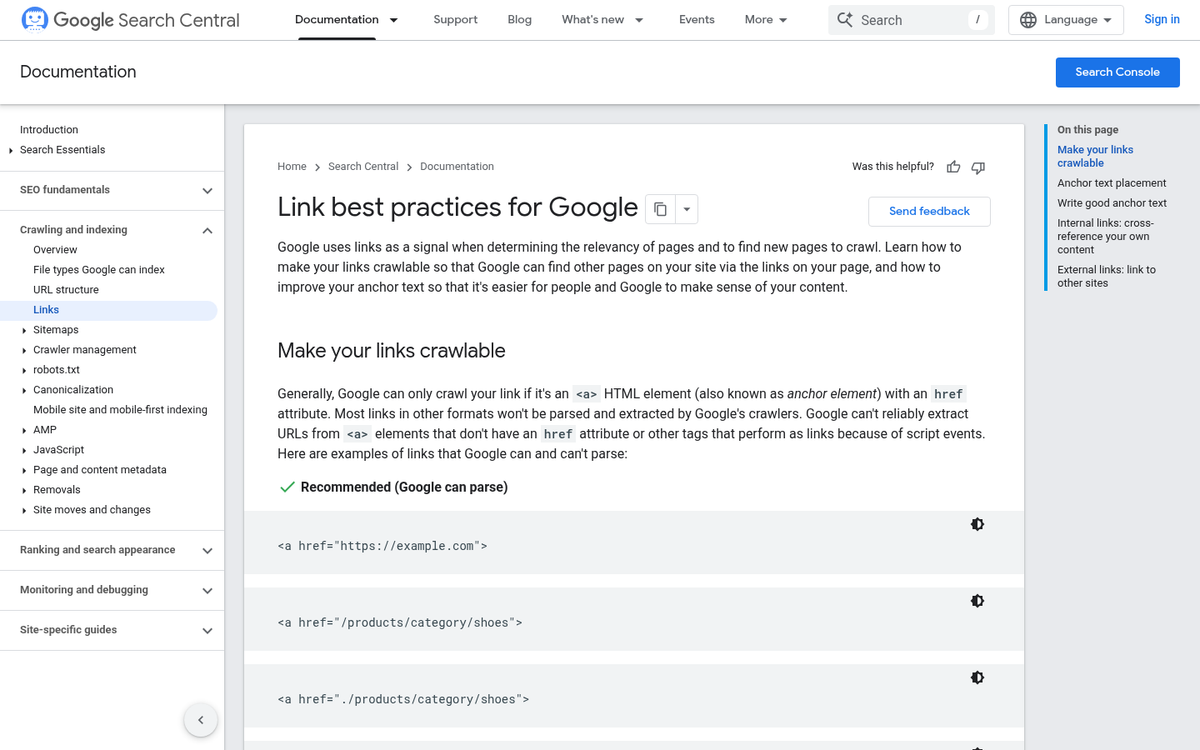
Poor internal linking can quietly work against you as well. Orphaned articles that no other page on your site links to are hard for search engines to connect to your wider topic structure. Look at your own site and see if your pages reference each other in a way that makes sense.
| Signs You Lack Topical Authority | Signs You Have Topical Authority |
|---|---|
| One or two pages rank but related pages don't | Multiple pages on the same topic rank together |
| New content takes months to get any visibility | New content picks up traction within weeks |
| Large subtopic gaps across your content | Subtopics are covered in a logical and connected way |
| Articles with no internal links pointing to them | Pages are linked to each other throughout the site |
| Content covers a topic broadly but never in depth | Content goes deep on specific angles within the topic |
Run through that table as a quick self-audit. Even one or two of the left-hand signs is a signal that there's work to do.
Building a Topical Authority Strategy Without Starting Over
If you already have content on your site, you're not starting from scratch - you're starting from somewhere. You want to work with what you have and build outward from there in a structured way.
Start with a content audit. Go through your existing pages and group them by topic. You'll probably find that some subjects have five or six articles and others have just one thin page with no supporting content around it. That imbalance is what you're looking to fix.
Once you can see your content grouped by topic, look for the gaps. Think about the questions a person may have about a subject and check if your site answers them. If someone reads your main page on a topic and then has a follow-up question, does your site have the answer? If not, there's a gap worth filling.
Internal linking is something sites underuse. When you publish a new page that relates to an existing one, link between them - this helps search engines understand how your content connects and tells them that your coverage of a topic runs deep instead of wide. Tools like Long Tail Pro can help you identify which subtopics are worth targeting as you fill those gaps.
It's also worth targeting subtopics that your competitors have covered but you haven't. These underserved areas are places to expand because they strengthen the picture of your expertise without requiring you to rebuild anything you've already done.
For AI-driven search specifically, tools like AI Overviews and answer engines don't review a single page - they look at patterns across your whole site. A large, well-connected body of content on a subject is more likely to be recognized as authoritative than a single well-optimized page with nothing around it. If you're building out a niche site, guides like tips for starting a travel blog or launching a mommy blog that earns money show how topical depth matters from day one.
The process is about layering. Audit what you have, map your topic clusters, fill the gaps, strengthen your internal links and expand where your coverage is thin - and each step builds on the last and the site you have is already a foundation to work from.
Think Like a Publisher, Not a Keyword Chaser
The sites winning are not the ones publishing the most content - they are the ones publishing the right content, organized around topics they legitimately own. That authority does not happen by accident, and it doesn't happen faster. But it compounds. Every well-structured cluster you build makes the next one easier, and every piece that earns trust reinforces the ones around it.
FAQs
What is topical authority in SEO?
Topical authority refers to how thoroughly and consistently your website covers a particular subject. It signals to search engines that your site is a trusted, expert source on a specific topic, making it more likely to appear in search results and AI-generated answers.
How does topical authority differ from domain authority?
Domain authority is a broad score based on external links pointing to your site. Topical authority measures how much expertise your site demonstrates on a specific subject. A newer site can outrank bigger competitors by going deep on one focused subject area, regardless of domain score.
How do content clusters help build topical authority?
Content clusters group related articles around a central topic, with strong internal links connecting them. This structure signals depth to search engines, helping them recognize your site as an authoritative source rather than a generalist site covering topics at a surface level.
Can a small website build topical authority?
Yes. Smaller sites can outrank larger competitors by owning a niche. RetroDodo, with a Domain Rating of just 47, earns over one million monthly clicks by covering retro gaming deeply and consistently - proving focused topical authority outweighs size and backlink volume.
What are signs my site lacks topical authority?
Key signs include only one or two pages ranking while related pages don't, new content taking months to gain visibility, large gaps in subtopic coverage, and orphaned articles with no internal links. These patterns suggest search engines don't yet recognize your site as an authoritative source.