




As a website owner, this matters more than you might think. Answer engines don't scan your pages for matching search terms - they build a semantic map of your content and look at whether your site shows genuine depth and authority across a subject area. If your pages cover a topic in a fragmented or shallow way, AI systems will probably pass you over in favor of sources that show clearer, more comprehensive topical coverage.
You can structure your content strategy to meet the way AI systems actually interpret and categorize information - making it far more likely your site gets surfaced as a trusted, citable source in AI-generated answers. This entry breaks down the mechanics of topic modeling, why it matters for AEO, and how you can apply it to your content.
Quick Answer
Topic modeling is an unsupervised machine learning technique that automatically identifies recurring themes or topics within a large collection of text documents. It works by finding patterns of co-occurring words, grouping them into topics without requiring labeled data. Common algorithms include Latent Dirichlet Allocation (LDA) and Non-negative Matrix Factorization (NMF). It is widely used for document organization, content recommendation, trend analysis, and summarizing large text datasets. Each document is represented as a mixture of topics, and each topic is characterized by a probability distribution over words.
How Topic Modeling Works Under the Hood
At its core, topic modeling is a way for machines to read large amounts of text and group words that seem to belong together into themes. The machine never reads for meaning the way a person does - it just looks for patterns across hundreds or thousands of documents at once. But those patterns turn out to be fairly helpful for understanding what a piece of content is about.
The most well-known strategy is called Latent Dirichlet Allocation, or LDA, developed by Blei, Ng and Jordan in 2002. Before that, a strategy called PLSA (Probabilistic Latent Semantic Analysis), introduced by Thomas Hofmann in 1999, laid the groundwork. Both methods work by assuming that any document is a combination of topics and that each topic is a combination of words.
In practice, if the words "mortgage," "interest rate," and "down payment" appear together across documents, the algorithm starts to treat them as part of a shared theme. It does not know to call that theme "home buying" - that part is left to a human to label - but it knows those words belong together.
The machine works backwards - it sees the words on the page and tries to figure out what hidden topics could have produced that combination of words. That is where the "latent" part of LDA comes from - the topics are not visible in the text, they are inferred from it.

A machine scanning your pages is not reading your headings and nodding along - it's building a statistical picture of which words travel together across your content. If your pages combine unrelated ideas without much consistency, the topic signals get weaker and harder to interpret. One practical fix is combining old posts into stronger, more focused resources rather than leaving fragmented content spread across many pages.
The algorithm also works at scale. A single page tells it very little. But dozens of pages on related subjects start to build a coherent picture. The more your content uses a connected set of terms, the more confidently the model can place your site within a recognizable topic space.
This matters because modern AI systems that read and index web content are built on similar principles. They use topic signals to determine what a page is about and how it relates to other content across the web.
Why AI Answer Engines Rely on Topic Signals
AI answer engines don't look for matching words when they review content. They analyze the full shape of what a part of writing is about and then weigh that against everything else on the same site.
That's where topical depth comes in. A site that covers a subject from multiple angles, across a few related pages, sends a much stronger relevance signal than a site with one standalone post that technically contains the right words.
A single page about "lower back pain exercises" tells an AI engine very little about back health as a whole. But if your site also covers posture, recovery, anatomy, and movement patterns, the system can build a more confident picture of your authority on that subject. Depth and consistency together do the work that no single page can do alone.
Scattered content works against you here. If a site jumps between unrelated topics without any thread, AI systems have a hard time assigning it a coherent subject area. That uncertainty usually means lower confidence in the source and a lower chance of being selected as an answer.
Topical clusters are the structural answer to this. A cluster is a group of pages that all relate to a main subject; each page can add something different to the picture. These clusters create a web of internal relevance that AI engines can read almost like a map of your expertise.
AI answer engines favor sources that go deep instead of wide. A site with ten pages on one topic will usually outperform a site with a hundred thin pages spread across ten topics. The signal needs to be concentrated enough for the system to trust it.
Consistency over time matters too. If your content returns to the same subject area and builds on itself across pages, that pattern reinforces the relevance signal every time the engine re-evaluates your site. Thin content that exists in isolation doesn't accumulate that weight.
That's the core reason why how you organize and connect your content matters just as much as what you write. The next section gets into how AI systems tell the difference between a keyword and a genuine topic signal.
The Difference Between Keywords and Topics in AI Content Evaluation
There's a difference between writing for keywords and writing for topics, and AI systems pick up on it faster. A page that repeats a phrase times looks very different to an AI than a page that legitimately covers the full context around an idea.
| Approach | What It Targets | How AI Reads It |
|---|---|---|
| Keyword Optimization | Exact match phrases | Surface-level signal |
| Topic Modeling | Thematic clusters | Contextual understanding |
Keyword optimization tells an AI what word appears on a page. Topic modeling tells it what the page is actually about. Those two things are not the same, and the difference between them is where content falls short.
AI doesn't scan for matching terms alone - it evaluates if a page fits into a wider thematic conversation. A page about "home loan rates" that never touches on related concepts like credit scores, lender types, or repayment terms will feel thin to an AI - even if the target phrase appears throughout the text.
Keyword stuffing made sense in an older era of search. Today's AI systems are built to find these patterns when content is written to manipulate instead of to inform, and they treat it accordingly.
The more helpful question to ask about any page is whether it commits to one topic or tries to cover too many things at once. A page that touches on five loosely connected ideas doesn't build strong topical signals for any of them - it just creates noise.
A test is to read a page and ask what single topic a reader would associate it with after finishing. If the answer is fuzzy, that's a sign the page is pulling in too many directions. This same principle applies when you combine older posts into a single resource - consolidating scattered ideas into one focused page strengthens its topical signal.
Thematic coherence separates content that AI systems treat as authoritative from content that gets passed over. Word count and keyword density matter less than whether the ideas on a page hang together and reinforce a main theme throughout.
A page can be well-written and still not have much topical focus; it's the part keyword thinking doesn't prepare you for.
Mapping Your Site's Topical Footprint
Think of your website as a single document- not a list of pages. Every post, landing page, and article changes a wider picture of what your site is actually "about." That picture might not match what you think it is.
First and foremost, audit what you already have. Go through your pages and group them by theme- not by category label or URL structure. You might find that you have fifteen pages touching on one narrow idea and almost nothing on a closely related topic that your audience legitimately needs.
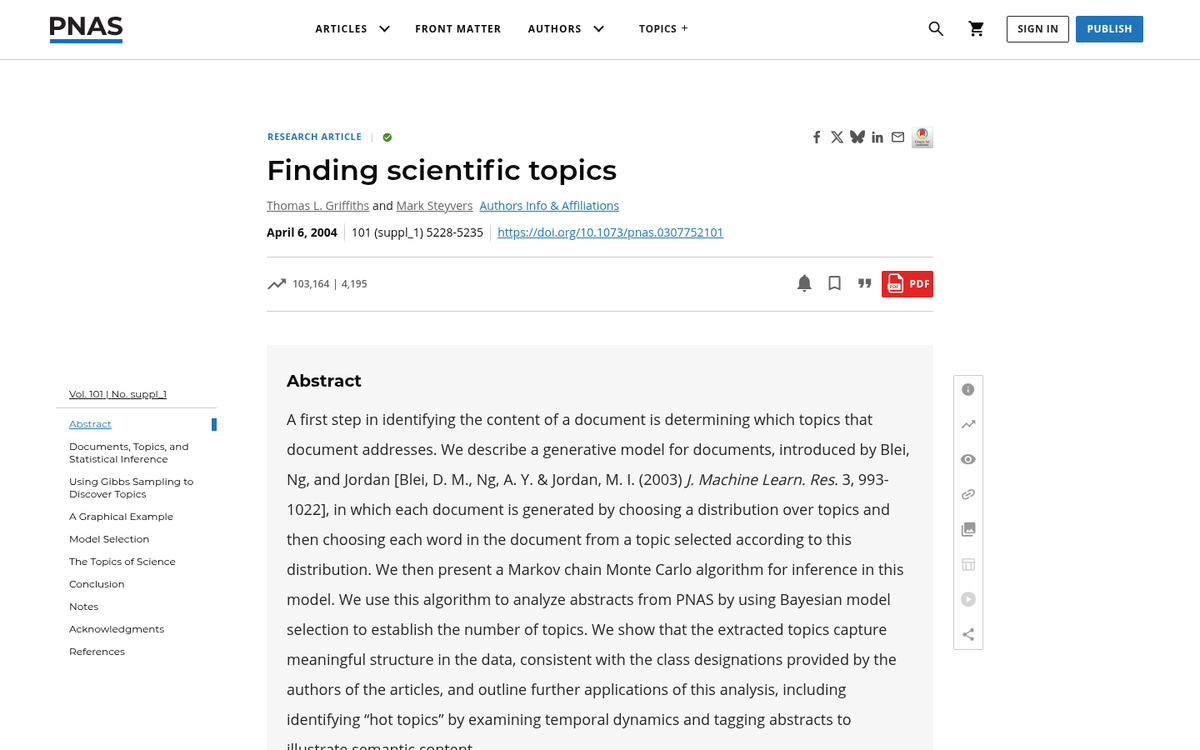
This mapping is not new to scientists. When Griffiths and Steyvers applied topic modeling to a decade of abstracts from the Proceedings of the National Academy of Sciences, they could track how topics rose and fell in prominence over time. The same thing goes with your website. If you look at your content as a whole and trace it over time, patterns show up - like gaps and areas where your coverage is thin or contradictory.
Contradictory coverage is worth mentioning. If two pages on your site take different positions on the same topic, AI systems that read your site as a document collection will register that inconsistency- it creates noise where there should be a signal.
You can do this audit manually by exporting your page titles and meta descriptions into a spreadsheet and tagging each one with a theme. Tools like Screaming Frog help you pull that data faster. From there, group the tags and count how much content you have in each cluster. If you use WordPress, it's also worth considering whether your existing tags are helping or hurting your site's organization.
The goal is balance and depth. A site that has strong topical coverage in one area and almost nothing in a related area does not "own" that wider subject. AI content evaluation picks up on this because it reads tells across your whole site- not page by page. Where you host your content can also affect how your topical authority is perceived across different properties.
| Coverage Status | What It Looks Like |
|---|---|
| Strong | Multiple pages covering different angles of the same topic |
| Thin | One or two pages on a topic with little supporting content |
| Contradictory | Pages that conflict with each other on the same subject |
| Missing | Closely related topics your audience needs but you have not addressed |
Once you can see your topical footprint laid out this way, the gaps become hard to ignore.
Building Content That Reinforces Topical Authority
Understanding where your site stands on a topic is just the first step - the next is to build content that deepens that position.
Internal linking is one of the most underused tools here. When a supporting post links back to your main pillar page and that pillar links out to related subtopics, you create a content structure that tells search engines what your site is about. Think of it as drawing a map of your expertise instead of leaving scattered notes around.
Content depth matters too. But depth doesn't always mean length. A page goes deep when it covers a topic's nuances, uses related terminology and addresses the questions that come up around a subject. Research into topic modeling has shown that 164 articles can generate over 1,252 tokens within a single theme - that semantic range is what makes a site feel authoritative to readers and algorithms.

Semantic variety is worth pursuing. Instead of repeating the same phrases over and over, you can use the natural language that surrounds your topic - synonyms, subtopics, related concepts and the vocabulary your audience actually uses. This gives your content more surface area without forcing you to write the same post ten times.
What to Watch Out For
Thin content is a problem when sites scale up too fast. A page that barely touches a subject can add almost nothing to your topical footprint and pull focus away from your stronger pages. Fewer, fuller pages are better than a large archive of shallow ones.
Topic dilution is a separate but related trap. If your site covers a tight niche and you start publishing content that only loosely connects to that niche, you start to blur the picture you've built. Every page you publish sends a signal about what your site is for, so pages that wander too far from your core topic work against you.
The goal is a content library where each piece earns its place. Supporting pages should add context to your pillars, answer adjacent questions and use language that reinforces the same core theme. One practical way to tighten that structure is to set up a consistent publishing workflow on WordPress so new content fits into your existing topic map rather than growing in an unplanned direction.
Make Your Content Speak the Same Language as AI
The most encouraging part of working with topic modeling is that the goal goes hand in hand with something worth doing anyway - creating content that's legitimately helpful, organized, and easy to get through. When that's the foundation, improved visibility tends to follow as a natural result - not a lucky accident. If you're also looking to grow that visibility through social channels, understanding how to find the most popular pins on Pinterest can be a great complement to your content strategy.
FAQs
What is topic modeling and why does it matter?
Topic modeling is a method AI uses to group related words into themes, building a semantic map of your content. It helps AI answer engines determine whether your site has genuine depth and authority on a subject.
How is topic modeling different from keyword optimization?
Keyword optimization targets exact match phrases, while topic modeling evaluates thematic context. AI systems look beyond repeated keywords to assess whether a page genuinely covers a subject's full scope.
How do topical clusters improve AI visibility?
Topical clusters group related pages around a central subject, creating a connected web of relevance. This structure helps AI engines confidently map your expertise and increases your chances of being cited as an authoritative source.
What does a strong topical footprint look like?
A strong topical footprint means multiple pages covering different angles of the same subject, with no contradictions or major gaps. AI systems evaluate your entire site as a document collection, not just individual pages.
Can thin or scattered content hurt AI rankings?
Yes. Thin content adds little to your topical authority, while scattered content across unrelated topics weakens your relevance signal. Fewer, well-focused pages consistently outperform large archives of shallow, disconnected content.