





Among certain circles online, Alexa was once one of the most important possible metrics. Among many others, it was a curiosity at best. But here's the thing - as of May 1, 2022, Alexa Internet was officially shut down by Amazon. So why are we still talking about it? Because its ghost still haunts SEO discussions, old blog posts, and the occasional outdated marketing deck. Let's set the record straight on what Alexa was, why it was always flawed, and what you should be using instead.
Key Takeaways
- Alexa Internet was shut down by Amazon on May 1, 2022, yet still appears in outdated SEO discussions and marketing materials.
- Alexa's rankings were only statistically meaningful for the top 100,000 websites, a tiny fraction of hundreds of millions online.
- Mobile visitors were completely excluded from Alexa's tracking, despite mobile representing over 60% of global traffic by 2022.
- Alexa's data came from opt-in toolbar users, creating a narrow, self-selecting, geographically biased sample unrepresentative of real web traffic.
- Semrush, Ahrefs, Similarweb, and Google Analytics are now the recommended replacements for competitive traffic intelligence and site analytics.
How Alexa Worked
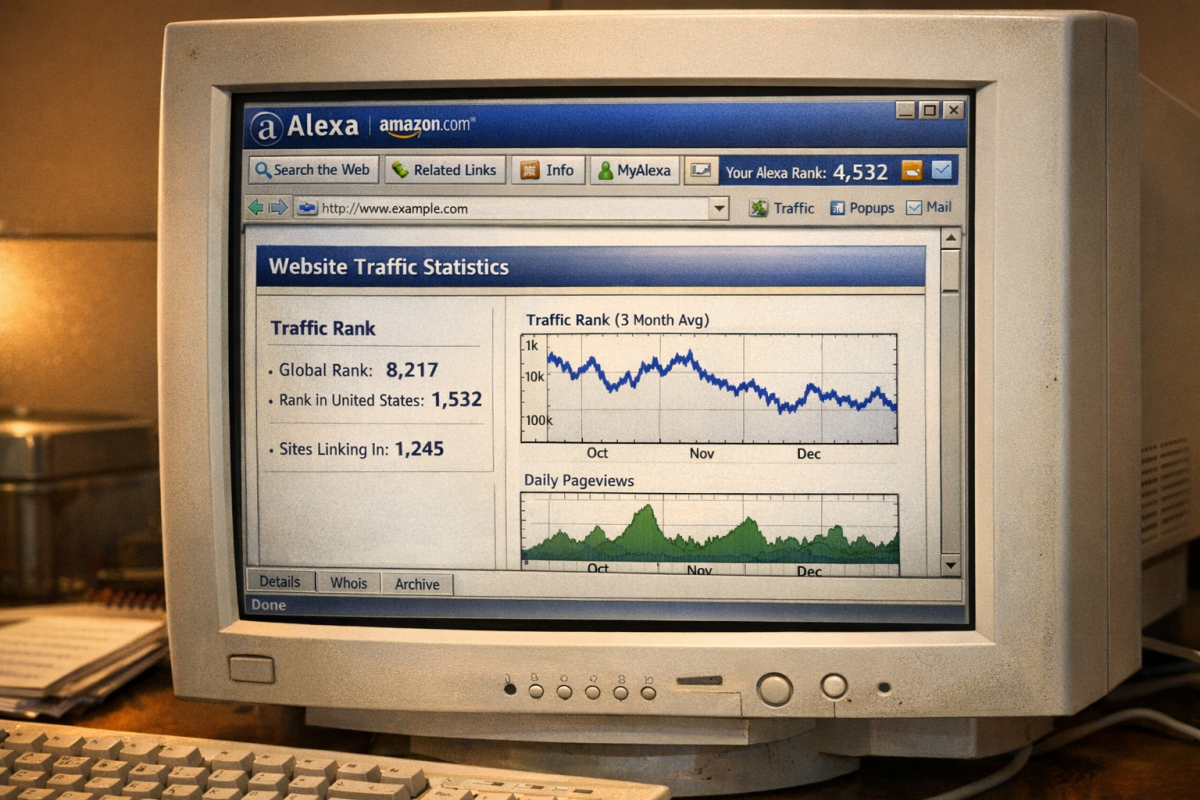
Alexa, owned by Amazon since 1999 (acquired for $250 million in stock), was a third-party analytics company that tracked information about websites and sold access to that data as a business model. The main draw was access to competitor traffic estimates and rankings, particularly useful if your competitors were among the top few thousand websites online.
Alexa's ranking system was primarily meaningful for the top 100,000 websites in the world - by Alexa's own admission. In fact, Alexa itself stated: "Sites with relatively low measured traffic will not be accurately ranked by Alexa. We do not receive enough data from our sources to make rankings beyond 100,000 statistically meaningful." While 100,000 sounds like a lot, remember there are hundreds of millions of websites online, making Alexa's meaningful data range a very narrow slice of the internet. What actually counts as a high Alexa ranking is worth understanding in that context.
In its earlier years, Alexa's data came almost entirely from one source: the Alexa toolbar. Users who browsed the web with that toolbar installed were feeding data about the sites they visited to Amazon and Alexa. Anyone without the toolbar was invisible to the system. In effect, Alexa was trying to draw sweeping conclusions about the entire web from what was effectively a narrow, self-selecting sample.
By 2020, Alexa had evolved somewhat, replacing the old toolbar model with data from browser extensions and from websites that had the Alexa tracking script installed directly on their pages. It was a modest improvement, but the fundamental problem - incomplete, biased sampling - never went away. If you need more reliable options, there are solid alternatives to traditional analytics platforms worth considering.
The Problem with Alexa Rank

Even in its evolved form, Alexa's data had serious structural problems that made it unreliable for most websites.
The toolbar era was particularly problematic. For years, Alexa only tracked users on Internet Explorer, Google Chrome, and Firefox. Users of any other browser, and crucially, any mobile browser, were completely ignored. As of 2014, mobile traffic already represented 30% of all web traffic - meaning nearly a third of all real-world visits to any given site were simply invisible to Alexa's ranking system. By the time Alexa shut down in 2022, mobile traffic had grown to well over 60% of global web traffic. The gap between Alexa's picture of the web and reality had become enormous.
Beyond mobile, toolbar and extension adoption was heavily geocentric. Some regions of the world were significantly overrepresented in Alexa's data while others barely registered, meaning rankings could be skewed simply by where a site's audience happened to live rather than how much traffic it actually received.
The result was a metric that looked precise - a single ranking number - but was built on a deeply unrepresentative foundation. For large sites in the top 10,000, it was a rough approximation. For smaller sites, it was effectively noise. Does having a high Alexa rank matter anymore is a question many publishers eventually had to ask themselves as these limitations became harder to ignore.
What Replaced Alexa?
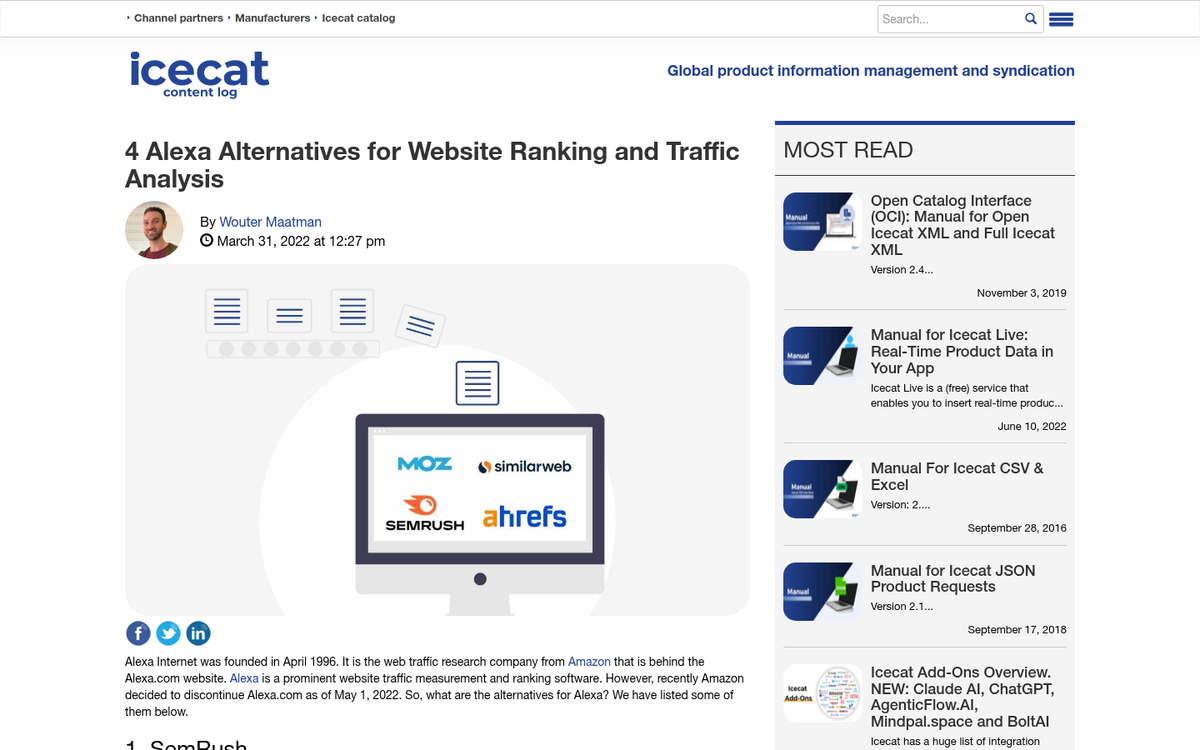
Since Alexa's shutdown in May 2022, the tools that were already outperforming it have simply become more dominant. If you need competitive traffic intelligence or website analytics in 2026, here are the tools actually worth your time:
- Semrush and Ahrefs remain the gold standard for competitive traffic estimates, keyword research, and backlink analysis. Both have invested heavily in their traffic estimation models and are significantly more reliable than Alexa ever was for sites of any size.
- Similarweb is arguably the closest direct replacement for what Alexa tried to be - broad traffic estimates across a wide range of sites, with better methodology and more transparent sourcing.
- Google Search Console and GA4 (Google Analytics 4) remain the most accurate sources of data for your own site. If you want to know what's actually happening with your traffic, these are non-negotiable - and knowing why GA4 might not be showing your traffic is just as important.
- Moz and Majestic offer domain authority and backlink-focused metrics that remain useful for evaluating site strength, even if they don't directly replace traffic estimates.
The Lesson Alexa Left Behind
The real takeaway from Alexa's rise and fall isn't just "use better tools." It's a reminder to always ask where a metric's data actually comes from. Alexa looked authoritative because it produced a clean, simple number. But that number was built on opt-in toolbar users, excluded mobile visitors, skewed by geography, and only statistically meaningful for a tiny fraction of the web.
In 2026, there are better options at every price point - including free. If someone in a marketing conversation still brings up Alexa rank as a meaningful benchmark, that's a signal worth paying attention to. Either they haven't kept up with the industry, or they're selling you something.
Use tools that are transparent about their methodology, cross-reference your data across multiple sources, and always weight first-party data - your own analytics - above any third-party estimate. That was good advice when Alexa was alive, and it's even better advice now.


2 responses
Thoughtful replies only - we moderate for spam, AI slop, and off-topic rants.
Thank you for this article. I found a lot of insight from it and will use this info. Others should too.
Thanks so much, Kaitlyn! We're really glad the article was helpful for you. Understanding how Alexa tracks mobile visitors can definitely make a difference in how you interpret your site's traffic data. Feel free to share it with anyone you think could benefit - the more people understand these metrics, the better decisions they can make about their websites. If you ever have questions or want us to dive deeper into any related topics, don't hesitate to ask!