Key Takeaways
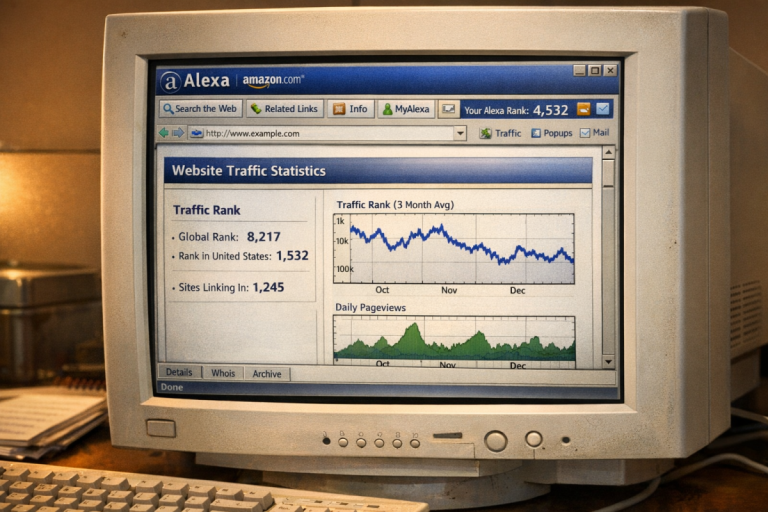
- Alexa ranked roughly 30 million websites by estimated traffic over a rolling 90-day window until shutting down May 1, 2022.
- Rankings relied on a browser toolbar sample, introducing severe bias toward SEO professionals and completely excluding mobile traffic.
- A ranking under 100,000 was considered a major achievement; anything beyond 1 million was statistically unreliable per Alexa's own documentation.
- Rankings were manipulable - services sold toolbar-equipped visits specifically to artificially inflate scores before site sales.
- Similarweb, Ahrefs, Semrush, and first-party tools like GA4 now serve as the recommended alternatives to Alexa.
What Was Considered a High Alexa Rank? (And Why It No Longer Matters)
Alexa was one of the oldest forms of non-Google rankings online with any sort of comprehensive scope. Unlike basic "top site" lists that seemed to pop up everywhere in the early 2000s, it covered every industry, wasn't pay-to-play, and didn't restrict rankings to any particular niche or editorial bias.
It was considered an "objective" ranking system - though that word deserves heavy quotes, for reasons we'll get into. For years, if you were selling a site on Flippa or another marketplace, potential buyers almost always wanted to see your Alexa ranking. It carried real weight in valuation conversations.
However, Amazon officially discontinued the Alexa Internet service on May 1, 2022. So while this post originally covered how to interpret your Alexa rank, it now serves as both a historical reference and a guide to what those numbers actually meant - and what you should be using instead.
How Alexa Worked

Alexa Internet was founded in 1996 as an independent web ranking and analytics company. Amazon acquired it in 1999 for $250 million in stock, and it operated as a wholly owned subsidiary until its shutdown. At its peak it claimed over 6.5 million monthly visitors, the majority of whom were using it for competitive analytics rather than browsing rankings.
Alexa ranked websites based on estimated traffic volume. At its core, that's all it did. Unlike Google, which uses hundreds of signals tied together by a complex algorithm, Alexa calculated estimated unique visitors and pageviews per day, aggregated that data over a rolling 90-day window, and ranked approximately 30 million websites globally based on that average. Because it was a rolling three-month calculation, rankings were fluid - sites could rise quickly, fall quickly, and seasonal content would fluctuate regularly.
To collect this data, Alexa didn't track every user on the internet. Instead, it relied on a sample of users who had the Alexa Toolbar installed in their browser. This was the central and most criticised limitation of the entire system. It's worth noting that traffic numbers from any analytics platform come with their own caveats and methodological blind spots.
The Flaws With Alexa
The toolbar-based methodology introduced serious sampling bias. Who installs a browser toolbar specifically for web ranking data? Not typical internet users - the toolbar audience skewed heavily toward SEO professionals, webmasters, and tech-savvy marketers. That meant Alexa's data was essentially a reflection of what that audience visited, not the broader web.
On top of that, Alexa traffic could be purchased. Services existed specifically to send toolbar-equipped visitors to a site in order to artificially inflate rankings. This was particularly common among site sellers looking to boost their valuation on Flippa in the months before listing.
Mobile traffic was another glaring gap - Alexa's toolbar was never supported on mobile browsers, meaning the enormous share of global traffic coming from smartphones was entirely excluded from its calculations.
According to Alexa's own support documentation, rankings beyond 100,000 were not statistically meaningful due to insufficient data. This was a significant caveat that many people glossed over when citing rankings as evidence of a site's performance.
What Was Considered a High Ranking?
Understanding Alexa rankings requires some context. The service ranked roughly 30 million websites, but the quality and reliability of those rankings varied enormously depending on where a site fell in the list.
Here's a general breakdown of how the internet marketing community interpreted rankings at the time:
- Top 1,000: Global household names - Google, YouTube, Facebook, Amazon, Wikipedia, Reddit, and their international equivalents. Untouchable for virtually any independent or commercial site.
- Top 10,000: Extremely high-traffic sites with massive, established audiences. Major industry publications and dominant niche leaders lived here.
- Under 30,000: Considered a very high ranking. Sites in this range had substantial, consistent traffic and were taken seriously by advertisers and potential buyers.
- Top 100,000: Widely considered a major achievement and a meaningful milestone for any independently operated site.
- Top 1,000,000: The minimum threshold that many internet marketers considered relevant. Anything outside this range was often dismissed as essentially worthless for valuation or comparison purposes. If you're working to reach this milestone, learning how to find high traffic blog topics can give your site a meaningful boost.
- Beyond 1,000,000: Statistically unreliable and not particularly useful as a metric, per Alexa's own documentation. Sites struggling here may also want to examine why visitors bounce and whether time spent on site is dragging down overall engagement signals.
Why Did People Care?
Despite its well-documented flaws, Alexa ranking persisted as a metric that mattered in certain circles for one simple reason: it was comparative. It didn't claim to measure absolute traffic with precision - it ranked you relative to every other site it tracked. That made it useful as a rough benchmark, even if the underlying numbers were imprecise.
Advertisers and site buyers used it because their decisions were inherently traffic-focused. Even an imperfect traffic signal helped them compare an unknown site to known performers. If a site was ranked 50,000 globally, that told a buyer something meaningful - it sat in a tier alongside recognisable, high-performing sites.
The problem, of course, was that Alexa ranking was manipulable, inconsistently sampled, and entirely blind to mobile traffic. By the time Amazon pulled the plug in 2022, its relevance in the SEO and analytics community had already been declining for years.
Alexa Ranking Alternatives
With Alexa gone, several tools have stepped in to fill various parts of what it once offered. None of them are direct replacements, but together they cover more ground - and more accurately:
- Similarweb is the closest modern equivalent for traffic estimation and competitive benchmarking. It pulls from a much broader and more diverse data set than Alexa's toolbar ever did, and it covers mobile traffic. It's the go-to tool for the kind of competitive research Alexa used to provide.
- Ahrefs and Semrush both offer domain-level traffic estimates, keyword rankings, and competitive research features that have largely absorbed the analytics use case Alexa served for SEO professionals.
- Moz Domain Authority remains a widely used comparative metric for evaluating site strength, though it measures link authority rather than traffic directly.
- Google Search Console and GA4 give you the most accurate first-party data about your own site's performance - always more reliable than any third-party estimate.
PageRank as a publicly visible metric has been dead for years and is not worth factoring into any current strategy.
The Bottom Line
Alexa had a long run. From its founding in 1996 through its acquisition by Amazon for $250 million in 1999 and all the way to its shutdown on May 1, 2022, it was a fixture of the web analytics landscape - flawed, manipulable, and incomplete, but widely referenced nonetheless.
If you're doing historical research on a site's performance, understanding what old Alexa scores meant can still be useful context. A global ranking under 30,000 was genuinely impressive. Breaking into the top 100,000 was a real milestone. And anything beyond 1 million was more or less noise.
For anything forward-looking, though, move on. Similarweb, Ahrefs, Semrush, and your own first-party analytics are doing the job now - and doing it better. If you want more control over your data, it's also worth exploring alternatives to Google Analytics that give you a fuller picture of your audience.