Key Takeaways
- Constant Content is a marketplace operating since 2003 where writers set their own prices, ranging from $20 to $200.
- Full Rights ownership is recommended over Usage Rights, which are non-exclusive and can cause duplicate content issues with Google.
- Every submitted article is reviewed by an editor and scanned for plagiarism, maintaining higher quality standards than many competitors.
- Buyer reviews are mixed, with a 2.45/5 rating on SiteJabber, citing quality inconsistency and limited revision options.
- AI tools have pressured the platform, though human-written content remains valuable for YMYL niches like health, finance, and legal topics.
There are many options available if you want to buy articles online. We've reviewed some of them before.
Not to be confused with the email service provider Constant Contact, Constant Content is a marketplace for content that has been operating since 2003, which makes it one of the oldest places of its kind on the internet. Writers can post articles they've written at prices they set, or they can work on assignments posted by clients who have content they want written.
As a blogger looking to buy content, you have free run of the site. You create an account and can search for topics at your leisure. Content is categorized and you get a preview description that's searchable, so you can search for keywords. When you find a post that looks promising, you can click to view it - this will show you the writer's description of the post, an excerpt of the article, and the pricing. You can also click through to see a bio of the writer, in case you want to check their credentials or other work they have written.
You won't be able to see the full text of the article, and the preview excerpt you get is presented in the form of an image, to stay away from shady bloggers stealing content that's publicly posted on the marketplace. Constant Content tries to protect their writers in this manner, since they can't go after scammers with legal action.
One thing worth mentioning before diving deeper: to get started as a buyer, you are required to buy a minimum of $25 in credits - it's a low barrier to entry. But it's worth learning about first.
Article Pricing
Most articles will have two tiers of pricing, though older posts will have three.
These are:

- Usage Rights. These are the cheapest, but you shouldn't buy a post for usage rights. Why not? Well, they're non-exclusive. Anyone can come in and buy a post for usage rights, and gain the rights to use the content. If you buy a post for usage rights and someone else has already bought and published the content, what do you get? You get content that someone else has posted. It's copied content, and it's something Google is going to devalue on your site.
- Unique Rights. These are going to be mid-tier pricing, trending towards the higher side. They give you the rights to the content publication, as is. The only things you are allowed to change are formatting like italics and bolding, and the addition of links. Changing the content itself can be considered a violation of the Constant Content terms of service and can get you blocked from the platform. This license is being phased out, however, and most modern content won't have it as an option.
- Full Rights. This is the most expensive set of rights, but it gives you total control over the content. Like with unique rights, the content becomes yours and is taken off the platform, so no one else can buy or use it. However, you don't have the change restrictions of unique rights. You are free to edit the post as you see fit, as much or as little as you like. It's your content now; the writer and Constant Content don't care what you do with it.
Pricing runs a number of levels, because there's no standard set by Constant Content itself. Writers are free to set their prices and change them at any time. Articles usually range from $20 to $200, with the average catalogue post sitting around $40 and the average custom content order coming in closer to $120. High-quality content tends to hover around the $75 mark.
How much are you willing to pay? That's the question you're going to have to ask yourself. In most cases the content with the higher pricing comes from more experienced, better professional writers. They charge what they know they're worth. The content you get for cheaper prices isn't always bad content - maybe content that was ignored because it didn't trend, and the writer has lowered the price in an attempt to get it to sell. Of course, it could actually be bad content; it's what the preview is for, so you can choose if the content is a fit for your blog.
Custom Requests
If you've searched and don't see any content that fits the bill of what you want - wrong topics, too expensive, too short, too long, wrong perspective, etc - you can commission content. You have two options here. You can either order content publicly, or you can find writers privately.
A public request lets you choose either a very open casting call, or a targeted request. The open casting call is open to all writers. Writers get to see your pitch, your pricing, and information about you according to the profile you fill out. They submit content to you, and you can pick one or more pieces to buy. You don't have any obligation to buy content you don't like, and the writer can just post it on the site publicly if you don't want it, so there's no loss or hard feelings.
Targeted requests are first sent to an editor. That editor reviews the request and checks through their stable of writers, looking for writers who have the expertise and the history in that category to fulfill your request. You have a higher chance of satisfactory content here, because you're not having to sift through open orders. However, this is likely to be a little more expensive, because it's a managed service. You can target by country, topic, or by certification from the writer.
On the private request side, you have casting calls and expert requests. Casting calls are like open pool orders, in that you post a pitch, except you don't get content submitted to you. Instead, writers submit their credentials and experience, and sometimes a pitch for the post as well. You then pick a writer to hire and work with them to produce the content you want for your blog.
The expert request is like an open pool request, except the "open pool" can become a closed pool of expert writers. These writers are pros who have been vetted by the Constant Content editors and are known to be high quality content producers with experience in their chosen fields. You aren't a person who Googled your topic 10 minutes before writing; you're a person who knows their stuff. There are a limited set of expert groups, but they cover large topics: Engineering, Health Care, Finance, Legal, Real Estate, Veterinary, Dental, and Marketing. If your blog doesn't fall into one of the categories, you won't be able to find an expert team.
In addition to picking the request type, you choose the type of content as well - it can be just a normal blog post or copywriting assignment, or it can be something like an eBook, a press release, or a white paper. Functionally, writers won't necessarily know what the differences are, and some of the categories overlap.
Editing, Revisions, and Details
Unlike some of the other content places, Constant Content doesn't give you much in the way of revision requests. You only get the ability to work with a writer on revisions if you commissioned them. If you're buying content from the open pool and a post doesn't fit your bill, you only have two options. You can buy the content for full rights and edit it to fit your blog, or you can commission the writer for a post "just like the one you wrote but with X changes made." Really, the first option is more likely to work, as some writers won't want to repeat content that way.
Even at the lower end of the quality range on Constant Content, standards are meaningfully higher compared to what you'd find on other content places. Every post submitted to Constant Content is reviewed by an editor before it can be released for sale, and that editor is going to require the writer to follow spelling and grammar rules. If a post doesn't read well, is full of typos, or otherwise reeks of poor quality, it won't be accepted. There's also a plagiarism scanner involved, so the content is original - at least, as long as it wasn't previously purchased for usage rights.

It is worth mentioning that buyer reviews of the platform are mixed. Constant Content currently holds 2.45 out of 5 stars from reviews on SiteJabber, which suggests the experience isn't universally positive. Common complaints tend to center around quality inconsistency and the limitations of the revision process, so go in with measured expectations.
As far as quality for the price goes, it can depend on what you have available in terms of budget. You'll find some great content for cheap if you spend the time looking for it. But if you just need some content, you're probably going to have to buy some of the more expensive articles or commission custom work.
Constant Content in the Age of AI
It would be dishonest to review Constant Content in 2026 without tackling the elephant in the room: AI-generated content. Tools like ChatGPT, Claude, and Gemini have dramatically changed what it costs to produce written content, and that change has put pressure on human-written content marketplaces like Constant Content.

For buyers, the temptation to simply use AI to generate articles is understandable. The cost is dramatically lower, and the speed is near-instant. However, there are legitimate reasons to still consider a platform like Constant Content. Human-written content tends to perform better in terms of depth, nuance, and expertise - especially for YMYL (Your Money or Your Life) topics like health, finance, and legal content, as Google continues to weight experience and authority heavily. If you're running a blog in one of these niches, human-written content from a vetted writer may still be worth the premium. It's also worth understanding how to approach content marketing without wasting time and money, regardless of whether you're using human writers or AI tools.
That said, Constant Content has not been immune to the challenge AI presents. The platform's long-term relevance will depend on how well it can position human expertise over generated content as a premium worth paying for.
Constant Content Overview
Overall, Constant Content remains a viable option for buying content, particularly if you need human-written articles with editorial oversight behind them. Articles range from $20 to $200, with catalogue articles averaging around $40 and custom content averaging closer to $120. The platform serves over 50,000 clients and has been in operation since 2003, which speaks to a degree of staying power that competitors haven't managed.

You can negotiate with writers via custom commissions, open up orders to a large or targeted pool, and sometimes find quality content at lower prices - but be prepared to invest time in the search. The faster you want content, the more you're likely to pay.
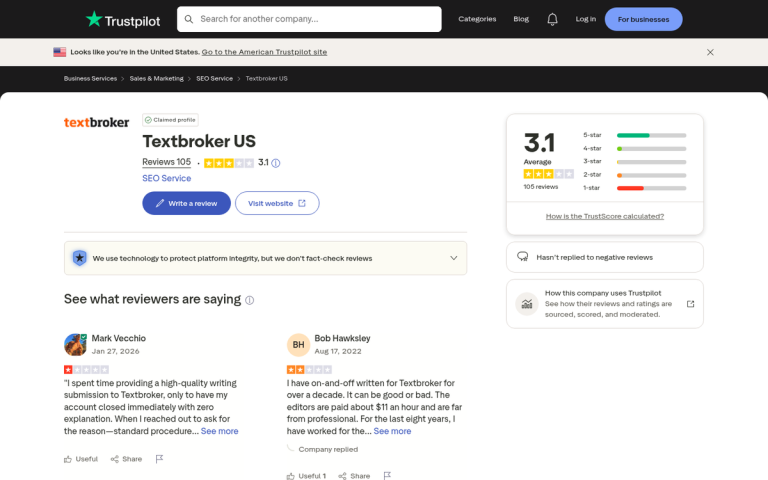
That said, the mixed buyer reviews are worth keeping in mind. Go in knowing that the revision options are limited, quality can vary, and AI has changed the competitive landscape. Constant Content is best suited to buyers who specifically want human-written, editorially reviewed content and are willing to pay a fair price for it. If you're evaluating similar services, our comprehensive review of Textbroker and article quality may help you compare your options.
The Writer's Perspective
I'm covering this a little bit at the end because, well, it's usually covered elsewhere on the web. Most of the Constant Content reviews you find are about using the site to make money - not about being a client and paying for content.
Constant Content is a solid platform for writers, with a few important caveats. The number one caveat is that it's a marketplace. There's no guarantee that your content will sell this week, this month, or this year - it might not sell at all. Constant Content estimates that most authors sell between 50% and 75% of all articles they submit, which is a decent hit rate for a marketplace model - but it still means a real portion of your work may sit unsold. You need to be writing to have the volume necessary to make a reliable income.
Constant Content takes 35% of the total price as their cut, which means writers receive 65% of what buyers pay, roughly in line with other content places. That means if you price a piece at $100, you're taking home $65. Price your content accordingly, and don't race to the bottom by undercutting other writers - it hurts everyone and devalues the platform for all.

The bigger challenge for writers in 2026 is the AI factor. Buyers who previously would have commissioned human-written content are increasingly generating it themselves or through AI services. Writers who are succeeding on Constant Content tend to be those who lean into demonstrable expertise - credentials, niche authority, and a track record of quality - instead of competing on price alone.
It can sometimes take days for editors to review a piece when it's submitted. General advice is to write multiple posts on any given topic, because bloggers often want to buy more than one piece of content on a related theme, and it creates the opportunity to sell a few articles to the same buyer. Experiment with lengths and topics to find what sells most.
Out of the ways to buy and sell content online, Constant Content occupies a middle ground - it's not a race-to-the-bottom content mill, but it's also not a managed agency service. For writers with expertise and for buyers who value editorial quality over raw speed and cost, it still has a place in the content ecosystem - even in an era when AI has fundamentally changed the game.