





Key Takeaways
- Content marketing requires specialized tools across six key areas: idea generation, writing, organization, analytics, social media, and promotion.
- AI tools like ChatGPT, Claude, and Gemini have transformed brainstorming, but cannot replace human judgment and original insight.
- Organizational tools like Notion, Airtable, and Trello prevent duplicate content efforts and keep editorial workflows manageable across teams.
- Analytics platforms like GA4, Ahrefs, and Hotjar help marketers understand content performance and give audiences more of what they want.
- Newsletter platforms and influencer tools have become essential promotion channels, with Beehiiv and Modash highlighted as leading options.
Content marketing is not a simple task. It's a tough machine with always changing laws in a system that's never static. To try for everything solo, on hand, is an exercise in futility. There just aren't enough hours in the day. That's why there are tools for just about every possible feature of the industry. Using tools puts you at a benefit - especially now that AI has changed what's possible. You're more responsive, more agile, and you can reach a wider audience than ever before.
Some of the tools I'm about to mention are going to overlap. Some will be narrow, some large. I'm not trying to tell you to use them; I'm just giving you options to learn.
Idea Generation and Content Discovery

These tools are all geared towards giving you ideas for your blog posts. For bloggers, writing is the easy part; coming up with what to write is the toughest and most time-consuming part of the job. These tools should help with it.
- Buzzsumo - Still one of the most powerful content research platforms available, BuzzSumo lets you search keywords or topics and instantly surface what's performing best across the web. You can filter by most shared, trending, or by content type. Their influencer discovery tools have also matured significantly. Pricing has evolved over the years, so check their site for current plans, but expect to pay anywhere from $199/month for the Content Creation plan up to enterprise-level pricing for larger teams. If you're serious about content strategy, it's worth every penny.
- AnswerThePublic - Now owned by Neil Patel's NP Digital, AnswerThePublic is a fantastic tool for uncovering the questions, comparisons, and phrases real people are searching around any given keyword. It pulls from search engine autocomplete data and presents it in a visual format that makes content gaps immediately obvious. Free users get a limited number of searches per day; the Pro plan unlocks unlimited searches and additional features.
- SparkToro - Built by Rand Fishkin after leaving Moz, SparkToro is an audience research tool that tells you what your target audience reads, watches, listens to, and follows online. It's incredibly useful for understanding where to promote your content and what topics resonate with your people. It's one of the most underrated tools in a content marketer's toolkit right now.
- Google Trends - Google probably has the single largest index of information in the world, so they're well positioned to analyze what's trending and where. You can use Google Trends to capitalize on swells of popularity some subjects receive, compare multiple topics side by side, and even filter by region or category. It's free, surprisingly deep, and still one of the best starting points for topical research available.
- ChatGPT / Claude / Gemini - No idea generation list in 2026 is complete without acknowledging AI assistants. Whether you use OpenAI's ChatGPT, Anthropic's Claude, or Google's Gemini, these tools have fundamentally changed the brainstorming process. Feed them a niche, a target audience, a competitor's URL, or a general topic and you can generate dozens of fresh angle ideas in seconds. They're not replacements for human judgment and original insight, but as a brainstorming accelerator, nothing else comes close.
Writing and Content Creation

You need to manage images, video, infographics, and increasingly, AI-assisted drafts. These tools should help you with that.
- Grammarly - Grammarly has evolved well beyond a basic grammar checker. Its 2026 incarnation includes a full AI writing assistant, tone detection, clarity suggestions, plagiarism checking, and even brand voice customization for teams. The free version catches the basics; the Premium and Business plans unlock the full suite. For solo bloggers and content teams alike, it's essentially a non-negotiable part of the workflow at this point. If you want more options, there are also other ways to spell and grammar check your blog posts.
- Surfer SEO - Surfer bridges the gap between writing and SEO optimization in real time. As you draft content, Surfer analyzes your text against the top-ranking pages for your target keyword and tells you exactly what to add, adjust, or cut. It checks keyword density, heading structure, word count, and more. For content marketers who want to write with search visibility baked in from the start rather than bolted on afterward, Surfer is one of the best tools available. You might also want to explore Long Tail Pro for deeper keyword research to complement your writing process.
- Canva - For non-designers who still need professional-looking visuals, Canva remains the gold standard. It has expanded dramatically and now includes AI-powered image generation, video editing, presentation tools, and even a basic website builder. The free tier is genuinely useful; Canva Pro unlocks brand kits, background removal, premium assets, and much more. If you're not using Canva or something like it to produce your visual content, you're working harder than you need to. For sourcing photos, check out these reliable websites to host your blog images for free.
- Descript - If your content strategy includes video or podcasting - and in 2026, it really should - Descript is one of the most impressive tools out there. It transcribes your audio and video automatically, then lets you edit the media by editing the text transcript. You can remove filler words in bulk, overdub your own voice using AI, and export to multiple formats. It has genuinely changed how creators produce long-form media content.
- Adobe Firefly / Midjourney - AI image generation has matured enough that content marketers now routinely use tools like Adobe Firefly (integrated directly into Adobe Creative Cloud) or Midjourney to produce custom illustrations, featured images, and visual assets at a fraction of what custom design used to cost. Neither replaces a skilled designer for complex work, but for quick, on-brand visuals at scale, they're transformative. Infographics are another visual format worth considering for your content strategy.
Organization

Keeping track of what you've done and how you did it matters. You don't want to get halfway through a great blog post just to find out it's the same topic you wrote about three months ago and forgot.
- Notion - Notion has become the organizational backbone for a huge number of content teams. It combines notes, databases, wikis, editorial calendars, task management, and project tracking all in one flexible workspace. You can build a content calendar, track post statuses, store research, manage team workflows, and archive published content - all within a single tool. The free plan is surprisingly generous, and the paid plans are affordable even for solo creators.
- Google Drive - Cloud storage that needs little introduction. Google Drive integrates seamlessly with Docs, Sheets, and Slides, making it ideal for drafting, collaboration, and file sharing across devices and team members. For content teams on a budget, the Google Workspace ecosystem is hard to beat. It remains one of the most practical everyday tools on this list.
- Airtable - Think of Airtable as a spreadsheet with superpowers. It's particularly popular with content teams for managing editorial calendars, content pipelines, and asset libraries. You can view your data as a grid, a kanban board, a gallery, or a calendar, which makes it extremely flexible depending on how your team thinks. Automations and integrations with tools like Zapier and Slack make it even more powerful.
- Trello - For teams that prefer a visual, card-based workflow, Trello is a simple and intuitive option. Each card can represent a piece of content, and you move it through columns representing different stages - ideation, drafting, review, scheduled, published. It's not as feature-rich as Notion or Airtable, but its simplicity is genuinely its strength for smaller teams or solo bloggers who don't need complexity.
- Contentful - A headless CMS that has become increasingly relevant as content gets published across websites, apps, and devices simultaneously. It's API-driven and requires some technical setup, but for teams managing content at scale across multiple channels and platforms, it's one of the most powerful publishing infrastructure tools available. If you're running a single WordPress blog, this is overkill - but at enterprise scale, it's invaluable.
Analytics
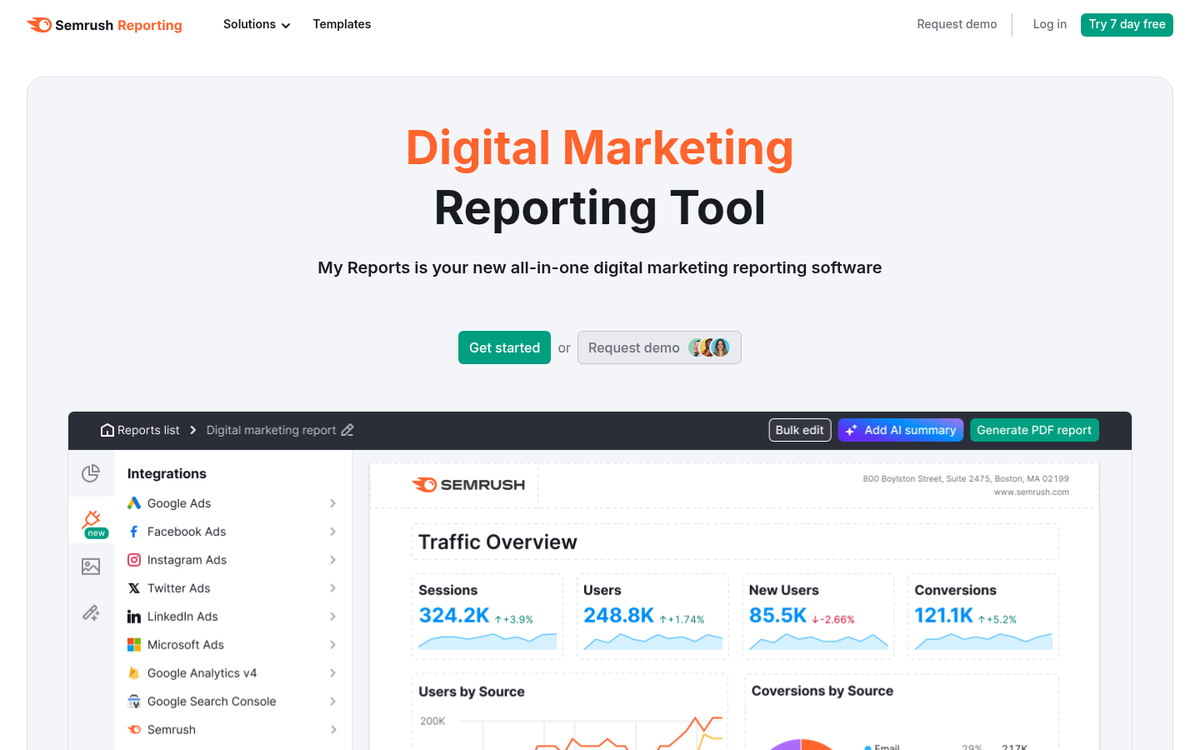
Knowing which content performs well and what doesn't work helps you make a content plan that has the maximum conversion possible. To strip out the buzzwords: learn how your content performs so you can give your audience more of what they actually want.
- Google Analytics 4 - GA4 is now the standard, having fully replaced Universal Analytics. It's event-based rather than session-based, which means you get a more granular picture of how users interact with your content. The learning curve is real, but the depth of insight available - especially when combined with Google Search Console - makes it an essential free tool for any content marketer.
- Semrush - More than just a keyword tool, Semrush has evolved into a full content marketing platform. You can audit your existing content, track keyword rankings, analyze competitor content strategies, find backlink opportunities, and even use their AI writing assistant. For content marketers who want a single platform that spans research, optimization, and performance tracking, Semrush is one of the most comprehensive options available.
- Hotjar - The heatmap and session recording tool of choice for many content marketers. Hotjar shows you where users click, how far they scroll, and where they drop off - which tells you a great deal about whether your content is actually being read and what's compelling enough to keep people on the page. Their feedback and survey tools are also useful for gathering qualitative data alongside the behavioral data.
- Ahrefs - One of the most respected SEO and content analytics platforms in the industry. Its Content Explorer feature alone is worth the subscription price - you can search any topic and find the most-linked and most-shared content on the web. It's also invaluable for backlink analysis, keyword research, and tracking your content's search performance over time.
- Databox - If you're tired of logging into six different platforms to check your content performance metrics, Databox pulls everything into one customizable dashboard. Connect Google Analytics, Search Console, HubSpot, social platforms, and more, then build a single view that tells you everything you need to know at a glance. It's particularly useful for agencies or content teams that report metrics to clients or stakeholders regularly.
Social Media Management
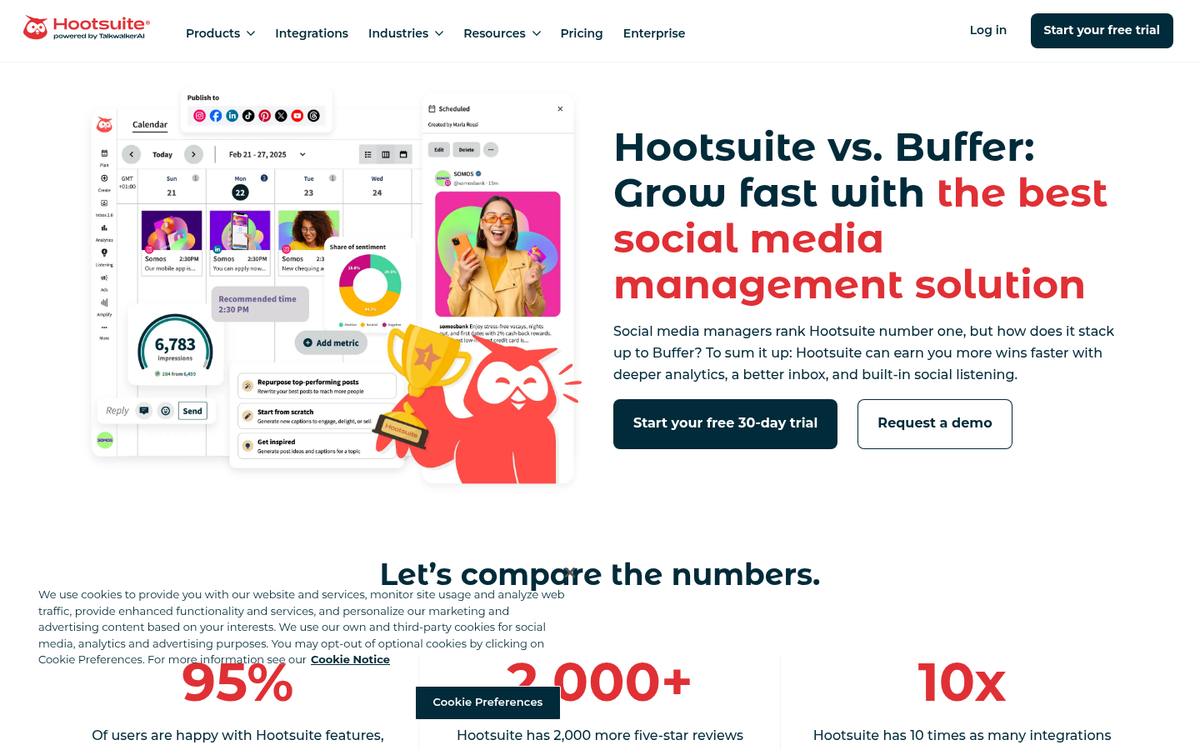
Social media promotion is the lifeblood of content marketing, and it matters for any sort of exposure or growth. These tools help you manage your social presence and publication.
- Buffer - Buffer remains one of the cleanest, most intuitive social media scheduling tools available. It's great for solo bloggers and small teams who want straightforward scheduling across multiple platforms without the overhead of a more complex tool. Their analytics have improved considerably, and their AI assistant can help you rephrase posts for different platforms automatically. An excellent starting point if you're just getting your social workflow in order.
- Hootsuite - The enterprise-level social media management platform. Hootsuite supports a wide range of networks, offers deep team collaboration features, and has built AI-powered caption generation and best-time-to-post recommendations directly into the platform. It's more expensive than Buffer and has a steeper learning curve, but for larger teams managing multiple brands across many platforms simultaneously, it's hard to beat. See how Buffer and Hootsuite compare in cost and effectiveness.
- Later - Originally focused on Instagram scheduling, Later has expanded into a full multi-platform social media management tool. It's particularly strong for visual content planning, with a drag-and-drop visual calendar that lets you see exactly how your feed will look before you publish. If a significant portion of your content strategy lives on Instagram, TikTok, or Pinterest, Later is one of the best tools for the job. Learn how to share and promote blog posts on Pinterest to get the most out of visual platforms.
- Sprout Social - A premium social media management platform that excels at social listening, team collaboration, and detailed analytics. Sprout's inbox consolidates messages and mentions from all your platforms into one place, which is invaluable for brands that get significant social engagement. Their reporting features are among the best in class and are particularly useful for teams that present social performance data to leadership.
- Taplio / Tweet Hunter - As LinkedIn and X (formerly Twitter) have become increasingly important channels for thought leadership and content distribution, tools built specifically for those platforms have emerged. Taplio is purpose-built for LinkedIn content creation and scheduling, with AI writing assistance and engagement analytics. Tweet Hunter does the same for X. If either of those platforms is central to your content strategy, these niche tools outperform the generalist schedulers for their specific use cases.
Promotion
These tools help you promote your content on other sites, through non-social channels, through influencer partnerships, and through paid advertising.
- Outbrain - Still a major player in native content advertising. If you've ever seen a "recommended content" widget at the bottom of an article on a major news site, there's a good chance Outbrain or its main competitor Taboola powered it. For content marketers with a budget to put behind distribution, native advertising through platforms like Outbrain can drive significant traffic from audiences who are already in a content-consumption mindset.
- SparkLoop - Newsletters have had a massive resurgence, and SparkLoop has become one of the leading tools for newsletter referral programs and paid newsletter sponsorships. If your content strategy includes an email newsletter - and in 2026, it really should - SparkLoop helps you grow your list through referrals and connect with sponsors. It integrates with all the major email platforms including Beehiiv, Kit (formerly ConvertKit), and Mailchimp.
- Modash / Creator.co - Influencer marketing has become a core content distribution channel for many brands, and tools like Modash make it manageable at scale. You can search for influencers by niche, audience demographics, engagement rate, and platform, then manage outreach and track campaign performance all in one place. For brands that rely on influencer partnerships to amplify content, a dedicated platform like this is far more efficient than doing it all manually.
- Beehiiv - Beehiiv has rapidly become one of the most popular newsletter and content publishing platforms available. It combines email newsletter tools with a built-in web publication, monetization features, a referral network, and detailed analytics. If you're building an audience through long-form written content in 2026, Beehiiv is one of the most powerful platforms to do it on - and its growth network makes discovery easier than starting from scratch elsewhere.
- Quuu Promote - A content promotion platform that distributes your content through a network of real social media accounts whose owners have opted in to share content in specific categories. It's a legitimate way to get your content in front of new audiences through authentic-looking social sharing, rather than through paid ads. It's particularly effective for evergreen content that you want to keep circulating long after the initial publish date.



6 responses
Thoughtful replies only - we moderate for spam, AI slop, and off-topic rants.
Hi James, Thanks for the great resources, One more tool I would like to mention which is proofhub, Best works with remote teams with most advanced features, Now rarely we use gmail chat for collaboration.
Thanks for your comment Meanu. Chat is definitely an invaluable resource for teams.
I agree Meanu. We Use Basecamp at our agency which is a great team project management and collaboration tool but wish it had a chat feature....
Richard, You can check out proofhub got group chat feature too. Give it a try! You will love it definately.
Great article James, how do I subscribe to your blog to get automatic updates?
Thanks Richard! Here's our RSS feed: https://blogpros.com/blog/feed