Key Takeaways
- Facebook removed share counts from its public Graph API, leaving third-party plugins showing zero while only the official button retains access.
- Plugins retrieve social data three ways: real-time scraping, cached scraping, or API calls - with API being most reliable and efficient.
- Facebook's motivations included promoting its official button, discouraging vanity metrics, and undermining fake share sellers' business models.
- AI-generated content and algorithm changes have made public share counts even less meaningful, with engagement depth now mattering more.
- Recommended solutions include hiding counts entirely, using lightweight privacy-friendly buttons, or replacing share counts with verifiable internal metrics.
If you've ever looked at your social sharing buttons and noticed a stubborn "0" where your Facebook share count should be, you're not alone - and the problem is more layered than it might seem. While the original trigger for this issue dates back to Facebook removing share count access from their public API, the community around social sharing has changed dramatically since then, and that's also the case with the rise of AI-driven content tools and growing platform policies.
The short version: Facebook removed the share count from their public Graph API years ago, which means third-party sharing buttons lost access to that number. Only the official Facebook share button retained access. But in 2026, there's quite a bit more going on than just that one API change - and the way marketers think about social sharing has shifted significantly.
Understanding Plugins
Every plugin that pulls social media sharing information does it in one of three ways.
The worst of the three ways is a scraper. A scraper is a tool that looks at a web page and pulls out a piece of data. Scrapers powered by search engines index your website. Scrapers that scan search results power tools like BuzzSumo, Semrush, and Ahrefs. Scrapers are not inherently bad.
However, a scraper that looks for social sharing counts is usually going to fire each time a user loads the page, because it runs the script on every load. If you get thousands of views on your content, that's thousands of requests hitting Facebook's servers. Multiply that across every site using this plugin and it puts a giant strain on the platform being scraped - it makes sense that platforms actively work to block or throttle these requests.
Sites like Facebook and Meta's other platforms use a number of anti-scraper technologies: CAPTCHAs, user-agent filtering, rate limiting, and IP-level blocking. None of these are the core issue here. But they make scraping increasingly unreliable in 2026.

The second type of plugin is a scraper with caching - this scrapes once per hour or once per day and stores the result, to cut back on server strain and stay away from rate limits. The number might not be real-time. But it will be reasonably accurate and far more stable.
The third type - and the best - uses an API. An API is a structured way for a platform to expose data in a lightweight, reliable format. Loading a full social media page to extract one number might cost a few megabytes of data. An API call for that same number could be only a few bytes - it's the preferred strategy for pulling platform data.
Facebook's API and What Changed
Facebook's Graph API has long been the preferred way for developers to access platform data - it's a versioned, rolling API, which means multiple versions are active at any given time, and older versions are deprecated on a set schedule to give developers time to adapt.
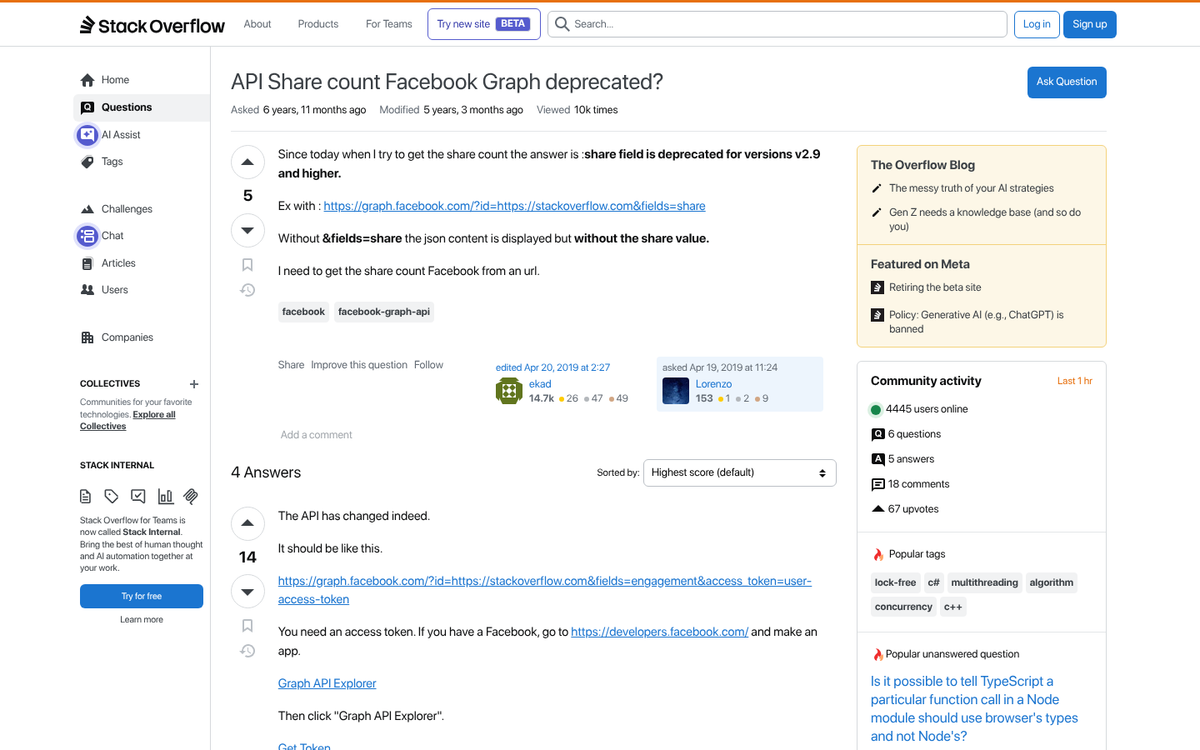
The core problem is that Facebook removed the share count from their public API entirely. This happened slowly, starting in 2014. But the full impact wasn't usually felt until around mid-to-late 2016 when older API versions expired. At that point, third-party plugins lost access to the share count - unless they were the official Facebook button itself.
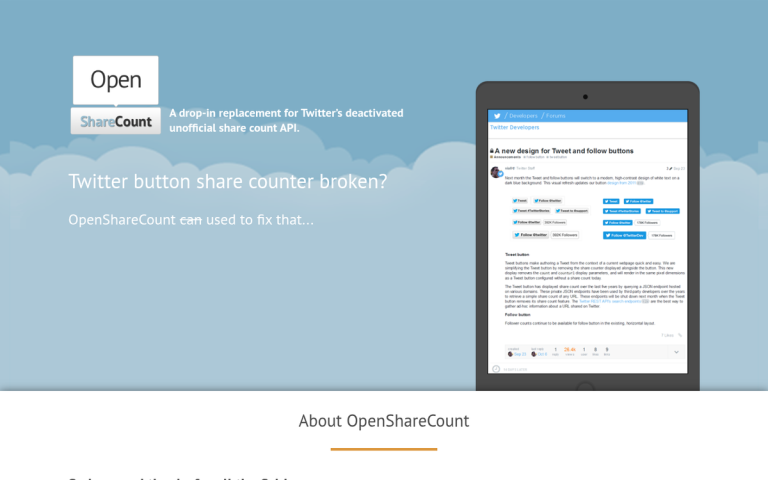
Much like Twitter had already done before them, Facebook pulled the public share count. Twitter removed counts from their buttons entirely, deciding the metric wasn't worth supporting. Facebook took a different approach: the count still exists. But it's locked behind the official button. Third-party plugins basically get nothing back from the API, which means they either show nothing or display a zero.
Why Facebook Made This Change
There are a few likely motivations behind this decision, and they haven't changed much in the years since.
First, Facebook wanted to drive adoption of their official button. If third-party buttons can't show counts and the official button can, that's a strong incentive to use the native implementation.
Second, this was part of a wider industry trend away from vanity metrics. Google stopped publicly updating PageRank. Twitter removed share counts. Facebook followed. The reasoning was sound: marketers were obsessing over raw numbers instead of actual engagement - comments, conversations, conversions. Hiding the number forced a change in focus.
Third, fake share sellers were a problem. Bot networks selling Facebook shares, Twitter retweets, and Instagram likes were rampant. By removing the visible count from third-party tools, platforms made it harder to show ROI on fake engagement, undermining those business models.
In 2026, this reasoning has only grown stronger. With AI-generated content flooding every platform, Meta and others have become even more protective of engagement data. AI tools can now generate, distribute, and even simulate engagement at scale, which makes raw share counts even less useful as a metric than they were a decade ago. If you're looking for better ways to measure success, calculating the ROI of your blog content is a more reliable approach.
How AI Has Changed the Social Sharing Landscape in 2026
It's worth tackling what's legitimately new here, because social sharing in 2026 looks very different from 2016 or 2020.
AI content generation tools - like large language models integrated into CMS platforms, SEO tools, and social schedulers - have made it trivially easy to produce and distribute content at massive scale. This has flooded every platform with content, which as you might expect has made organic share counts even less reliable as a signal of quality or reach.
Platform algorithm changes have deprioritized public share counts across the board. What matters now - to platforms and marketers - is engagement depth: saves, comments, shares to private groups, click-through rates, and time-on-site after social referral. These are harder to fake and harder to scrape.
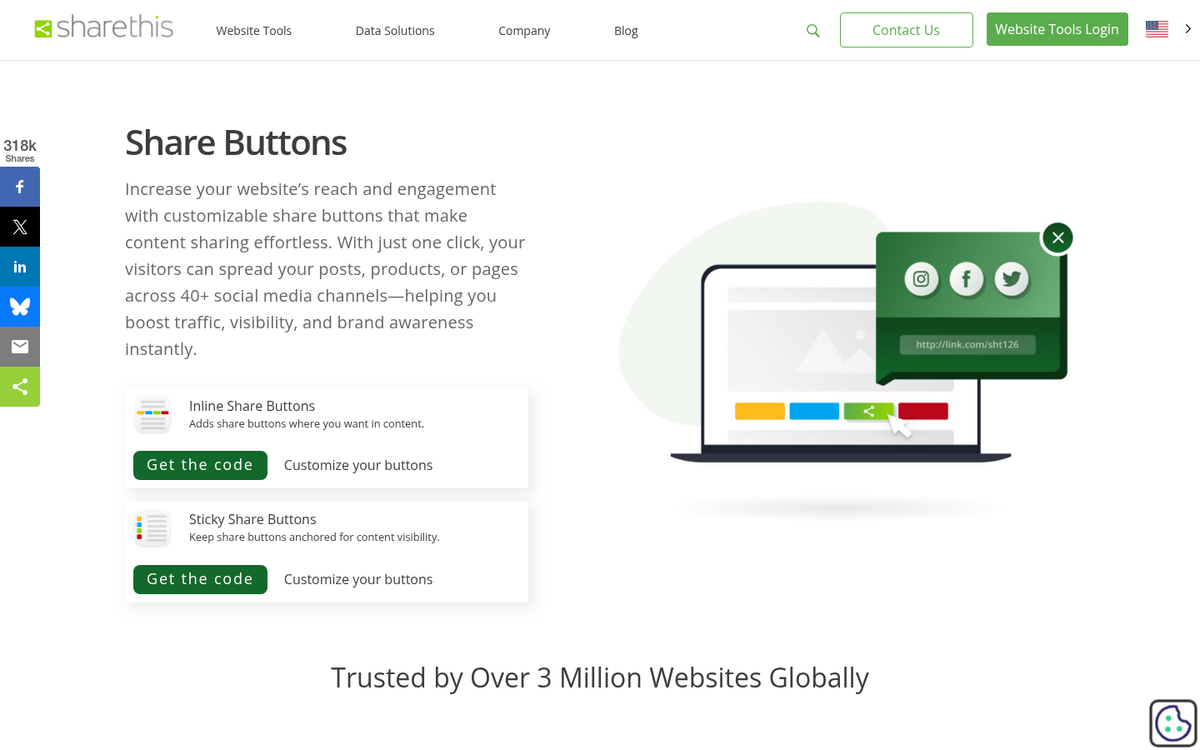
Third-party social sharing plugins have declined in importance. With Core Web Vitals and page speed being confirmed ranking factors, the performance cost of loading multiple third-party social scripts has pushed site owners away from traditional sharing button suites altogether. Many modern themes and page builders now include lightweight native sharing options that don't use external API calls at all.
Social proof has moved to other formats. In 2026, embedding short-form video clips, displaying comment counts, or showing newsletter subscriber numbers tends to carry more perceived credibility than a share counter that audiences have learned to distrust.
What You Should Do About Your Share Buttons Today
Given the above, here are the most helpful options available to you:
Go without share counts entirely. This is increasingly the default choice for well-designed sites. Most modern sharing button services allow you to toggle counts off. Uniform, clean buttons with no numbers look far more professional than a combination of healthy counts and a conspicuous zero where Facebook should be.
Use lightweight, privacy-friendly sharing buttons. Tools built for performance and privacy - instead of vanity metrics - have become the standard. These usually don't make external API calls at all and simply open a share dialog when clicked. They're fast, they work, and they don't expose your readers to third-party tracking. Social Warfare is one option worth looking at if you want a well-regarded plugin in this space.
Replace share counts with more meaningful signals. Consider displaying comment counts, reading time, or a "trending" indicator based on your own internal traffic data. These are metrics you actually control and can verify, unlike a number pulled from an increasingly locked-down third-party API.
If you still want counts, you can use an aggregated strategy. Some plugins combine data from multiple sources - API calls where available, cached scrapes where not - and display a total engagement number instead of a per-network breakdown. This avoids the embarrassment of a zero on one network while others show healthy numbers.
Focus your energy on what actually moves the needle. In 2026, the obsession with share counts is a relic. Your analytics platform - whether that's Google Analytics 4, Plausible, Fathom, or another tool - can tell you how much traffic is actually coming from social referrals, what those visitors do on your site, and whether they convert. That's the data worth optimizing for.
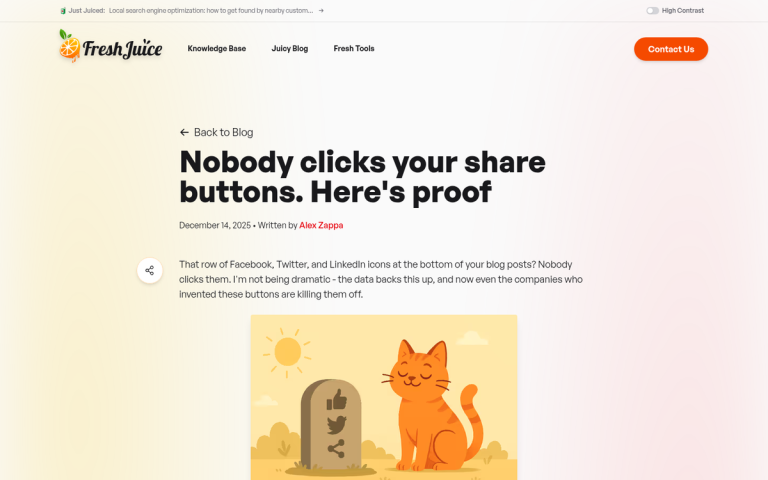
The bottom line is that Facebook's removal of the public share count API was frustrating in 2016. But it turned out to be a preview of where the entire industry was heading. Share counts as a public-facing metric are largely obsolete. Update your buttons, drop the counts, and focus on engagement that actually tells you something helpful.