Key Takeaways
- Twitter's 2015 architecture change removed unofficial share count APIs, breaking third-party plugins and disrupting the social sharing ecosystem significantly.
- OpenShareCount temporarily bridged the gap but shut down after Twitter's 2023 API restrictions eliminated free access tiers entirely.
- Social Warfare, Shareaholic, MashShare, and Social Count Plus remain viable sharing plugins, though most now prioritize buttons over accurate counts.
- Facebook and LinkedIn also removed public share count data, making accurate cross-platform share counts legitimately difficult to maintain reliably.
- For most sites, clean fast-loading sharing buttons matter more than accurate counts; energy is better spent on content itself.
Any time you're using a plugin on your website, you're reliant upon any data sources that plugin uses to keep it functional. In some cases, there's no path to failure. Something like Yoast SEO won't break unless they push an update that breaks something. Other plugins, like share count buttons, can use drawing share count data from the relevant website to display it accurately on your site. If the share site removes the ability to find that count, your plugin breaks.
This very thing happened back in November 2015 with Twitter. What happened was a back-end change. Twitter switched from one server architecture to another, and in that switch, changed quite a bit about how their APIs worked. As part of that change, they removed the share count display from their buttons and killed off the unofficial, undocumented API endpoint that powered third-party share count plugins.
The issue with the old share count API is that it wasn't, in fact, an API at all - it was a sort of unofficial endpoint, a JSON counter that was publicly accessible. Share count apps were built on this source of data. But when Twitter changed their internal architecture, they changed how share counts were stored and stopped maintaining backward compatibility for developers who had built on top of it.
Rather than do the engineering work of maintaining the old strategy with their new architecture, Twitter basically said "tough luck" to app and plugin developers. Want to display a Twitter share count on your sidebar? Too bad. They aren't the only platform to have done this over the years. But given Twitter's scale at the time, it was one of the most disruptive.
What About OpenShareCount?
For a while, a third-party service called OpenShareCount (OSC) stepped in to fill the gap. The way it worked was fairly simple: OSC used Twitter's REST API to search for any URL you gave it, tallied up how many times it had been shared, and then continued performing that search every day or two to keep the count updated over time - it was basically Twitter's own suggested workaround, packaged into a service that handled the API keys and authentication.
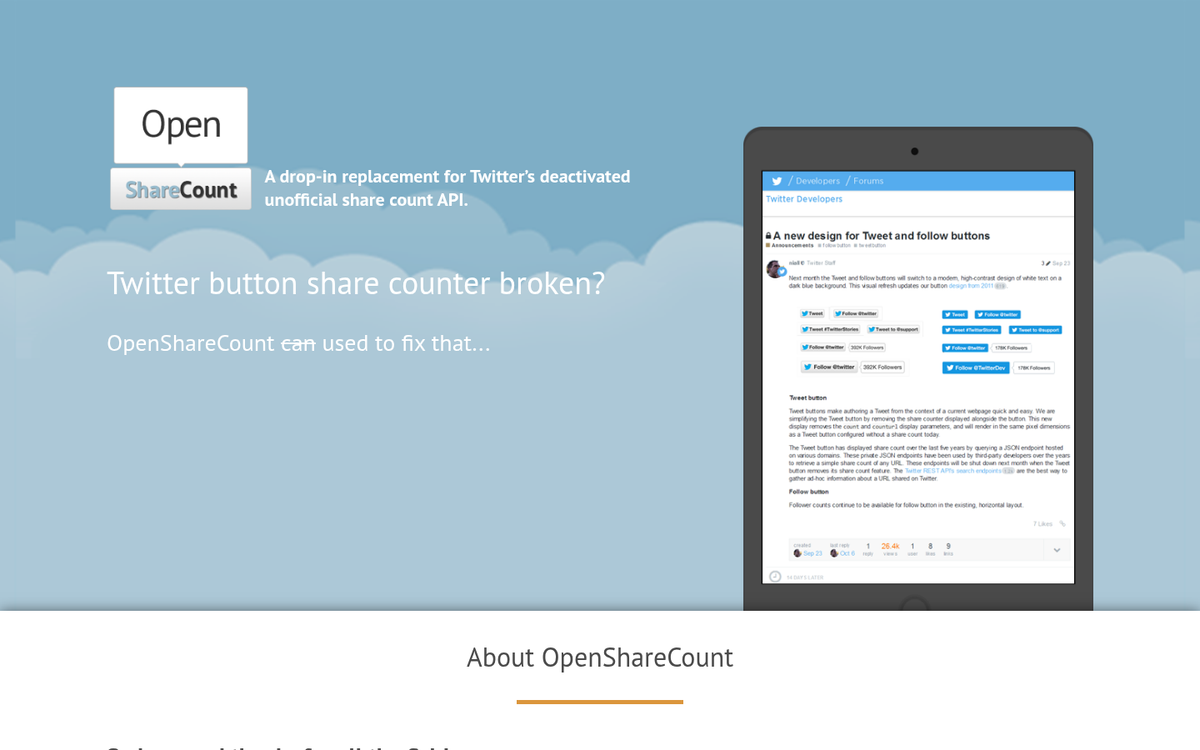
It was never a perfect answer. The REST API search only surfaced results going back about a week, which means any shares older than that basically couldn't be recovered. Content that had been around for months or years would have its count reset to zero from the point of sign-up. And users were limited to one domain per Twitter account. Still, for sites that were actively publishing new content, it was a workable stopgap.
However, OpenShareCount is no longer operational. Subsequent changes at Twitter - like the dramatic API access restrictions introduced under new ownership in 2023, which eliminated free API tiers and dramatically curtailed what third-party apps could do - made the underlying workaround OSC relied on unviable. The service shut down, and there's currently no direct equivalent replacement.
Plugins That Still Work
Since the core premise of this post is social sharing plugins, here's where things stand. The community has shifted quite a bit since 2015, and the focus has moved away from share counts toward basically providing clean, functional sharing buttons. Here are some options worth thinking about:
Social Warfare. Social Warfare remains one of the more polished social sharing plugin suites available for WordPress. They've been proactive about adapting to API changes across multiple platforms over the years - like Twitter, Facebook, and LinkedIn. If share counts matter to you, check their latest documentation for what's supported, as platform-level restrictions continue to evolve.
Shareaholic. This plugin has multiple formats for social sharing buttons along with a number of integrations and extra tools - it has historically handled API changes well and remains an all-in-one option for most sites.

MashShare. Designed to mimic the sharing button style made popular by Mashable, MashShare is a clean and well-maintained option with a number of add-ons available to extend its functionality - like click-to-share and responsive design features.
Social Count Plus. This plugin works for covering social networks that most others ignore - like SoundCloud, Twitch, and Vimeo. If your site operates in a niche that relies on those platforms, it's worth a look - it also caches data locally, which gives some buffer against future API disruptions.
Should You Care About Share Counts?
A question worth asking, given everything described above, is whether share counts are even worth pursuing in 2026. The honest answer is: it depends. But for most sites, probably not as much as they used to be.
The harder reality is that Twitter's API restrictions, Facebook's removal of public share count data, and LinkedIn's similar moves have made it legitimately difficult to surface accurate share counts without constant maintenance. The third-party services that once bridged that gap have largely shut down or become unreliable.

There's still a social proof argument to be made. A post with thousands of visible shares does tend to reinforce more sharing. For newer or smaller sites, strong share counts can point to credibility and help posts gain momentum. But the infrastructure to support that reliably just isn't what it once was.
For most site owners, the better focus is on clean, fast-loading sharing buttons that make it easy for readers to share content, without worrying too much about whether the count displayed is accurate. The work involved in chasing share count data across increasingly restrictive platforms doesn't pay off relative to the effort. Your energy is better spent on the content itself.